e-Literate

Present is Prologue

Author: Curtiss Barnes

  • Textbook and Chill?

    A Simple, Post-Consumer Model for (Real) Education

    Education is an interactive experience.

    The wave of consumerization of education is arguably several decades old now. To my view, there are two prevailing themes of that consumerization: 1) the idea of student-customer who is therefore “always right” and deserves guarantees of certain outcomes like employability and ROI, and 2) the idea that knowledge is a consumer-good.

    Certainly, we have seen significant changes in the attitude institutions take toward their students with respect to life goals like employability. My own alma mater now offers an incredibly robust set of programs that start early in the college experience-including internships, sponsored projects, and career counseling. A stark contrast to the sparse, non-proctored library of leaflets and files during my time there.

    But it is the second theme that I want to address here, because I believe we are at an important inflection point in the industry.

    Knowledge As Consumer Good

    One thing I learned early on in my tenure at publishers is that students will only spend money on curricular materials that they believe will help them get the grade they want. The patterns were extremely clear and consistent: first years tended to buy new versions of all recommended materials, and that behavior shifted with time and experience to be more selective and price sensitive. Over the last decade, the entire pattern has changed with reduced information asymmetry and changing student preferences.

    More used, more digital, less cost, please.

    The early efforts by Chegg and Amazon to make a hyper-efficient market for used textbooks generated marketplaces of used and rental textbooks, both physical and digital. Since then, those markets have evolved into something vastly different, while they continue to offer those textbooks. On-demand “homework help”, access to reams of essays and other “aids” for getting the grade I want are the dominant value propositions.

    Inevitably, the primary producers of those textbooks made moves to offset the real economic and product model threat posed by those markets. Branded rental programs and early online shopping sites have now given way to all-you-can-read subscription services, modeled not so loosely after Disney+, Netflix, Spotify, and other media aggregators.

    All of these strategic and tactical moves, some by disruptors, others by incumbents, focus on the idea that learners are consumers. From a certain product-market-fit perspective, it’s spot on: price, selection, on-demand, any device, anywhere.

    And it is highly transactional in nature, it ends with distribution.

    Textbook and chill, bro.

    Is That Good Enough?

    The trend toward consumerization begs several questions:

    What are we trying to learn?

    How are we going about it?

    What are we learning about how we are going about it?

    And I’ve got more questions:

    Could we do it better?

    Could we do it more cost effectively?

    We can, we should, we must.

    A Post-Consumer Model for Education

    Here is my simple proposal for a Post-Consumer Model for Education:

    Instructor Led

    Education is an interactive experience. Live educators help guide and curate the learner through the process. Asynchronous video is great for mass distribution, and it is not an adequate substitute for the real thing. Blending the fantastic affordances provided with digital tools and live/hybrid instruction creates greater value for both the learner and the educator.

    New Models for Assessment

    Education is an interactive experience. Research is increasingly convincing about massive gains made by learners who engage in project-based, experiential, and authentic learning and assessment. Online robo-graded homework is great for mass distribution, it has also lost the battle against the “study aid” sites. It is increasingly easier and cheaper to create newer, for more effective kinds of learning and assessment models at scale. Educators should have broad access to use them.

    Intentional Design

    Education is an interactive experience. The burst of demand for instructional/learning designers on campuses and in corporate settings is a powerful indicator that the existing courses and design models are lacking. Designing pure-play and hybrid digital learning experiences in ways that specifically engage the learner and provide the educator the powerful advantages of data-informed teaching create far more value than your typical off-the-shelf and rigid courseware.

    Agile Design

    Education is an interactive experience. It should not be sufficient to claim victory with a well-designed digital learning experience. We live in an age where many industries and business focus on rapid upcycle to improve their goods and services. Yet the learning industry seems stuck on 4+ year course redesign and textbook revision cycles. Designing digital learning experiences specifically to conduct A/B testing and upcycling at least term to term should be the new normal.

    Measurable Across the Learner Journey

    Education is an interactive experience. It should not be sufficient to capture assessment grades from various digital interactions, especially those “aided” by “study sites”. Incredible amounts of learner activity data are exhausted into the ether in the existing learning experiences on campus today. Learners move from their LMS, to a variety of disconnected digital experiences, with little coherence or understanding of the learning moments being captured. If we want to achieve scaled improvement in how we deliver digital teaching and learning, we need to design, deliver, and measure across the entire learning journey.

    A Dialogue and Collaboration

    We are interested in your thoughts and ideas for how we can collectively progress the art and science of technology-enabled teaching and learning. Please contribute here and stay tuned for much more discussion and interaction!

  • Good vs. Great Product Teams

    Allowing teams to do their work is the hard part.

    Michael and I do a fair bit of work on topics like product-market fit and validating clients’ product and market strategies. We recently completed work with a company that I would characterize as a good exemplar of a “great” product team. In fact, during one of the calls with the client, Michael pinged me on Slack, “they appear to be amazingly competent”. It’s what inspired me to write this post.

    We see a lot of different organizations in both non-profit and commercial setting and always learn a ton about organization design, leadership and the impact of product teams on the enterprise’s relative success. Of course, I have my own learning experiences leading a large, multi-tens-of-millions dollars product organization as well. There are several distinct themes that separate the bad or merely good from the great, which I will try to parse out with a bit of EdTech context:

    1. Customer centricity vs. business centricity
    2. Trust vs. command and control
    3. Leadership vs. management

    Great product teams serve the customer

    Being “customer first” may seem trite or cliché to some, but it is worth being very clear about why this matters and why it is hard for some organizations to be great at it. First, many organizations do business strategy planning and the product roadmaps fall out of what the various business functions believe to be important – often claiming to be customer-centric. Here’s what that might look like in different settings:

    • The sales and marketing teams listen to the hype cycle being driven by hot startups and/or innovators in the industry. In EdTech the classic example is “adaptive learning”; a category rife with widely divergent approaches. That hype cycle buzz is amplified by the media and the talk on the floor of the trade shows. That hype cycle in turn creates real and perceived roadblocks with customers in the sales process. Sales and marketing in turn demand that “product” add those features in the roadmap immediately, only to find that by the time “product” delivers, the hype has moved into the trough of disillusionment.
    • The technology team emerges from business planning worried about a range of real-world threats to the tech stack, cybersecurity, tech debt and growing overhead costs associated with the delivery environments. FERPA, GDPR, and especially web accessibility offer consistent headaches for EdTech teams. The technology team believes they—not “product”—are accountable for these business risks and in turn demand that well more than half of the available roadmap is devoted to “non-functional requirements” to offset the real and perceived risks. Often this leads to risk-shifting, where one risk is solved only to push the cost and accountability (e.g., reduced product innovation, forced tech migration costs) elsewhere in the organization and on the balance sheet.
    • The “product” team is really operating as an agile scrum team, which could be great, but they have become religious about a specific implementation of agile. Agile methods deconstruct customer value into smaller “chunks” for execution, based on the premise that teams can iterate subsequent releases to get customer value “just right”. The challenge, particularly in EdTech, is that release cycles do not typically allow for incremental customer validation because shipping features that change educator or learner experiences during a term is strictly verboten. The overly precious focus on the process model undermines innovation, and the “product” person becomes a de facto backlog manager, delivering output but not necessarily value.
    • The leadership team believes they need a big project to talk about with the board and shareholders. They establish a “big idea” initiative and pull key talent into a “tiger team” or something similar, set them up with their own budget and tell them to go build the next generation something or other platform. I have seen this a number of times in EdTech: an LMS trying to build a content marketplace, a book seller building an ebook platform, an institution building its own LMS, ebook and marketplace. The project begins to consume all the internal executive spotlights, water cooler chatter, investor attention and generates negative energy across the rest of the organization, causing talent to flee and customers to question what they can expect.

    Great product teams serve the customers in ways that are aligned to and meet the needs of the business. They are specifically a cross-functional mix of product, design, analysts, engineering and architecture, intentionally supported by other key functions and empowered to solve problems. Those problems are framed as being directly customer-centric and are lined out against customer value creation; customer utility and usability; the feasibility of organization’s ability to implement (on-time/on-budget); and the viability of the solution across dimensions of the business. The product team is then held accountable to metrics related to the solving of those problems. And everyone in the business understands the importance of supporting that product team, helping them make informed decisions, avoiding delivery pitfalls, and messaging clearly to internal and external audiences about customer value and related business results.

    In the case of our exemplar client, while we do not have organization charts or much visibility into how they operate, it became clear that the product team holds true to the role of creating customer value. The other teams spoke to us of how they are contributing to a shared set of outcomes, how they are providing critical information for the product team to consider about feasibility, time to market, user interaction design. And that the product team owns the customer value creation in line with the needs of the business.

    Great product teams assemble great talent and earn trust

    A lot of companies hire product managers and tell them to, well, manage products. As discussed above, this might happen in different flavors, with different results, past performance isn’t indicator of future performance etc. etc.

    Great product teams (and companies) realize very early on that the qualitative nature of their products holds a very specific correlation to the qualitative nature of their talent and how they are empowered. These teams place considerable emphasis on talent acquisition and management. The talent acquisition is about character equally as much as past track record, technical skills, or the pedigree of their education. Short cuts and trade-offs are not allowed, character matters a lot. Demonstrated integrity and personal motivations for wanting to be on the team are critical, but humility, or lack thereof, is a deciding factor.

    And as great product teams are assembled they are set up deliberately to earn trust across the organization.  There are myriad ways to do this, and if you’re following the thread, this trust is essential, it is why great product teams focus on talent acquisition and grooming to demonstrate their competence and ultimately to own the customer value creation in line with the needs of the business.

    In the case of our exemplar client, we have no direct insight to their talent acquisition approaches, but we were struck by a very consistent attitude across the functional teams: they are all in it together. Often we hear functional teams at odds, and air grievances with us hoping we can “help” (which only sometimes we can, see below). Competence, confidence and ability to execute are all enhanced when the team(s) are rowing in the same direction.

    Great product teams understand where leadership and management matter

    All too frequently, companies believe the role of executive leadership is to provide a command-and-control model of “management”. It’s pretty straightforward, especially with experienced, and “intelligent” (frequently not humble) executives. They think they know what the customer wants, they see trends in the market to guide the arc of the business, and they start directing product teams what to build, how to build it, and when they want it. They might even require the team to work with an external “partner” that brings a technological innovation or apparent engineering competence not found in the existing team. From there the work falls to managing the “partner” and crafting multi-page decks for the regular executive update meeting, where all focus is on delivery, and very little on customer value creation. The product teams all fall into a rhythm of meeting their individual roadmap’s obligations, with little or no cohesion or coherence when it’s rolled up.

    Management should not be confused with Leadership. Management of a great product team should be about what I discussed in the previous section: how you approach talent acquisition, talent development and coaching, and the goals and objective outcomes by which talent will be measured. (yes, the financial business metrics flow from this, your org is your product)

    Leadership, on the other hand, begins with the transition point from well-managed team development to the grooming of trusted teams that are empowered to solve the problems that stand in the way of them creating customer value in line with the needs of the business. Leadership is the arbiter of how trust is developed within great product teams.  And there is a straight line between a carefully crafted description of the company’s vision (or the product vision in bigger companies) and how product strategy and priorities are executed. Leadership sets the tone, provides the purpose and the critical points of alignment, and establishes the operating culture; that word – trust – looms large in the responsibility set of leadership.

    And great leadership, in great product companies, then becomes the number one cheerleader—gets out of the way, empowers, and evangelizes. Even better, a hallmark of great leadership is ensuring credit goes where and when credit is due.

    In the case of our exemplar client, again without benefit of being “on the shop floor”, we got a keen sense of teamwork and trust. Leadership providing the framework for what’s important, the value of the mission, and the goal for creating customer value and how it aligns to the vitally important strategic objectives for the business. Yes, amazingly competent.

  • The Netflix of Education, ad nauseum

    To get the model right, we need to inspect the value chain more closely.

    It’s been a COVID- and US national politics-blurred couple of months since I last posted here. Much has transpired in those months and it’s clear that nothing in education and EdTech will be the same as it was, and yet we still have so much to learn about how the sector will evolve. If you’ve been following Michael’s posts, you know we have our fingers in some things and remain excited about the possibilities for large-scale, positive impact with the next wave of technology-enabled teaching and learning.

    I have to say, this “Netflix of Education” thing has legs. The typical half-life of “X of Education” comparisons is roughly 42 days. Yet after a spate of comparisons by McGraw-Hill, Pearson, D2L and Udemy a few years ago, we have at least two notable players claiming the specific comparison again in recent months.

    I get that Netflix is a media company, some call it a TV station, or a video on demand platform, and therefore media…content…education, you know, they are kinda related?

    But what is driving serious companies and executives to use the phrase in often remarkably different contexts? What’s driving the interest in aligning a business value proposition to that of Netflix? I thought about a couple of different ways to examine the question and decided on an easy framework of “they either mean it literally, or they mean it figuratively”.

    Let’s look at both cases.

    Literally

    If taken literally, it should mean the company is proposing some kind of platform for a direct to student streaming service that is offered by subscription. Netflix is inherently a consumer service, so I will include that in the literal definition This would allow learners to access a wide variety of “learning” on internet connected devices. And ostensibly the learners would receive “personalized” lists of additional learning to consume, you know, to increase | improve | extend their learning.

    Certainly, Cengage has referred to their Unlimited subscription service as a “Netflix” model. For 4 months at a time, students can get access to any of Cengage’s eTextbooks for $69.99, or upgrade to get all the online homework platforms as well for $119.99. But the adoption is tied directly to courses the students are taking. I believe the rule of thumb is if a student is taking at least two courses that use Cengage materials, they benefit economically. The math for the bundled access seems to work well for some students, as Cengage reports continued, albeit slowing, growth of Unlimited adoption. But it is not an obvious no-brainer, as half of their digital activations are not under the Unlimited umbrella.

    Like Netflix, this is uber transactional. I don’t know whether some students are trying to self-substitute Cengage products for their other non-Cengage-using courses, or if others are simply hoovering up loads of knowledge, but I do know people who flip from one streaming service to the next to get what they want, when they want it. This is far from a lifelong relationship.

    Looking at Pearson’s shifting language over the last few years, the Netflix reference was originally about “one platform to rule them all” inside a company with more platforms than sharks have teeth or Netflix has TV titles. Michael covered this at the time and was called into the CEO’s office for a word, so I won’t retread that, but the magical platform has yet to appear at any real scale across different “learner ages and stages”. It definitely has not provoked visible innovation, new product launches, or helped reposition Pearson in the market four years hence.

    Recent language from the new leadership at Pearson gives a nod to Netflix but wisely eschews a full embrace. Nonetheless, they are very open about the direct-to-consumer relationship opportunity they see and are organizing the business very directly in that manner, referring to it as the “direct-to-learner” strategy to have a direct relationship with millions of learners globally.

    The challenge here, well-trodden but worth repeating, is education is not intrinsically a consumer market. Higher Education today is pre-dominantly heavily mediated by accreditation, institutional cultures and individual teacher/faculty choice. The same holds for K12 with less teacher choice. Students choose their course. Students do not choose their course material. The course platforms do not, and should not, offer “…other students who used Product X, also liked Product Y” cues.

    Furthermore, what is true about education, and not media, is that high quality, rigorous, and certifiable education essentially requires a human known as an educator. The learner in this equation is not simply streaming content but interacting with it and getting cues from the educator. Simply providing “consumers” with a playlist of educational content will not be the winning strategy. Education is something that is done by the learner, actively facilitated by the educator, rather than “Netflix and Chill”. (Dude, did you see that chapter of Campbell’s Biology last night? Those B-heads, Woah!)

    And yet furthermore, a direct-to-learner strategy begins to position Pearson as a competitor to its own customers today. In other words, a direct-to-learner, learn-on-demand AWATAD (anywhere, any-time, any-device) strategy inserts Pearson directly between institutions and students. This is true even if Pearson’s strategy is more oriented around supplemental, or strictly skills-oriented learning, because all of the institutions are busy trying to pivot to similar offerings. Indeed, for Pearson to make that move, you also have to believe the broader sector realizes tectonic level breaks in long-established norms like accreditation. Otherwise, the quantity and quality of demand is simply too unpredictable, as the MOOCs know all too well.

    There’s another likely outcome of Pearson moving to a direct-to-learner model: to achieve this strategy, Pearson needs to “spin-off” the Higher Education business unit. Doing so takes some of the customer-cum-competitor stressor off the table. Plus, it fits well with the same thesis that drove the separation of the K12 publishing unit; that the old-line content publishing franchise doesn’t reflect the simpler, digital-first business model and experience brand dynamic of the “new” Pearson. Selling the unit might be a tall order given some of the declining metrics like market share that might make it difficult to operate stand-alone. And the post-secondary textbook publishing space doesn’t seem to offer many options for classic roll-up private equity plays as the recent CL/MHE saga bore out. But it would lighten up the mother ship to pursue a dramatically different strategy!

    Figuratively

    So maybe “the Netflix of education” means something less literal. What could it be? Let’s start with culture.

    Seven Aspects of Netflix’ Culture:

    • Values are what we value – there are 9 behaviors and skills that are valued: judgement, communication, impact, curiosity, innovation, courage, passion, honesty, selflessness
    • High Performance – rigorous talent management
    • Freedom & Responsibility – empowered teams
    • Context, not Control – no top-down autocracy
    • Highly Aligned, Loosely Coupled – clear on strategy and key objectives, degrees of freedom to get things done
    • Pay Top of Market – and sever generously and unapologetically
    • Promotions & Development – feed the talent virtuous cycle

    Nope. Based on my own experiences and observations, the aspects of Netflix’ culture don’t completely fit with the publishers. Granted, it’s easier to foster a culture based on context, not control, keeping alignment with loose coupling, and empowering teams when you are not excising billions of dollars of cost out of the business. So that can’t be what they mean.

    I will offer that the most applicable figurative interest for any business to compare itself to Netflix is its earnings multiple, currently 4x Pearson’s.

    A way forward for the Netflix of Education?

    Ok, enough of that, I do want to press ahead on the question. Is there actually a way for in which a “Netflix of education” could work and create value for the sector? I think so, but it requires a far less literal analogy and must express a deep understanding of the complexities and nuances of the value chain and affordances necessary to deliver education.

    A drive by of Ben Thompson’s terrific Stratechery.com site gives a good framework for how we might think about this in the context of aggregation theory. The idea is straightforward:

    The value chain for any given consumer market is divided into three parts: suppliers, distributors, and consumers/users. The best way to make outsize profits in any of these markets is to either gain a horizontal monopoly in one of the three parts or to integrate two of the parts such that you have a competitive advantage in delivering a vertical solution. In the pre-Internet era the latter depended on controlling distribution.

    But the internet has disrupted distribution of digital goods by making it essentially free and neutralizing the integrated supplier-distributor advantage. The internet also drives transaction costs close to zero, making it far easier for a distributor to integrate forward with end users/consumers at scale. Thompson goes on:

    Instead, suppliers can be commoditized leaving consumers/users as a first order priority. By extension, this means that the most important factor determining success is the user experience: the best distributors/aggregators/market-makers win by providing the best experience, which earns them the most consumers/users, which attracts the most suppliers, which enhances the user experience in a virtuous cycle.

    So, for the Netflix of Education to work, the first issue is proper identification of the end user. I posit the most effective model suggests that is the educator. The educator decides what is taught, what material is used when, the manner with which that material is to be interacted with the learners. And the educator governs the assessment of the learner, which routinely involves feedback and guidance. All of this holds largely true even with adjuncts. To get the model right, we need to recognize educators for what they are: consumers, content creators and curators, and distributors. Thus, the Netflix for Education would need to embrace the content creators broadly and allow for large-scale syndication and sharing of their work and practice.

    A key reason Netflix works on the technical level is there are standards for delivered video content and they in turn manage bit rates and device specific formatting to ensure the AWATAD user experience. No such set of standards exists for education content and assessment. Vendors/providers are notoriously restrictive with their copyright IP and black-box with their delivery and assessment technology. And content stranding is a common fear for early adopters of adaptive platforms. So, the Netflix of Education would need technical standard models that support content transparency and portability beyond what is currently available today.

    And Netflix’ rise was also due to the focus on a great user experience as Thompson suggests. Since virtually all of the publisher products support only a fraction (typically well less than half) of a course on syllabus- or portion-of-grade basis, the teaching faculty are truly the final-mile content creators and curators. They drive the pedagogical interaction model with the learners. They determine what matters in the “preferences” of the learner. The Netflix of Education would need to afford them much more control over that learner journey personalization and experience, regardless of modality.

    Seamlessly delivering interactive, instructor-mediated learning experiences at scale is a far more complicated problem than seamlessly delivering non-interactive video. The fragmented ecosystem we know today lacks the depths of standards and alignment of business models to create the frictionless world we might imagine when we invoke Netflix. That doesn’t mean it is impossible, it simply means there’s a lot of work to do. It doesn’t mean it isn’t worth trying to do, it just means we need to consider where the value accrues.

    More. Soon.

    Disclosures: Pearson is a current sponsor of the Empirical Educator Project. Curtiss is a prior Pearson and Cengage employee. Michael is a prior Cengage employee. Neither Curtiss nor Michael have been employed by Netflix, but both are subscribers. Curtiss’ oldest daughter occasionally refers to a (non-Campbell) Pearson biology textbook while attending college. All of Curtiss’ daughters are highly active and likely lifelong consumers of his Netflix subscription. Michael has chickens.

  • The Billion Dollar EdTech Platform Hole

    Actually, make those plural: billions, holes…

    In my last post I began to frame a multi-part discussion about the state of play of #edtech and how response to the global pandemic will result in a significant acceleration of what has been a relatively long and drawn out adoption of technology-enabled teaching and learning. And, while it seems an obvious statement – in light of the extraordinary increase in, say, use of technology-enabled grocery delivery – my point is that many of the specific objections and barriers that persisted are moot in the face of the alternative (insolvency of the institution). As those issues are reconciled, it is clear that a key driver is the (re?)realization that organizing around the needs of learners is job one.

    Let’s start with a quick historical take on the various players in the education ecosystem and their assertions about how technology, platforms and data would transform the education landscape. I will speak in broad brush generalities and to protect the innocent and guilty I will not use names of companies, institutions or individuals.

    Some quick, level-setting definitions for purposes of this post (obviously leaving some categories out at this point of the series):

    Publishers – large and small purveyors of products including textbooks and online courseware systems that are based on a specific author’s (or team of authors’) content, pedagogy and reputation.

    Institutions – including higher education state systems, for-profits and consortia

    LMS providers – commercial and not-for-profit providers of learning management systems (LMS) / virtual learning environments (VLEs) and course management systems (CMS)

    Point Solution providers – defined as offerings typically designed to solve on specific business problem. Due to this specialization and focus, point solutions are champions in their specific area of functionality.

    Going back more than twenty years, we saw the first portals and LMS companies enter the market. Most of the positioning related to efficiencies like “get out of line and get on line” – for example, providing online access to registrar and bursar functions, anytime access to course materials like syllabi and handouts, and even rudimentary online office hours. For the institutions, the LMS promised to give students an anytime, anywhere access point to their courses and ideally for the institution to have another vehicle for collecting data. But it was hard work!  The teaching faculty were mostly left to their own devices to set these courses up; it took well more than a decade for 50% of US college courses to have an instance in their local LMS that presented much more than a file download of their syllabus.

    Publishers, on the other hand, used technology to create marketing splash and develop bundles intended to preserve the demand and value of the underlying print product. What started as CD-ROMS in the back of books became online access to supplemental course content and eventually to auto-graded online homework systems (a huge time-savings benefit to teaching faculty, especially in quantitative disciplines). As I mentioned in my last post, these systems typically comprise a fraction of the overall course experience. It is also evident that not all disciplines could be supported effectively by the auto-graded homework systems.

    Point solutions providers invariably entered the market chasing whatever cycle of buzzword-worthy solution development was in vogue: e-portfolios, lecture capture, e-books (42 at the peak, including “fit for learning” tablets), and adaptive learning platforms to name a few. As my definition indicates, these typically solved for a specific value proposition and many championed big ideas for the market broadly. Many failed along the way, a smaller number operate independently today as small companies, while a surprising number were acquired and bundled into the LMS and Publisher portfolios.

    Meanwhile, Institutions have been developing their own technologies as well. Partnering with other institutions to build LMS as well as creating point solutions like clickers, e-book readers and adaptive systems.

    And along the way, each of these organizations staked their claims to the nature of the market:

    • “the cable television network of education”
    • “the EBay of education”
    • “the consortium that will flip the textbook market on its head”
    • “the Amazon of education”

    You get the idea.

    It’s in that incomplete, but sufficient context, that I want to make my case. It takes millions of dollars, in some cases hundreds of millions of dollars, to build, maintain and evolve education technology platforms. Across the landscape there are dozens and dozens of organizations that have made investments at that order of magnitude. In some instances, organizations built and acquired more than one. That adds up to billions of dollars.

    And yet, the learner journey and experience remains very disjointed in today’s reality. In the spirit of academic freedom, an overwhelming majority of individual teaching faculty curate the materials and tools for their courses. And since it is the very rare case for a single provider to deliver an end-to-end experience – it is rather common for students to be required to navigate multiple, disparate systems, jump through multiple authentication sequences, and experience jarring differences in user experience and content fidelity. Beyond the challenges of the interactive experience, this form of curation can also complicate topics like affordability and equity of access for diverse student audiences.

    In the background, industry technology interoperability standards have evolved tremendously but are implemented in asymmetrical, unpredictable and sometimes proprietary ways. The use of instructional designers by institutions is growing, but there are still only 10,000 or so individual practitioners or roughly 1 per 100 teaching faculty members. These and other efforts can help, but are really band-aids covering bigger issues.

    Billions of dollars spent to develop products that are still hard to use because of massive market inefficiencies, competitive dynamics and other challenges in the broader education ecosystem.

    And here we are, the great acceleration. Yes, adoption of technology-enabled teaching and learning is and will accelerate further. But the question is how higher education institutions and the companies that serve them will react to preserve (or not) academic freedom. Certainly, there is a bi-furcation within the market and even within institutions for more top-down course design and development – but a significant percentage of the overall enrolments are based in institutions with far more complex academic freedom cultures and governance models.

    I think this bi-furcation will widen. More and more courses will be built to “scale” with super clean instructional design, careful consideration of student engagement models, insightful use of data to drive outcomes, and “hands on” training for instructors who will deliver using best practices, their own skills and experiences, but little academic freedom.

    On the other hand, institutions for which academic freedom is a key tenet in their institutional mission will strive to build the capacities necessary to preserve their brands and the uniqueness of their teaching culture, while delivering high quality, differentiated learner experiences in technology-enabled environments. For these institutions, two things will become paramount: 1) changes to tenure and promotion incentives and 2) providing the time and resources (including outsourced services) to help faculty develop great courses.

    And those are not the only big changes looming: those institutions will become far more demanding of the companies seeking to provide them with content, technologies and services to ensure those offerings are not locked into proprietary platforms and business models. As they don’t say in politics, it’s about the learner experience, stupid!

    Next Up: The Netflix of Education, part ad nauseum

  • Shape of the Curves: What Next in the Higher Ed Courseware Market?

    This is a post by Curtiss Barnes, Senior Advisor at e-Literate and the Empirical Educator Project.

    Now that I’ve joined up with Michael, it’s time to share some of my thoughts on the industry, the various players in the ecosystem and opinions about the current state of play and how things might evolve. My posts will be relatively short, rarely steeped in deep scientific research, and intended to spark dialogue and debate rather than being “right”. I’ll also provide some updates on #backyardchickens and other tidbits related to the work we are doing at e-Literate and the Empirical Educator Project.

    For some reason I’ve been thinking (and dreaming) frequently about longitudinal curves and their shapes for the last 150 days or so. I can’t quite figure out why…

    Seriously, in addition to flattening curves, many are writing and discussing accelerating curves across different sectors. And that’s what I’ve been turning over a bit; how the impact of COVID-19 is accelerating the technology adoption curve in teaching and learning and in turn fundamentally changing the digital courseware landscape.

    Today I will focus on the issues of technology adoption (a market’s willingness to embrace or adopt new technologies) and, product-market fit (the degree to which a given product and it’s features/capabilities meet strong market demand) and implications on the sector. This will be a multi-part blog, in part because it is a richly textured topic, but also because I intend for my blogs here to run about half the length of Michael’s usual tomes 🙂

    A number of articles struck me in recent weeks, I’ll use just these two examples:

    1. McGraw Hill ALEKS® Wins Two CODiE Awards for Successful and Effective Education Technology
    2. How ‘Learning Engineering’ Hopes to Speed Up Education (Jeffrey R. Young, EdSurge)

    At first glance, these might be only loosely related. One is an announcement about an award for a digital courseware and assessment system, and the other is a brief history of the now-again-buzzy term “learning engineering”. My point? Both highlight the effective use of online/hybrid teaching and learning technologies that were initially developed in the 1990s and have not otherwise been fundamentally rearchitected in the ensuing twenty plus years.

    Twenty plus years ago.

    And concurrently I am hearing from colleagues across the industry about numerous cases where teaching faculty are frantically uploading their powerpoints into an LMS to facilitate whatever version of online/hybrid/flex learning will be their reality next term. And as they do so, they realize how under prepared they are to *really* teach online and how to select and leverage various technology offerings to replicate the quality and consistency of outcomes as in their in-class courses.

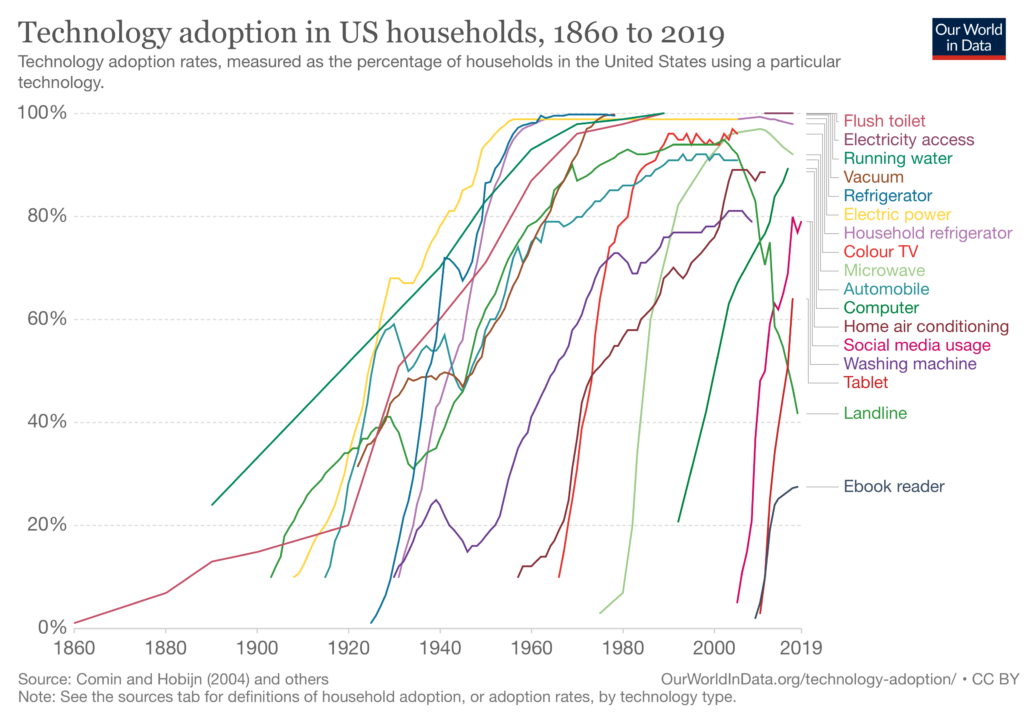
    Typically adoption curves project a market’s desire for a product. The graph below is a standard view of various technologies adopted over time by US households. Clearly some achieve nearly 100% market adoption (like flush toilets), while others achieve high adoption only to lose share in the long run (like landline phones). Geoffrey Moore’s Crossing the Chasm suggests that a company tailor its products specifically to a key market segment known as the “early majority” to move from “early adopters”, achieve success and grow more market share. Those that don’t cross this chasm either fail outright, or limp along in a low- or no-growth regime, sometimes for, well, decades (like Ebook readers!). This is something I have seen countless times in edtech, and that was certainly true of ALEKS before it was acquired by McGraw-Hill Education (MHE).

    https://ourworldindata.org/technology-adoption

    So what changed? For ALEKS, being more integrated with MHE content, marketed and sold by the considerable resources of a major textbook publisher helped generate new demand. But like most big publisher products, faculty tend to use ALEKS as a supplement to a course. Typically these products comprise 30% or less of the course activities and grade-able components. It’s difficult to say whether the product has “crossed the chasm” at this stage.

    On the other hand, Acuitus—the tutoring technology platform cited in the EdSurge article—has been refining an approach over the last several decades to model how human tutors help with valuable interventions at key points of the learners’ progress. Their goal now is to pivot to more mainstream education needs, including an income-share arrangement for upskilling workers. A task that will require many millions of dollars to achieve. They are most definitely still trying to cross the chasm.

    Some would argue that product-market fit—the degree to which a given product satisfies strong market demand—improved in both of these cases, but why is it taking so long for the industry at large to adopt these kinds of technologies? Despite the growing influence of “online learning” in the industry, why are so many faculty still wrestling with getting the basics of their curricula ready for the demands of the incredibly altered 2021 academic year education landscape? Why does it seem like EdTech players writ large continue to struggle to find the right product-market fit to gain significant market share advantage?

    First and foremost, technology alone is not going to provide the answers. The latest adaptive learning platform is useless without good content. And an online course will fall short if it does not offer truly great user / learner / teacher experiences from implementation through completion. Using technology to track learner profiles is great, but if a significant percentage of the learners are using their own technology to search homework sites for answers to textbook questions, then a learner profile will not describe outcomes accurately. More generally, faculty who do not have formal training or the support of institutional culture, policy, infrastructure and best practices to implement their courses will likely struggle.

    I would never claim to have all the answers, but I do believe that these extreme exogenous factors that flow from the pandemic are fundamentally recasting many of the vectors that drive an adoption curve. Chief among them, the stark threats to institutional viability and business continuity will force the shape of what has been an otherwise long and drawn out technology adoption curve to accelerate. Other vectors like advancing technology, business model innovation by institutions and commercial providers, the regulatory landscape, and changing consumer tastes will continue to add accelerants as well.

    It is increasingly clear this crisis mode we are in will permanently change attitudes. But it certainly should/will not be simply “how do I stuff my powerpoints into the LMS?” rather a more deliberate consideration of how technology-enabled teaching and learning must be implemented to ensure our academic institutions stay relevant to the needs of learners while also retaining the most important features of academic freedom, academic integrity and enduring brand value.

    Next up: The Billion Dollar EdTech Platform Hole

    The egg layers: Poppy, Paisley, Cherry, Princess Leia and Nutmeg