
e-Literate

Present is Prologue

Author: Jim Farmer

  • MOOCs: Student Motivation, Perspectives and Government Incentives

    Analysis of the sketchy available data reveals two myths about MOOCs: First, MOOCs are subsidized, not free. Second, MOOCs have high completion rates for those who seek credit.

    To better understand MOOCs, discussions are emerging with classification schemes that provide perspectives of students with different motivations, needs and methods of learning. These schemes can be used to further refine “completion” rates, and to understand subsidies. Though there is limited data available, the several examples can be used to develop a better, but far from complete, understanding of MOOCs in higher education.

    Colleges and universities need to know the full costs of offering “free” courses, even when provided by a commercial firm to students at no cost. The definition of “completion” becomes critical to public funding policies for students and colleges and universities

  • The World Conference on International Telecommunication (WCIT) and Richard O’Dwyer

    Richard O’Dwyer

    On Monday, delegates from 193 countries began meeting in Dubai at the World Conference on International Telecommunications. The resulting International Telecommunications Regulations (ITR) could change the operation of the Internet. Russia Today summarized the event as “Free Internet=American Internet?” Intense lobbying by Google and Russia’s 17th November  proposal focus on retaining the current Internet governance structure versus one based on national and international authority over the Internet.

    A name shaping the discussion that will never be mentioned is university student Richard O’Dwyer. (more…)

  • Romney and Obama Education Advisors On Higher Education

    OPINION

    Regardless of who is elected president, there will be a significant impact on higher education. The focus will be on supporting academic majors that immediately contribute to the economy—measured by starting salary, supporting students who can complete a degree-program, increasing access only for those who can afford the cost of higher education, and expanding “accountability.” Both presidential candidates promise reducing the cost of education. Both believe immediate implementation of technology—specifically online learning—will achieve learning efficiency.

    (more…)

  • MOOCS: The new higher education?

    On September 19, Slate Magazine concluded “Online Higher-Education Startup Coursera Is Taking Over the World.” Following Silicon Valley practice, reporter Will Oremus judged Coursera’s success on the basis of the number of customer universities offering Coursera courses. He concludes “Coursera has positioned itself perfectly to capitalize on their eagerness.”

    In July, Slate posed the question “Will online education start-ups like Coursera end the era of expensive higher education?” Oremus wrote: “Why would anyone pay tens-of-thousands of dollars for an education at a mid-tier college when they could learn from Ivy League professors online for free (or, at least, for cheap)?” (more…)

  • More Venture Capital for Higher Education: $10.75 million for rSmart

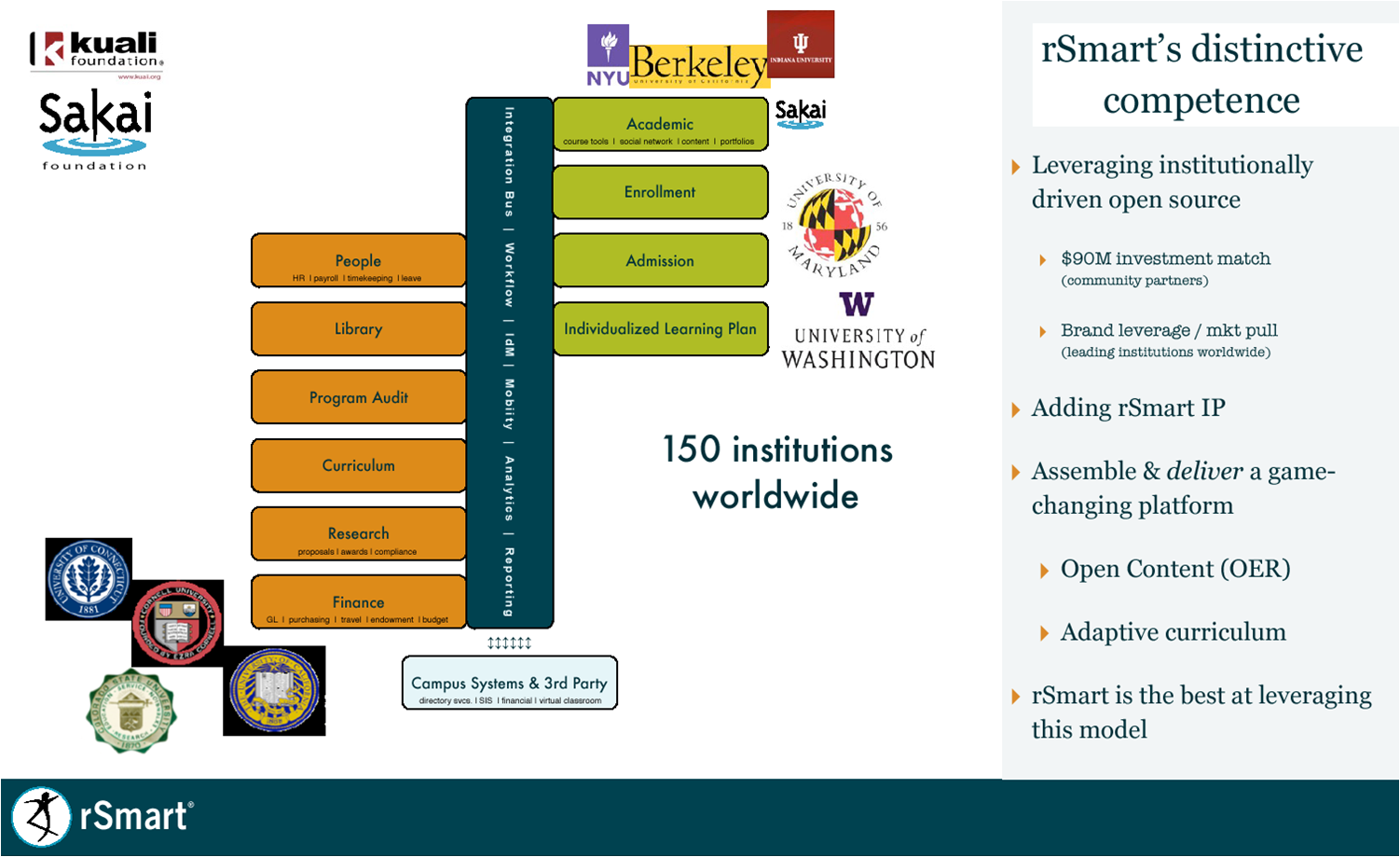
    On August 16 rSmart Group Inc. announced securing funding from Asahi Net Inc., GSV Capital Corp., and private investors. GSV investment advisor Michael Moe expressed confidence in the firm saying “rSmart is helping universities realize lower total cost of ownership and higher quality products that are easy to use. Most importantly, rSmart’s customers are becoming part of a sustainable, collaborative movement using solutions built by higher education for higher education. GSV wants to be part of this movement, and rSmart is the company to make it happen.”

    rSmart is a more mature and experienced company than the 26 others who presented at the “sold out” April “Education Innovation Summit.” GSV Advisors and Arizona State University hosted the third annual Summit with presentations on innovation and by new companies seeking to enter the education market. (Presentations are available here; rSmart’s presentation is available here and here). rSmart has participated in the Kuali and Sakai open source software initiatives to meet the needs of colleges and universities. Moe lists open source as a major trend in education. rSmart also has had an international presence teaming with Asahi Net Inc. and its U.S. subsidiary in cloud services. rSmart Chairman John Robinson is a visionary with 35 years experience with innovative higher education software technology. rSmart is one of the first to contribute to software architecture that spans both administration and learning using current software design techniques and technology—a goal of the Kuali Foundation.

    (more…)

  • Blackboard Inc.: The Rise of the New “Online Learning” and the Race for Profits

    In organizing the resignation of University of Virginia President Theresa Sullivan, Rector Helen E. Dragas may have expressed the concerns of many higher education boards of directors about the impact and effective use of education technology. Other Presidents and Chancellors may now have a similar career-threatening incentive.  History in technology suggests a wave of implementation of “online courses” will follow when decision-makers are presented with similar press enthusiasm for a technology.

    (more…)

  • Online Learning: Where is the Money?

    MIT offers their MITx online courses and certificates for a price, Stanford offers some online courses free, and Utah State University professor Wiley provides successful students with letters confirming course completion. But offering online learning has failed many using these business models. Cambridge, Chicago, Cornell, Michigan, New York and Oxford, Stanford, Temple and Yale Universities, University of Maryland University College and the London School of Economics all terminated their online courses for financial reasons. They were all started assuming student tuition and fees would pay for both the cost of operation and for developing very effective, high quality course materials.

    As Case Western Vice President for Information Services Lev Gonick summarized: ”University presidents got dollars in their eyes and figured the way the university was going to ride the dot-com wave was through distance learning.”

    (more…)