The “OPMs and Program Support” category covers vendors and services that support the development of online and blended programs, including Online Program Management (OPM) vendors.
Nine months ago we wrote about the new movement for the companies formerly know as “for-profits” in the education space to convert the actual schools into non-profit entities and declare their intent for parent companies to become a new form of Online Program Management (OPM) providers. Kaplan University, Grand Canyon University, Ashford University (Bridgepoint Education) all made similar declarations, but the problem was that each one was a single-client OPM – serving only their supposedly independent non-profit schools. That’s not much of a new market segment.
Today the movement became real as Grand Canyon Education announced their agreement to buy Orbis Education Services for more than $362 million.
Grand Canyon Education, Inc. (NASDAQ: LOPE), a publicly traded shared services partner dedicated to serving colleges and universities, announced today that it has entered into a definitive agreement to acquire Orbis Education Services, LLC, an education services company that supports healthcare education programs for 17 regionally accredited universities across the United States (“Orbis Education”), for $362.5 million in cash. The transaction is expected to close during the first quarter of 2019, subject to customary closing and regulatory conditions.
The acquisition combines the strengths of two of the nation’s most innovative service providers in higher education in an effort to align their expertise and better address a nationwide shortage in licensed healthcare professionals.
“This is a natural extension of what Grand Canyon Education is already doing as an education services partner,” said Brian Mueller, GCE’s CEO. “We are very impressed with the quality of nursing and healthcare education that Orbis Education’s client institutions are providing. GCE can help grow that by providing investment capital and advanced technologies with behind-the-scenes support that will help University partners accomplish their goals and increase the number of licensed healthcare professionals they educate with the same high-quality outcomes.
While they use the phrase “education services partner” instead of OPM, Grand Canyon in one move became a competitive provider worth watching. This news is significant.
The large for-profit chains all developed scalable processes for the same functions that OPM vendors provide for non-profit schools – marketing & recruitment, course & curriculum development, technology platform & data analysis, and student support & retention services – and the basic idea of this market change is for the for-profit parent companies to provide these same services for other non-profit schools. With the Orbis acquisition, Grand Canyon will pick up 17 partner institutions.
Orbis Education is a niche-market full-service OPM provider serving pre-licensure healthcare programs (mostly nursing) and was founded in 2003. Parter institutions include Concordia University, Northeastern University, Marquette University and Mercer University.
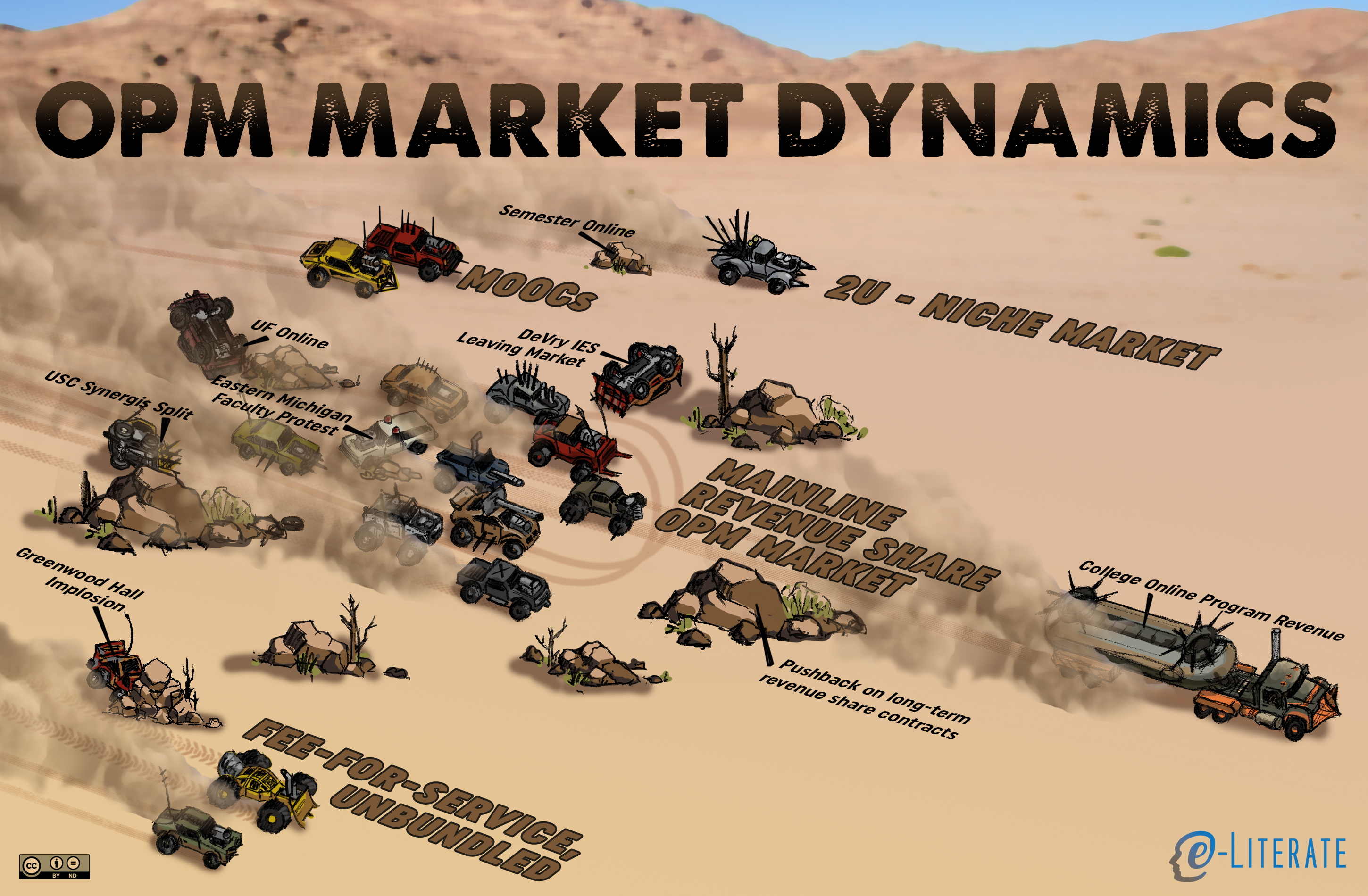
In a broader sense, this acquisition follows the Wiley acquisition of Learning House for $200 million announced this fall. We’ll need to update our graphics, but the OPM market is profitable and growing, but it is also messy and chaotic. OPM vendors are in a battle to have the financial strength and customer scale to survive the chaos and grow in an expensive model.
We’ll follow this story and others like it while sharing information on the likely impacts on the overall OPM market. For now the biggest issue is establishing that this for-profit-turned-OPM segment is real.
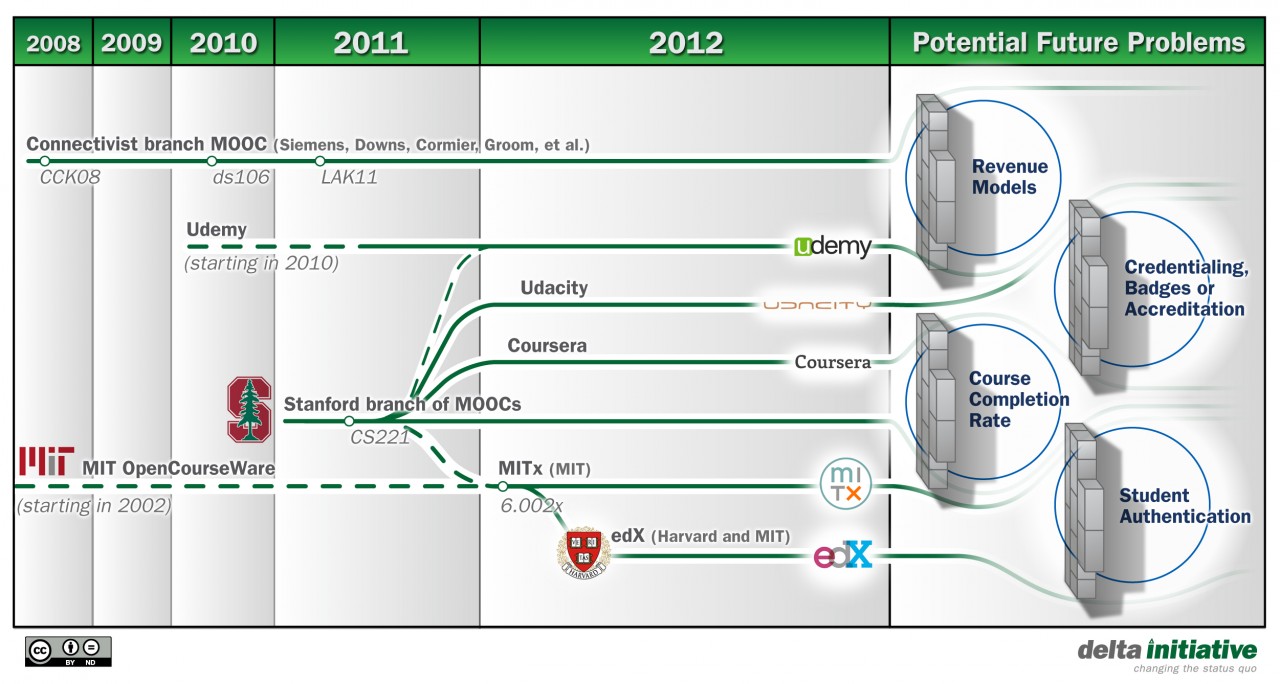
In mid 2012 during the midst of MOOC mania, I wrote a post noting that we should pay attention to future generations of the concept and that there were four barriers that the MOOC vendors would have to overcome to have any long-lasting impact.
Given this short timeline and the nature of investment-backed educational experiments, I think the real focus should be on whether and how MOOCs or successor models build on current scalability and openness while overcoming these four barriers.
Six years later, it is becoming increasingly clear that the next-generation model for MOOCs in higher education is to become a form of Online Program Management (OPM) providers, including the near-term focus on master’s degrees. The OPM market has demonstrated revenue models (tuition revenue sharing mixed with fee-for-service), the end credential is the already-accepted degree, course completion rates are higher for paying and matriculated students, and degree programs have methods for student authentication. In other words, the MOOC-based OPM model is the next-generation designed to address these challenges.
The shift into the OPM market has been documented in a series of posts in July of 2017, March, April, and May of 2018; and from Dhawal Shah from Class Central . In the May e-Literate post:
The picture one gets is of a chaotic market that is not for the faint of heart, and one that will likely see further consolidations and category changes. 2U, for its part, has been successful partially due to a niche strategy where they go after elite master’s programs and mostly avoid direct competition or engagement with the rest of the market. And recently we have started to see the MOOC providers become OPM providers – where the primary revenue for Coursera and FutureLearn are based on revenue sharing with online programs, albeit with lower sharing rates and with very different marketing approaches. In other words, there seems to be several efforts to enter into the same OPM race, but if possible to avoid being in the mainline rev-share OPM market.
Last week Julia Stiglitz from GSV Advisors, in their first podcast episode, interviewed Coursera CEO Jeff Maggioncalda who joined the company summer 2017. This interview gives the clearest view yet of Coursera’s emerging business model, and by extension it helps explain the new subset of MOOC-based OPM that includes FutureLearn, edX, and Udacity as vendors. ((Outside of Georgia Tech legacy contract, Udacity has moved to corporate professional development market, which is a different approach to same problem.)) I think that the media narrative of tuition revenue-sharing vs. fee-for-service OPM models is overblown, especially since there is a spectrum in that respect more than a binary choice of OPM vendor types. What the MOOC-based OPM entry introduces is a more fundamental characteristic of how traditional institutions develop online programs – namely low-cost vs. full-cost online degrees.
The first note from the interview is that the Coursera of 2018 is not the Coursera of 2012. While Maggioncalda still shows aspects of that old-time MOOC belief system, his approaches are very much rooted in focusing Coursera on a solid business model. And the difference shows. The second note is that 2U’s success in the OPM market and a successful IPO had a big influence on Coursera’s shift. [Emphasis added in transcript]
Julia: You know when you first joined. You spent some time looking at Coursera’s strategy, and really digging in and looking at the different businesses that Coursera had, and one of them that you were particularly attracted to, and you have put increased attention on here at Coursera is the online degrees business. What was it about online degrees that excited you?
Jeff: Yeah. This is sort of I think another good example of what good entrepreneurs have to do, is you have to have feedback loops; you need to get information from multiple sources to understand the nature of a problem so that you can come up with solution. The nature of an opportunity so you can develop a strategy to go after it. It’s really actually pretty simple. I came in – you were on the team, too, we did a lot. We call them deep dives. We went all through the business model, and there’s a great book Business Model Generation that really, to me, gives a nice framework for saying this is what a business model is. It is a target customer. It is a value proposition and offering that solves their needs. It’s a set of channels of how you acquire those customers. It’s a servicing models of how you service the models. Internally it’s the key activities and resources you bring to bear on that. It’s the partners that you work with. It’s the financial revenues and costs, and is your competition. So and that’s the framework. And we stepped through every one of those. I wrote 250 questions across that business model that we as an executive team went through. You know step by step by step, so that everybody learned the nature of our business. And what became very obvious is we had a few things that nobody else really has.
We had 36 million learners, at the time it was 25 million. 25 million learners from all around the world. That’s a pretty big asset. We had university partners. Now there are competitors out there like LinkedIn Learning, previously Lynda, like PluralSight, like SkillSoft. You know there’s YouTube, there’s Khan Academy – there’s a lot of content out there. You were one of the ones who told me in one of those early meetings, “Hey we’re worried that content, generic content, might become a commodity.” Well, we don’t want to play a commodity game. So what is it about my partners that’s super distinctive? Well our partners are universities, and they’re not just the universities, they’re the best universities in the world, and they’re spread around the world. So you say, well I’ve got a resource that almost no one has, which is this network of universities. Right now they’re publishing MOOCs, and there’s something special about MOOCS, but MOOCs are a little more susceptible to that commoditization just as MOOCs. But what was not very susceptible to commoditization are degrees. So that’s OK. We have an asset nobody else has, and what they do really well is degrees, and they still have market sizing. How big is the market for degrees? 1.5 trillion dollars. Okay, well that’s a pretty big opportunity. And then you say, what’s the likelihood that that industry could be transformed due to technology . . . You know, some industries it’s easier to transform, others, it’s harder. The provision of education is absolutely set up nicely to be enhanced, transformed by technology.
I think Uber and Lyft were really smart when they said “you know on-demand transportation, called a taxi, it’s a big market, but it’s a broken product. And if we just do some sort of digital view of this kind of redesign what on-demand transportation looks like, it’ll be a much bigger market.” I’m looking at degrees, I’m not saying it’s broken altogether, but if you look at the student debt out there, you look at the the lack of access, and you look at how inconvenient it is for people to have to stop their lives – especially for master’s degrees – quit their job, move their family, pay hundreds of thousands of dollars, forfeit their income. That’s a broken product. So I thought we got partners who are really good, and a massive economic opportunity, and a product that is just ready to be dramatically improved by technology, and so I thought this is pretty good. We should go after this. By the way we also had 2U trading at like a 12 times forward multiple. So clearly Wall Street loved the idea of online degrees, and 2U’s been doing great. They’re growing really rapidly, so there’s a data point out that says, hey this company is doing really, really well; We should be able to do pretty well here, too.
Julia: Could you share a little bit about what this redesign looks like? Because the online degrees aren’t new. You know 2U is doing them. And before 2U there were a whole set of online degree providers that were out there, so why is what Coursera is doing different?
Jeff: Yeah I think it’s a few things. The number one, I would say, is quality. When I say quality, I mean the quality of the credential. So a lot of people have spent a lot of money on for-profit college degrees that just don’t have very good credential value, they’re not recognized in the job market. You pay a lot of money, you don’t get much back for it. One of the reasons that people pay so much for the top universities is that those types of degrees means something in the job market. There have been a lot of online degrees out there, from universities, that charge a lot and don’t get you very far. Our partners happen to be the best universities in the world, with the highest credential value in the world. When these degrees come online, and these degrees online are the same degrees as on campus, you’re getting something as a credential that’s extremely valuable. That should have a very high ROI. Because we’re doing it online the cost is often less than half. So it’s a top quality credential at half the price. Same credential you get on campus.
Different Assumptions on Tuition
There’s a lot of useful insight in the full interview, but I’d like to call out the fundamental question that gets raised about online education with this market view. Should online degrees from traditional universities cost the same as face-to-face offerings, or should they cost significantly less?
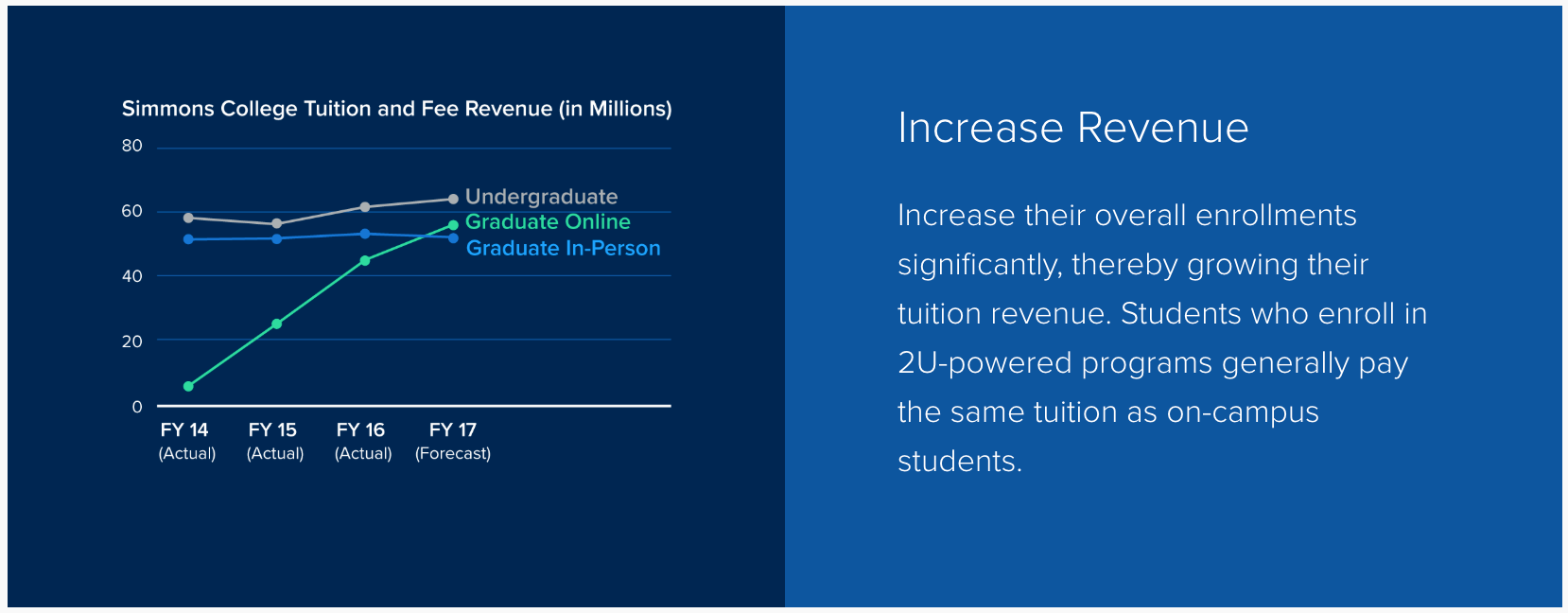
For full-service revenue-sharing segment of the OPM market, some core assumptions are built on the assumption of high revenue share percentages and full-priced online degrees. 2U is probably the best-known and arguably the most successful OPM company, and like Coursera they target elite institutions as partners. In 2U’s website under “Our Approach” they describe how their online programs typically charge the same as on-campus programs.
Most of the full-service revenue-sharing segment of the OPM market is similar in its view, whether from Pearson, Wiley, Academic Partnerships, or others – relying on consistent tuition as for online programs, and if there are lower prices they tend to be marginally lower. ((Disclosure: 2U and Pearson are sponsoring participants in our Empirical Educator Project.)) The Coursera approach is in direct contrast with this view, based on the interview as well as several of their online degree programs. There are arguments for either approach. With full-cost tuition, the idea is that the online degree gives at least as much value to students as the face-to-face, or on-campus, degree, and therefore students will be willing to pay the same. With low-cost tuition, the idea is that while students get the same value, “because we’re doing it online” the costs should necessarily be lower. Online infrastructure and marginal costs are much lower than investment in physical facilities. The point here is that this is a fundamentally different set of assumptions.
For most, the initial appeal of the program was certainly the price tag. Illinois’ iMBA costs a fraction of a degree from an elite school, where the median cost is roughly $171,000 and can break the $200,000 mark at the far end of the scale. Illinois’ own residential two-year MBA costs more than $100,000. Arshad Saiyed, executive director of online programs at the Gies College, acknowledges that the low cost brought the program to many prospective students’ attention — but says the iMBA has kept students around through a combination of high-quality instruction and successful community building.
Different Assumptions on Student Recruiting
For OPM full-service vendors, the largest expense is typically marketing and sales – i.e. recruiting potential qualified students. The predominant approach to OPM student recruitment has been based on digital marketing – advertising and outreach on social media platforms, search engine placement, digital advertisements in articles. With the MOOC-based OPM subset of the market, there is now an alternative approach based on having a multi-sided platform model. Coursera views their 36 million registered learners as an asset – a natural base of potential students for online degrees that can be reached without external advertising. In addition, the original aim and design of large-scale MOOCs is based on ability to easily sign up new learners for low- or no-cost, with the opportunity to move these students into higher-cost credentials and degrees over time, not requiring full financial commitments from students up front. While a Coursera or FutureLearn might use digital marketing for recruitment, that is not their primary method.
Different Assumptions on Course Size
Related to the above assumptions, in 2U’s case the class size is small – typically 10 – 20 students leveraging the platform’s design around small discussion groups, using both synchronous and asynchronous learning. This 2018 article about Washington University’s two programs partnering with 2U partially describes this approach.
But what is it like for student to pursue a graduate degree in law fully online? How could a pre-recorded lecture support the active teaching that’s integral to discipline? After all, watching a video isn’t the same as participating in a conversation. To support such engagement, 2U created a new tool.
“Through building an online LLM [master’s of law] program with Washington University in St. Louis, we learned how to design one of the most important tools we provide today: the bidirectional learning tool, or BLT,” said Chip Paucek, co-founder and CEO of 2U. “Socratic-style teaching is fundamental to all law curriculum and coursework. As such, it was imperative for us to design a way to conduct Socratic-style group discussions for Wash U once we signed their online LLM program.
“What we didn’t realize is that while we were developing a software tool to help solve the challenge of teaching the Socratic method online, we were simultaneously creating a way to facilitate discussion-based learning in an asynchronous environment that would eventually be used in all of our future partner programs.”
The approach that 2U and Wash U Law conceived relies upon the ingenious integration of asynchronous and synchronous course components. Instead of lecturing from a podium, faculty address small groups of student actors. At key points, the instructor breaks the fourth wall and addresses the online student, who is prompted to answer without the benefit of knowing how his or her peers have responded. In other words, students can’t piggyback like they might in an in-person class.
After responding, online students can review one another’s answers. They might be prompted to answer follow-up questions, or they might be asked to come to the next live class prepared to defend whatever position they’ve chosen. The preparatory work that might otherwise happen during an in-person class is accomplished in advance through the pre-recorded sessions, enabling faculty to make better use of live, synchronous time.
In contrast, consider a Class Central interview with Maggioncalda when talking about scaling and its challenges.
I think about systems. As the system gets bigger, where would the bottlenecks emerge? My sense is that the bottlenecks will emerge in live sessions and in grading. That’s my guess. The grading, I’m actually not so concerned about because I think the ability to automate grading at scale will become pretty good. The live sessions get tricky. From a technology perspective, I’m not that worried about it. It’s the professor’s time and attention. My thought is it’s going to be a little bit like pyramid, where the number of hours that the main professor puts in won’t really change. If you think about how medical systems have worked, a doctor is in the system, but the number of minutes and hours that a doctor spends [with each patient] becomes an increasingly smaller portion of the total time [during which medical treatment is being delivered]. I think it will probably be somewhat similar for education. The size of the classes could be big, let’s say 10,000. But that will be broken into sections of say 50. And each of those sections has an expert who’s probably not the professor. Also, there will be a lot more collaborative learning among the peers in the class. If you think about it, a lot of learning does actually happen among the folks in a class. The expert just dispensing wisdom is not the way most learning happens. I call it “high engagement learning at scale.” A major piece of high engagement learning at scale is utilizing your classmates to provide a highly valuable learning experience.
Coursera is pursuing a path to enable high enrollments in low-cost programs, and they view their challenge to balance scale and student engagement, with class sections of ~50 students.
Good Enough vs. Better Enough
In twoposts recently, Michael described a battle in the digital curricular materials market. Focusing on Cengage Unlimited in the first one, he described this dynamic.
Make no mistake; this is a potential inflection point in the curricular materials market. There is a war raging between curricular materials that are “good enough,” meaning that the lower price has a bigger impact on student outcomes than any differences in the quality of more expensive alternatives, versus “better enough,” meaning both instructors and students believe the product makes a sufficient difference in student outcomes that the more expensive product is worth the premium. Cengage is betting the farm on “good enough” beating out “better enough” and, win or lose, their bet could cause tectonic shifts in how curricular materials are developed, purchased, and used. It will have implications for inclusive access, adaptive courseware, textbook companies, textbook authors, and the landscape of options available to students and teachers.
Elaborating in the second post:
The distinction I’m trying to make between two strategies is a little tricky. I’m not arguing that Cengage, for example, thinks that their products aren’t great or that they think all anybody needs is the cheapest PDF possible. And on the other hand, “better enough” no longer means better editing or better production values, which is the way that textbook publishers used to position themselves against OER (and still do sometimes, although that reflex is beginning to fade). Rather, it’s about improving student outcomes.
What we are seeing in the OPM market, with the introduction of MOOC-based degrees, is a new battle. MOOC providers and its partner institutions, represented by Coursera, betting on “good enough”; and 2U and its partners betting on “better enough”. Like the curricular materials market, the product is based on student outcomes, which wraps in the value of the credential coming from the university along with the academic and administrative experience enabled by the company. Coursera obviously believes in the quality of their experience, and their partners have some programs that are not deeply discounted, but their market position is based on the program price being the compelling feature for students, including free or low-cost on-ramps. 2U understands that students are seeking more cost effective options, which was one driver behind creating the short-course segment with the acquisition of GetSmarter, but their market position is based on quality of experience and value of credential being the compelling feature for students. But the difference in approaches is stark and significant.
While there is likely room in the market for both approaches, the Coursera of 2018 (and not the Coursera of 2012) deserves careful observation to understand future trends with online degrees. Win or lose, their bet on low-cost online degrees will have big implications in the market.
A couple of weeks ago, our response to Open SUNY’s Request for Information (RFI) on Online Program Management services (OPMs), we published an abridged version of our response on our company website and wrote a post about our observations here on e-Literate. Since, then, ExtensionEngine has followed suit. Here’s the introduction to the version that they published on their site:
The online program management (OPM) landscape is a confusing one, the result of rapid evolution and an ever-greater assortment of businesses keen on winning their share of what has become a very lucrative market. We do not envy the task of any institution of higher learning seeking to upgrade their online learning program, and even less one considering the launch of their first program.
A few days ago, MindWires — a strategic consultancy and advisory firm — took an unusual step, one that begins to make the task a little easier by increasing transparency among all of these diverse providers: they published their response to a request for information (RFI) from the State University of New York (SUNY).
The action reflects — and begins to correct — concerns expressed by MindWires’ Michael Feldstein in a series of articles regarding the complicated 2018 OPM market. Greater transparency, as modeled by this move, may be exactly what the marketplace needs to make sense of itself.
In fact, the SUNY RFI itself has made a contribution to greater clarity. This RFI was more than a request for information on what various providers could do for them; rather, it asked the question: What do we need to know before we move forward? Asking for this guidance before generating a request for proposal, or RFP (which will come later), was a brilliant and insightful move on SUNY’s part.
The SUNY RFI listed 15 information-gathering objectives. As we formulated our own response, we noticed that we were, in effect, creating a road map through the wilderness of the 2018 OPM market, one that could be valuable to many institutions of higher learning that are thinking of creating or upgrading an online learning program. Some sections are more pertinent to multicampus systems like SUNY’s, but much of the road map applies to any institution, regardless of size.
For those who are not familiar with ExtensionEngine, we are a professional services organization that designs, builds, launches, and markets custom learning experiences — an integrated, holistic experience designed for learners, pedagogy, vision, and brand. We are a fee-for-service partner — no revenue sharing — and are paid by the hour to provide a full suite of services to help our clients to create successful online learning.
So, in the spirit of transparency inspired by MindWires’ publication of their response, we are following suit to share portions our response to SUNY’s RFI. Below is a substantial excerpt from the road map through the OPM landscapewe created for SUNY, shared with their permission.
This is great stuff. In mature product categories like the LMS, this kind of sharing can do more harm than good, because schools tend to just copy and paste requirements without giving a lot of thought about or investigation into which requirements are right for their particular context. But in the still-maturing OPM and broader Digital Enablement Solutions product categories, this kind of sharing helps to surface the differences in needs and contexts that lead to different kinds of optimal solutions. Publishing both the requests and, at least, abridged versions of the responses is very helpful in advancing the conversation. As ExtensionEngine’s Scott Moore noted in the blog post, such responses can “creat[e] a road map through the wilderness of the…OPM market.”
More transparency in this space would be extremely helpful at this time. We’re giving some thought into different ways to accomplish that aim.
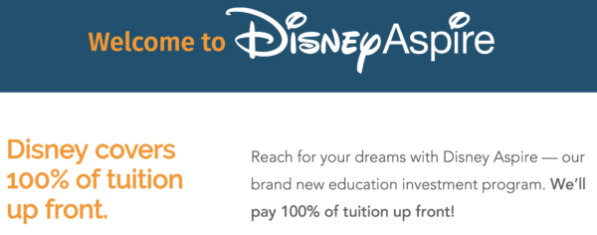
Two weeks ago The Walt Disney Company announced a new educational benefit program called Disney Aspire that goes beyond what other recent benefit programs have offered. As described in a company blog [emphasis added]:
Disney Aspire is the most comprehensive program of its kind. To make participation easier for eligible employees, The Walt Disney Company will cover 100 percent of tuition upfront and will also reimburse application fees and required books and materials, removing the worry of paying to start or continue school. The program is designed for working adults and offers our Cast Members and employees maximum choice and flexibility with their studies, regardless of whether the program and classes they choose are tied to their current role at Disney. Disney Aspire includes a network of schools that offer a wide array of disciplines and diplomas—including college and master’s degrees, high school equivalency, English-language learning, vocational training and more.
This program is offered through Guild Education to 80,000 of Disney’s hourly employees in the US (after 90 days of employment), and the ‘regardless’ point is crucial – the options for degrees is not constrained to pre-selected majors or degrees that have to be tied to an employee’s current role.
Yesterday there were additional details announced by the University of Florida Online (UF Online) about programs that they are offering for Disney Aspire.
As part of this relationship, Disney employees may apply to one of several fully online bachelor’s degrees – the Bachelor of Arts or Bachelor of Science in business administration from the Warrington College of Business; the Bachelor of Science in sport management from the College of Health and Human Performance; and the Bachelor of Arts in public relations, and the Bachelor of Science in telecommunication from the College of Journalism and Communications. If granted admission by the University of Florida, Disney cast members could begin UF Online classes in January 2019 as part of the University’s spring semester. Once cast members sign up for the Disney Aspire educational benefit, a coach from Guild Education will contact them to determine their eligibility to receive educational benefits, review their academic background, and to provide qualified prospective students with a unique link to the UF Online admissions application.
One reason this announcement is interesting is the rapid growth of Guild Education, providing a derivative of Online Program Management (OPM) services. Guild describes itself as providing a platform that connects large-employer educational benefit programs with partner schools such as UF Online, Brandman University, Valencia College, etc. As we described in June when Walmart and Discover Financial announced their benefit programs:
I think these moves are more significant than just individual benefits. What we are seeing is UF Online, along with a handful of others, defining a different approach to marketing and finding potential online students, at least for undergraduate degrees. Historically, there is a common assumption that to enable a scalable online program there is a need for traditional digital marketing as the primary approach – Google AdWords, call centers, social media campaigns – with a partnership or two thrown in on the side. The origin of the OPM market is centered on providing these services in exchange for a percentage of tuition revenue, and for the majority of cases, the OPM’s spending on this marketing and enrollment management category is the most expensive service in the package. The Employer Pathways approach by UF Online has the potential to flip the student acquisition assumptions – primarily driven by employer partnerships with traditional digital marketing channels as a secondary approach.
Since the June post, Guild Education raised a round of $40 million for a total of $71.5 million since 2015. As EdSurge noted in its article, however:
One challenge is that few employees who are given education benefits options take advantage of them. The Wall Street Journal recently reported that while nearly 90 percent of mid- and large-size companies offer tuition reimbursement, less than 10 percent of employees at those companies take advantage of the benefits.
That figure is even lower at Guild’s partner companies, where only 3 to 5 percent of employees take advantage of the educational offerings, says Carlson. “We are optimistic that our companies want to go beyond that.”
Guild Education works on a tuition revenue share basis, although the details of these agreements are not public information yet. Charging tuition revenue sharing for up-front marketing and acquisition of students for online programs – sounds like a lot of overlap with the OPM market, but for a new or derivative model. This gets to Michael’s point most recently described in a post about Noodle Partners and their evolving model:
In my last twoposts, I talked about OPMs being long-term partners in the ongoing management of online programs. I also argued that unbundling of services opens up a world of possibilities for solving different problems, and that we therefore need an umbrella product category called “Digital Enablement Solutions” with other (emerging) subcategories that could live along side Online Program Management.
Guild Education does not provide any of the program management services beyond admissions, as they do not help with program design, instructional design, student support, ed tech platforms or analytics. So it would be a mistake to lump them into the OPM category, but there are some interesting overlaps. We referenced this situation in our response to the SUNY Online Education Request for Information.
Financing models are proliferating in higher education, to the point of creating a great deal of market confusion, in part because one size does not fit all. Universities will likely have to evaluate a wide range of financial models and make sure that their approved portfolio of solutions providers includes a substantial subset of those models.
As for the educational partners, there is long-term potential but not yet sufficient demand for that flip in student acquisition assumptions. UF Online estimates that within the next two years they might reach 10% of students coming from their Employer Pathways. One motivation for this type of program, according to Associate Provost and Director of UF Online Evie Cummings, is that ideally the “coach from Guild” will be able to pre-screen applicants, since the cost of marketing to students who do not make it through the admissions process is quite expensive for selective institutions.
Beyond the online programs, starting in January there are likely to be face-to-face options as well, as described in the Orlando Sentinel.
Under the education program, Disney employees can take courses toward a high school diploma, a college degree or vocational skill.
A Disney spokeswoman said the online courses are the first rollout of the tuition program and employees would be eligible for in-person classes — at Valencia College as well as other schools — in the next phase beginning in January.
Count this news as further evidence of the broader market of Digital Enablement Solutions based on tapping into corporate HR and learning opportunities rather than traditional ad-based student recruitment methods.
If you spend some time browsing the Google News search results for ‘OPM “revenue share”‘, you’ll find one industry figure who seems nearly ubiquitous, particularly in pieces by general audience news outlets: John Katzman. Mr. Katzman, currently the founding CEO of OPM company Noodle Partners, is one of those rare individuals who has been extremely successful as a serial entrepreneur in education. He founded both Princeton Review and 2U before going on to start Noodle. In his current incarnation as Noodle Partners CEO, Katzman is waging a publicity war against the OPM revenue share model that companies like his last one—2U—are built on. Josh Kim’s recent interview with him in Inside Higher Ed is quite revealing and tells us a lot about the real debate surrounding OPM revenue sharing.
In three years, no one will be able to explain why it was that colleges and universities continued to hand more than half of their tuition to companies marketing and supporting their online programs — the online program managers. It will be even more challenging to explain why some agreed to contractually share their tuition for the next 10 or 15 years.
In that same piece, Katzman referred to traditional OPM revenue sharing agreements as “payday loans” and wrote,
I’m suggesting the time for the ‘share the bounty’ approach to online education is over. This approach is driving up education costs (and student debt) and fueling a marketing race as schools and online program managers spend more and more to recruit and retain online students.
That online program managers continue to sell their outdated and misaligned tuition-sharing model fuels the suspicion and mistrust educators have for for-profit education companies. Those of us who believe for-profit investment and innovation can improve the quality and accessibility of education are obligated to raise our voices when things go off the rails or become ineffective or outdated – as the revenue sharing model has….
Few, if any, institutions can afford to share their tuition and none can afford the all-out marketing war that outside companies will be all too happy to wage for a cut of the action.
The good news is that the market knows a change is coming. Tuition-sharing percentages are trending down and contracts are getting shorter. More colleges are investing in in-house solutions to recruit and manage their online offerings. And fee-for-service management options like the one my company offers are also becoming more abundant. That’s progress.
Pretty harsh words, especially from a guy who founded one of the most successful OPMs in the industry. Has Katzman softened his stance in the last two years?
Nope.
Here’s what he says in response to Josh’s question about whether the OPM industry should form an association:
My job is to decimate the OPM industry, which is driving up higher ed tuition. So … perhaps, but doubt they’d want me in it.
Clearly, Katzman is on a mission to kill revenue sharing agreements. Here’s what he says in response to Josh’s question about how universities can manage the up-front costs of building an online program without revenue-sharing agreements:
Some traditional OPMs are trying to position us as fee for service, but Noodle also offers a temporary revenue-share option in which we fund a program and take on all risk. The school pays a share of revenue, but only until we have recouped our out-of-pocket expenses for its programs, after which it pays for actual services. This is the best of both worlds, and about half our schools take advantage of it.
Wait. What?
Noodle Partners’ position gets flattened into “revenue sharing bad,” partly because it makes good headlines, partly because Mr. Katzman knows it makes good headlines, and partly because Noodle Partners’ position has evolved. According to the Wayback Machine, Noodle Partners’ 2016 version of their web site said the following about financing:
Choosing to work with Noodle Partners is the most affordable route to great, quality online programming. While there is an up-front investment necessary to launch your programming, Noodle Partners can work with you to get outside capital from a trusted, low-interest financing partner.
But if revenue sharing isn’t the core problem that Noodle Partners is intended to rectify (anymore?), then what is? Is it the bundling? Here’s what Mr. Katzman says to Josh on that point:
[U]nbundling isn’t exactly what we’re doing. A program needs instructional design, marketing, recruiting, funding, technology and support services; we’re just comfortable with helping a school build capacity rather than use outside providers exclusively. Any way our competitors follow us, though, they will leave Noodle as the leader in the next-generation OPM space.
In my last twoposts, I talked about OPMs being long-term partners in the ongoing management of online programs. I also argued that unbundling of services opens up a world of possibilities for solving different problems, and that we therefore need an umbrella product category called “Digital Enablement Solutions” with other (emerging) subcategories that could live along side Online Program Management. Noodle Partners isn’t unbundling services but is rejecting the model of the long-term full-service management of online programs by the company.
So what does that make them?
I would call the service that Katzman describes “Online Program Enablement (OPE).” In this model, the vendor may offer revenue sharing or some other form of financing designed to cover the up-front costs of full-service support for the program launch, but then unbundles those services to some extent and allows customers to pay for them as needed on a fee-for-service basis. That shift in models after the program launch is what distinguishes an OPE from an OPM.
Katzman characterizes the shift as “next-generation OPM,” but the resulting service really solves a different problem than an OPM does. If you think your institution is best served by focusing on its current core competencies and outsourcing the lion’s share of online program management work to a specialist on an ongoing basis, then an OPM service is what you want. If, on the other hand, you want full-service support (and financing) to launch your program but want to take over management of significant portions of it once it is up and running, then an OPE service is really what you want.
How much OPM and OPE services are ultimately going to compete or just co-exist is an open question. At the moment, we don’t see a lot of evidence that OPE growth is coming at the expense of OPM growth. There is likely a Venn diagram of potential customers between the two product categories, but we won’t know the size of the overlap for a while. In fact, we have very little visibility into OPE growth, in part because many service providers are offering multiple pricing options these days. There’s still a lot of improvisation going on without a lot of thought about how tinkering with the pricing model changes the offering enough to put it into a different product category.
The main point, once again, is that many significantly different offerings are getting crammed into the OPM product category because it’s the only product category that we have. This obscures the fact that some of these services are different enough from each other that they solve different problems from each other. And the differences that tip an offering into a different product category are not always obvious.
There are several factors that are major contributors to the current rush to by vendors to call themselves OPMs:
The variation between kinds of programs that universities are looking to launch is significant and increasing. As a result, different OPM vendors are specializing in different kinds of programs.
More universities are making fine-grained choices about which aspects of their online programs they want to outsource to a specialist, which aspects they want to pay a consultant to help them get started or improve, and which aspects they believe they can do themselves. This broadening out of customer choices is creating further variability in in OPM business models and OPM-like services offered by an increasingly wide range of companies.
As the OPM business disaggregates, universities are increasingly recognizing that certain functions that OPMs perform, like recruiting students who are likely to be successful in a program, redesigning courses to maximize student success, providing early interventions to promote student success, and working with employers to help with career readiness and post-degree employment are all services that might be useful for improving the success of their traditional programs.
This last point is especially important. Within the three-letter acronym OPM, the “P” and the “M”—”program” and “management”—are defining features of the product category. OPM is a service in which the vendor actively manages at least some substantial subset of a full online programfor some significant period of time. As in multiple years. Once customers start contracting for individual services a la carte on a relatively short-term basis—say, just to get the program up and running—those customers are no longer paying for an OPM service. They are paying for some other digital enablement service which may not yet have a widely used name.
Because this distinction can be a little fuzzy, it helps to have a case study. Luckily, we have one. Open SUNY recently released a Request for Information (RFI) for vendors that can help them meet a wide range of ambitious goals. While the term “OPM” was never used in the RFI, it’s pretty clear that the request was written specifically to include questions that one might ask of an OPM service provider. MindWires, our consulting company, responded to that RFI. Because we think the answers we provided to SUNY might be useful to a wide range of colleges and universities, we have published a shorter, edited version of our response. Because that response includes fairly detailed descriptions of our consulting services, we have published it on the MindWires site rather than here on e-Literate. But some less commercial discussion of SUNY’s request is also appropriate for the blog because it sheds some light on the challenge defining the product category in a useful way.
SUNY’s Goals
In their RFI, Open SUNY enumerates quite a few ambitious and complex goals (even before accounting for the fact that these goals are for a system of 64 diverse and independent colleges and universities):
Opportunities to position SUNY as a unique provider of educational opportunities for all learners;
Reaching the millions of New York residents currently not enrolled at a SUNY campus, who need higher education to be more effective on their jobs;
Significantly expanding SUNY’s online learning experience to serve exclusively online students who are currently not at a SUNY campus;
Potential next-generation innovations in online/digital education where SUNY may have a unique opportunity to leapfrog competition;
The most appropriate ways to productize SUNY’s vast educational offerings to prospective students;
Business and revenue sharing models to incent behaviors, ensure sustainability and provide campus/System revenue growth;
Opportunities to capture students SUNY is losing to other online schools generating revenue for investment in our campus operations;
Outreach and marketing plans that reach a broad range of key stakeholders, including potential students in-state and out-of-state, internal staff and professors, and other key stakeholders as identified;
Platforms and services to expand SUNY’s current online environment and enrollments to challenge current leaders in the field;
Insights into the type and structure of programs appropriate for this platform/business model;
Requirements to continually align educational opportunities with labor market needs;
How to best integrate SUNY’s 64 campuses and their faculty into this improved platform/business model;
The impact of the changing demographics in New York, as well as surrounding states and potential global opportunities;
Partnering with interested industry leaders, including other university systems;
Consideration of prior learning assessment as part of the improvement to this process.
Much of this sounds like classic OPM work. For example, “[b]usiness and revenue sharing models” and “outreach and marketing plans” are classic elements of an OPM solution.
The revenue sharing model is both particularly characteristic and widely misunderstood. Revenue sharing is best understood as a service offering. It’s financing. When I bought my last car from the dealer, I got a loan from them to help pay for the car. There were other ways that I could have financed the purchase. I saw the prospect of owing money and paying interest to the car company as a feature rather than a burden because the specific terms they offered were advantageous relative to other options I had at my disposal. In my case, I was buying a new car that cost more than the cash I had on hand. So I needed to take a loan from somewhere. But at 0.9% interest, I might have decided to take the loan even if I had the cash. I might have decided that the interest rate was low enough that I’d prefer to hold onto my cash.
In SUNY’s RFI, they specifically ask for information about “business and revenue sharing models” because the system wants “to incent behaviors, ensure sustainability and provide campus/System revenue growth.” The revenue sharing model, which is also a risk sharing model, theoretically aligns the vendor’s incentives with the customer’s. Again, theoretically, the vendor makes money only to the extent that the new program is successful. In order for companies to share the risk, they generally want some of the control in addition to some of the revenue. They want some ability to influence decisions that impact the program’s success. This kind of arrangement only makes sense for both parties when the customer wants the vendor to actively manage parts of the program on a long-term basis because they believe their program will have a higher likelihood of success if the vendor does so. Management is a particular kind of enablement where the service provider actively oversees a particular function that the customer doesn’t feel is their core competency (like online marketing) so that the customer can focus more energy on in-house areas of strength (like curriculum).
So here’s a rule of thumb for defining the shape and boundaries of an OPM service: If a reasonable person could believe that a revenue sharing arrangement is a rational option for paying for the program (regardless of whether the customer chooses that option), then the service may well be an OPM.
Conversely, if a rational person could not believe that revenue sharing is a rational choice, then it probably isn’t an OPM service. Revenue sharing isn’t definitional for OPM, but it is an indication of the kind of close, ongoing reliance on the vendor to actively manage the program that is the hallmark of an OPM service. One could imagine a customer having one or more of SUNY’s goals and not wanting a full program management service. Take, for example, “[p]latforms and services to expand SUNY’s current online environment and enrollments to challenge current leaders in the field”. This could be as simple as an LMS or a courseware platform. It’s hard to imagine a university or system signing a revenue-sharing contract with their LMS vendor. A learning platform, or even a course registration portal, would be a kind of digital enablement service. But it would not be online program management.
I’ve been very careful so far to refer to OPM as a service. “Solution” or an “offering” also both work. But I have deliberately avoided talking about OPM companies. Such beasts do exist. 2U and Academic Partnerships are two well-known examples of fairly pure-play companies that are known for offering full-service, revenue-sharing online program management solutions. But once companies start to unbundle their offerings to the point where it no longer makes sense for customers to think about paying for what they are buying via a revenue-sharing agreement, then those companies are offering both OPM and non-OPM digital enablement solutions. Since the sector doesn’t have product category names for those other solutions, they tend to get called OPM services. But prospective customers should think about them quite differently. In one case, the business arrangement should maximize the alignment of incentives between long-term partners. In the other, the customer might well want the opposite, i.e., to minimize long-term dependence on the vendor.
Generally speaking, true OPM solutions make sense when a college or university is looking to launch a new, differentiated, free cash flow-generating online degree or certificate program. Many of those words can be boiled down to one: Money. The college or university (or system) wants to create an offering that, among other things, pays for itself and generates free cash flow—i.e., leftover money after covering certain core expenses—to spend on fulfilling other aspects of its mission. It’s a new program, and maybe even a completely new kind of offering for the school, so it’s more likely that the institution will need ongoing help with certain aspects of the program. Since there are a million billion MBA programs online already (for example), a new MBA program would need to be differentiated enough to draw students. Otherwise, it won’t generate money. Many colleges and universities know how to create traditional face-to-face programs that are differentiated and will bring in more money than they cost. Fewer know how to launch and run one online. Or, honestly, would want to. There are all kinds of tricks to marketing online programs successfully. Managing seamless registration is hard. Managing, say, live nurse practicums to support an online nursing degree program is hard. Running the registration, LMS, CRM, learning analytics, accounting, and other software, tuned to work together for an online program, is hard. Some schools just don’t feel like they want to put their money and energy into learning how to do these things well enough to run an excellent program. That’s where an OPM offering—which is almost always some flavor of lasting partnership between the school and the vendor, regardless of financing arrangements—can look attractive.
There is a lot of attention being paid to a-la-carte, fee-for-service models within the OPM product category. We think that much of the activity in a-la-carte falls into one of two situations. First, a lot of OPM service providers tinker with the details to customize their service a bit. “Would you like to hire us for only 80% of our full service portfolio? OK, we can take these things off the service agreement (but not those others).” “Would you like to finance partly with loans rather than revenue sharing? Or use a down payment to reduce the size of your long-term payments to us? You can do those things.” The other situation is that the customer is looking for digital enablement but not online program management. They want help to get up and running. Maybe they’ll continue to contract out a couple of things, like help desk or marketing, but for the most part, they expect to manage the online program themselves. We’re not seeing a lot of activity in the middle ground between these two types of situations. That supports our belief that these are really two distinct product categories. True a-la-carte digital enablement services that do more than tinker around the edges are not OPM services. That doesn’t make them better or worse. It just means that they solve a different problem.
There’s one more point worth making about the boundaries of “OPM” which is specific to SUNY’s situation. Precisely because online program management requires a very close, ongoing collaboration between the school and the vendor, many OPMs sell first not to universities but to individual schools within a university. First they may develop a relationship with the business school. Maybe they’ll use that to get a referral to the nursing school. And so on. That way of working cuts against the grain of a large, diverse, and decentralized system like SUNY. I used to work at SUNY Systems Administration, and I still know people both in the central offices and out on the campuses. It’s very difficult to get SUNY to do anything in unison as a 64-campus system. Nor is that abnormal for a large, diverse state system. The kind of slow consensus-building and respect for autonomy required to galvanize group action in that kind of environment is hostile, if not outright antithetical, to kind of joined-at-the-hip relationship required for a successful OPM partnership. SUNY can vet and pre-negotiate with OPMs for adoption on a campus-by-campus basis. They can contract for system-wide digital enablement services where campuses can opt-in. They can even build their own sort of system-internal OPM (which would not be entirely different from the function of the original SUNY Learning Network). But we don’t see any evidence that a traditional OPM service could be successfully implemented as the default partnership system-wide in an environment like SUNY. To reach that kind of scale in that kind of environment, the State of New York will have to come up with something truly innovative.
We are seeing a tremendous surge in interest regarding Online Program Management (OPM) companies. Certainly many of the major higher education news outlets are running stories on them and many analyst firms are publishing white papers. That’s a sign that others who pay attention to this space are hearing…something. But it’s not a strong signal by itself.
In our own work, we are definitely hearing more interest in OPMs, and we are also hearing from OPM companies (and OPM-like companies) that there is a pick-up in incoming requests from universities. For example, we had an opportunity to facilitate an institution-wide approach at UCLA to vet and pre-qualify OPM vendors as individual colleges determine their online strategy. There was a pretty robust and diverse range of responses. Equally importantly, the pre-qualification approach indicates a sense that different schools and other stakeholder groups within large universities or systems may have different needs.
You can see this as well in Open SUNY’s system-wide Request for Information (RFI). Here is one of the largest university systems in the country, and they are essentially casting a wide net, asking, “What do you think we should know about this space in order to serve our 64 very different campuses with a wide range of needs, while also serving the needs of the system as a whole?”
That wide open RFI from SUNY really speaks to the good news/bad news of the current state of the OPM market. The good news is that there is an increasingly broad range of options for colleges—or schools within those colleges—with different needs. The bad news is that the market is such a mess right now that it’s hard for colleges to find the right vendors to talk to and hard for vendors to find potential customers who need what they’re offering.
A lot of the analysis we’ve seen so far has been variations on a theme: “There’s a lot of [mostly unspecified] innovation in the the OPM market. For example, revenue sharing isn’t the only financial model anymore!”
While there is indeed increasing variation in the OPM space—only some of which we would call genuine “innovation”—we believe the expanding range of financing options is the tip of the iceberg. The deeper cause of the current chaos in the market is largely the result of a more profound broadening out of demand. This, in turn, is driven by a tectonic shift in how universities go about fulfilling their core mission of enabling student success. As new change management needs emerge, we don’t yet have names for the solution categories that meet those needs. But since the new solutions share elements with solutions to online program management problems, everything is getting lumped under the heading of “OPM.”
There are several factors that are major contributors to the current rush to by vendors to call themselves OPMs:
The variation between kinds of programs that universities are looking to launch is significant and increasing. As a result, different OPM vendors are specializing in different kinds of programs.
More universities are making fine-grained choices about which aspects of their online programs they want to outsource to a specialist, which aspects they want to pay a consultant to help them get started or improve, and which aspects they believe they can do themselves. This broadening out of customer choices is creating further variability in in OPM business models and OPM-like services offered by an increasingly wide range of companies.
As the OPM business disaggregates, universities are increasingly recognizing that certain functions that OPMs perform, like recruiting students who are likely to be successful in a program, redesigning courses to maximize student success, providing early interventions to promote student success, and working with employers to help with career readiness and post-degree employment are all services that might be useful for improving the success of their traditional programs.
The common theme with all three factors is that customers who think they are all looking for “OPMs” are, in fact, trying to solve a wide range of different problems. So wide a range, in fact, that the term “OPM” is on the verge of becoming meaningless.
We believe that all of these needs belong under a larger umbrella that we call “Digital Enablement Services.” In general, colleges and universities are beginning to move from having a philosophical commitment to student success toward operational excellence at enabling student success. The idea here is to use modern tools—and more importantly, the educational practices and organizational processes enabled by those tools—to do a better job of making sure that students don’t fall through the cracks.
It’s easiest for universities to see the need to improve their operational excellence when they are launching a new, (hopefully) revenue-generating and net cashflow-positive degree or certificate programs. They are making a substantial upfront financial investment in the hope that future tuition will make that investment pay off for the university as well as for the students. To do this, they need to keep students happy enough that they stay in the program, even as the university loses the traditional face-to-face touchpoints that they have relied on to engage with their students and have to figure out how to build digital equivalents. It can feel like a scary (and potentially career-ending) undertaking. This is why 2U—a publicly traded OPM with a $3.9 billion valuation—made a smart branding choice with their tag line, “No back row.” ((Disclosure: 2U is one of the sponsors of the Empirical Educator Project.)) It is also why universities have been willing to accept revenue share arrangements. They reduce the up-front cost of the program—sometimes to the point of making an otherwise unaffordable program possible—and shift some of the risk to the vendor in return for a share of new revenues and some sharing of control over certain aspects of the program design and management.
There is increasing interest from universities to step away from revenue sharing agreements and be more selective in how they use external vendors to plan, launch, and manage new online programs. That’s a real trend, though it is being somewhat hyped by shallow market coverage and some industry players who are looking to differentiate themselves against more established competitors. As far as we can tell, there is growth across the different models, particularly since the range of program types universities are looking to offer increasingly have different kinds of risk profiles.
Think about the differences in launching and running the following different types of programs: (1) a largely synchronous online nursing degree, including a required face-to-face practicum at a hospital, (2) a mostly self-paced, competency-based MBA, (3) a “micro-masters” degree in cyber-security, and (4) a code academy. Think about what it would take to design and launch each type of program, how much new expertise each would require of the university, how much support the students would need in each case, how hard it would be to recruit students, to track them in the existing ERP system, and so on.
Given the differences in these challenges, there should be demand for significant variety in OPM services with different sweet spots. OPMs with different models do end up competing head-to-head in the market sometimes, but that’s partly because customers don’t yet have a good way of sorting out what kinds of characteristics are most important to support their specific goals. In its current state, the market isn’t efficient at enabling customers and vendors to determine if there’s a good fit.
The chaos we are seeing now is nothing compared to what’s coming. Universities are beginning to see needs for OPM-like services elsewhere. As budgets continue to tighten and pressure to improve outcomes continues to rise on public colleges and universities, academic leaders are increasingly realizing that improving degree completion and decreasing time to degree are good for both the student and the financial health of the institution. At the same time, changing student expectations are putting pressure on high-end private colleges and universities to recognize that the formula which has made them successful for the past century is not guaranteed to bring them top students and generous alumni in the next one. This has the potential to be a Pandora’s box. Where is the line for defining an OPM? And how can universities find vendors with the kinds of OPM-like services and business models that are appropriate for helping solve their particular problem?
Over the next months, we at e-Literate are going to try to put some definition around this market, first by defining the boundaries of the OPM solution category—and the variation within those boundaries—and then by naming and defining other, similar-looking solution categories that solve different problems. We will be blogging about it and releasing at least one report about it as well.