e-Literate

Present is Prologue

Category: Recommended Reading

  • Defining Personalized Learning

    As many of you know, Phil and I have been exploring the topic of “personalized learning” for the past year, trying to figure out what the heck it means and what it’s really good for, separate from the hype. We’ve boiled down the idea into the beginnings of a framework, which we’ve just had published in EDUCAUSE Review. The central focus is to think of “personalized learning” as a set of technology-supported teaching practices that un depersonalize teaching. While we’re exploring that, we also dive into the question of why hype happens, why the hype cycle exists, and how we can try to kill it.

    You can read it here

  • LMS Market Updates, Dec 2015

    There seems to be a series of news and analysis on the LMS higher education market worth summarizing.

    Major Adoption News

    I posted last weekend about University of Phoenix (UoP) and their LMS. UoP is well-known for being the biggest user of a homegrown LMS for well over a decade, but in the past several years they rolled out “Classroom”, an entirely new adaptive-learning based design. In a major strategic change, UoP is abandoning this effort and moving to a commercial provider.

    What we can now confirm at e-Literate is that the “learning platform” selected by the University of Phoenix is Blackboard Learn Ultra. This is the cloud-based redesign of Learn that Michael and I have described in several posts. Even with the University of Phoenix’s reduced enrollment, I consider this news to be the most important new client acquisition for Blackboard since at least 2011.

    Today Campus Technology reported that Stanford is moving to adopt Canvas as their campus-wide LMS. Previously Stanford was a founding member of Sakai, with its implementation called CourseWork.

    The university has been piloting Instructure Canvas since the 2014-2015 academic year. The vice provost for teaching & learning (VPTL) said in a statement that about 80 percent of faculty in the pilot reported being “very or somewhat satisfied” with the new platform; even more students (94 percent) found it “very or somewhat easy” to use.

    Alongside the pilot, two Stanford schools had already adopted the application independently. The Graduate School of Education moved to Canvas in 2013-2014, and the Graduate School of Business did so in 2014. Both adoptions were considered successes.

    During this school year, the migration was accelerated. Some 300 classes switched to Canvas. And the plan is to migrate the remaining 4,200 classes still using the legacy LMS software over the next academic year.

    (more…)

  • New Column At EdSurge

    Starting today, Michael and I are publishing a three-post series on personalized learning at EdSurge. Depending on how that goes, we could end up providing a regular column there.

    The first post today is titled “Why Personalized Learning Matters to a New Generation of College Students”.

    As we talk to the people on the front lines of these differentiated instructional approaches—students, faculty and staff with real-world experiences, both good and bad—the most significant theme that emerged was the challenge of helping students that come to class with wildly different starting knowledge and skill levels. Personalized learning should be seen as an effort for institutions to directly support students across the spectrum.

    EdSurge

    We’re excited to be working with EdSurge, helping them expand their coverage of higher education and helping us to share analysis and e-Literate TV content with a broader audience.

    You can read the whole article here.

  • College Scorecard Article Published In Washington Post

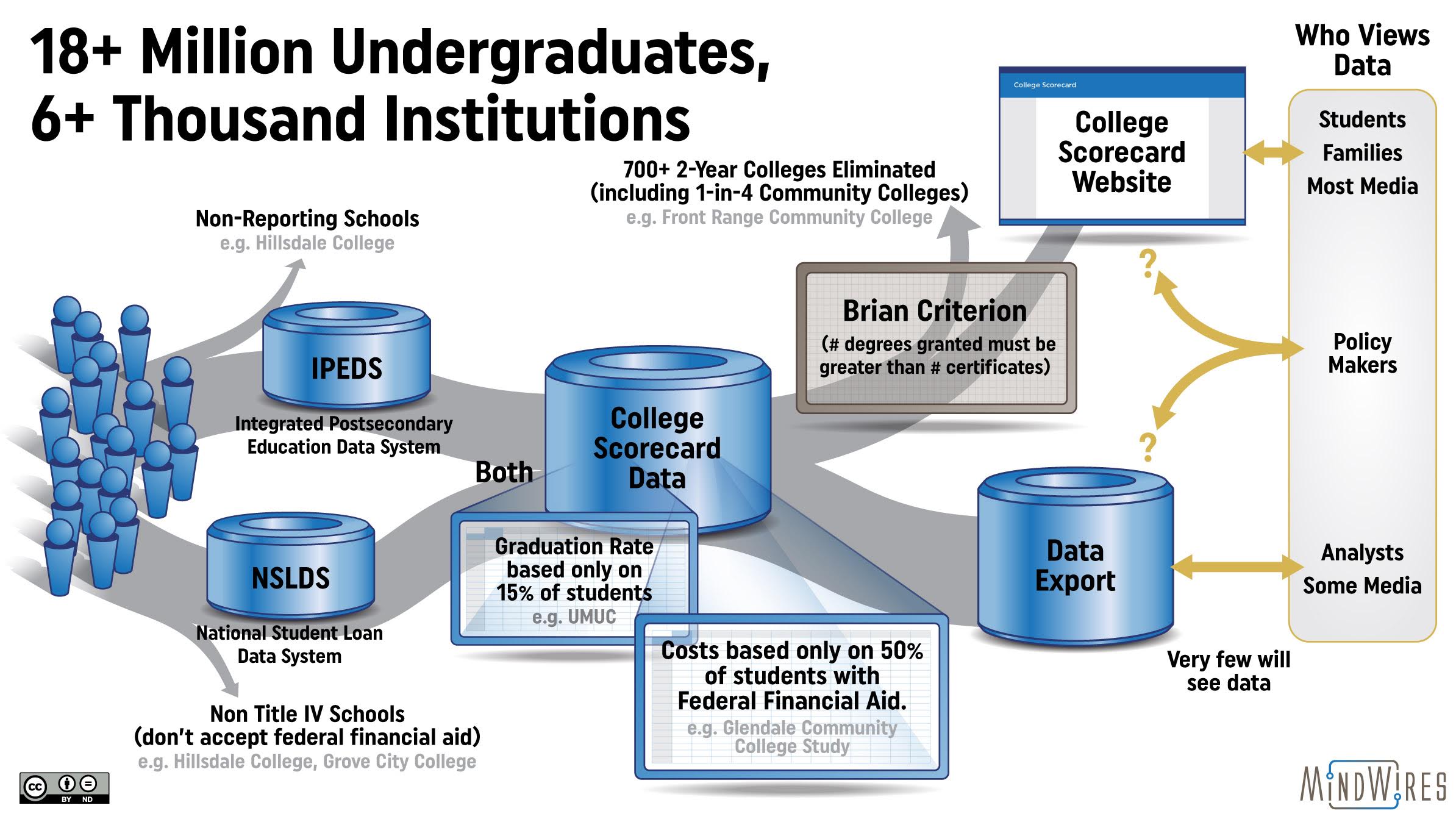
    I have written several posts looking at the new College Scorecard and its inherent flaws in the data, often starting with observations from Russ Poulin at WCET. Today Susan Svrluga, education reporter at the Washington Post, posted a new article co-written by me and Russ and titled “Hundreds of colleges missing from Obama’s College Scorecard?”. The gist of the article is taking a holistic view of data problems and why they exist.

    In a nutshell, the College Scorecard combines data from multiple sources – primarily from the Education Department’s own Integrated Postsecondary Education Data System (IPEDS) and National Student Loan Data System (NSLDS) – and publishes the results of both as a consumer-facing Web site and an analyst-friendly data download. The essence of the problem is that throughout this process the data is filtered based on questionable assumptions, leading to the fuzzy lens viewing subsets of the real data.

    Poulin Hill College Scorecard Graphic

  • Yes, I did say that Knewton is “selling snake oil”

    My comments in today’s NPR article about Knewton are getting some attention on Twitter. One comment in particular, actually. The one where I accused Knewton CEO Jose Ferriera of selling snake oil. To understand the basis of the comment, you have only to look at the quote from Jose earlier in that selfsame article:

    We think of it like a robot tutor in the sky that can semi-read your mind and figure out what your strengths and weaknesses are, down to the percentile.

    Can it read what I’m thinking now?

    And then there’s this:

    We can take the combined data power of millions of students — all the people who are just like you — [who] had to learn a particular concept before, that you have to learn today — to find the best pieces of content, proven most effective for people just like you, and give that to you every single time.

    Really? Every single time?

    Objectively speaking, I don’t know much about Knewton’s platform or the value that it adds. The only efficacy studies I have seen are for Pearson products, and those studies do not differentiate between Knewton features and Pearson-native features in terms of impact. If you dig deep enough on their site, you can find some information on the techniques that they use. For example, this overview paper, while not perfect, is a credible attempt to explain the techniques that the platform employs and the benefits to the users in layperson’s terms. If Knewton were doing more of this, I wouldn’t be as critical. There are still questions about the value of the product, but they are on the same level with many other products in the adaptive learning category. A company like Knewton should be working hard to demystify what their product does and providing hard, reproducible evidence that they add value.

    But much of what Jose says, at least to the media, is the opposite. No responsible educator or parent should adopt a product—even if it is free—from a company whose CEO describes it as a “robot tutor in the sky that can semi-read your mind” and give you content “proven most effective for people like you every single time.” I’m sorry, but this sort of quasi-mystical garbage debases the very notion of education and harms Knewton’s brand in the process.

    If you want to sell me a product that helps students to learn, then don’t insult my intelligence. Explain what the damned thing does in clear, concrete, and straightforward language, with real-world examples when possible. I may not be a data scientist, but I’m not an idiot either. If you can translate the technical mumbo jumbo into sensible teaching insights for me, then you just might make a sale. But most people wouldn’t buy a used car from somebody who describes their product using language as hyperbolic as “robot tutors in the sky.” The same principle should hold for educational technology.