e-Literate

Present is Prologue

Category: Ed Tech

The “Ed Tech” category includes posts about educational technology products themselves, including LMSs and other learning platforms, adaptive learning and other digital curricular materials products, learning analytics, and educational apps of all types. It also includes technical aspects of ed tech products, especially interoperability.

  • The Need for Alternative Educational Models in California Illustrated in One Chart

    An earlier version of this article appeared at the Delta Initiative website

    There is a full-court press in the media regarding the California budget crisis and its likely impact on higher education. The most recent entry is in the New York Times.

    Class sizes have increased, courses have been cut and tuition has been raised — repeatedly. Fewer colleges are offering summer classes. Administrators rely increasingly on higher tuition from out-of-staters. And there are signs it could get worse: If a tax increase proposed by Gov. Jerry Brown is not approved this year, officials say they will be forced to consider draconian cuts like eliminating entire schools or programs.

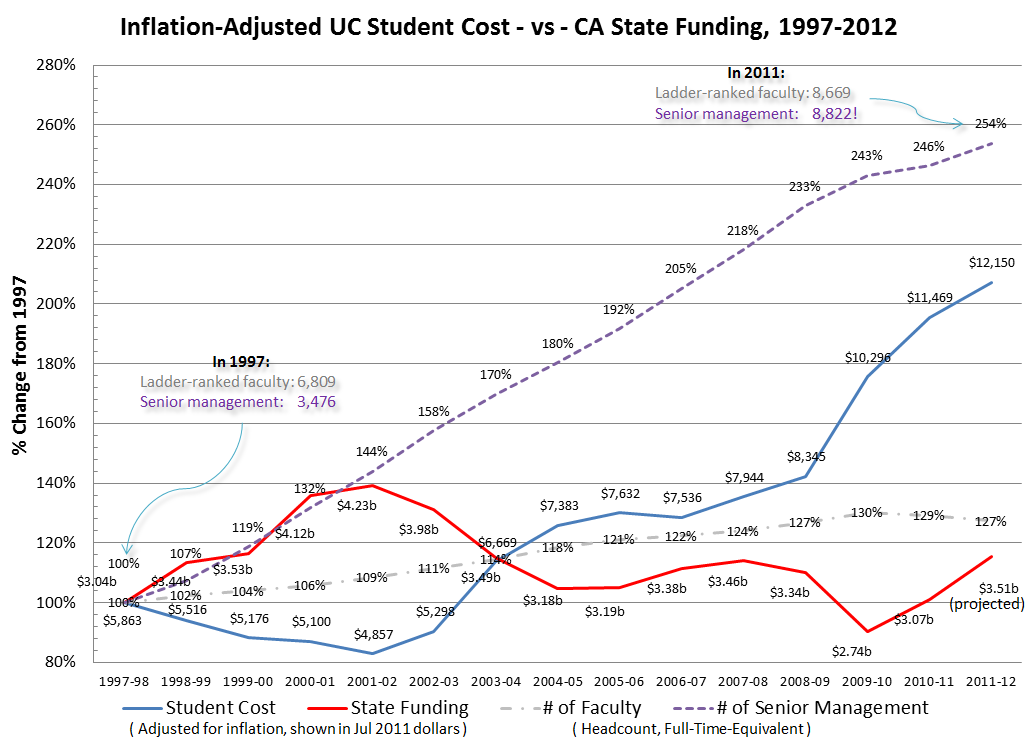
    While I’m not arguing the point that there is a crisis, I do think it is worth looking at historical trends to get perspective. Consider the following chart from the California Review (blog post here). It looks at inflation-adjusted budget numbers and faculty and senior management headcount from 1997 – 2011. [Click to expand]

    (more…)

  • Piazza – An Example of Free Learning Tool Targeted at Faculty / Student Adoption

    In my recent webcast with Patrick Masson for WCET, we described the growing usage of learning tools outside the official LMS solution. Patrick described survey results done by UMassOnline that captured the rich source of (often free) learning tools used in UMass courses. Much of educational technology is moving from an enterprise LMS market – with feature-rich LMS solutions expected to provide the majority of learning tools – to a learning platform market – with interoperable tools patched together with or without the official LMS by either campus staff or even directly by faculty. These tools are quite often free, and as such they are targeted at faculty and student adoption, rather than institutional adoption via a Request for Proposal process.

    One example of these tools is Piazza, which is a “a place where students can come together to ask, answer, and explore under the guidance of their instructor”. Think of the tool as an combination of discussion board, chat room, and wiki, with some design elements from Google Wave. While the description might be hard to understand, that is part of the issue – Piazza is not targeted to replace the LMS or to replicate specific LMS functionality.

    Jessica Wong at MakingUseOf has a very useful post running through the functionality of Piazza for those interested in the tool itself. My interest for this post is more on what Piazza represents in terms of ed tech trends with the availability of free platforms and tools that are targeted at student and faculty adoption.

    (more…)

  • Why the Google Art Project is Important

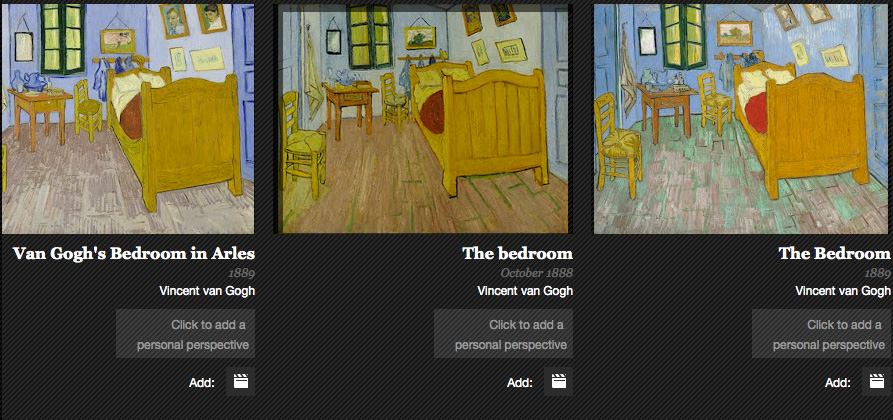
    Google Art Project Van Gogh Bedrooms Gallery
    by Beth Harris, Ph.D. and Steven Zucker, Ph.D., Deans, Art and History, Khan Academy

    Our schools and libraries are being radically re-imagined for the digital age, but what about our museums? The New York Public Library, for example, is bravely (and controversially) rethinking its Fifth Avenue flagship building. Last month, MIT and Harvard announced edX, a partnership to offer free online courses, and last fall, Stanford offered three massive open online courses (MOOC) to hundreds of thousands of students for free, and Khan Academy provided 6.1 million unique users with free instruction in March 2012 alone. Museums, on the other hand, have remained largely insular and focused on their institutional identity. So perhaps it’s no surprise that the most recent digital innovation comes not from the museums themselves but from Google, which launched the second iteration of the Google Art Project last month.

    Google faces numerous challenges among academics; nevertheless, we should recognize that Google’s Art Project has done something extraordinary for both museums and for education. A small team based in London persuaded more than 150 museums from around the world to share more than 32,400 high-resolution images beyond their own institutional boundaries.

    This is a really big deal.

    For the first time in history it is easy for non-specialists to explore and closely examine art from museums across the globe on a single website. There have been other initiatives that have moved in this direction, but never with the scope or functionality of the Google Art Project. The Art Project isn’t finished. It needs more museums and more art. It needs improved search and filtering tools. And the public needs better ways to discover and contribute new narratives about art’s history. Despite these weaknesses, the educational potential is tremendous.

    Meanwhile, many museum professionals (Nina Simon, Nancy Proctor, Seb Chan to name just a few), have been grappling for some time with the question of the future of the museum (see AAM’s Center for the Future of the Museum). And those of us who have worked in the area of museum technology have asked specifically about the future of the museum website. Koven Smith, Director of Technology at the Denver Art Museum asked more than a year ago, “What things do museums do *exclusively* because of tradition? If you were building a museum from scratch, what would you do differently?” Since born-digital institutions often succeed where legacy institutions struggle, this is an important question. Mia Ridge, whose blog Open Objects, has addressed this question often, responded, “a museum invented now would be conversational and authoritative – here’s this thing, and here’s why it’s cool.”

    The question of conversation is key and it’s been central to Smarthistory.khanacademy.org’s pedagogy. In many ways, scholarship at its best is conversation. But up until now, museums have conversed very little with one another—either on or offline.

    Here are two examples of how the Google Art Project opens the conversation. In 1889, Vincent van Gogh painted three canvases depicting his bedroom in Arles; these now reside in three different museums. Only the van Gogh Museum in Amsterdam illustrates another version on its website and remarkably, none of the three museums link to the paintings at the other institutions.

    Now imagine a student studying Édouard Manet’s 1863 painting, Olympia, in Janson’s History of Art textbook. The book mentions Titian’s Venus of Urbino as an important source for Manet, but doesn’t reproduce this older, Renaissance painting. Even at 1152 pages, the Janson text must be extremely selective for reasons of space and cost. Of course a museum website has no such constraints. Nevertheless, although the Musée d’Orsay, home to Olympia, also mentions the Titian, it provides no link to the painting or to the Galleria degli Uffizi where the painting hangs.

    In contrast, the Google Art Project allows visitors to create and share a gallery where these paintings can be viewed side by side; it also includes links to their respective museum collections (where they exist). Imagine the educational impact if museums put together online galleries like this one and included commentary from curators at multiple institutions aimed at a non-scholarly audience.

    The Art Project succeeds in large part because it relies on museum expertise—one of the great strengths of the museum in the digital age. Too often museums don’t surface in a simple Google image search. General searches are more likely to return unreliable sites hawking reproductions. In contrast, visitors to the Art Project access current and reliable information. In fact, the Art Project highlights the relative scarcity of educational text and video provided by museums about their permanent collections, the very content the public is looking for. Museums need to create more free content aimed at a general audience and to do so within the broader context of art’s history. Museums employ curatorial staff that, like college and university faculty, have deep knowledge in their areas of expertise, yet too little of that expertise makes its way onto the museum website. Instead, expensive, narrowly targeted, scholarly exhibition catalogs remain the focus of museum publishing.

    Naturally, linking and creating content is not free, but it doesn’t have to be prohibitively expensive either. Links go bad and have to be updated and there is, of course, always a resource issue. There are ready solutions but such issues are framed by a bigger concern. Namely, should museums point visitors away from their own collection? Museums don’t use the word competitor, but this concept informs such considerations. In an era when education is increasingly occurring outside of traditional learning institutions, we believe that the role of the museum is increasingly important.

    There are some hopeful signs. Recently, a few museums (The National Gallery of Art, The Brooklyn Museum, and the Metropolitan Museum of Art for example) have begun to offer public domain images for download. We hope more museums will recognize that in the digital era, the old model of controlling and charging for reproductions of public domain work flies in the face of their mission. Museums, and the artists’ rights organizations (such as ARS and VAGA) and the estates they work with, need to do far more to make the shared cultural heritage they hold in trust, accessible. Peter Samis, Associate Curator, Interpretive Media at the San Francisco Museum of Modern Art recently asked, “Are the artworks ours to give? Are they ours to withhold?”

    Now that the value of a global art platform is evident, will museums think differently about sharing resources with each other and the public? The Google Art Project shows what can happen when museums work in parallel; now imagine what could happen if museums choose to work together.

    Disclaimer: Harris and Zucker created the Khan Academy videos on the Google Art Project

  • The Search for Differentiated and Engaging Student Experience

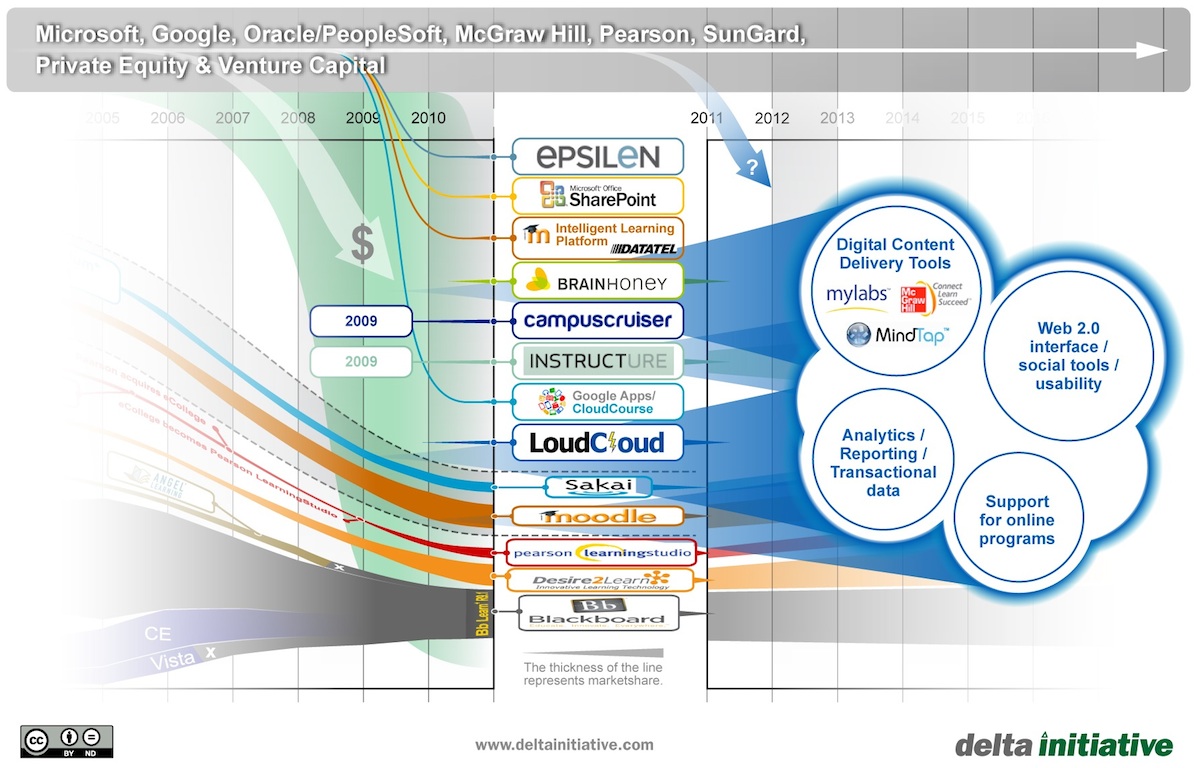
    One of the trends I highlighted last summer was that the LMS or learning platform market was overlapping the educational content market.

    The lines are blurring between content delivery systems (e.g. Cengage MindTap, Pearson MyLabs, etc) and LMS.  Content delivery and ability to keep students engaged within the content will drive much of the broader ed tech market.  This integration of markets is being seen as a strategically important issue for institutions, particularly for online programs.

    While I feel quite confident in having made that description, I did not have a model, or explanation, of what was driving the trend. Nine months later, I believe the trend has proven itself empirically, as more examples emerge: Apples iBooks2 / iTunesU App, Online Education Service Providers such as 2tor combining online programs with custom learning platforms, Pearson OpenClass, MOOC startups with custom platforms such Coursera, Udacity, etc.

    Last week Roger McNamee, co-founder and managing director with venture capital firm Elevation Partners, gave a presentation to the Mashable Connect conference titled “How to Revive the Web”. The presentation described how Apple won big by betting against the web and its prevailing culture (Mashable post here and Roger’s full presentation here). Roger’s theory is that Apple’s strategy was to move away from commoditized content, which most of the PC-based web (HTML4) assumed,  by delivering content in a differentiated, elegant manner – tightly combining content and the delivery mechanism. Furthermore, as HTML5 emerges, this move will accelerate.

    If this theory is correct, I think it helps explain the trend of the LMS market combining and blurring with the educational content market.

    (more…)

  • What Are Ed Tech Entrepreneurs Good For?

    The recent ASU Education Innovation Summit, which brought together venture capitalists with aspiring ed tech entrepreneurs, created quite a stir in the edublogosphere and the edutwitterverse. A lot of the reaction came from people who were watching from a distance via video. Audrey Watters, for example, wrote an epic rant on her frustrations. There were many angry tweets from a number of quarters. First-hand reporting was relatively scarce, though. George Siemens, who attended the conference live, wrote a thoughtful and nuanced post on the topic. The question of how entrepreneurs can productively play a role in educational progress, innovation, and reform is a topic that I think about a lot. In fact, I already had a post planned in my backblog from an interview I did with the Instructure founders and CEO on this very topic. So now that e-Literate has successfully migrated to a new host, and before Blackboard buying somebody else forces me to write another post series, I’d like to take some time to lay out my thoughts on the topic.

    (more…)

  • What is a Learning Platform?

    While I have written (along with others) about the shift we are seeing in the LMS market, where it is moving from an enterprise LMS market to a learning platform market, there has not really been a good definition of what a learning platform is. As Jeff Bohrer asked via Twitter, “What are the hallmarks of LMS as a “learning platform” (beyond SaaS)? Any posts you can point to?” Mike Zackrison offer some very helpful thoughts in his response of “A few I’ve observed: cloud, multi-tenant; open API; social, analytics, mobile baked in; apps/content discovery too”.

    Rather than reply within the limits of 140 characters, I’d like to offer a response here (I have trouble with being pithy).

    Platform Definitions

    First, let’s look at the metaphor. A platform is typically defined in the generic sense as a raised surface of some type that supports other interacting objects. Within computer and software terminology, a platform can be defined as “A platform is any base of technologies on which other technologies or processes are built”. The idea is that the platform is not intended to stand on its own, as its definition includes the support of other technologies or applications.

    Given this context, there is a rather extensive Wikipedia entry on learning platforms with some useful definitions included. I have excerpted several below.

    A learning platform is an integrated set of interactive online services that provide teachers, learners, parents and others involved in education with information, tools and resources to support and enhance educational delivery and management.

    (more…)

  • Upcoming WCET Webcast: “Why the RFP Process Doesn’t Work in Today’s LMS Market”

    I have written several articles (posted here at e-Literate, here at the Delta Initiative website, and as a guest post at WCET) about the significant changes that the LMS market is undergoing, moving from an enterprise-class, mini-ERP, system to a learning platform. The folks at WCET provide a great set of resources for the higher ed community, and the asked me to set up a webcast on the subject, to allow a more interactive discussion. As part of this webcast, I will be joined by Patrick Masson, Chief Technology Officer at UMassOnline. Patrick and his team have created a Needs Identification Framework for Technology Innovation (NIFTI) that is a much more robust approach to technology selection and innovation that the standard RFP process.

    The webcast is scheduled for May 22. You can go to the WCET site here for more information or to register.

    From the description:

    (more…)