
e-Literate

Present is Prologue

Category: Ed Tech

The “Ed Tech” category includes posts about educational technology products themselves, including LMSs and other learning platforms, adaptive learning and other digital curricular materials products, learning analytics, and educational apps of all types. It also includes technical aspects of ed tech products, especially interoperability.

  • Openness: The Proof of the Pudding is in the Eating

    In my last post, I said that I thought Blackboard’s announcement of making it easy to add a Creative Commons license to a Common Cartridge export is significant. One day later, we have some evidence of just how significant. e-Literate featured blogger Audrey Watters has a post up on her own blog about a big announcement out of Washington state:

    With help from matching funds from the Gates Foundation, the Washington State Board for Community and Technical Colleges has built a Open Course Library (OCL), which launches today. The idea behind the library is to address the increasing cost of textbooks by making openly licensed course materials available for 81 of the state’s most enrolled classes. Some of the materials in the OCL are free, but some aren’t. The only stipulation: no required material or textbook can cost a student more than $30.

    The first phase of the project, which is available today, features materials for 42 of these classes, including Introduction to Literature, Introduction to Chemistry, Calculus I, and Microeconomics. (The other 39 should come online in the Spring of 2013)….

    As the materials in the OCL are licensed CC-BY, instructors will be able to adopt the course modules or adapt the materials to suit their own classes’ needs. The materials are available via Google Docs and Google Sites so that they can be shared between faculty and institutions, but there are also options to import the content into standard LMSes.

    By “options to import the content into standard LMSes,” she means that the content will be available as IMS Common Cartridges. How are they being produced? It turns out that the Washington State Board for Community and Technical Colleges has a state-wide license for ANGEL, which happens to export to Common Cartridge. So this initiative, which could turn out to be a big deal in terms of community college affordability, is partly enabled by a for-profit LMS vendor’s decision implement Common Cartridge export. Who was the guy in charge at ANGEL at the time that technology decision was made? Ray Henderson, the same guy who announced Common Cartridge export for Blackboard.

    By the way, there’s plenty of room for Pearson to play here too. Production of OERs is only part of the problem. You still need to drive adoption. If OpenClass made it very easy for faculty to find and import OCL content, either through Google Apps integration or through Common Cartridge import, that would be a significant step forward in at least one kind of Openness.
  • Perhaps ‘Open’ Is a Flag of My Disposition…

    Anyone who went to EDUCAUSE this year had to come away with the impression that Open is the new black. This product now comes with 50% more openness! That one’s openness is 99.44% pure! It’s easy to get jaded about all of this and cry “openwashing,” as Anya Kamenetz did, among others (including me, at times). But while it’s perfectly appropriate to hold vendors accountable for hype, it’s also important to look carefully at the announcements beneath the hype. Because they are not all the same. I proudly serve on the Sakai Foundation Board of Directors and proudly provide all content on this blog under a Creative Commons license, but I also recognize that there are different kinds of “open”—and different kinds of “free”—vendors can provide that have different kinds and levels of utility.

    Case in point: The respective announcements by Pearson and Blackboard last week reflect very different ideas of both “open” and “free.” Those differences matter. If we simply throw up our hands and declare the use of these words by all for-profit entities as meaningless marketing babble, then we will miss some valuable information.

    (more…)

  • When Large Companies Enter Ed Tech

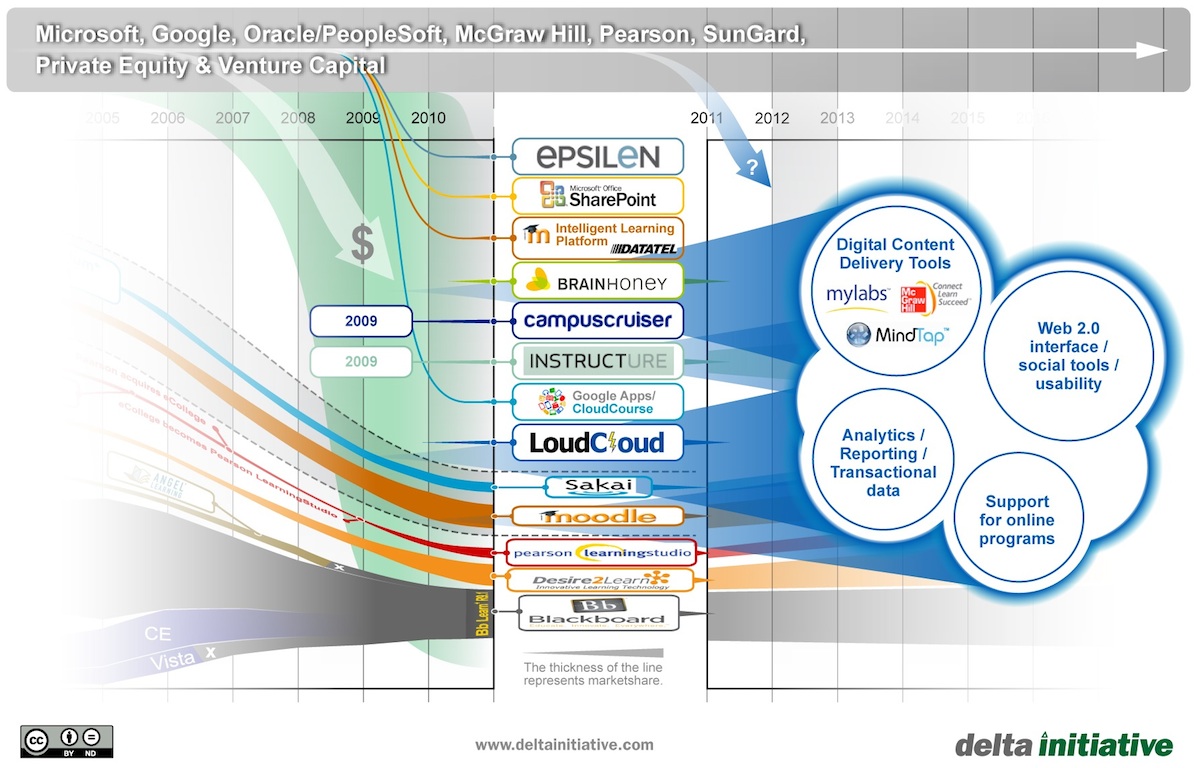
    I had a very interesting conversation on the way home from EDUCAUSE with Frank Florence, who is the Senior Director of Education Market Management for Cisco.  We discussed the changes happening in the ed tech market, and Frank helped me understand some of the market forces behind the changes we’re seeing.  One topic in particular was the dynamic between entrepreneurial companies that develop within a vertical market and larger companies that span markets.  I have argued that internal investment from larger companies is helping to change the ed tech market, but Frank provided valuable insight into the nature of the typical market forces we’re living through.  This observation of large company involvement helping to change the LMS portion of the ed tech market is shown below, in many of the companies in the top gray bar and some that are not listed.

    (more…)

  • Can Enlightenment Scale?

    I had the pleasure of listening to Jim Groom give a keynote speech at the Open Education conference this morning. I generally find listening to Jim equal parts inspiring and frustrating. Inspiring because he has a direct tap into the moral wellspring of passion for education that drew me into education in the first place. Frustrating because Jim (and Gardner Campbell, and other prominent thinkers in the school of thought formerly known as edupunk) and I haven’t seem to be able to find common ground on the meaning or value of the word “scale.” For Jim, I get the sense that scale is synonymous with industrialization. And I can guess why that might be so. If you believe that the essence of education starts with people discovering their own personal dignity, passion, and talents, it seems almost oxymoronic to talk about scaling that. You can’t mass produce personal journeys. I buy that. But I also am painfully aware of the fact that we, the human race, have so far failed to either catalyze that personal journey or provide the basic skills and practical education necessary for material comfort and basic dignity for the substantial majority of people alive on earth today. Heck, we’re failing a very substantial percentage of people alive in the United States today, despite the great wealth of this country. For me, it’s all about Archimedes. I’m looking for a large enough lever to move the world. I want to believe in scale. I need to believe in it.

    And so I came to think of Jim and his friends as gadflies. Irritants, in the best possible sense of the term. Good people who are doing good work and can remind me of important things on occasion, but not the kind of folks who are going to help me find that lever.

    I was wrong. And I should have known better. I had the opportunity to learn this lesson a long time ago.

    (more…)

  • A Quick Follow-Up on the OpenClass Post

    I’m already getting quite a bit of public and private feedback on my earlier post on Pearson’s OpenClass, and it is all over the map in terms of what people seem to think I was trying to say. This was really a complex topic to try to handle in one post, and I may not have done it justice. So let me lay out a few points as clearly as I can:

    • I think Pearson is trying to create a platform in the way that Google and Facebook are platforms. What I mean is that Pearson will get value not so much from selling their products (although there will definitely be some of that) as from (a) becoming a marketplace for other people’s products (think Apple’s iTunes and App stores) and (b) from getting rich data about student learning needs and behaviors that can enrich both Pearson’s products and those of the third parties that sell through Pearson’s platform.
    • I think there is a lot that is compelling about the idea of such a platform, and that it could deliver improvements to the learning experience that would be difficult to achieve without the kind of scale and centralization that Pearson is trying to create.
    • I also think that a platform approach entails a very different relationship with the vendor than simply licensing a hosted LMS and raises some very serious concerns, including issues of privacy and control over the market for learning content. Schools should make sure they understand the tradeoffs they would be making and discuss them carefully with Pearson (or any other ed tech vendor that brings a platform approach to market) as well as with their peers before jumping in with both feet.
    • Pearson’s marketing efforts have been finely tuned to emphasize free and easy, which I believe is a strategy designed to foster very fast adoption by disrupting the market, starting at the low end and moving up. In doing so, their message emphasizes low cost and ease of use over direct improvements to teaching and learning. In essence, the message is that Pearson will get the LMS (and its price tag) out of the way so that, in Adrian’s words, teachers can focus on “climbing the value chain.”
    • So far, there is relatively little public detail about the product itself. On the one hand, the deep integration with Google Apps is new to the market and suggests that OpenClass will have its own take on things. On the other hand, there is not yet evidence that OpenClass is trying to fundamentally re-imagine what an LMS does or how it does it as a delivery platform. The deeper innovation will likely come from the content marketplace and the analytics, neither of which has been publicly unveiled yet.
    • While Pearson has made what could be characterized as a couple of PR missteps in the introduction, I view these as mostly minor and not indicative of any nefarious intent. Nor am I suggesting that their overall product and marketing strategies are intended to deceive. However, I am suggesting that Pearson will need to raise its game if it wants to foster the kind of trust necessary to build the new customer relationships that it appears to be shooting for.
  • Ambivalent on Ed Tech: The EDUCAUSE Re-write

    Now that I’ve had time to digest the implications of EDUCAUSE 2011 – which were significant, but not as mind-blowing as the Reading Market experience – I keep going back to a post I wrote earlier this year (although not on e-Literate).  In that post contrasting a Gartner report on IT spending with an Ambient Insight report on ed tech and online spending, I argued that ambivalence was the key to understanding both reports in context.  Likewise, based on the hype and reality of ed tech at EDUCAUSE, ambivalence can help us understand future implications for education.

    One of the benefits of blog posting is the ability to wholesale plagiarize yourself where needed (ed – I’ll see you in court, Mr. Hill).  Herewith is my rewrite of that post based on this year’s EDUCAUSE experience.

    (more…)

  • Why Pearson’s OpenClass Is a Big Deal

    The big buzz at EDUCAUSE last week was around OpenClass, Pearson’s new LMS entrant. Much hyped but only rarely glimpsed, speculation has been rampant about whether it is a big deal or just a gimmick. Because most people (including me) don’t have access to the product yet, the best source of information on it at the moment is Adrian Sannier, eCollege’s VP of Product. I had the good fortune to both listen to  him give a presentation on OpenClass and chat with him about it one-on-one. My conclusion is that this product could be a very big deal indeed.

    In a previous post here on e-Literate, Phil Hill characterized OpenClass as potentially disruptive. I think he’s right, but I also think this is one of those times where we have to be careful about how we use that term. Adrian Sannier is a big fan of Clayton Christensen, the man who coined the term “disruptive innovation.” If you really want to understand what OpenClass is all about, go out and read The Innovator’s Dilemma and The Innovator’s Solution very carefully.  There are very specific reasons why “free” and “easy” are the words you will hear most often from Adrian when he is speaking about the product.

    The audacity of what Pearson is attempting should not be underestimated. If they succeed, they could cause major tectonic shifts across several markets that are currently critical to higher education. Colleges and universities need to pay close attention to the kind of deal that they will be striking for themselves. Overall, I don’t think the biggest concern is whether Pearson will fail to maintain the platform as free. Rather, the more serious question is what will they be getting if they succeed.

    (more…)