e-Literate

Present is Prologue

Tag: 20 Million Minds

  • New post at 20MM: Two Approaches to Watch in Remedial Education Innovation

    The 20 Million Minds Foundation is starting a new blog, and for topics of mutual interest, Michael and I will be posting articles  several times a month on their site and occasionally cross-posting here. The first article of mine went up last week.

    Two Approaches to Watch in Remedial Education Innovation

    It is no secret that the current approach to remedial (or developmental) courses does not work. According to a study by Complete College America (see original for footnotes documenting sources):

    “The numbers tell a dispiriting story. Half of all undergraduates and 70 percent of community college students take at least one remedial course. Too many of these students never overcome being placed into a remedial course. Only about a quarter of community college students who take a remedial course graduate within eight years. In fact, most students who are referred to remedial education do not even complete the remedial sequence: One study found 46 percent of students completed the sequence in reading and only 33 percent completed it in math.”

    Following the maxim that “if it doesn’t work, try something else”, two community colleges on opposite coasts – Miami-Dade College in Florida and Cerritos College in California – are trying to change the game. What can we learn from these two divergent examples?

    Read the whole article here.
     

  • Re:Booting CA Higher Education – Transcript of Phil Hill Presentation

    The following is a rough transcript of my presentation at the 20 Million Minds conference on January 7th. 

    Thank you very much, and thanks to everybody for coming to the conference.

    We seem to be in a unique situation. I had someone remark to me in the hallway discussions leading up to the event that we have quite a unique group of people here, both in terms of the online educational programs and in terms of statewide system administration and faculty.

    Jeff Selingo pointed out very well some of the major forces affecting higher education and affecting where we’re going. A lot of people understand this current situation is not a temporary setback, not a temporary change where we can pull back to the normal once certain things change. We’re in a situation where an entire education ecosystem is changing and putting us into uncharted territory. How higher education changes will be up to a lot of the people in this room, as far as key choices go. How can we use the power of online education to transform traditional institutions and systems? I think this meeting is helping to set up a lot of the discussion on the potential changes.

    (more…)

  • Re:Booting CA Higher Education – Transcript of Jeff Selingo Keynote

    The following is a rough transcript of Jeff Selingo’s keynote at the 20 Million Minds conference on January 7th. Any errors in transcription are mine, and sections that were garbled are marked by []. I’d like to thank Rovy Branon for his recordings of these sessions. I’ll post additional transcripts soon.

    We’re gathered here today at one of the great public university institutions, and this past summer, at another great public institution, on the other side of the country a drama played out that revealed the immense pressures affecting colleges and universities as they deal with the financial and historical foundation that is swiftly shifting [under us].

    Selingo

    Last June, as many of you know, on a late Sunday afternoon, the University of Virginia announced that its president Teresa Sullivan was stepping down after just two years on the job, citing philosophical differences of opinion with the board. The resignation of this popular leader shocked the campus community and over the next few weeks opposition to the board action mounted. Angry students, faculty and alumni took to Twitter and Facebook. The governor threatened to withhold financial support and said for the board to figure this out of he’d replace them all.

    (more…)

  • Summary of Statements Before California Panel Discussion on Online Education

    As Michael mentioned, the two of us will be participating in a panel discussion next week – Rebooting CA Higher Education, sponsored by the 20 Million Minds Foundation, on January 8th. The event will be live streamed.

    I’ve been asked to give a short talk based on my recent EDUCAUSE Review article that described various online educational models, and I will also moderate several panels. Given my role, I’d like to collect links to several of the key posts and articles that frame the issues to be discussed next week. After the event I’ll share my thoughts on the discussions.

    Statements Prior to Formation of Online Symposium

    The panel discussion is based on governor Jerry Brown’s call for the three public higher education systems in California (University of California, California State University and California Community Colleges) to evaluate online education as one method to control or reduce student costs. In particular, much of the discussion started during Governor Brown’s meeting with the UC Regents on Nov 14, 2012.

  • Project Blue Sky: Big Boost to OER From . . . Pearson?

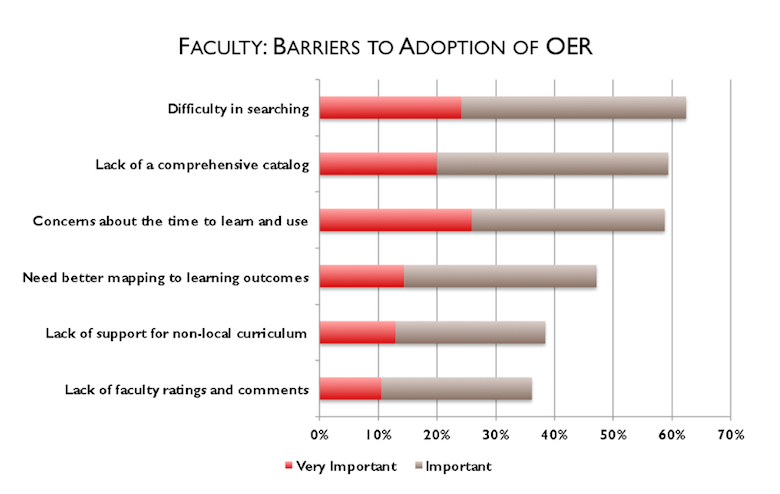
    In June 2012, Campus Technology interviewed some higher education leaders in the use of open educational resources (OER) to discuss the major challenges to more prevalent adoption of free and open resources. The top two challenges mentioned in the article were:

    • discovering material efficiently due to the vast quantity of resources; and
    • getting faculty to move beyond the “textbook is the course” mindset.

    In a move that could have a significant impact on higher education, Pearson announced just before EDUCAUSE the creation of Project Blue Sky, which directly addresses both of these challenges.

    From the article:

    There are too many resources to choose from. OER may be a new concept for some professors, but that doesn’t mean there aren’t enough resources to go around. In fact, Geoff Cain, director of distance education for Eureka, CA-based College of the Redwoods, said the number of resources is so vast that it can literally paralyze instructors.

    “Helping faculty find appropriate resources is a major issue,” said Cain, whose institution is a member of the Community College Consortium for Open Educational Resources.[snip]

    Cain said impressing upon the educators the fact that they already “adapt” coursework and textbooks to meet student needs is a good way to help break them out of the “textbook is the course” mindset. “Teachers skip chapters, incorporate current events, and drill down on specific student needs all the time,” said Cain. “OERs are really just an extension of that.”

    While anecdotal, the findings of this article (at least on discoverability) are backed up by an upcoming report from the Babson Survey Research Group that lists the barriers to adoption of OER from a faculty study.

    (more…)