
e-Literate

Present is Prologue

Tag: 20mmreboot

  • Re:Booting CA Higher Education – Transcript of Phil Hill Presentation

    The following is a rough transcript of my presentation at the 20 Million Minds conference on January 7th. 

    Thank you very much, and thanks to everybody for coming to the conference.

    We seem to be in a unique situation. I had someone remark to me in the hallway discussions leading up to the event that we have quite a unique group of people here, both in terms of the online educational programs and in terms of statewide system administration and faculty.

    Jeff Selingo pointed out very well some of the major forces affecting higher education and affecting where we’re going. A lot of people understand this current situation is not a temporary setback, not a temporary change where we can pull back to the normal once certain things change. We’re in a situation where an entire education ecosystem is changing and putting us into uncharted territory. How higher education changes will be up to a lot of the people in this room, as far as key choices go. How can we use the power of online education to transform traditional institutions and systems? I think this meeting is helping to set up a lot of the discussion on the potential changes.

    (more…)

  • Re:Booting CA Higher Education – Transcript of Jeff Selingo Keynote

    The following is a rough transcript of Jeff Selingo’s keynote at the 20 Million Minds conference on January 7th. Any errors in transcription are mine, and sections that were garbled are marked by []. I’d like to thank Rovy Branon for his recordings of these sessions. I’ll post additional transcripts soon.

    We’re gathered here today at one of the great public university institutions, and this past summer, at another great public institution, on the other side of the country a drama played out that revealed the immense pressures affecting colleges and universities as they deal with the financial and historical foundation that is swiftly shifting [under us].

    Selingo

    Last June, as many of you know, on a late Sunday afternoon, the University of Virginia announced that its president Teresa Sullivan was stepping down after just two years on the job, citing philosophical differences of opinion with the board. The resignation of this popular leader shocked the campus community and over the next few weeks opposition to the board action mounted. Angry students, faculty and alumni took to Twitter and Facebook. The governor threatened to withhold financial support and said for the board to figure this out of he’d replace them all.

    (more…)

  • New Post at WCET On Activist Role of State Government in Higher Education

    I have a new post up at WCET based on some observations from the recent 20 Million Minds conference.

    In past years the primary role of state government was to take the lead on funding while working with statewide systems on enrollment policies to serve workforce and general educational needs. Last week in California we witnessed the state government, both from the governor’s office and the legislature, become the driving force of change for determining the role of educational technology and online education to transform the public systems. State officials are no longer content with encouraging and hoping that postsecondary institutions will develop a strategy for systemic change on their own.

    Three interdependent events are emerging that clarify this trend.

    Read the whole article here.

  • Smart

    Governor Brown appears to be focusing his attention on “bottleneck courses”:

    As part of the additional $125.1 million in proposed state funds, $10 million has been directed in the Governor’s budget for online strategies to get more students through so-called “bottleneck” courses. These are courses across the system that cause many students to slow their time to degree until they can find a “seat” in that particular course. They are either lower-division general education requirements, pre-requisites for majors or high demand classes. The directed funds would be used for a multi-pronged approach incorporating technology-enhanced learning, student advising and course redesign to ensure student success. Together, all of these efforts are expected to provide thousands of students more access to classes and help them progress to degree.

    They will also save the state money. In a state system, every student is subsidized. Reducing time to graduation also reduces budget burdens. So it’s good for everyone. This is a smart, targeted approach that could also form the basis for experimentation and innovation with ed tech. Note the reference to “course redesign.”

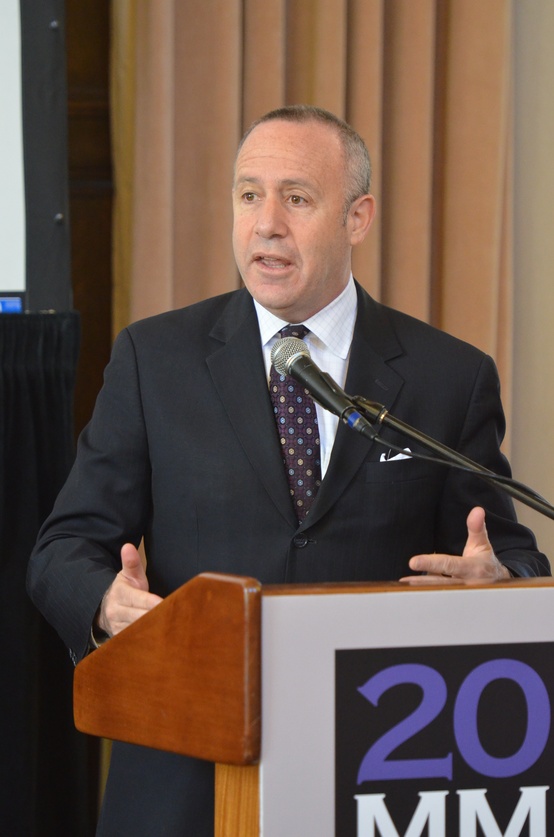
  • Re:Booting California Higher Education – Transcript of Darrell Steinberg Introduction

    The following is a rough transcript of Senate President Pro Tem Darrell Steinberg’s talk at the 20 Million Minds conference on January 7th. Any errors in transcription are mine, and sections that were garbled are marked by []. I’d like to thank Rovy Branon for his recordings of these sessions. I’ll post additional transcripts soon.

    Thank you, Dean. Senator Florez, once you’re a senator, you’re always a senator. And thank you for your nice introduction and for inviting me to give a brief welcome, and I know we have a busy agenda today. And I want to thank you and 20 Million Minds, not only for organizing this forum, but for directing me towards these issues that we’re talking about here today.

    Steinberg

    I’m not really a tech guy that much [] – I think about traditional education, mental health, foster care … I balance budgets and that sort of thing. And this [online education] is a whole new world for me. But Senator Florez last year, after he left office, talked to me about this revolution and possibilities around using technology in ways that not only equal or enhance quality but also reduce the cost of higher education for struggling students and their families. And so after we did SB1052 and 1053, which are now being implemented after Governor Brown’s signature, with the help of the faculty associations across all three systems, that take the 50 most popular courses across the three systems, and develop instructional materials to an online or open source format. Offer them as a competitive alternative to the traditional textbook and ensure that that offering is free for the student online (and no more than $20 if they print it). Simple, but potentially revolutionary in terms of bringing down costs of instructional materials, where we know the cost of higher education is becoming prohibitive to too many people and so many families.

    (more…)

  • Re:Booting CA Higher Education: My First Thoughts

    As expected, the 20 Million Minds-sponsored event was fascinating and information-packed. Kudos to the foundation for setting up such a rich and, I think, important meeting. In fact, I’m still digesting it, and may need to write several posts to lay out my thoughts once the dust settles. But I do want to get my initial thoughts down while they are fresh. In particular, underneath all the head nodding and apparent agreement, there were some strikingly divergent ideas about the future of higher education that are worth spelling out in some detail.

    (more…)