e-Literate

Present is Prologue

Tag: Bill and Melinda Gates Foundation

  • Instructor Replacement vs. Instructor Role Change

    Two weeks ago I wrote a post about faculty members’ perspective on student-centered pacing within a course. What about the changing role of faculty members – how do their lives change with some of the personalized learning approaches?

    In the video below, I spoke with Sue McClure, who teaches a redesigned remedial math course at Arizona State University (ASU) that is based on the use of Khan Academy videos. There are plenty of questions about whether this approach works and is sustainable, but for now let’s just get a first-hand view of how Sue’s role changed in this specific course. You’ll see that it took some prodding to get her to talk about her personal experience, and I did have to reflect back what I was hearing. Note that the “coaches” she described are teaching assistants.

    (more…)

  • Pilots? We don’t need no stinkin’ pilots!

    Timothy Harfield commented on Arizona State University’s approach to pilots and scaling innovation at ASU.

    excellent comment on the problem of scaling innovation in #HigherEd. This is a central concern for @UIAinnovation.

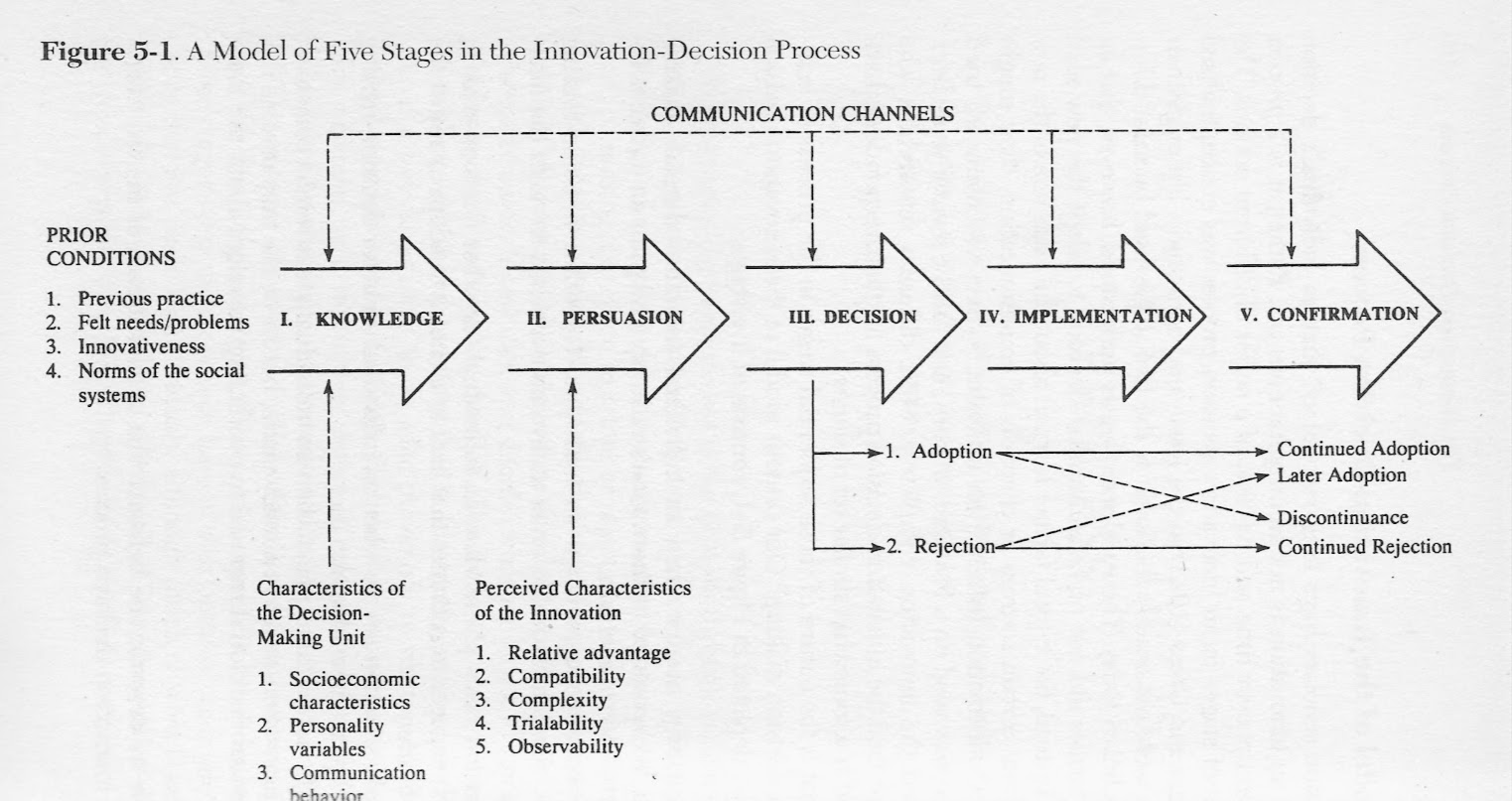
    The University Innovation Alliance is “a consortium of 11 large public research universities committed to making high-quality college degrees accessible to a diverse body of students”. I wrote about this “central concern” last summer in a post titled “Pilots: Too many ed tech innovations stuck in purgatory”, using the frame of Everett Rogers’ Diffusions of Innovations model. While the trigger for that post was on ed tech products, the same situation applies for the course design situation.

    5 Stages of Adoption

    What we are seeing in ed tech in most cases, I would argue, is that for institutions the new ideas (applications, products, services) are stuck the Persuasion stage. There is knowledge and application amongst some early adopters in small-scale pilots, but majority of faculty members either have no knowledge of the pilot or are not persuaded that the idea is to their advantage, and there is little support or structure to get the organization at large (i.e. the majority of faculty for a traditional institution, or perhaps for central academic technology organization) to make a considered decision. It’s important to note that in many cases, the innovation should not be spread to the majority, either due to being a poor solution or even due to organizational dynamics based on how the innovation is introduced.

    The Purgatory of Pilots

    This stuck process ends up as an ed tech purgatory – with promises and potential of the heaven of full institutional adoption with meaningful results to follow, but also with the peril of either never getting out of purgatory or outright rejection over time.

    (more…)

  • NYT Michael Crow Condensed Interview: More Info needed . . . and available

    The New York Times ran an “edited and condensed” interview with Arizona State University (ASU) president Michael Crow, titled “Reshaping Arizona State, and the Public Model”.

    Michael M. Crow sees Arizona State as the model of a public research university that measures itself by inclusivity, not exclusivity. In his 13 years as its president, he has profoundly reshaped the institution — hiring faculty stars from across the country, starting a bevy of interdisciplinary programs, growing the student body to some 83,000 and using technology to bring his ideas to scale, whether with web-based introductory math classes or eAdvisor, which monitors students’ progress toward their major. Last year, Dr. Crow made headlines when the university partnered with Starbucks to offer students the chance to complete their degree online for free. His new book, written with the historian William B. Dabars, is called, appropriately, “Designing the New American University.”

    (more…)

  • Release of ASU Case Study on e-Literate TV

    Today we are thrilled to release the third case study in our new e-Literate TV series on “personalized learning”. In this series, we examine how that term, which is heavily marketed but poorly defined, is implemented on the ground at a variety of colleges and universities.

    We are adding three episodes from Arizona State University (ASU), a school that is frequently in the news. Rather than just talking about the ASU problems, we are talking with the ASU people involved. What problems are they trying to solve? How do students view some of the changes? Are faculty being replaced by technology or are they changing roles? For that matter, how are faculty members involved in designing some of these changes?

    You can see all the case studies (either 2 or 3 per case study) at the series link, and you can access individual episodes below. (more…)

  • Release of e-Literate TV Series on Personalized Learning

    Today we are thrilled to release the initial episodes in our new e-Literate TV series on “personalized learning”. In this series, we examine how that term, which is heavily marketed but poorly defined, is implemented on the ground at a variety of colleges and universities. What does it really mean in practice? What problem is intended to solve? And how well is it working?

    e-LiterateLogoMED

    We have initially released case studies of approximately 30 minutes each from two very different schools – Middlebury College and Essex County College. You can see all the episodes (either 2 or 3 per case study) at the series link, and you can access individual episodes below.

    e-Literate TV, owned and run by MindWires Consulting, is funded in part by the Bill & Melinda Gates Foundation. When we first talked about the series with the Gates Foundation, they agreed to give us the editorial independence to report what we find, whether it is good, bad, or indifferent.

    As with the previous series, we are working in collaboration with In the Telling, our partners providing the platform and video production. Their Telling Story platform allows people to choose their level of engagement, from just watching the video to accessing synchronized transcripts and accessing transmedia. We have added content directly to the timeline of each video, bringing up further references, like e-Literate blog posts or relevant scholarly articles, in context. With In The Telling’s help, we are crafting episodes that we hope will be appealing and informative to those faculty, presidents, provosts, and other important college and university stakeholders who are not ed tech junkies.

    We will release three more case studies over the next month or two, and we also have two episodes discussing the common themes we observed on the campuses. We welcome your feedback, either in comments or on Twitter using the hashtag #eLiterateTV.

    Enjoy!

  • A New e-Literate TV Series is in Production

    We have been quiet about e-Literate TV lately, but it doesn’t mean that we have been idle. In fact, we’ve been hard at work filming our next series. In addition to working with our old friends at IN THE TELLING—naturally—we’re also collaborating with EDUCAUSE Learning Initiative (ELI) and getting funding and support from the Bill & Melinda Gates Foundation.

    As we have discussed both here and elsewhere, we think the term “personalized learning” carries a lot of baggage with it that needs to be unpacked, as does the related concept of “adaptive learning.” The field in general is grappling with these broad concepts and approaches; an exploration of specific examples and implementations should sharpen our collective understandings about the promise and risks of these concepts and approaches. The Gates foundation has funded the development of an ETV series and given us a free editorial hand to explore the topics of personalization and adaptive learning.

    The heart of the series will be a series of case studies at a wide range of different schools. Some of these schools will be Gates Foundation grantees, piloting and studying the use of “personalized learning” technology or product, while others will not. (For more info about some of the pilots that Gates is funding in adaptive learning, including which schools are participating and the evaluation process the foundation has set up to ensure an object review of the results, see Phil’s post about the ALMAP program.) Each ETV case study will start by looking at who the students are at a particular school, what they’re trying to accomplish for themselves, and what they need. In other words who are the “persons” for whom we are trying to “personalize” learning? Hearing from the students directly through video interviews will be a central part of this series. We then take a look at how each school is using technology to support the needs of those particular students. We’re not trying to take a pro- or anti- position on any of these approaches. Rather, we’re trying to understand what personalization means to the people in these different contexts and how they are using tools to help them grapple with it.

    Because many Americans have an idealized notion of what a personalized education means that may or may not resemble what “personalized learning” technologies deliver, we wanted to start the series by looking at that ideal. We filmed our first case study at Middlebury College, an elite New England liberal arts college that has an 8-to-1 student/teacher ratio. They do not use the term “personalized learning” at Middlebury, and some stakeholders there expressed the concern that technology, if introduced carelessly, could depersonalize education for Middlebury students. That said, we heard both students and teachers talk about ways in which even an eight-person seminar can support more powerful and personalized learning through the use of technology.

    The second school on our list was Essex County College in Newark, New Jersey, where we are filming as of this writing (but will be finished by publication time). As you might imagine, the students, their needs, and their goals and aspirations are different, and the school’s approach to supporting them is different. Here again, we’ll be asking students and teachers for their stories and their views rather than imposing ours. We intend to visit a diverse handful of schools, with the goal of releasing a few finished case studies by the end of this year and more early next year.

    With the help of the good folks at ELI, we will also be bringing together a panel at the ELI 2015 conference, consisting of the people from the various case studies to have a conversation about what we can learn about the idea of personalized learning by looking across these various contexts and experiences. This will be a “flipped” panel in the sense that the panelists (and the audience) will have had the opportunity to watch the case study videos before sitting down and talking to each other. The discussion will be filmed and included in the ETV series.

    We’re pretty excited about the series and grateful, as always, to the support of our various partners. We’ll have more to say—and show—soon.

    Stay tuned.