e-Literate

Present is Prologue

Tag: Blackboard-Inc.

  • Instructure is not “the New Blackboard”

    Instructure is not “the New Blackboard”

    Yesterday, I wrote about my experiences at the recent IMS Learning Impact Leadership Institute. Today, I’m going to write about a sentence that I heard uttered several times while at that summit. One that I’ve been expecting to hear for nearly a year now.

    “Instructure is the new Blackboard.”

    It’s not the first time I have heard that sentence, but it has reached critical mass. I have known it was coming since last Instructurecon. I wrote a blog post specifically to prepare for this entirely predictable moment. It has finally arrived.

    And now it is time to explain why nobody should ever say “X is the new Blackboard” about any company ever again.

    Predicting the inevitable

    I have often characterized Instructure’s first decade of customer relations as “gravity-defying.” Once or twice, I have had people challenge me on the blog about that characterization. “Why are you rooting for them to fail?” they would ask. But I wasn’t. I was merely observing that gravity exists, and nobody can defy the laws of physics forever. What goes up eventually comes down. And in ed tech, any fall is a fall from grace. As a rule, educators are distrustful of ed tech companies, are really distrustful of large ones, and are bitterly resentful of companies that disappoint them. At some point, Instructure would have to slip from abnormally good and revert to mean. And when that happened, there would be blowback.

    It was clear that moment had arrived at Instructurecon 2018 because Instructure was no longer able to pull off the impossible. Josh Coates keynotes should have been impossible. Josh is a smart, interesting, thoughtful guy. He is not a good keynote speaker. He rambles. He careens. He talks about what he cares about, and what he thinks you should care about, but doesn’t give a lot of thought to what you think you need to hear from him. And yet, somehow, his Instructurecon keynotes came off as charming and fascinating. Nobody cared that he said not one damned thing about anything that every other LMS company CEO would have been shredded by their customers for not covering. He was like some funhouse mirror version of Mr. Rogers.

    Until 2018, when his keynote was a disaster. It wasn’t just that the quirky charm failed to work this time. Josh offended multiple groups in the audience. What goes up must eventually come down.

    Then there was Josh’s fireside chat with Dan Goldsmith, then the newly announced President. It was obvious to Phil and me that Dan was being introduced to the customers because he would be CEO within a year. Gravity-defying Instructure would have somehow magically helped the audience understand that they were being introduced to the line of succession while being reassured that things were steady-as-she-goes. But that would have been a near-impossible feat to pull off, and the Instructure of 2018 walked on the earth like you and me. So the audience reaction was, basically, “Uh, he seems nice, but why do I need to hear about how he was an Uber driver for a while?”

    There were also smaller signs, and other facts from which one could draw inferences. There was the small but noticeable reduction in spending on the conference. There was the increasing pressure from the stock market for Instructure to grow their sales of Bridge to corporations. The dominos had already started falling, and the pattern was set for the next ones to fall in a certain order:

    • Josh would leave soon. Other executives and senior managers would likely leave as well. Some would go because they had had a good run and were ready to move on. Others would go because Dan would want to put his own team in place.
    • Instructure was built around Josh, who is an idiosyncratic leader. It was also built to sell to higher education. In order to retool it so that it is something that can run well under Dan’s leadership style and sell into higher education, K12, and the corporate market, many things would have to change internally. People would move around. Some people would leave. Others would arrive. Processes would change.
    • All of this would be distracting to people who are trying to do their jobs. Things inevitably would fall through the cracks. Some of those things would be important to some customers. Those customers would notice.
    • All of this uncertainty would inevitably create some trepidation among the employees, even if the new management handles the situation beautifully. The fact is that when people are no longer sure what their job is or how they can be successful at it, which is inevitable in this kind of environment of change, they tend to keep their heads down until they figure it out. They may not challenge decisions that they think are on the wrong track.
    • Meanwhile, some of the new senior management, crucially including the CEO, were new to education and wouldn’t know where the landmines are. And there are many, many landmines. It wouldn’t matter how smart the new people are. It wouldn’t matter how decent and kind they are. Since they wouldn’t know where the landmines are, and their people would be likely too nervous or distracted to warn them, then sooner or later they would step on one.

    In March of this year, Dan Goldsmith said this:

    What’s even more interesting and compelling is that we can take that information, correlate it across all sorts of universities, curricula, etc, and we can start making recommendations and suggestions to the student or instructor in how they can be more successful. Watch this video, read this passage, do problems 17-34 in this textbook, spend an extra two hours on this or that. When we drive student success, we impact things like retention, we impact the productivity of the teachers, and it’s a huge opportunity. That’s just one small example.

    Our DIG initiative, it is first and foremost a platform for ML and AI, and we will deliver and monetize it by offering different functional domains of predictive algorithms and insights. Maybe things like student success, retention, coaching and advising, career pathing, as well as a number of the other metrics that will help improve the value of an institution or connectivity across institutions. [snip]

    We’ve gone through enough cycles thus far to have demonstrable results around improving outcomes with students and improving student success. [snip] I hope to have something at least in beta by the end of this year.

    That quote is pulled from Phil’s contemporaneous post on the statement, where he then goes on to reference the “robot tutor in the sky.” But Dan probably wouldn’t have gotten that reference, because he wasn’t in the industry at the time that former Knewton CEO Jose Ferreira made it. As a result, his own statement, which was predictably explosive to Phil and me, probably seemed somewhere between anodyne and exciting to him.

    So. You have an ed tech company that has spectacularly over-performed for a decade. Their performance slips, not to horror show levels, but to levels where some customers are noticeably unhappy. The company leadership makes a tone deaf statement or two about unreleased products that we really don’t know that much about.

    And that is all it takes to become a fallen angel in higher education ed tech. There is likely no way that employees at Instructure who have only ever worked at that one ed tech company could have known that to be true in advance of having experienced it. There is likely no way that executives coming in from outside of ed tech could have known that to be true without having experienced it either. Because it doesn’t make sense. But it is true. Instructure’s brand was destined to crash hard precisely because it was so good. That’s how it works in ed tech. Cynics are disappointed optimists, and we have a lot of those.

    But why, specifically, “the new Blackboard?” It’s not the first time I’ve heard that phrase used about a company. And really, it’s unfair to both Instructure and Blackboard. In fact, when I wrote in my last post about how some companies that used to be barriers to interoperability work now are among its most important champions, I was specifically thinking of Blackboard. The complaints I’ve had about them in recent years have been related to (1) trying to spin their financial challenges and (2) struggling to execute well during an extraordinarily tough transition. In other words, totally normal company stuff. Today’s Blackboard may not be perfect, but it is basically a decent company. In the moral sense.

    This sector has a lingering revulsion for a version of a company that ceased to exist in 2012–at the latest—and yet continues to loom as a shadow over the entire vendor space, creating a sense of ever-present subconscious dread. It’s like having a lifelong fear of clowns from something that happened at a circus when you were three years old but that you can no longer remember.

    It is time to remember.

    The personal as parable

    As I described in a recent post, my public debates with Blackboard over their patent assertion are something of an origin story for e-Literate. There is a lot about the story that I’m going to tell now—some of it for the first time on the blog—that became personal because certain parties at Blackboard chose to make it personal. Throughout that period, and through my writing since, I have tried to keep e-Literate professional and focused only on details that are worth sharing insofar as they advance the public good. I have not always succeeded in that aspiration, but it is important to me to try.

    Today I choose to share some actions that were taken against me because I think it is important to understand how truly bad actors behave. These are not the kinds of actions that either Instructure or today’s Blackboard would take. If the sector is going to improve, then we need to get better at distinguishing between bad behavior, which can have a variety of causes and can be corrected through engagement, and truly bad actors, with whom there can be no negotiating. In my experience, truly bad actors are rare.

    So I’m going to share some personal experiences later in this blog, but I’m going to try to keep this as minimally personal as I can. When possible, I’m going to avoid naming names, even though some of you will know who I’m talking about. I will share some details but not others. What I ask you to think about as you read my portion of the story is not what happened to me or who did what but how what happened then is qualitatively different from what is happening now.

    The old Blackboard

    The period of Blackboard’s history that I am talking about is specifically from roughly 1999 to roughly 2012 (or 2009, depending on how you mark the end of the era). During this period, the company carefully developed a carefully crafted and highly successful business strategy. First, they were pioneers in the software rental business. You didn’t own Blackboard software, even if you ran it on your own servers. You paid an annual license fee. I can’t say that Blackboard invented this strategy—I’m not sure who did; it might have been Oracle—but Blackboard certainly drove it deep into the education sector.

    This could be a handsomely profitable business model, particularly if they could hold market share and maintain pricing power. Which brings us to the second leg of their strategy. Blackboard sought to dominate ed tech product categories by buying up every vendor in the category as soon as it reached significant market share. Here’s how that looked in the LMS product category:

    • In 2000, they acquired MadDuck Technologies, which made Web Course in a Box
    • In 2002, it was George Washington University’s Prometheus
    • In 2006, WebCT (which had spun out of University of British Columbia but had been independent for a while)
    • In 2009, ANGEL Learning from IUPUI
    • In 2012, after reportedly failing to buy Moodle Pty, the company bought Moodlerooms and NetSpot, the biggest Moodle partners in the US and Australia respectively

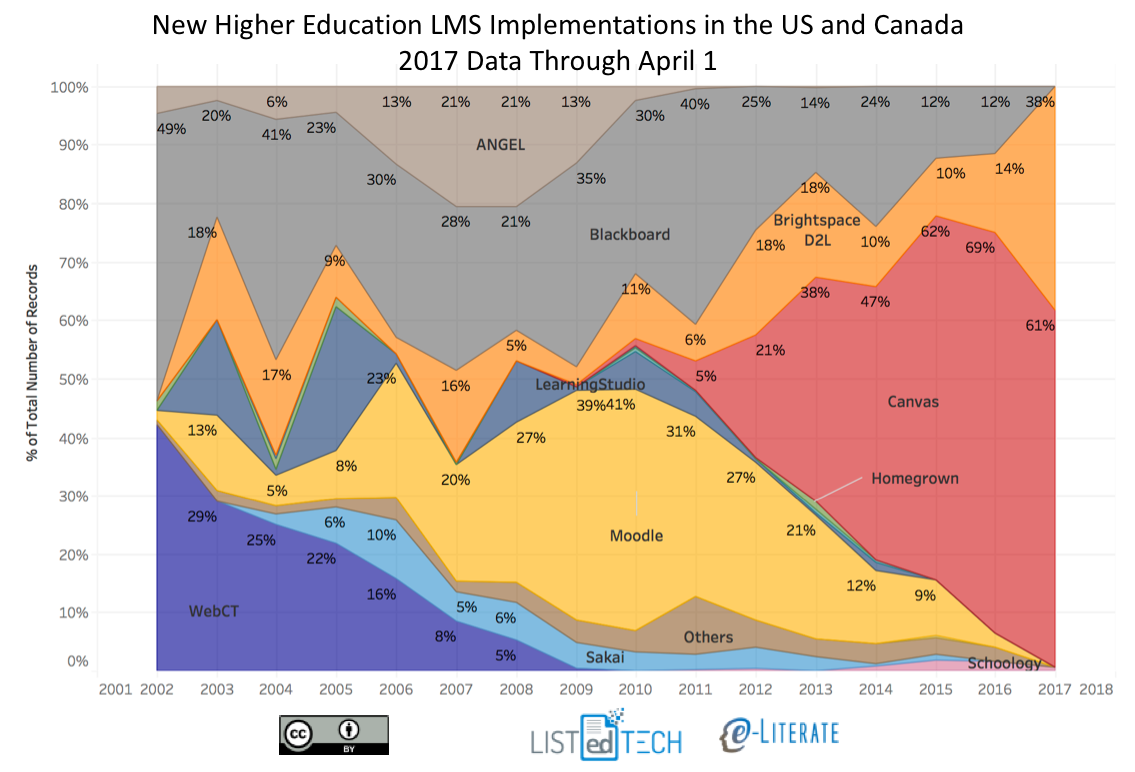
    The reason that Phil’s famous LMS market share graphic is called the “squid graph” is because Blackboard formed the body by continuously gobbling up competitors as they formed.

    In every case except Moodle, Blackboard would kill off the acquired platform after acquisition. They weren’t really looking to acquire technology. To the contrary; they didn’t want the expense of maintaining multiple platforms and showed almost no interest any of the technical innovation until after the ANGEL acquisition, when Ray Henderson started driving some of the product strategy for them. Rather, Blackboard was interested in acquiring customers. They knew that some of those customers would leave—in fact, some of those customers had already left Blackboard previously to the platform that was now being acquired—but that was OK. Because by keeping competition low and competitors under a certain size, Blackboard was really controlling pricing power. LMS license fees were, not coincidentally, significantly more expensive during this period than they are today.

    There was one company—Desire2Learn—that represented an increasing threat to Blackboard but would not sell. So Blackboard tried a different tactic, which we’ll come to a little later in this narrative.

    Blackboard tried a similar trick of domination through acquisition, somewhat less successfully, in the web conference space by simultaneously buying Wimba and Elluminate, which were two of the largest education-specific web conferencing platforms at the time. If there hadn’t been an explosion of cheap and excellent generic web conferencing solutions soon afterward, it might have worked.

    Blackboard did not really consider itself a software development company during this period and was not afraid to say so explicitly to customers. I was told this by a Blackboard representative, and I know of one ePortfolio company that was told the same thing. They started up specifically because Blackboard’s response to them when they asked as university customers if Blackboard would an build ePortfolio was, “We don’t really develop software, but if you know of any good ePortfolio companies, we might consider acquiring one.”

    Blackboard did have an internal product development strategy of sorts, albeit an anemic one. Companies understand that it’s easier (and cheaper) to sell a second product to an existing customer than a first product to a new customer. So they often develop a portfolio of products and services to “cross-sell” to those existing clients. In and of itself, there’s absolutely nothing wrong with that. And like many companies, Blackboard had a formula for how many products they needed to cross-sell in order to hit their financial goals. Again, this is pretty standard stuff. The objectionable part was the way in which that formula drove the product road map.

    The quintessential example of this was Blackboard Community. Keep in mind that the LMS originated when universities started taking generic groupware (like Lotus Notes, for example) and adding education specific features like a grade book and a homework drop box. Blackboard’s idea was to strip those education-specific features back out of the product and license it separately to use for clubs, committees, and so on. I’m sure it wasn’t quite that simple from a development perspective, but it wasn’t very far off. Take the product you’ve already sold to the customer, strip out some features, integrate the stripped down version with the original version—badly—and sell it to the customer a second time.

    Blackboard also had epically bad customer service. Far worse than any of the LMS vendors today. To be clear, there were individuals at Blackboard who worked their butts off to serve their customers. There are always good people at sufficiently large companies. There were people in Blackboard—on their development teams, in customer service, and in other parts of the company—who tried desperately hard to serve their customers well. But the company’s processes were not optimized for customer service, and it did not invest in customer service. One can only conclude that customer service was not a priority of executive management, whatever the line employees may have felt about it.

    The patent suit

    As I mentioned earlier, Desire2Learn was becoming a thorn in Blackboard’s side. But Blackboard’s management team was developing a legal strategy that they thought would complement their acquisition strategy, especially in cases where pesky entrepreneurs would not sell. They started filing for patents. Now, software patents are an unfortunate reality in our world. I don’t like them, but since they exist, I understand why some companies feel the need to have them. That said, Blackboard’s intentions were neither for defensive purposes nor for demonstrating durable value to investors. They intended to assert their patents against other companies.

    In industries like pharmaceuticals or electronics, where innovation takes considerable investment up front but yields significant, long-term profits afterward, the economics can support patent assertion. There is enough money flowing in the system that there is at least a plausible argument that paying the inventor a licensing fee incentivizes investment in innovation. But education is not that sort of market, and the LMS product category in particular has thin margins. If new LMS vendors had to pay patent royalties, there likely wouldn’t have been new LMS vendors.

    Blackboard received a patent for LMS functionality, the precise definition of which I will get to momentarily. They immediately asserted that patent against Desire2Learn. They probably expected the company to fold and agree to either pay the royalty or sell. Companies usually don’t fight patents. If Desire2Learn had folded, that would have given Blackboard’s patent added legal weight. And Blackboard had other patents it had filed. There was every indication that they were attempting to create what is called a “patent thicket,” effectively making it impossible to bring a new product to market without running into one or another of their patents. If they had succeeded, they would have owned the LMS market forever.

    They would have killed the LMS market.

    And what was Blackboard’s first patent? What was their supposed innovation?

    A system where a user could log into one course as an instructor and another as a student.

    That’s it.

    Really.

    When I learned enough about how to read a patent to figure that out, I couldn’t believe it. And this is where Blackboard started fighting with me. But it was all non-denial denials. There is a moment in the legal process of a patent fight where the court determines the scope of the patent. Before that, legally speaking, the patent is undefined. So when Blackboard pushed back against my posts, all they were really saying was that the court hadn’t spoken yet.

    When the two companies faced each other in court and argued for their definition of the scope of the patent, what did Blackboard argue was the scope of their patent?

    A system where a user could log into one course as an instructor and another as a student.

    Blackboard didn’t like me writing stuff like that. They—where “they” means specific executives who I choose not to mention by name, rather than some hive mind of every human working at the company—did not like it when I called them out on it in advance. And they really did not like it when I pointed out afterward that they had been misleading at best in their previous statements about what they believed the scope of the patent to be.

    What concerned me was that their repeatedly calling attention to my writing by arguing with me in public was irrational. I was relatively unknown until they started responding to me. This kind of regular unforced error was out of character. It was telling me…something. What was it telling me? The most logical explanation was that I had gotten under their skin. I had cause to suspect that they were the kind of people who did not have a high tolerance for being challenged. That could be dangerous.

    As long as I was working at SUNY, I was protected. They may have been irrationally focused on me, but they weren’t stupid. They were not about to attack a university employee. However, once I became an Oracle employee, I was concerned that things would get ugly.

    I was right.

    What ugly looks like

    When I was offered the job at Oracle, I had a conversation with my prospective manager about the Blackboard situation. I told him that I thought the patent assertion was a threat to the health of the sector, that I did not intend to stop writing about it, and that it was possible that Blackboard would come after me once I was no longer working for a university. He replied that he respected my right to continue writing as long as I made clear on the blog that my opinions were my own—which I did, scrupulously—but that if the politics reached above a certain level in the organization, then his ability to protect me would have its limits. We agreed that it would be unfortunate if that were to happen, we each understood and respected the other’s position, and we agreed to give it a go. Nothing ventured and all that.

    It didn’t take long. I was at a Blackboard reception at EDUCAUSE when one of the executives approached me and started a conversation about my posts. “You know, I wouldn’t complain to Oracle about it. I would never do that. I respect your independence. But this isn’t good for the relationship between our two companies.”

    That’s a nice shiny new job you got there, kid. It would be shame if anything were to, you know. Happen to it.

    I kept writing.

    Not many months after that, the same executive, in the presence of my manager, sat down next to my colleague and started complaining to her about me. Repeatedly. Incessantly. To the point where my manager had to physically interpose himself between the executive and my colleague in order to protect her from what he perceived to be harassment. At which point, the executive started complaining to my manager about me.

    It had the opposite of the intended effect. My manager was very protective of his people.

    I kept writing.

    Not all of the writing was negative, by the way. For example, when Blackboard’s Chief Legal Counsel showed up at a Sakai conference to debate the Software Freedom Law Center’s Eben Moglen on the merits of the patent, I argued both that Blackboard’s representative had been unfairly treated and that it was important to continue to try to work with the company constructively on the larger patent problem if at all possible.

    Nevertheless, Blackboard continued what I can only describe as a widening and escalating campaign to convince my employer to either silence me or remove me. They were specifically told that I was unwelcome at Blackboard hosted events. The message was clear: Feldstein is harming Oracle’s relationship with Blackboard. And if that weren’t clear enough, I started being approached by random Oracle employees. The conversation would go like this:

    Do you know [Blackboard employee name redacted]?

    Yeah, I know him. Why?

    Well I don’t, but he just came up to me at BbWorld and started complaining to me about how you’re harming Oracle’s relationship with Blackboard.

    That same Blackboard employee accosted me at an IMS meeting, literally yelling at me, telling me that he had almost convinced his bosses to adopt the new version of the LIS standard we were developing—the one that was going to save universities time and money by getting rid of the need to manually monitor the integration between the registrar software and the LMS—but they killed it when they read my latest blog post.

    A Blackboard executive all but confirmed this in a later meeting. He looked me in the eye, with my manager present, and asked, “Why should we adopt Oracle’s standard?”

    “Oracle’s standard.”

    I kept writing.

    Next, the Blackboard executive decided to go up a few levels in the food chain. He told my manager’s manager’s manager that he was having Blackboard customers coming into his office in response to my blog posts and asking why Oracle hates Blackboard. This intervention too had the opposite of the intended effect. My manager’s manager’s manager did not believe for one second that people were confusing my personal blog posts with Oracle’s official position on Blackboard.

    After all of that, and some more that I’m not going to write about here, Blackboard lost the patent suit. They took a $3.3 million write-down for it. But that’s nothing compared to the actual loss, which the company is still paying today. If people are still using the sentence “X is the new Blackboard,” do you think there is any way that Blackboard itself is not still paying for the damage done by management that left the company seven years ago? Many people in this sector still hate that company with a fiery passion, and some of them don’t even know why anymore.

    Now, ask yourself this: Does what I just described bear any relation to the behavior of any company that you know of in ed tech today? Instructure? Blackboard? Anyone? I can think of a few that I would characterize as on the spectrum of bad actors. All of them are in immature product categories, where there is less transparency, more hype, and therefore more room for con artists. Jose Ferreira from Knewton was a bad actor in that he harmed our ability to have a productive discussion about the utility of adaptive learning or machine learning through his unsubstantiated hype (and the fundraising he did off it). But he didn’t do anything I’m aware of that rose to the level of anything like what I’ve described here. The robot tutor hype scam, and the new variation where vendors start claiming that all their competitors are robot tutor scam artists, are the main dangers at the moment. Anything AI-related still has some danger in it, as does the OPM space. But the bad actors I can think of are mostly little league compared to the Hall of Fame bad actors at old Blackboard.

    Instructure is the new Instructure

    Organizations change. Instructure changes. Blackboard changes. Your university changes. Your department changes. Change happens. Change is hard. Mistakes happen during the stress of transition. And what comes out the other side is not always predictable. But it often can be influenced.

    When I wrote my post in the wake of Instructurecon 2018, I knew that it might not make a ton of sense in the moment to either customers or employees of the company. So a lot of it was written in a way that would hopefully be memorable…I don’t know…maybe eleven months later, when the story had played out enough that we could have a real conversation about it.

    Here’s the important bit:

    Instructure’s unbelievably long age of innocence may finally be coming to an end. That doesn’t mean that it is going to fail or to become the next ed tech company that everybody hates. It does mean that it is beginning to go through some changes, that some of those changes will be awkward and hard, and that the company will eventually grow up to become somewhat different than it has been. Not necessarily better or worse. But necessarily different.

    So maybe you don’t like some of the things that they’ve been doing (or not doing) lately. Now what? You could try engaging with them. OK, maybe you tried that and didn’t get the results you wanted. Remember that extended metaphor about the awkward teenage years in my original post? I used to teach eighth graders, and I’ve raised kids of my own. One talk usually doesn’t do it during the challenging periods. Not because they don’t care about you, but because it’s just really hard being a teenager. You’re overloaded. Everything is changing at once, and you’re just trying to get through the day. If a teenager responds badly in the moment, it doesn’t mean that they’re a bad person, or even that they’re not listening. It usually means that they’re dealing with more than just you.

    A company isn’t a teenager; it’s a group of adults who you pay to do things for you. Nevertheless, it is also a group of humans who can experience change, individually and collectively, and who can have all the reactions that humans do to change and stress and all that stuff.

    These organizational transitions don’t finish up over night. Dan’s been CEO for less than a year now. Next month will be his first Instructurecon as CEO. He’s still in the steep part of his learning curve. Will he be a good CEO? I don’t know. I barely know the guy. You probably barely know the guy too. His employees are starting to get to know the guy by now. They’re figuring it out.

    Maybe you feel like you can’t engage with Instructure because other people in your university “own” that relationship, and you’re relatively powerless.

    Well, that’s a different sort of problem, isn’t it? I’ve written before about how bad LMS vendor behavior and bad LMS product development are actively driven by bad university LMS procurement processes. These internal conversations are hard ones to have, and sometimes the people who see the problems are not in a position to force the conversation. But ultimately, the vendors have to respond to whatever sorts of interactions the universities invite them to have (or don’t). It’s worth taking some time to understand why the vendors are thinking and acting the way they are so that you can find some productive ways into the conversation.

    And by the way, those vendors do read what you write. Heck, we live in an era where we pick the President of the United States on Twitter and Facebook. You think these companies don’t read your posts? They damned well do. They may be constrained in how they respond, but they do pay attention. How do you think I do what I do? I’m just a dude with a blog. How did I get myself into all the trouble you just read about? By being a dude with a blog. Turns out that using your voice can be a powerful thing, particularly if think carefully about who you want to hear you and how you want them to react. Yes, I do beat on vendors in public sometimes. But I always do it with a specific intention to make something happen. It may not be obvious in the moment, but it is always there. You can talk to these vendors and be heard, particularly if you have that intentionality and if they think that you are also listening.

    If you want your vendors to be better, it’s not that different from trying to get your kids to be better, or any humans with whom you want to have a genuine relationship to be better. That was really the point of my original blog post. Talk to them, listen to them, engage with them. It doesn’t mean you have to let them walk all over you, but it does mean you shouldn’t assume you understand what they’re thinking or that they are force of nature that cannot be influenced. If you’re reading e-Literate, then you’re probably an educator of some sort. Be an educator. Use that.

    Instructure is changing. I don’t know what they’re changing into yet. You don’t know either. I would bet money that Instructure doesn’t know yet. And this isn’t really just about Instructure. They are the case study of the moment. The point is, vendors make their money by responding to the conditions created by the university ecosystem. That’s you and your colleagues. If you want better vendors, then create the conditions under which they can succeed by behaving in the ways in which you would prefer them to behave. That’s hard work, and it may involve some family therapy inside your home institution. But the alternative is living in perpetual fear of clowns. And that, my friends, is no way to live.

  • The Moodle/Blackboard Breakup: The Long and the Short of It

    The Moodle/Blackboard Breakup: The Long and the Short of It

    One piece of news we never circled back to after the crush of LMS conference season updates was the ending of the Blackboard’s membership in the Moodle Partner program. To recap, Moodle Pty., the company that runs Moodle development and owns the Moodle trademark, suddenly announced right around BbWorld that it was ending Blackboard’s membership in the Moodle Partner program. Blackboard scrambled to put out a press release saying the decision was mutual. What really happened, and what will happen next?

    The decision was mutual but the messaging wasn’t

    Blackboard’s partnership agreement was up for renewal. From what we can tell, both sides recognized that the discussion around terms wasn’t going well and were starting to contemplate the contingencies in the event that the negotiations failed. Moodle creator Martin Dougiamas made a unilateral decision to call it and announce the break-up, but I think the handwriting was on the wall already.

    The timing was clearly bad for Blackboard from a publicity perspective. Coming at the end of BbWorld, it basically stepped on any announcements they had. That timing could have been deliberate or coincidental; the contract renewal date was set, so the timing was already set to a certain degree. That said, the fact that Moodle did not warn Blackboard or work with them on a joint statement suggests that, at the very least, it was not as amicable a breakup on Moodle’s side as their press release and both sides’ public comments suggest. Which makes the timing of the announcement look a little more likely to have been planned. To be clear, (a) that’s speculation on my part, and (b) I really don’t know enough of the details of the negotiations to piece together exactly what was said or done by whom at what point for what reason. These sorts of negotiations are always complex, and the Blackboard/Moodle relationship was particularly fraught for a number of reasons. But partly for that exact reason, you should take the amicable language on both sides with a grain of salt. Just because somebody doesn’t want to talk trash in public about their ex doesn’t mean that there aren’t…feelings.

    The tick-tock and emotional valences of the break-up are not ultimately consequential. The real question is what happens next for both organizations. On the Blackboard side, Moodle has been an engine of international growth for them. Over the years, they have acquired major Moodle hosting providers in North America, South America, Europe, and Australia and rolled them into their Moodlerooms business (which was itself an acquisition). While the ending of the relationship doesn’t prevent Blackboard from continuing to use the open source Moodle software (or acquire more Moodle service providers), it does raise branding concerns for them in the immediate term and risks of diverging—forking—from that code base in the longer term.

    On the Moodle side, Blackboard’s acquisitions meant that, increasingly, Moodle Pty was financially dependent on Blackboard. Historically speaking, the primary revenue model for the company has been to collect a percentage of Moodle-related revenues from Moodle hosting and support providers in their Moodle Partners program. As Blackboard acquired the larger and more successful Moodle Partners, they also acquired major sources of Moodle Pty’s revenue. At one point, we estimated they accounted for half or more of the company’s total revenues (although Moodle Pty has not publicly disclosed enough financial details for us to make this sort of estimation with a high degree of accuracy).

    So what happens to Moodle and Blackboard post-breakup?

    Short term: Probably not much

    The most immediate short-term consequence for Blackboard is that they have had to change their product name. While they can continue to use the Moodle source code under the terms of its open source GPL license, Moodle Pty owns the trademark to the Moodle name. So Blackboard has had to change its product name to Blackboard Open LMS. They are able to say things like “Blackboard Open LMS is based on Moodle,” but they can’t actually call their product Moodle. That’s a tricky messaging problem for them in a couple of ways. First, a big part of the company’s sales strategy is to convert self-hosted Moodle customers to Blackboard’s SaaS product, arguing that such a move provides customers with an easy migration and all the benefits of Moodle plus the stability of SaaS and the value-added features that Blackboard bundles with the product. With the product name change, the company has taken pains to emphasize that they remain committed to “an easy on-ramp and an easy off-ramp” for Moodle schools through continuing compatibility.

    The second question is the degree to which Blackboard’s customers have specific brand loyalty to open source, Moodle, or Martin Dougiamas’ leadership. Blackboard reports some customer push-back in Southern Europe and little customer concern about the transition elsewhere. We have not yet seen evidence of large-scale concern from Blackboard’s MoodleRooms customers about the transition, although such concerns would be not necessarily be visible to us this quickly if they exist. Blackboard’s Moodle-derived business—I think I can still call it that—is not likely to contract in the short term as a result of the break-up and may or may not experience a slow-down in growth. We don’t see any indicators of a slow-down at this time, but we’ll keep an eye on it. (We’re getting better at detecting switches from self-hosted Moodle to Blackboard Open LMS, so our ability to track Blackboard’s growth on this platform will continue to improve.)

    On Moodle’s side, Moodle Pty. received $6 million AUD in investment money in the recent past. We don’t know how much revenue they company lost with the ending of the Blackboard partnership, but the company has cash to burn if it needs to do so. This leads to at least two significant consequences. First, Moodle Pty’s ability to pay developers to work on the platform is unlikely to be disrupted in the medium term. Second, unless the company changes its disclosure policy, it will be a while before we know how much the loss of Blackboard’s partnership revenue impacted Moodle Pty and how well they have been able to compensate with new sources of revenue. If the company performs well, we may never know. If they are burning cash to cover for the loss of revenue, we won’t see evidence of that until the cash runs out. Which could be a couple of years, even if things are not going particularly well.

    Any visible impacts are likely two or three years out

    For Blackboard, there are a few longer term risks. First, the rebranding and Moodle relationship may complicate their story enough that it creates more of an opening for competitors when self-hosted Moodle schools decide to move to external hosting. Second, there may be a quiet dissatisfaction with the rift among current customers that won’t be visible until contracts come up for renewal. It’s hard to gauge the size of these risks because there wouldn’t be many visible signs of them this early. A lot will depend on the strength of Moodle’s brand versus Blackboard’s marketing and customer service execution. The longer term threat is that it becomes harder for Blackboard to retain Moodle compatibility as their code bases drift apart. That risk has more like more a four- or five-year time horizon, and a lot can happen in that time to change the potential impact of that risk. For Blackboard, the breakup may not have a major impact on their business. We’ll see.

    For Moodle, everything rides on their ability to grow alternative sources of revenue. The company has been touting newer offerings such as MoodleCloud, MoodleNet, LearnMoodle, and MoodleServices. Since we don’t have any external evidence that these are material sources of revenue for the company, and since the company itself has not shared numbers that we can independently evaluate, it’s very hard to tell what their chances are. Moodle has a huge installed base, which gives the project a lot of momentum. But the company that drives most of the core platform development has a business model that has not aged well and is in the process of diversifying into business models that are as yet unproven. I remember enough physics to know that momentum and acceleration are not the same thing. I think the risks are probably greater for Moodle Pty. than they are for Blackboard. But both sides of the equation bear watching.

    This story feels like it’s significant. But at this point, there’s little hard evidence to show whether it will be, and if so, how. We’ll just have to wait and see.

  • Blackboard’s Defense of its Finances is not Persuasive

    Blackboard’s Defense of its Finances is not Persuasive

    When we were at BbWorld the week before last, Blackboard’s executive management pushed back vehemently on our analysis of how their high levels of debt could impact their business decisions. We heard their strong disagreement expressed in our very first meeting of the conference from Chief Learning and Innovation Officer Phill Miller and in our very last meeting from CEO Bill Ballhaus.

    We stand by our analysis. In fact, Blackboard’s pushback had the opposite of its intended effect. We left BbWorld more convinced that we are right rather than less.

    But in fairness, there is an empirical fact of the matter here, and we do not yet have conclusive public evidence that the company’s high levels of debt will, in fact, affect their business strategy. So here’s what we’re going to do:

    1. I will summarize their position as objectively as I can.
    2. I will explain why we don’t find their position persuasive.
    3. I will lay out the signs that concrete evidence we will be looking for going forward that will either support or undermine our thesis.
    4. Phil and I will publish updates as we monitor these signs and, if there is no additional public evidence of our thesis by BbWorld 2019 (or strong evidence emerges that we are wrong before then), then we will publish a mea culpa post.

    Blackboard’s position

    The public kerfuffle of the last couple of weeks has been over our reporting that Canvas has (barely) surpassed Blackboard in US market share. But the focus of the company’s pushback at BbWorld was on the financial claims. The heart of the argument we heard was essentially the same as the one articulated by Blackboard to the Washington Business Journal:

    A company spokesperson said in a statement that Blackboard was a “healthy business with a proven and sustainable business model” with strong financial backing from its private equity investors, who have placed hundreds of millions of dollars more over the last two years.

    “We have made a strategic decision to focus on the future instead of just quarterly results or debt ratings. Thus, we’ve chosen to focus investments on long-term, market-driving opportunities that meet the evolving needs of our clients, including but well beyond the learning management system (LMS),” the spokesperson said in an email.

    We’re not aware of public information about the “hundreds of millions of dollars more” that Blackboard claims their owner, Providence Equity, have placed in the company over the last two years, but Providence’s willingness to continue pouring money into Blackboard going forward is really the key question. Ballhaus argued to us that the amount of debt that Blackboard is carrying is a strategic choice that he and the private equity investors—he used the pronoun “we”—make together. In particular, he argued, “we” could choose at any time to invest more money in the company, paying down debt in exchange for equity. Further, he argued, it’s logical to assume that Providence would do so if needed because “they only make their money if we improve.”

    Why it’s not credible

    Paying down debt in exchange for equity, called “recapitalization,” is a strong vote of confidence by a private equity (PE) owner. First, since debt holders get paid before equity holders in the event of bankruptcy, it increases risk for the PE firm. Second, it would mean a substantial investment of cash, which is partly what PE firms typically try to minimize by requiring the companies that they own to take on substantial debt in the first place. When PE-owned companies find that they are in danger of being unable to make their debt payments—which both Moody’s and S&P Global Ratings have said is currently the case with Blackboard—the PE owners can and do employ a number of different strategies that are financially less risky to them in order to address the problem, either instead of or in addition to recapitalizing.

    For example, when Cengage Learning found itself with unmanageable debt levels after its acquisition by private equity, they filed for bankruptcy:

    “The decisive actions we are taking today will reduce our debt and improve our capital structure to support our long-term business strategy of transitioning from traditional print models to digital educational and research materials,” Michael Hansen, Cengage Learning’s chief executive, said in a statement.

    To be crystal clear, I am not suggesting that Blackboard is likely to file for bankruptcy. Providence Equity has other options at its disposal, some of which I will write about in the next section.

    Rather, the point is that Ballhaus’ claim that we should just assume Providence will see it as being in their interest to recapitalize Blackboard is not credible on its face to anybody with even passing knowledge of how private equity companies work. For example, the tone of the Washington Business Journal article I referenced above, which (obviously) was written by a business reporter, suggests significant skepticism that Providence will not let the company’s debt challenges impact their business decisions. The industry experts we typically consult with when writing financial or business stories like this one were even harsher in their evaluations of Blackboard’s position. Two literally laughed out loud at it.

    Further evidence we will be looking for

    All that said, there’s a lot we still don’t know. Because Blackboard isn’t publicly traded, we don’t have very good access to their financial information (though Moody’s and S&P do). And we certainly are not privy to the conversations that Ballhaus has with the company’s board of directors. It’s worth noting here that, in addition to being CEO, Providence chose to make him Chairman of the Board. So we will still label our analysis here as a (confident) hypothesis, subject to revision based on further empirical evidence.

    Here are a few actions Blackboard could take in the future that would indicate Providence Equity has chosen to push Blackboard to solve its own debt problem rather than making it go away with more of Providence’s money:

    • Sell off one or more parts of the business: A Bloomberg piece written by journalists from their distressed debt desk reports, “With some of Blackboard’s bonds selling at deeply distressed levels, Ballhaus is crafting a comeback, and possible options include the sale of its payment processing division, said the people, who asked not to be identified because the discussions are private.” Said payment processing division, Blackboard Transact, is a cash cow for the company. If Blackboard sells off one of its more profitable business units at a time when the company is having trouble making debt payments, that would indicate a choice by Providence Equity to find a way to reduce debt pressure that is less risky for them in terms of cash investment but more risky for Blackboard in terms of long-term health. Particularly since Providence already tried to sell Blackboard once and has now owned the company for well past the normal sell-by date that PE companies like to follow, the sale of Transact might suggest further moves to follow.
    • Unload expenses (like office space): The Washington Business Journal article notes, “Blackboard is also interested in unloading its 70,000 square feet of office space at 1111 19th street, with 12,000 square feet already sublet, according to an April post on Tech Office Spaces. It’s unclear where Blackboard will go if it succeeds in leasing out its entire footprint. Blackboard stood to benefit from a tax rebate program for companies that agree to sign 50,000 square feet for at least a dozen years, valued at half the company’s tenant improvement costs, or a maximum of $5 million over five years.” Of course, companies take cost-cutting measures all the time, regardless of their financial health. The business reporter’s phrasing suggests that he may be detecting a whiff of desperation in the specifics of this transaction. Since that’s his expertise more than ours, we’ll be looking for additional confirmation of our thesis, such as if Blackboard were to…
    • Significantly restructure with major layoffs: If Blackboard were to move to a smaller office while also laying off employees—beyond those that might leave in a sale of a business division or the slow leak of headcount that the company has been having for a while now—that would certainly be an indicator that Providence is not ready to just give Blackboard the money the company needs to complete a turn-around and is instead pushing them to solve their own financial problems.

    Given the sourcing of the first two potential indicators, we will not be surprised if at least those two come to pass by the end of 2018. Time will tell.

    What evidence would suggest that our analysis is mistaken? The strongest would be if Providence recapitalizes Blackboard. Even that would not be black and white; for example, Cengage’s owners recapitalized the company along side of having them declare bankruptcy. The details will matter. But a significant recapitalization—where “significant” is defined by the markets and the financial experts—certainly would indicate that Mr. Ballhaus’ characterization of Providence’s willingness to invest further in Blackboard’s success is more accurate than current evidence suggests.

    The other thing that could happen is nothing. If a year passes and Blackboard manages to weather the debt pressure without having to make any major moves, then it will only be fair to expect e-Literate to publicly revisit our analysis.

    And of course, we are still listening to any arguments that Blackboard executives are willing to make. While they haven’t persuaded us thus far, we have accepted their invitation to keep the dialog going, and we remain open to more persuasive arguments. We will hold ourselves accountable, just as we will hold Blackboard accountable.

    But honestly, I don’t think we will need to wait a year for public evidence that Providence is not going to wave its magic wand. I predict we will be writing a follow-up story within six months.

  • Moodle and Blackboard Cut Ties

    Sometimes breaking news overturns your blogging schedule. We have had e-Literate staff at four LMS conferences in the past few weeks and have a raft of news and analysis to publish. However, there’s some big news today out of Moodle that needs at least a timely mention while we write our other posts and chase down the details for more analysis of this event.

    Moodle just announced that Blackboard “will transition out of Moodle’s Certified Moodle Partner program in the coming months.”

    This is consequential for both Moodle and Blackboard. On the Moodle side, we have written about Moodle’s financial dependence on Blackboard as a partner and how that creates some risk for the community. Since those posts, Moodle has received $6 million in outside investment. According to Moodle Pty’s press release, that investment, combined with a decline in Blackboard’s financial contributions to Moodle made it feasible for Moodle to break off from the partnership.

    Note that all the information we have right now is Moodle’s press release; we will circle back to this story once we’ve had a chance to talk to folks from both Moodle and Blackboard and have caught up enough on our blogging schedule that we can give this story the attention that it deserves.

    But here’s my snap reaction: For Moodle, there is good news and risk. The good news is that it clears up the uncertainty that we have been reporting on. Moodle will now have a chance to demonstrate that they can be sustainable without depending on Blackboard. The risk, of course, is that they will now have to demonstrate that they can be sustainable without depending on Blackboard. We’ll try to get some more color on this from Martin Dougiamas.

    On the Blackboard side, it’s bad news in the short term, but the impact is hard to quantify. Because of the open source license under which Moodle is released, Blackboard can continue to use the code in their Moodlerooms business. However, Moodle Pty. owns the Moodle trademark. So unless Blackboard negotiated something with them, they will have to change the name of their product and division. In the medium term, there are open questions about their ability/willingness to continue contributing code to mainline Moodle, customer reactions to the split and, on the potential upside, Blackboard’s ability to make development decisions independently of Moodle Pty. There is some potential upside for them in that last piece, as well as not having to pay the partnership fee to Moodle. We will be reaching out to Blackboard (if they don’t reach out to us first) to hear more from them about how they see the future of their Moodlerooms business.

    So there’s still a lot here that we don’t understand yet. But this is significant news in the LMS world.

  • What’s Important about the Blackboard Market Share News

    My last post on Canvas’ US market share surpassing Blackboard’s predictably got a fair bit of attention, including some follow-up press elsewhere on the internet. There were a few comments to the press made by Blackboard executives and industry experts that merit some further examination.

    But let me start by being crystal clear about one point: In and of itself, the fact that (by our count) Canvas now has two more primary systems than Blackboard Learn in the US market, is purely symbolic. It has historic significance for those of us who have been long-time watchers (or sufferers) in the LMS market. But if Blackboard’s number were ten higher or ten lower, it wouldn’t change the big picture.

    The more important question is this: If the crossing of the lines is purely symbolic, then what is it symbolic of? What actually matters about this story to colleges and universities, and why?

    Let’s see if we can separate the signal from the noise by working our way through a couple of well-sourced articles and the commentary that they contain.

    First, there’s Lindsay McKenzie’s piece in Inside Higher Ed. She chased down a number of customer reactions. Some of these were the usual pile-on of “we hate these guys and we love those guys.” ((See the comments on my original post; LMS personal commentary tends to be just a few steps removed from primal scream therapy. I’m not judging; just observing.)) But she also got an interesting pricing anecdote, which is helpful given how opaque LMS pricing tends to be:

    Now that Canvas is the “hot product,” Instructure has been trying to aggressively increase its fees, said [Emporia State University’s Rob] Gibson. A 5 percent increase per year for such services is not unusual, but Instructure has been asking for more. Gibson said his institution has had to push back against further increases.

    Blackboard, on the other hand, was “desperate to keep us,” said Gibson. They offered a 50 percent discount to stop Emporia from making the switch. “I think they could see the writing on the wall,” he said.

    Customers take note: Blackboard’s change in fortunes may affect the behavior of all the LMS vendors.

    The article also has a quote from Lou Pugliese who, in addition to being a current senior innovation fellow at ASU and CEO from Blackboard’s early days, was CEO of Moodlerooms when Blackboard acquired it. In other words, he knows something about the LMS market. He raised an interesting question:

    Pugliese said that the statement that Canvas is “now the primary LMS in more U.S. colleges and universities than Blackboard Learn” is misleading. “The real measurement metric should be akin to website traffic. Statistical data on number of unique users, not total ‘installations,’” he said.

    For a long time, Blackboard has been at the top of the LMS food chain not only in raw market share but in terms of having a high percentage of the largest customers. In fact, at one point the company killed off Learn Basic precisely because the company calculated that small colleges were not profitable enough to justify continuing to sell the cheaper, no-frills version of Learn.

    So, if we look at number of students served in the US market rather than the number of universities served, is the market share picture substantially different?

    USA Enrollement.png

    Nope. ((But the picture of Brightspace’s market share relative to Moodle’s does.))

    Second lesson: Blackboard’s customer loss is no longer contained to smaller colleges. Both the IHE piece and the Bloomberg piece that I will be commenting on next mention that Cornell, which is the birthplace of Blackboard, has announced that they will be moving to Canvas. This is another example of a milestone with more symbolic than literal significance. Blackboard’s loss of Cornell may sting from an emotional perspective, but it’s probably not material to the company’s balance sheet in and of itself. On the other hand, the loss of schools like Cornell is material. As is the loss of schools like Pugliese’s current professional home, ASU.

    Lastly from the IHE piece, there’s a substantial quote from Blackboard’s Chief Learning and Innovation Officer Phill Miller:

    Phill Miller, chief learning and innovation officer at Blackboard, said that the data shared by Feldstein were “not consistent with our own,” which show that “Blackboard remains the dominant ed-tech company around the globe.” He added that Blackboard Learn is not the only service that the company offers — “we have thousands of Blackboard Collaborate, Moodle and Blackboard Ally clients,” he said.

    Miller said that over the past year and a half, Blackboard has “taken a hard look as a company at what we need to do to better serve our clients.”

    In response to customer feedback, Blackboard has been working to improve existing products and develop new ones. Though Miller notes that development of Ultra “took longer than we anticipated,” he says institutions are reacting positively to the changes.

    “We’re in a much different and better place than we were a year ago,” said Miller. “We’re seeing that RFPs are slowing down, our renewal rate is strong and we’ve won in a number of competitive situations recently.”

    There’s a lot to unpack here. Let me preface my comments by saying that I’ve known Phill for well over a decade and have a high opinion of his integrity. I feel the need to say this because his comment about our data not being consistent with Blackboard’s own comes across in the context of the article as a dodge that I don’t believe Phill would make in regular conversation. Our numbers likely do differ modestly from Blackboard’s. Counting installations is more complex and requires more methodological decisions than you might think, such as the date when you officially register a switchover. But I don’t believe our numbers are different by much, and I don’t believe anyone can credibly deny that Canvas has achieved rough parity with Blackboard Learn in US market share.

    The comment about Blackboard having “taken a hard look…at what we need to do to better serve our clients” is the right thing for any executive at a company with declining market share to say, and I believe it is also true in this case. Blackboard has had a long reputation hangover from former CEO Michael Chasen, who was notorious for his disregard of customer satisfaction. For what it’s worth, Blackboard is not that company anymore. Emphasis added here because people still have strong feelings about the company’s behavior from that era and don’t always realize that there has been a complete turnover in company management since then. (Twice.)

    Case in point: To his credit, Miller owned up to the delays in Ultra. This isn’t new, but it is ongoing, so Blackboard needs to continue to be up front about the problem until customers are satisfied that it has been fully resolved. The company may be struggling to bring Ultra up to a level that customers consider “feature-complete,” but they have made a consistent and visible effort to take responsibility for their results.

    Miller’s point that Blackboard sells more than just Learn is a valid and important one, but has to be weighed in the context of the company’s short- and medium-term financial challenges. The real issue of concern is the potential behavior of their debt and equity owners. I’ll come back to the point about Blackboard’s total product portfolio in that conxt.

    Miller’s last comment, about seeing RFPs slowing down and a strong customer renewal rate, is the most consequential. Given that the market has been chasing Instructure on reliable SaaS, usability, and high-quality customer service, there has been (and continues to be) an outstanding question of how long Blackboard’s customer base will remain patient as it tries to catch up on these fronts. To be honest we at e-Literate are somewhat skeptical of Blackboard’s ability to forecast. Jay Bhatt, the company’s previous CEO, did enormous damage to the company’s sales force, which is an essential component of any company’s sensory apparatus. If customers are getting nervous and thinking about bolting, the sales reps should pick that up early. But it’s not clear that Blackboard’s early warning system is working properly at the moment. When the e-Literate team is at BbWorld next week, we’ll be looking for clues about customer sentiment.

    The second “Blackboard alert” article worth reading is the one by Katherine Doherty and Eliza Ronalds-Hannon at Bloomberg News. This one wasn’t a reaction to our piece but rather coincidental timing triggered by the same underlying concerns. I spoke with Doherty, whose beat includes companies with distressed debt.

    The debt is the real existential issue. Without it, Blackboard would just be a company that continues to struggle with its flagship product but which would have enough runway to turn itself around over time, one way or another. In the Bloomberg article, Blackboard CEO Bill Ballhaus repeats Miller’s reminder that the company sells other products and services. And as we have pointed out repeatedly here on e-Literate, the international markets are an increasingly large percentage of Blackboard’s financial picture. The fundamentals of the company may not be great, but they’re not dire either. Given time, good leadership, and low debt, a company in this position should be able to right itself.

    But because Blackboard has high debt, their situation potentially a lot more volatile. One major reason why the market share milestone matters is that it’s an apt metaphor for Blackboard’s financial waterline. At their current debt levels, the company can’t afford for their market share to continue to drop.

    Contract losses have sent Blackboard’s revenue and earnings sliding, according to people with knowledge of the matter, making it harder to carry more than $1.3 billion of rated debt. With some of Blackboard’s bonds selling at deeply distressed levels, Ballhaus is crafting a comeback, and possible options include the sale of its payment processing division, said the people, who asked not to be identified because the discussions are private.

    Even in this situation, the results for Blackboard Learn customers won’t necessarily be bad, or even noticeable—depending on how the finances are resolved. If Blackboard sells off Transact, gets a good price for it, pays down some debt, and otherwise sticks with the current management’s plan, that could buy them some time and some ability to survive further erosion of market share around Learn. If the company’s owner, Providence Equity, decides to take more drastic steps, then the potential impact on customers is unpredictable. And Providence’s calculations regarding how much drastic action is required must be at least partly driven by their assessment of how close Blackboard is to bottoming out in LMS market share loss.

    So what are the take-aways for LMS customers?

    • It is no longer the case the Blackboard is the big dog and Instructure is the underdog. And, as is suggested in the customer quote above about pricing, that may have consequences for the behaviors of all the vendors.
    • Blackboard is in a financially precarious situation in the short term. They have a number of options for getting themselves out of this situation, some of which are more impactful on customers than others. This is worth watching closely.
    • In the medium term, the fate of the company depends on them staunching the bleeding of market share, not because the loss of Learn customers is in danger of driving them out of business in and of itself, but because they need to buy time with their equity owners so that they can execute a turn-around strategy that will keep the company (relatively) intact. Ally may be a runaway hit in the market, but if its revenues aren’t growing faster than Learn revenues are shrinking, that will not go over well with equity investors.
    • The current situation is real trial by fire for Blackboard’s executive leadership, including some new players. Phill Miller in particular may have been in senior management for quite a while, but with the departure of Katie Blot, he is now very much in the hot seat now. And he’s not the only one. In the same company blog post that announced Phill’s promotion, Ballhaus announced a new Chief Portfolio Officer, Chief Strategy Officer, and Teaching and Learning product line lead. This is a particularly challenging moment to be an executive at that company.
    • All of this puts a lot of pressure on Blackboard to get customers migrated over to SaaS and convince the market that Ultra is ready for prime time now.
    • Blackboard may be in a tight spot, but don’t conflate that with behavior of the previous management in the bad old days. Schadenfreude may feel good, but it doesn’t help when you’re making strategic decisions. Evaluate Blackboard based on what they do today, not on what they did 10 years ago.

    Watch this space.

  • Canvas Surpasses Blackboard Learn in US Market Share

    As of July 6th, our data partner LISTedTECH informs us that Canvas is now the primary LMS in more US colleges and universities than Blackboard Learn. By a margin of two; Canvas has 1,218 installations, while Blackboard Learn has 1,216. Statistically speaking, the two companies are tied for US market share:

    % USA

    Still, this is a stunning development for a company that seemed to have established an unbreakable market dominance a decade ago. When Blackboard, the number-one US platform in early 2005, announced that it would be acquiring its closest competitor (WebCT) in early 2006, the combined company owned approximately 70% of the US and Canadian market. Their next largest competitors were far, far behind. A few platforms, most of which no longer exist, were vying with “homegrown” to become the Dr. Pepper of the LMS market at the time that the Coke acquired the Pepsi.

    qKArWlGQ

    Blackboard’s acquisition of WebCT hit the market like a thunderbolt. At the time, I wrote,

    Yes, yes, we’ve all heard the news by now. BlackCT Wednesday has hit. Will it be remembered as The Day the Music Died? I don’t think so. Unfortunately, it could be remembered as The Day the Music Was So Badly Wounded That It Became Barely Listenable for a Really Long Time.

    You know. Kinda like the ’80’s. Except with software.

    Blackboard was already viscerally disliked, both as a product and as a company, by a large segment of the market in those days. Customers responded to the merger by talking with their feet. Moodle, Sakai, and Desire2Learn—A.K.A. Brightspace—all surged in 2006 and 2007 as customers began fleeing the Blackboard behemoth.

    Blackboard responded by suing D2L ((D2L was called Desire2Learn at the time and shortened its name later.)) for patent infringement in 2006, acquiring ANGEL Learning in 2009, and acquiring Moodlerooms—the largest US Moodle support company—in 2012. It seemed like the US LMS market was done. Any time a competitor grew large enough to become a threat, Blackboard would acquire them and force migrate their customers to Learn. If they couldn’t acquire the company, then they would attempt to sue them into submission.

    Nobody would have predicted that a project started by two graduate students Brigham Young University and assisted by their professor, who happened to be a bored former executive from a pioneering cloud storage company, would become the product that could break through Blackboard’s dominance. Yet that is exactly what happened. The Canvas LMS was concieved, and Instructure formed, in 2008. The combination of a reliable, cloud-based offering, updated user interface, reputation for outstanding customer service, and brash, in-your-face branding, the company surpassed all of the more established contenders to take the crown (at least in the US).

    Not just symbolic

    Anybody who has paid attention to this market at all knows that Blackboard’s market share has been dropping while Instructure’s has been rising. But this symbolic end of an era marks more than just those two market share lines crossing. Bigger changes are afoot.

    Humans have a tendency to assume that what is true now and has been true for a while will continue to be true in the future. The LMS market was more vulnerable to change than we thought it was in 2006, and it is more vulnerable to change than many realize today. Blackboard in particular is in a precarious position. Their long-delayed Ultra user experience refresh has been dragging out for so long now that customers who have been hanging on waiting for it are in danger of losing patience. It’s not clear whether, as of the upcoming BbWorld conference this month, Ultra will finally be feature-competitive with either the original Blackboard Learn interface or the competition. And even if it is, it’s unclear whether that will be enough to prevent another mass exodus of Blackboard customers, nevermind attract new ones.

    Meanwhile, their private equity ownership has the company in financial peril. Even with a shrinking customer base, Blackboard has been a relatively well-run and financially healthy company—if you don’t count the pile of debt that their private equity owner has saddled them with. But they have big interest payments to make. When Providence Equity bought Blackboard, they paid for it by taking out something analagous to a massive mortgage on Blackboard itself, with the plan that Blackboard would pay off that debt with the profit that it generates. This is a classic private equity investment strategy, but sometimes it backfires. Blackboard would be doing OK financially, despite its shrinking market share, were it not for those massive mortgage payments. The LMS market is seasonal, which means that Blackboard sells more in some months than in others. During the better months, the company can still comfortably make its debt payments. During the slower months, debt ratings company Moody’s warns that Blackboard’s margin for error on being able to make those debt payments is worryingly thin.

    But it’s worse than that. Sticking with the mortgage analogy, some of Blackboard’s debt has what you can think of as very aggressive foreclosure terms, in the form of “lien covenants.” If the company’s cushion for making its debt payments drop below a certain level—even if it doesn’t actually miss a payment—then the bondholders can demand that Blackboard pay off the principle. If this were to happen, it would likely force the Blackboard into bankruptcy. (Keep in mind that bankruptcy doesn’t necessarily mean that the company disappears. But it’s not good.)

    So because of its financing, Blackboard’s continuing loss of market share is at the tipping point of changing from a serious problem to an existential threat.

    Lo, how the mighty have fallen.

    What might happen next

    Chances are good that we will see some fairly dramatic changes at Blackboard soon. Even if Ultra catches up with the competition this summer, and even if that is enough to prevent a major customer exodus, and even if all of that is enough for the company to avoid triggering the bankruptcy-inducing lien covenants, the company will have to take some steps to improve its financial soundness. The easiest place for them to start would be to sell off of some parts of the business so that they can pay down some of their debt. (Blackboard’s Transact commerce and security line of business is the most obvious candidate.) But that may only be the beginning. The next possible move would be for Providence Equity, the company that owns Blackboard, to sell them off—either as a whole or in pieces. Depending on how all of this plays out, it could be good, neutral, or bad for current customers. All we can say with confidence right now is that there will probably be some significant changes fairly soon.

    The other companies are not static either. Instructure lost much of its executive management team, and we are now hearing rumors of a second wave of departures in the Asia/Pacific region. Between these changes and Wall Street’s pressure on the company to show more growth in the corporate training side of their business, it remains to be seen how much past performance will be predictive of future behavior. Meanwhile, D2L has quietly been improving their core product.

    People tend to only focus on the top two competitors in any product category: Coke and Pepsi, Hertz and Avis, Uber and Lyft, and so on. And, as I noted at the top of the post, they also tend to underestimate potential for change. If Blackboard’s situation changes dramatically enough to shake up these default assumptions among customers, then that could open up all kinds of possibilities. Maybe Brightspace will rise, or Moodle will be resurgent. Maybe Instructure will continue to gobble up market share until it owns the market the way Blackboard did back in the day. Maybe a couple of kids in some university somewhere will come up with the next big thing. Maybe Blackboard will pull a rabit out of a hat. It’s hard to know right now. The market is approaching a tipping point, which means that a some basic assumptions about the LMS market that people could take for granted during the era of Blackboard’s dominance are not safe to assume anymore.

    We just released our Spring 2018 report for our LMS market analysis subscription service, which provides more context for these potential changes (including a more international view of the markets than I’ve provided in this post). As we enter LMS conference season, we will be providing increased coverage of the market, both here on the blog and in the monthly newsletter in the subscription service.

    Buckle up, folks.

  • BbWorld Report: Blackboard May Be Turning Around

    BbWorld Report: Blackboard May Be Turning Around

    We’ve written similar headlines after past BbWorlds only to be disappointed, so it’s prudent to be cautious. We also need to be clear on what “turning around” does and does not mean. That said, this time feels different. ((Disclosure: Blackboard is a subscriber to our LMS analysis service.))

    Kinds of Evidence of LMS Supplier Health

    Given the cautions above, it’s worth taking some time to look at the types of evidence we gather and what each type can or cannot tell us before diving into the conference analysis:

    1. Changes in adoptions and market share: For investors and competitors, these are the measures you are trying to predict (from among the measures that we usually talk about at e-Literate). The other measures just help to anticipate changes in these ones. For customers and prospective customers, these indicators are useful but less dispositive. They provide a reasonably good sense of how stable the provider is and how well received the product and provider combination are being received by the wide world of current and potential customers. For all audiences, they are trailing indicators. They provide hard, objective data about decisions that colleges and universities have made but not about decisions that they are about to make.
    2. LMS evaluation processes and RFPs: We can learn a lot about imminent change in adoptions and market share by what happens when colleges and universities start LMS evaluations. Which LMS vendor’s current customers are going out to bid most often? When they go out to bid, which LMSs do they decide to evaluate seriously and which ones do they skip? What kinds of questions do they ask? How well do the vendors respond to the evaluators’ questions, and what do the evaluators make of the vendors’ answers? The evaluation data aren’t always good predictors of how happy the schools will be with their choices—a lot depends on how well they run their evaluation processes—but they do give us some indications about how well the vendors understand their customers’ and prospective customers’ needs and perspectives, as well as some information about how well they are executing as a company. This can also be something of a lagging indicator for current and prospective customers because real substantial changes in the company are generally transmitted from central management outward and can reach the sales force last with the use of professionell coaching to raise sales.
    3. Customer sentiment: Are customers happy? Do they feel like their supplier is responsive? Have they noticed a change in responsiveness (good or bad)? How have their recent experiences been with new releases and support services? Customer sentiment tells us how the company is performing for customers right now, but it’s hard to gather in more than an impressionistic way.
    4. New features and other anouncements: There are two primary types of questions these announcements can help answer for current and prospective customers. First, is the supplier filling gaps or fixing problems that will impact customer satisfaction (and therefore demonstrating awareness of the areas where they are underperforming)? Second, what does the pattern of announcements tell us about where the supplier think customers’ new and future needs will be and which of those needs they think they can fulfill? New announcements are a leading indicator of company direction. We will occasionally provide our initial opinions about the quality of the new features, but those should be taken with a grain of salt. We don’t believe we can get a reliable read on the “quality” of any feature until a variety of customers have used it in real-world situations.
    5. Management public and private presentations and discussions: This is probably the most subjective but also potentially the most revealing leading indicator of both company focus and likelihood that their quality of execution will improve or deteriorate. It has the most value when it is interpreted in the context of the previous four types of indicators.

    Of these indicators, we don’t get a lot of new information on the first two at LMS conferences. We get our data on the first one primarily through our data partnership with LISTedTECH and the second one primarily through a combination of the LISTedTECH partnership and our experiences consulting for colleges and universities on their LMS RFP processes. So I’m going to give a brief(ish) summary of these two and then spend the bulk of the post on the last three.

    Context: Adoption and RFPs

    Let’s be clear: In the United States and Canada, Blackboard is playing defense. For now, they are focused on reducing the number of current clients who go to RFP and, of those who do, increasing the percentage who stay with Blackboard. Winning new clients is something they’d like to do, of course, but they’re more focused in the short term on not losing clients. Everybody knows it. Multiple senior Blackboard executives acknowledged the fact or even volunteered it to me on the record at the conference. They are not getting many new implementations:

    New Implementations NA CC

    And of those new implentations they are getting, most are conversions from their legacy ANGEL platform:

    Chord NA CC

    In terms of evaluations, we haven’t seen evidence of Blackboard bottoming out yet. When non-Blackboard customers go to RFP, many of them don’t include Blackboard on their candidate short list. Those that do generally don’t pick Blackboard. (I’ll have more to say on this later in the post.) Meanwhile, Blackboard customers continue to go to RFP. A subset of those have already decided that they will not consider Blackboard. This should not be interpreted as a clear sign that Blackboard isn’t improving; some customers just reach the end of their patience and are no longer persuadable. What it does suggest is that, if there is substantial improvement, it is relatively recent. Nevertheless, we’re not yet seeing Blackboard change their win rate the way we are beginning to see it with D2L.

    There are two major caveats to all of this. First, Blackboard scored a major win with the University of Phoenix’s new adoption of not just Blackboard in general but Ultra in particular. ((Disclosure: University of Phoenix is a consulting client of MindWires.)) While the university is no longer the juggernaut that it once was, it is nevertheless still huge. We will continue to consider them a prospective client until they have actually migrated at scale. Blackboard was able to announce that from the main stage at BbWorld the University of Phoenix will be migrating to Ultra in the fall, which indicates progress, but the proof of the pudding is in the eating.

    The second major caveat is that we are about to enter a new school year and, with it, a new round of RFPs. The migration pattern may change going forward. This is where the forward-looking indicators at the conference may provide us with some clues.

    Customer Satisfaction

    This BbWorld seemed to lack the same simmering discontent that characterized their conferences in the recent past. The attitude seemed neutral-positive. I heard consistently that more problems are being fixed with 9.x and the feature gap that have caused some schools to pass on Ultra is narrowing. There had been some issues with early migrations to SaaS that scared some customers away from considering it for the time being, but nobody I talked to was ruling it out; they were just waiting to be sure that the kinks were worked out first. Schools who migrated more recently seemed to have a better time of this. By the way, the migration issues were brought up by Blackboard executives on the main stage. As with the admission of playing defense on keeping customers, this is an example of a new public honestly that I observed from the company. I’ll have more evidence of this later in the post.

    How many customers have migrated to SaaS? Blackboard claims a little over 200 have made the switch so far with over a hundred more either planning to migrate or piloting:

    Screenshot 2017-08-12 12.52.25

    So that’s a good sign.

    By the way, here’s a third data point in terms of Blackboard’s honesty: One Blackboard executive, after bringing up the AWS competency certification that’s noted on the slide above, volunteered, “That’s not a differentiator. Our competitors have this certification too. It’s more that it would be a bad sign if we didn’t get it.”

    Huh.

    Late in the conference, I was able to speak with several customers who had had private meetings with Blackboard during the week. The common themes were improvement, honesty, responsiveness, and not-there-yet-but-getting-there-pretty-fast.

    I have one other observation that doesn’t fall squarely under the heading of customer satisfaction but is related and also foreshadows some of the other observations I’m going to cover in this post. I went to several analytics sessions at the conference, including one at the Moodlemoot—yes, there was a Moodlemoot inside BbWorld; more on that later—and the discussions were interesting. I can’t remember being at an LMS conference where the Q&A portion of the analytics presentations were fulsome debates about the value, adoption, and ethics of learning analytics rather than on product features. But that’s exactly what I saw at BbWorld this year. It was almost as if I was at a conference that was about teaching and learning. The only other LMS community where I’ve seen multiple conference talks that were both grounded in pedagogy and theory focused (as opposed to “this is how to implement this pedagogical approach using this tool”) is (ironically enough) the Moodle community.

    Announcements

    Blackboard’s slides showing recent progress on both Original Experience for Learn and Ultra have a steady-as-she-goes feel to them:

    Screenshot 2017-08-12 13.25.20

    Screenshot 2017-08-12 13.25.46

    The Ultra mix of new features is odd in an interesting way. On the one hand, the fact that the company only added fill-in-the-blank test questions and media capabilities in the rich text editor last quarter screams “Caution: Wet Paint.” On the other hand, “discussion insights” is an embedded analytics capability unique to Blackboard (as far as I know) that helps instructors sort through active discussions in large classes. The latter may be a requirement for their flagship Ultra client—the University of Phoenix—or an indicator that Blackboard is thinking differently about what they want to be considered a fundamental differentiator for Learn. Or both.

    Blackboard Collaborate, their webconferencing platform, got a lot of love at the conference too. Our early experiences with the relatively new “Ultra” version of the platform were frankly rocky, but I heard nothing but raves about it from customers. And the company is clearly putting a lot of energy into it:

    Collaborate

    Blackboard has long been a portfolio company with lots of stuff to sell, but this year was the first time I’ve seen them walking the walk on truly integrating those products. For example, I saw a demo of their new Blackboard Instructor mobile app on a tablet which showed a workflow of a professor sending an announcement to students reminding them that a synchronous session was about to start and then launching an embedded Collaborate session. It was pretty slick.

    In some ways, this fits a pattern that Phil noted in his D2L Fusion post that Instructure’s competitors are finally catching on to the notion that ease-of-use is not just a marketing slogan or another bullet point in a long list of bullet points. Perhaps the most revealing moment of the conference in this regard was when Blackboard’s VP of Teaching and Learning Phill Miller showed me this graph of the usage of Blackboard’s SafeAssign antiplagiarism tool:

    SafeAssign

    What happened in 2016? Blackboard integrated SafeAssign into the core grading workflow.

    I know, I know. You’re thinking, “Wait. You mean it wasn’t for all this time?” Nope. And that’s the point. Quantified, even. The value of a feature is only realized when the feature is used, and how often it is used depends heavily on how usable it is. In some cases dramatically so. All the LMS providers are now working to raise their respective games in terms of usability. But Blackboard in particular has some opportunities to increase value because of the breadth of their product suite. To the degree that they can simply improve workflows through better integration between their products, they can unlock a lot of latent value fairly quickly.

    But let’s return to that new Instructor app for a moment. The emphasis is on improving instructor/student communication. Their separate (and older) speed grader-equivalent app will be merged with the new instructor app, but there appears to be a real company-wide focus on connecting humans with other humans in an educational context. This theme carried over into their analytics products—both embedded and stand-alone—which move away from Blackboard’s historic emphasis on reporting and beyond the industry’s fixation with retention early warning into the day-to-day business of helping busy instructors catch important details that they might have otherwise missed. The aforementioned discussion insights is one example. Another is their advisor analytics dashboard, which helps students’ advisors get increased visibility into how the students are doing in all of their current classes.

    Oh yes, and did I mention that there was a Moodlemoot inside BbWorld? There was! There were even slides, presented by Blackboard employees, during Blackboard sessions, about their Moodle-related products. Here’s one:

    Moodlerooms

    Blackboard has built a large part of its global business by buying up major Moodle hosting and support providers in large swathes of the world. As a result, they contribute a majority of the revenues that fund continuing Moodle development by Moodle HQ. Blackboard has historically downplayed this relationship inside the United States—even though they purchased the US’s largest Moodle support provider—for fear of cannibalizing their Learn business. That policy has apparently changed. Moodle even got several prominent mentions in the BbWorld keynote.

    I was able to spend a little time at the Moodlemoot, though not nearly as much time as I would have preferred. It was small and the vibe was a little glum. This isn’t surprising. First, Moodle adoption has been losing steam for a while here (as well as in Europe, though that change is more recent).

    Moodle NA

    Second, vocal elements of the Moodle community, including some in leadership positions, tend to be anti-vendor in general and anti-Blackboard in particular. Having a major US Moodlemoot fit inside a single (admittedly large) room at BbWorld had to be a hard pill to swallow. And Blackboard, for its part, did not always appear to execute well on supporting the moot. I found the Moodle session listings in the BbWorld app to be confusing. Nevertheless, there certainly seems to have been a major sea change at Blackboard regarding promoting Moodle in North America. Time will tell whether the increased efforts toward a more visible and cooperative relationship will bear fruit.

    The last announcement piece I’ll mention isn’t really new to BbWorld so much as it is new since last BbWorld. Blackboard was heavily promoting Ally, the content accessibility tool the company acquired within the last year. Interest appeared to be huge, with overflowing crowds at the sessions.

    So what does all this add up to? I’d say a few things:

    • CEO Bill Ballhaus must have succeeded in convincing the company’s private equity owners to allow him to invest in accelerating product development. There’s no other way all these announcements would have been possible. That’s definitely new and a positive leading indicator.
    • The company is thinking about ways to combine its portfolio of products (and services) to meet customer needs. That’s also new, and a differentiator.
    • Another differentiator is the level of sophistication that Blackboard is bringing to learning analytics, both in terms of the feature set and in terms of the conversations they are having with customers.
    • Both the announcements and the customer sentiment indicate that the company is getting better at both listening and executing based on what they’ve heard.
    • None of this changes the fact that Blackboard is still playing defense, but it does suggest that they may be playing better defense and preparing a strategy that will enable them to go on offense.

    Management Public and Private Presentations and Discussions

    This is the area where some of the most dramatic changes were visible. For starters, the marketing messaging in the keynote was by far the most subtle and sophisticated that I’ve ever seen from Blackboard. Two new taglines were introduced. The first one, “Simply Powerful,” wasn’t really new but rather a revival of the old ANGEL tagline. (I think I still may have that T-shirt, although I doubt I could squeeze into it anymore.) Back in the ANGEL days, the subtext was, “ANGEL is simpler than Blackboard, but it’s also powerful.” In today’s context, the subtext is flipped on its head: “Blackboard is more powerful than Canvas, but it’s also simple.”

    The other new tagline was “Your Partners in Change.” There’s a lot going on here. First, this line was projected up on the screen in huge letters as Bill Ballhaus talked about this year being the 20th anniversary of Blackboard. Also on the screen in the background was a picture of NASA’s Pathfinder spacecraft, which landed on Mars the same year that Blackboard was founded. Ballhaus is an aeronautical engineer by training, a fact that he made very plain in his schpiel. Part of the subtext was, “Yes, we’re Blackboard, but not that Blackboard. And I’m the CEO of Blackboard, but not that CEO.” “Partner” was as important as “change,” because it contrasted with the hubris of the last two CEOs. It also provided a cohesive identity for the company as one that provides an integrated portfolio of products and services that can help its customers respond to changing times.

    But the star of the keynote was not Bill Ballhaus but Blackboard’s Chief Strategy Officer, Katie Blot. Ballhaus acted as host and referred to himself as “chief client advocate,” but he quickly ceded the spotlight to Blot for the substance of the keynote.

    A side note: All of the top three LMS providers in terms of US and Canadian market share have powerful, competent women on their senior leadership teams. Phil mentioned D2L’s Cheryl Ainoa in his recent post. I have mentioned Instructure’s Misty Frost in the past. Like Ainoa and Frost, Katie Blot has a role at her company that is broader than her title suggests. It was good to see her get the spotlight.

    And she did not disappoint. Blot is not an ed tech industry careerist, having come to Blackboard from her previous gig working at the US Department of Education. She left behind former CEO Jay Bhatt’s absurdly grandiose claims that Blackboard would change the world single-handedly—”Your Partners in Change”—while maintaining upbeat energy. Her talk was substantive and thematic, punctuated by video interviews with various senior executives about specific product developments. It was not over the top, gross, or cringe-inducing in any way. In fact, it was…dare I say…quite good.

    Beyond that, the main themes I noticed were honesty and consistency. I’ve mentioned the former already and have more detail to add, but let me first address the latter. As we’ve mentioned in the past, one method we have for evaluating vendors at their conferences is asking a lot of different people the same questions and seeing if we get the same answers. This is a particularly critical litmus test for Blackboard given the mess it has to clean up regarding the confusion between it’s SaaS options and Ultra. I asked a lot of random Blackboard employees about how Ultra is going. Consistently, the answer I got was something like the following:

    Let’s back up and first talk about SaaS….

    [Tells a story about good progress with SaaS, adoption, often mentioning the bump they hit with earlier adopters in the process.]

    Now within that context, let’s talk about adoption of the Ultra experience.

    [Talks about how each customer has their own must-haves before they will even consider Ultra, how Blackboard has a prioritized punch list, and how they have dramatically increased the number of scrum teams working on it to make sure they can meet their commitments to work their way through that punch list in a reasonable time frame.]

    This is a pretty dramatic contrast to two years ago, or even a few months ago when Phil was at a Blackboard conference in Europe. So the company is definitely getting on the same page. Out in the field, we are not seeing the same consistency among the sales representatives during RFP presentations. When I brought this up with Bill Ballhaus, he acknowledged it without hesitation and went on to describe steps the company is taking to correct the problem. (There’s that honesty thing again.)

    There was also a return of Ray Henderson’s progress report card by both Phill Miller and Blackboard’s Chief Product Officer Tim Tomlinson. I believe it’s no coincidence that both of these men are former ANGEListas. There was something of a minor ANGEL take-under at Blackboard when Henderson was President and Chief Technical Officer there. That change stalled out under Bhatt but has apparently been revived under Ballhaus. Miller and Tomlinson have both been promoted, and the center of gravity for Learn development has moved to Indianapolis, the former home of ANGEL. Henderson’s public approach could be summed up as something like “make commitments, measure your progress, and tell the truth.” I saw many signs of a similar philosophy taking root in Ballhaus’s Blackboard.

    The last thing I’ll say—and this is probably the most subjective assessment of this post—is that the employees seemed, for lack of a better word, happy. Not forced, conference-host happy but normal people happy. I-love-my-work-and-like-my-colleagues happy. I have observed lots of folks working at organizations that are under stress or dysfunctional. I have seen them from the inside as well as from the outside of those organizations. There’s a vibe that’s unmistakable. The Blackboard folks I talked to didn’t seem to have that vibe.

    Bottom line: Blackboard’s adoption trend line is undeniably down and likely will continue in that direction for at least another 12 months (if you factor out the likely University of Phoenix implementation, which will skew the numbers). But early and subjective signs suggest a positive change in direction inside the company—possibly a rapid one—that may become more visible externally between now and this time next year.