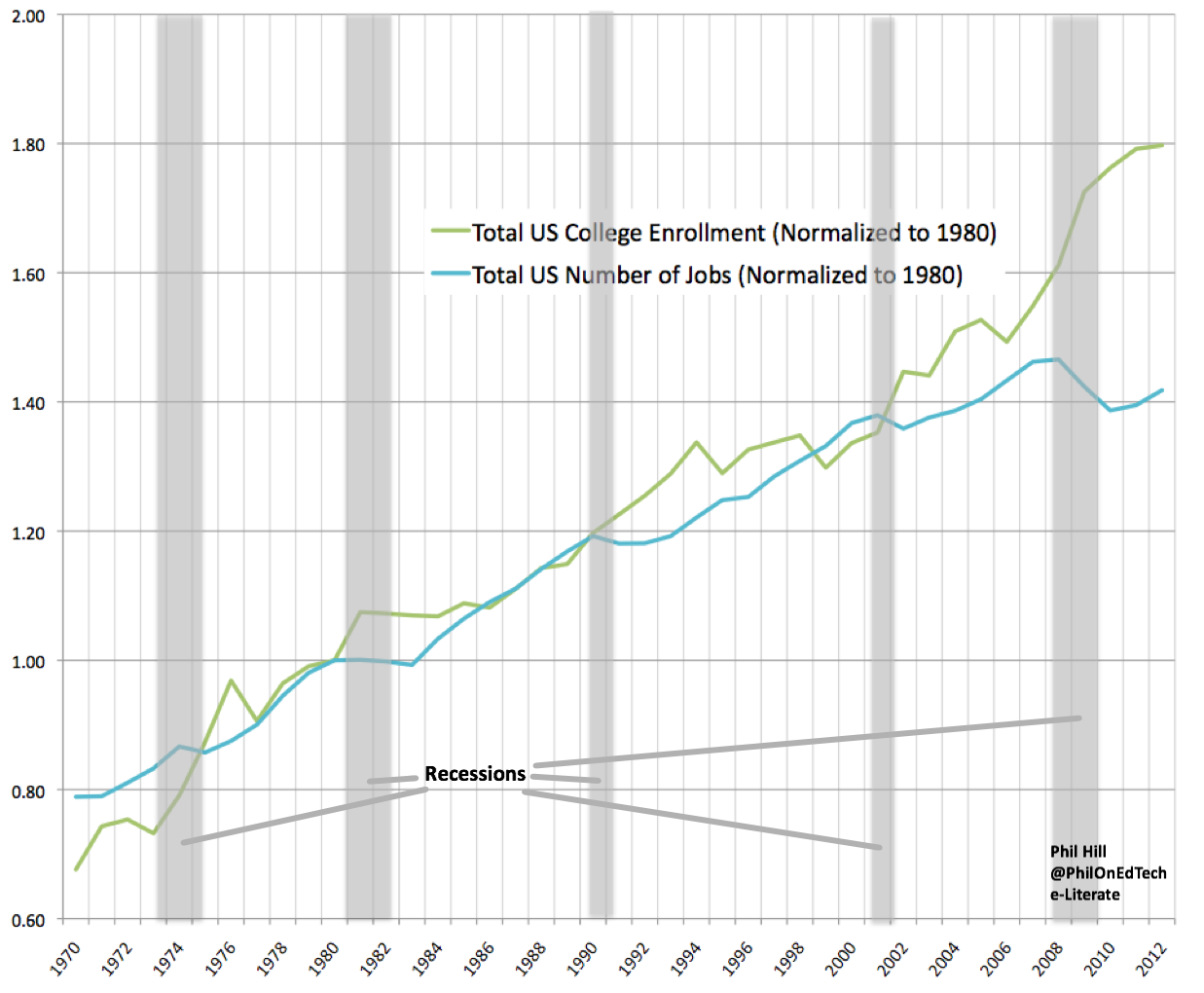
In a post two days ago, I showed US data comparing enrollment and employment trends. The salient feature of the data that I called out was the significant divergence of the two trend lines since 2006.
When you look at the data from 1970 – 2012, the results could explain some significant pressures experienced by higher education institutions. In a nutshell – this time is different, we are in uncharted territory.
There are two related comments that I would like to address, both of which ask the question of whether the mix of full-time vs. part-time enrollment explains part of the divergence noted.
The first (excerpted) comment is from Thomas Warger under the original post:
I have to wonder how much of the gap you show here can be attributed to the increased availability of pay-as-you-go higher education–opportunities to take a few credits at a time at a community college or an online provider? Does “normalized for 1980″ factor for this relatively new phenomenon?
The second comment is from Stephen Downes in his OLDaily blog:
I don’t agree with the proposition that “this time it’s different.” Here’s what Phil Hill writes: “The conventional wisdom holds that enrollment jumps when employment drops, and the data does show some divergence followed a few years later by a correction. What is different this time is A) the magnitude of the divergence and B) the start of the divergence fully two years before the recession started in 2008.” I think the apparent spike in enrollments is created by a lot of part-time and online learning, and that it is a bit illusory. It’s also caused by echo-boom effects, as the population born between 1982-1995 is in post-secondary education between 2002-1015, give or take. If (and it’s a big if) employment improves, I would expect a dramatic drop in (traditional) enrollment.
What’s really different is that world population is reaching a breaking point, climate change is disrupting food supplies and other industry, resource depletion has become a significant problem, and (by contrast) worldwide prosperity, literacy and general awareness has led to an increasingly restive global population. There is moreover a chronic economic imbalance, with increasingly large quantities of wealth simply being hoarded instead of invested (it’s an amount that if deployed would makemoney itself meaningless). U.S. demographic trends – which could be rendered obsolete with one major wave of immigration – are irrelevant in the face of these wider forcess.