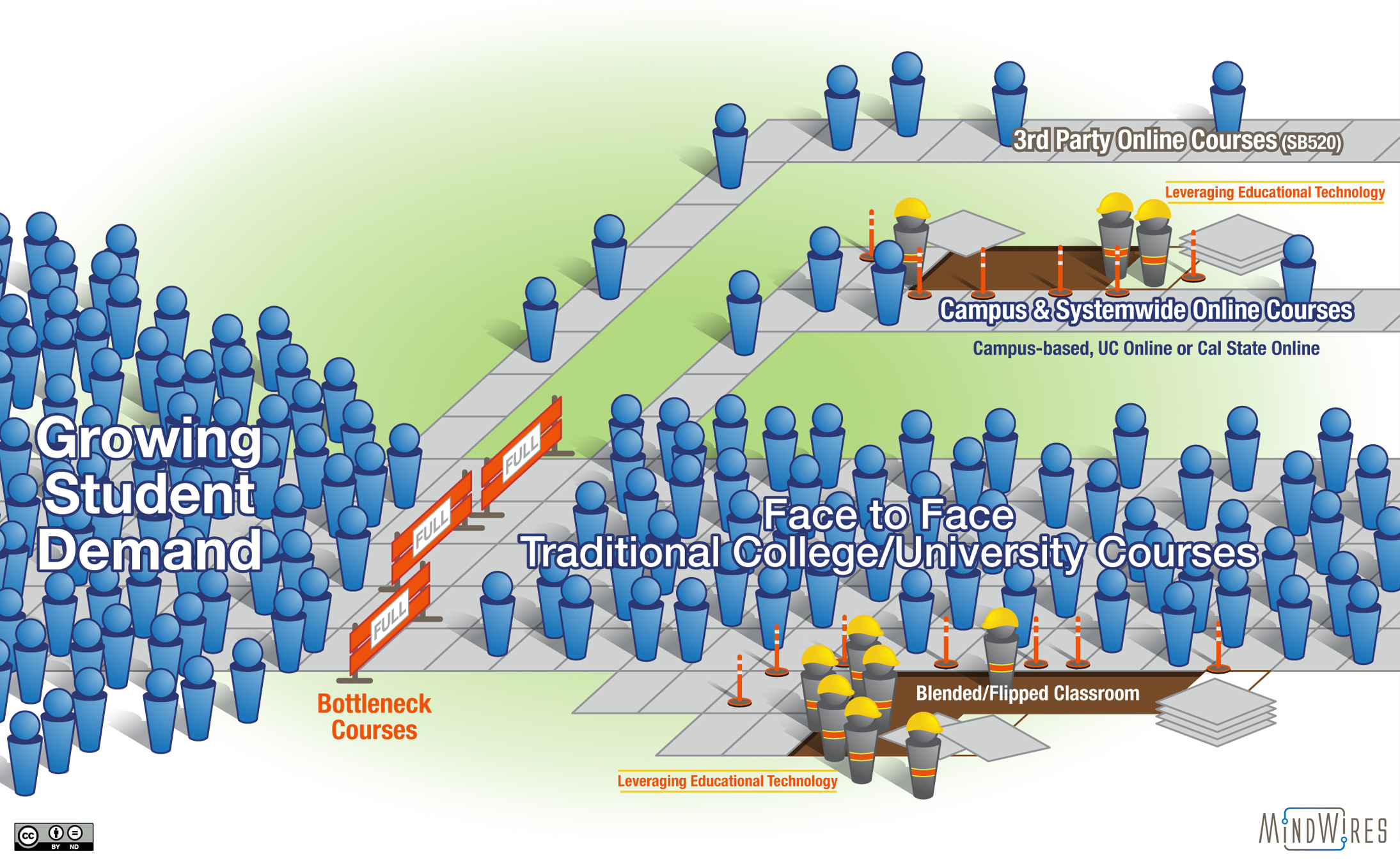
If you’re a regular e-Literate reader, you know we have a macro thesis that the higher education sector is in the early stages of an evolution from having a philosophical commitment to student success toward having an operational commitment to student success. In other words, colleges and universities are starting to approach student success systematically, not as the natural by-product of hiring good faculty but as something that every student-facing aspect of the institution needs to be optimized for.
There is no road map for making this transformation and a number of formidable obstacles to it. First, academia was simply never designed for this purpose. The civilizational goal of empowering every human to live up to her or his potential via access to higher education is very new. Much newer than higher education system itself. In fact, it’s almost a thousand years newer. The University of Bologna in Italy, which is the world’s oldest university in continuous operation, was founded in 1088. The Morrill Land Grant Act, which created the first public universities in the United States, was passed in 1862. The G.I. Bill passed in 1944. Pell grants were created as part of the Higher Education Act in 1965. In 2018, achieving the as yet unrealized ambition of access to higher education regardless of income is very much a live political discussion. Just this month, the Sacramento Bee reported on a poll showing that 58% of Californians view college affordability as “a big problem,” with another 25% saying it is “somewhat of a problem.”
Even newer is the idea that we should not only be giving universal access to higher education but also taking responsibility to ensure that, once students have access, the institution is maximizing their chances of success (as opposed, for example, to the much older and still much more common idea of elitist “weeder” programs that filter for the “best” by failing out most). The deep structure of academia, from its governance to its professional training to its funding structure to its culture, is the evolutionary product of serving different missions than the one which we are now asking it to serve.
Second, even if we agree to embrace the mission of universal access and affirmative responsibility for student success in higher education writ large, how that plays out is very different at, say, Stanford, Loyola Marymount, UC Berkeley, Cal State Chico, and Los Angeles City College. The requirements for access are different. The definitions of and requirements for success are different.
And then their are the students, each of whom comes with her own definition of success, life goals, strengths, needs, and life context.
This is a hard problem. One that drives a lot of our work and our thinking. In a series of posts, I’m going to try to lay out what that shift looks like in a variety of academic contexts, how a successful shift across the sector would impact the future various ed tech product categories, and how the Empirical Educator Project (EEP) is intended to foster a methodology for empowering that shift.
In this first case study, I decided to start with the California Community Colleges Online Education Initiative (OEI). ((Disclosure: CCC OEI is a consulting client of ours.)) In fact, much of the structure of this post is drawn from an analysis we wrote on their behalf for the California State Legislature. I’m interested in extracting some generalizable lessons from OEI’s design. It’s important to be clear that the story I’m telling here is compatible with but not quite the same as OEI’s official position as represented in the report that they submitted to the legislature. OEI is also an interesting place to start this post series because, as we will see, it operates in an extreme environment that makes it particularly instructive.
This is a story about the whole being greater than the sum of its parts. OEI has put together a number of pieces that other institutions also have put in place, either individually or in various combinations. But they have done so with larger strategic vision for the future of California Community Colleges firmly and consistently in mind. It is also the story of a work in progress. California OEI has some impressive early successes under its belt. But it is also a hugely ambitious effort with much still to achieve. (Its in-process merger and rebranding with California Virtual Campus (CVC) is one example of forward-looking plans that I will touch on later in this post.)
Aligning the “business” drivers
When you go to the home page of the California Community Colleges web site, the first thing you will see, right at the top of the page, is the following:
The California Community Colleges is the largest system of higher education in the nation, with 2.1 million students attending 115 colleges. Our colleges provide students with the knowledge and background necessary to compete in today’s economy. With a wide range of educational offerings, the colleges provide workforce training, basic courses in English and math, certificate and degree programs and preparation for transfer to four-year institutions.
That’s a lot of students and a lot of colleges. One more college than last year, in fact. The legislature just approved the creation of a 115th campus (which will be virtual). California Community Colleges cover a lot of ground—literally as well as metaphorically. If you were to drive from College of the Siskiyous, which is about an hour south of the Oregon border, to Imperial Valley College which is about 20 minutes from the Mexico border, you would have to travel over 820 miles. They serve the top 100% of students. A lot of ground indeed.
There’s one word you won’t find in that rather dramatic description of California Community Colleges: “system.” Many state college and university systems are pretty big on local control, but California Community Colleges takes that principle to an extreme. For example, despite being a program intended to serve the entire system, OEI is run out of the Foothill-De Anza Community College District (after winning a competitive grant) because the Chancellor’s Office of California Community Colleges is more or less forbidden the legislature from running it centrally. California’s legislators are fiercely protective of the autonomy of their home districts. And as far as I know, OEI has negligible power to compel campuses to do anything.
In that environment, how do you help the entire 2.1-million-student, 115-campus, 820-mile-long “system” move together toward better operational excellence in enabling student success?
Academics tend to bristle at terms like “business drivers” and “business processes” when applied to academia, and there are good reasons to be cautious about using them. I’m applying the terms narrowly here because terms like “sustainability” are less effective at focusing people’s thinking about the machinery of balancing budgets. At the end of the day, colleges and universities need to take in as much money as they spend in order to keep fulfilling their mission. If you want to think clearly about how the sustainability machine works, then business is not a terrible metaphor. People have a basic, intuitive sense of what kind of machine a business is. The same sort of machinery is obscured the moment you start using words like “university” or even “institution” (or “sustainability”).
What do businesses (or sustainability machines) need? Money. There are a number of ways to have more money. One is to spend less of it. So one of OEI’s first moves was to offer to pay for the campus’ LMS, thus relieving each campus of the need to spend that money. LMS licensing may be an insignificant expense for an R1 university with a big endowment, but for a community college, it matters. There is no wiggle room in the budget. Hard choices have to be made—choices that impact student access and student success. We found anecdotal evidence that campuses have been using the money freed up by OEI’s LMS subsidy to invest in student success.
Our courses are much improved. In one year we have had 75% of current online instructors are fully certified. Almost 80 additional faculty are in process of being certified. We have approved 46 online course sections and reviewed or are currently review this semester another 35-40 courses. Without the resources from OEI and @one, we could not have made this happen.
– Faculty Senate Curriculum Chair, College of the Desert
Funding that would be used for [the common course management system] can be redirected to training for faculty who need extra help learning HOW to teach online.
– Dean, Business, Technology, and Career Technical Education, Ohlone College
Part of the people/resources that Coastline was able to shift, include our new Faculty Success Center, whose staff was able to create a new online course template in Canvas that helps faculty design a quality course. In addition, we were able to devote trainers to help faculty learn to use [the common course management system]. In this environment, our Academic Senate then felt comfortable mandating training for online instructors, something we never had before. I believe all this would not have happened if we had to pay for the [the common course management system] license….
So, continued state/OEI support for the…license will be critical for us to continue to train/support faculty and disseminate the use of these [OEI support] apps and support services….
One thing we were able to do, due to the free license, is pay all District faculty a stipend for the completion of [course management system] training.
– Associate Dean, Distance Learning, Coastline Community College
So just saving the campuses more money, by itself, led to actions by at least some campuses invested in improving their operational excellence at enabling student success. But that was really just the beginning. First, to get the subsidy, the campuses had to agree to do certain things. One of which was to adopt the same LMS. There were reasons for this, which I’ll get to shortly. For now, consider the likelihood of getting that many resource-strapped community colleges to migrate LMSs. How hard would it be? How long would it take?
All 114 campuses signed the contract agreeing to move to the common LMS, and many moved quickly to implement. In fact, the migration proceeded so far ahead of schedule that OEI had to go back to the legislature and request additional funding to cover the unanticipated extra subsidies. Saving these campuses money was a powerful motivator. And, as we’ll see, OEI accomplished a lot more than meets the eye with this one seemingly prosaic move of subsidizing an important but work-a-day piece of enterprise software.
How else can businesses make more money? By doing a good job of aligning their investments with their business opportunities. A grocery store doesn’t want to overstock with produce that will spoil on the shelves. But it also doesn’t want to run out of that produce when there’s high demand. And demand is variable. Demand for produce the week before Thanksgiving is likely to be different than the week after.
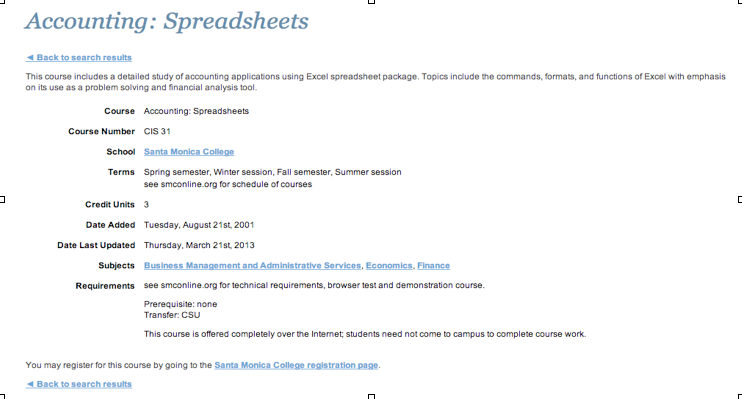
Colleges have an inventory management problem too. Sometimes courses are under-enrolled; other times they are over-enrolled. Both represent money problems to the campuses. One of the reasons that OEI wanted all the colleges on the same LMS—not just the same brand, but the same instance—was to create a course exchange. Balancing course “inventory” in a single community college is tough. Room availability, instructor availability, changes in the job market and economy, and the unpredictability of part-time student enrollments all work against you. But balancing “inventory” across 114 community colleges is less hard (once you can figure out how to get it to work in the first place). One campus may be over-enrolled in macroeconomics, but chances are pretty good that one of the 113 other campuses is under-enrolled in the same course. If you can get enough campuses to put enough courses on the online course exchange, then you can solve a “business” problem for all of the campuses. And the more courses there are on the exchange, the more valuable it becomes to the campuses. Thus, colleges have incentives to create courses for the exchange, and the more courses that are created, the more incentive the colleges have to utilize the exchange.
You could tell this same story from a student access perspective. Over-enrolled courses prevent students from taking them in a timely way. If the course is required, this could force them to delay graduation (and a full-time or better paying job), take on additional unneeded courses in order to qualify for financial aid, take extra financial aid from the state and federal governments, take up an enrollment space that might have gone to other students, and increase the risk that they will not graduate. Under-enrolled courses risk cancellation, with many of the same knock-on effects. I don’t mean to neglect or downplay this portion of the story.
But the focus on business incentives lets us think more clearly about the machinery of the institution itself. Which, in turn, helps us to think clearly about how that machine works and how it can be tuned. OEI designed a machine to drive operational excellence at enabling student success across the largest community college system in the country. And it runs on only positive incentives because. This design constraint immediately rules out copying some of the most frequently cited examples of innovative universities which, through one mechanism or another, can exert varying degrees of top-down control. At ASU, President Michael Crow has an unusually strong hand to play within a reasonably traditional structure of faculty shared governance. (Ithaka S+R has some interesting and revealing interviews of some of ASU’s top leaders that give some hints about how that governance works.) Western Governors University is more extreme; there is no faculty senate and no shared governance. SNHU’s Paul LeBlanc has tried a combination of strategies, working with with the faculty senate on governance of the traditional college while separating out their College of Online and Continuing Education (COCE) and running it in a way that is only loosely coupled to the shared governance of the rest of the university. Like many universities and systems, OEI cannot redesign the machine from the top down. so thinking about the live-or-die campus sustainability incentives that could be used to drive collective action has been a central principle that influenced the rest of OEI’s design.
Creating the infrastructure
The desire to move all campuses in the system to one LMS wasn’t just for the sake of contracting convenience. It accomplished a variety of goals. First, it became a foundational layer of software infrastructure for rolling out other system-wide capabilities and services, from plagiarism detection to online tutoring to faculty training and help resources. Having everybody on the same instance of the same platform—cloud-hosted Instructure Canvas—made it much easier to do this. In the old world, where campuses were on a hodgepodge of different self-hosted and vendor-hosted LMSs, the best the system could have accomplished would have been common contracting. It would still be up to each campus to integrate and support the tools and services. After all, the way a tool looks and works in Moodle can be different than in Brightspace. Centralized support would have been a nightmare. And remember, these campuses are very tight on resources. Supporting add-on tools and services is costly to them.
In addition, sharing one LMS made it easier for OEI to create faculty training that could be shared across the system, and for campuses to do the same. As with system-wide licensing for LMS-connected tools and services, it’s not impossible to do this in a system with different LMSs. But the added friction makes it less likely to happen. I’m going to use the “B” word again: academia needs to think about business processes. Once again, stripping away the culture- and mission-inflected language lets us see the machinery more clearly. A business process is the way in which a business accomplishes something that is important for the business. For example, how does a business make sure that all its employees have up-to-date software, including critical ones like system updates and the latest anti-virus software? Sure, they could leave that to the individual employees to do. We’ve all updated our software on our personal computers; it can be done. But how likely is it that everyone will do so in a fashion that is timely, reliable, and consistently correct? And what work are all those employees not getting done while they are wrestling with software updates? It’s better to develop a business process for pushing out those updates from a central IT group so that employees don’t have to worry about them. Likewise, there are effiency benefits to centrally rolling out and support services for 115 campuses than to have each campus IT support person duplicate the effort. From a perspective of strengthening the business drivers that hold the group together, all of these benefits can be boiled down to saving money by providing additional capabilities with reduced cost to on-campus resources (in direct licensing fees, support staff time, or both). As we have already seen, the campuses tend to invest the money they’ve saved in enhancements that are specific to their local needs and that benefit their students.
The common LMS also helps with the over- and under-enrollment problem. Having all course exchange courses on a single instance of a common LMS made it easier both to provide more data to the campuses that would help them with their planning and to reduce friction in expanding the course exchange. If everybody is using the same system, that’s one less thing for faculty and students to learn, less help desk support, and more productive support (for both course delivery and course design) because the OEI staff don’t have to try to accommodate multiple flavors of learning environments.
Of course, there are trade-offs, the biggest one being autonomy. In OEI’s case, for example, all the campuses had to agree to use the same LMS rather than choosing their own. Anyone who has run a campus LMS selection process knows it can be an exercise in delicate diplomacy. Imagine doing the same with 114 campuses. As we’ll see, OEI turned this challenge into an opportunity. I’ll have more to say about that in the next section.
Anyway, once you start seeing infrastructure as the structure “underneath” (i.e., “infra-“) that supports business processes, two things immediately start to happen. First, your definition of success changes. You can no longer declare victory just because you successfully installed the software and got people to start using it. You have to start looking at whether it successfully enabled or improved the business processes you were intending to support.
Our Professional Development Coordinator is encouraging the creation of Pro Dev workshops in [common course management system] Canvas, such as health and wellness (“dealing with difficult people”), how to create Open Educational Resources, how to use [Student Learning Outcomes] for better teaching, and a lecture on science and its assumptions. What is developed at Butte can be instantly shared with other schools, and vice versa. I see a renaissance of Pro Dev opportunities!
– Technology Mediated Instruction coordinator, Butte College
The second thing that happens when you start thinking in terms of business processes is you identify new problems as well as rethinking and reprioritizing old ones. For example, OEI is in the process of revamping (and merging brands with) California Virtual Campus (CVC). Why? CVC exists today. It’s a web-based catalog of online courses students can across the California Community Colleges and California State University System, which is many more than the handful of OEI exchange courses. As of 2017, CVC included 23,445 online courses and 1,376 degree programs. So it’s big. If you think of infrastructure as a thing to have, then you might think of CVC as a massive success.
But if you think about CVC as the structure underneath that supports the critical business process of students finding, (wisely) selecting, and registering for online courses across the many campuses represented in the CVC course catalog, then you start to develop different metrics for success. And if you also think about the back-end process of making sure the right institutions get the registration information, tuition, and transcript information (respectively), then CVC becomes both a critical priority and a tough piece of infrastructure to build well, particularly across so many different campuses that are not all migrated to a single instance of common Student Information System (SIS) software. If students fail to register for online courses that they need because the process is too cumbersome, or if they don’t get properly credited by their home institutions after taking an exchange course, that is bad for the long-term health of both the students and their institutions. This is what it really means to say that some infrastructure is “mission-critical.” CVC is a big catalog with lots of courses, but it does not yet do a great job of fulfilling its mission-critical role of helping students find, register for, get credit for, and pay for their courses. Each of those is a business process that CVC should support. And the number of courses in the catalog tells us very little about how well the software is supporting those processes for the students and the campuses.
If you think about infrastructure in this way, then your communications to your stakeholders will also change. Here’s an explainer video they had us create for them in order to help communicate that message to the various campus folks:
(Source video: https://youtu.be/1DdlaIZYiDI)
Why was this so important to communicate? OEI could have gone to their constituents with a message of “Here’s a bunch of great free stuff for you!” Instead, they chose a much more challenging message to communicate; one about the ripple effects of having shared infrastructure. That wasn’t an obvious choice.
If you’ve read any one of a million articles on how to succeed with any major campus-wide initiative, you will have read the cliché about how important it is to “get buy-in.” Most of the time, “getting buy-in” is interpreted as “handling objections” or “reducing resistance.” It is an obstacle to get past. But the video above shows that the OEI leadership has interpreted the term differently. You only communicate to your stakeholders in this way if you believe that buy-in is infrastructure.
Fostering a culture
In our consulting work, we facilitate LMS selection processes reasonably often. The more forward-thinking institutions view these processes as opportunities. How often do you get to gather a group of faculty and other academic stakeholders from across your institution in one room and have them talk to each other about how they teach and what they need to serve their students well? A search for a product like an LMS can become a rare opportunity for focused, intensive, purpose-driven community-building. Yes, it lowers resistance, enabling people who might not be happy with the final decision to at least feel like they were heard. But it also begins to foster familiarity and dialog that can help foster a broader and more lasting community of purpose. When you’re trying to build such a community across 114 campuses as part of an ambitious and completely voluntary system-wide effort, taking that view of LMS selection is even more important. Needless to say, it wasn’t easy. Or seamless. That said, both during the selection process and and afterward when communicating the results, OEI worked toward building affirmative buy-in—not just lowering resistance but increasing the sense of goodwill and common purpose. For example, the selection committee was near unanimous in its selection, with the sole dissenter acknowledging the importance of what the committee was doing together and supporting the final decision.
The program design elements I’ve described so far helped OEI to foster increased organizational alignment at two levels across campuses. The campus executives who are responsible for financial health and sustainability of their campuses are aligned through infrastructure subsidization and the course exchange. In 2018, the state legislature decided to augment the initiative with an additional $35 million funding. California Community Colleges has chosen to invest that extra money capacity-building. In particular, the money will go toward grant programs intended to enable the campuses to launch more online courses on the OEI-CVC infrastructure, thus further strengthening this alignment while aiming to serve more students effectively. The common infrastructure and the culture-building process around it has helped to build a culture among the academic and technical support staff across campuses. The hoped-for consequence is that improvements on one campus will travel more quickly and easily to others:
I now know that I can ring up any other [Distance Education] Coordinator and we’ll be speaking the same “language” regarding the use, training, and administration of the [course management system]. I’m also really looking forward to faculty being able to share ideas and resources via Commons.
– Director of Distance Education, Santa Rosa Junior College
Building a similar sort of sharing network among the faculty in the system is an even larger challenge. The culture-building work has been ongoing work for years now, but one can acknowledge all the hard work and progress to-date while still also recognizing that this is a huge project that has barely begun. Certainly, having common resources and common platform supported by OEI has provided a boost, as has the inclusion of faculty voices in the OEI planning process. The augmentation grants, which will likely include instructional design support, represent another opportunity. But to me, one of the most interesting vectors for culture-building is the course exchange course quality rubric. Every course on the exchange has to be evaluated against a rubric of evidence-backed effective online teaching practices. As the pace at which exchange courses are developed increases, OEI will not be able to keep up with demand to evaluate these courses using central staff. So they are creating a peer reviewer mechanism in which faculty on the campuses are trained on the rubric and presumably compensated to review courses that are candidates for the exchange.
This opportunity fascinates me. We know that faculty who go through an expert-supported course redesign process often experience intellectually deep and emotionally moving shifts in their teaching strategies. Is the same true when faculty are trained reviewers of their colleagues’ redesigned courses? What effect will simply exposing faculty to more and different course designs have? How will their role as reviewers and critiquers shape or enhance that effect? Can a continuously improved and updated rubric become a vector for sharing new research-supported processes across the system on an ongoing basis? Will the impact be broad and deep enough to foster new kinds of intra- and inter-campus faculty dialogs about the scholarship of teaching and learning (SoTL)? Will these cultural changes help to foster alignment around continuous operational improvement for enabling student success? This is the last mile problem of higher education. Operational excellence at student success cannot be achieved unless it is infused in the daily operations in individual classrooms. That requires affirmative faculty buy-in, support, training, and embedding in a culture that invites them into the larger conversation.
This is highly reminiscent of the cultural transition that doctors had to make from the mid-Nineteenth through the mid-Twentieth Century. In the 1840s, one could begin practicing as a physician with no medical training at all, just as one can start practicing as professor with no pedagogical training today. Doctors learned medicine from whomever they happened to train with and whatever they read in the newspaper ads about cures and treatments ranging from early antiseptics to leeches and literal snake oil, with no easy way to distinguish them. There were no major conferences or respected, peer-reviewed journals. There were no standards for quality research or convincing evidence. There were a handful of teaching hospitals and medical colleges of wildly varying quality that touched only a small minority of practicing physicians. All of these institutions, all of this social infrastructure, needed to be built and bought into by physicians before antiseptics could be differentiated from snake oil, the signal separated from the noise, regarding “progress” or “innovations” that might help their patients’ welfare.
OEI has accomplished some remarkable early successes in an extremely challenging context. But the degree to which they are able to move 114 California community colleges toward better support of student success as a group may well depend on the ability of the social infrastructure they are creating to reach faculty, be embraced by them, and and foster a culture in which academics collaborate differently and more intensively in their day-to-day work of helping students to succeed, one student at a time.