
e-Literate

Present is Prologue

Tag: California

  • California SB 520 – Text of Proposed Draft Bill for Online Education Platform

    Thanks to Ry Rivard at Inside Higher Ed, we have a copy of the draft bill as of March 8, 2013. With cooperation of Caffeine-Fueled Transcriptions, Inc, I thought it would be useful to share the full text. Please note that this is a draft bill that will be amended over time. I have added formatting (indents) to help with readability. See previous post for description of press conference (including Q&A) and press coverage.

    *************************************************************

    SECTION 1. The Legislature finds and declares all of the following:

    (a) In recent years, California’s public higher education institutions have faced skyrocketing demand for enrollment at a time when they lack capacity to provide students with access to courses necessary for program completion and success.

    (b) In the 2012 – 13 academic year, 85 percent of California Community Colleges (CCC) reported having waiting lists for their fall 2012 course sections, with a statewide average of more than 7,000 students on waiting lists per college.

    (c) Similarly, impacted courses have contributed significantly to difficulties within the University of California (UC) and California State University (CSU) systems, with figures indicating that only 60 percent and 16 percent of students, respectively, are able to earn a degree within four years, with lack of access to key courses a factor in increased time-to-degree.

    (d) With rapidly developing innovation in online course delivery models, California’s public institutions of higher education have a unique opportunity to meet critical demands for enrollment and reduce time-to-degree by providing students with access to high-quality, alternative, online pathways to successfully complete and obtain credit for the most impacted lower division courses.

    (e) California could significantly benefit from a statutorily enacted, quality-first, faculty-led framework allowing students in online courses in strategically selected lower division majors and general education fields to be awarded credit at the UC, CSU, and CCC systems. While providing easy access to these courses, these systems could also continually assess the value of the courses and grates of student success in utilizing these alternative online pathways.
    (more…)

  • Proposed California Legislation for Statewide Online Education Courses – The Basics

    Outside of the Vatican, the big news this week in higher education is the proposed legislation in California that would identify and approve a set of up to 50 online courses that the three public systems would accept as credit for admitted students. Senate President Pro Tem Darrell Steinberg is co-authoring SB520 that addresses popular, introductory courses for which students cannot get access from their University of California, California State University, or California Community College campus. The pre-coverage of the event included the following:

    As described in the NY Times:

    Legislation will be introduced in the California Senate on Wednesday that could reshape higher education by requiring the state’s public colleges and universities to give credit for faculty-approved online courses taken by students unable to register for oversubscribed classes on campus.

    If it passes, as seems likely, it would be the first time that state legislators have instructed public universities to grant credit for courses that were not their own — including those taught by a private vendor, not by a college or university.

    “We want to be the first state in the nation to make this promise: No college student in California will be denied the right to move through their education because they couldn’t get a seat in the course they needed,” said Darrell Steinberg, the president pro tem of the Senate, who will introduce the bill. “That’s the motivation for this.”

    Update 3/14: Text of bill here

    Senate President Pro Tem Steinberg held a press conference today via Google Hangout and video streaming (archive available soon on site) to announce the package of legislation. I have attempted to summarize the press conference below (any mistakes in note-taking are my own, and I’ll update as needed). While Michael and I will both have analysis of this proposal soon, I wanted to first share the information directly.

    (more…)

  • Smart

    Governor Brown appears to be focusing his attention on “bottleneck courses”:

    As part of the additional $125.1 million in proposed state funds, $10 million has been directed in the Governor’s budget for online strategies to get more students through so-called “bottleneck” courses. These are courses across the system that cause many students to slow their time to degree until they can find a “seat” in that particular course. They are either lower-division general education requirements, pre-requisites for majors or high demand classes. The directed funds would be used for a multi-pronged approach incorporating technology-enhanced learning, student advising and course redesign to ensure student success. Together, all of these efforts are expected to provide thousands of students more access to classes and help them progress to degree.

    They will also save the state money. In a state system, every student is subsidized. Reducing time to graduation also reduces budget burdens. So it’s good for everyone. This is a smart, targeted approach that could also form the basis for experimentation and innovation with ed tech. Note the reference to “course redesign.”

  • California Discusses Cost and Effectiveness in Higher Education

    On the heels of the passage of a historic tax increase to cover deficits in the California higher education system, the UC system is apparently already warning that they may need to raise tuition again. In response, Governor Jerry Brown has called for action and discussion about rising tuition costs, and in particular, to discuss how getting more aggressive with online education might help the cost situation. The Los Angeles Times characterized it this way:

    “In order to meet the needs going forward without constant large tuition increases, there will have to be different ways in which people learn and people teach,” Brown said.

    He told the regents — and they quickly agreed — to invite industry leaders in free online education, such as the Udacity website, to the January meeting to discuss how UC can more aggressively get into the digital classroom.

    Brown said he wanted those talks to be “not in the gilded tones of academia but in the harsh reality of the marketplace and technologies.”

    In response this call, the 20 Million Minds Foundation is sponsoring a conversation about controlling rising costs while maintaining (or improving) quality in the California public higher education systems from 9 AM to 2 PM Pacific Time on Tuesday, January 8th. More information, including the full agenda and the webcast sign-up form, can be found on the home page of 20mm.org.

    This event has the potential to be impactful for a variety of reasons. First, the folks who are organizing the event were directly involved with California’s new law to fund the creation of 50 open textbooks for higher education. Their involvement by itself means it is likely to be an interesting event. Second, it comes at a critical moment in California’s funding situation. Something has to change. Third, it’s California. What happens there matters, both because the state is so big and because it has been a model for quality public higher education. Californians still have a great deal of civic pride invested in that idea of themselves (which may be why Governor Brown was able to pass the tax increase). And finally, with the MOOC hype at its apex, previously unthinkable technology-driven changes to large, conservative prestige schools are suddenly not only thinkable but positively trendy.

    It turns out that e-Literate will have its own little part in this grand drama. Our very own Phil Hill will be both a speaker and the moderator of several panels. I will have the privilege of participating on one of the panels. Never having been at an event like this before, I will be fascinated to see how it all plays out. Obviously, various folks will be coming with different agendas. From my personal perspective, while I’m not a big believer in the role of the “harsh reality of the marketplace” as a driver for educational policy, I do think the harsh reality of student debt burdens should motivate a sense of urgency. And I think there is a huge opportunity for a long overdue rethink of how we approach education. Fellow panelist Candace Thille from CMU’s OLI has said it well:

    “Rather than using information technology to mimic or scale typical classroom teaching methods, I hope the participants will begin to discuss how to use emerging technologies to effectively re-engineer the teaching and learning process as a whole.  We have the opportunity to address large-scale societal issues in higher education while simultaneously making progress in our fundamental understanding of human learning.

    Another issue we need to address is balancing institutional competition and collaboration.  Many higher education pundits believe that the competitive nature of American higher education is a key reason that many American research universities are the best in the world. However, pursuing innovation in teaching and in education research are areas in which, I believe, we can make progress more rapidly through a better balance between competition and large-scale collaboration.”

    If the conversation can get beyond a zero-sum political tug-of-war between disruptive xMOOC companies and traditional academic institutions to a genuine dialog about new possibilities, then this could turn out to be a big deal. But as I said, I’ve never been to anything like this before and I’m frankly not sure what to expect. It will be interesting.

  • The Need for Alternative Educational Models in California Illustrated in One Chart

    An earlier version of this article appeared at the Delta Initiative website

    There is a full-court press in the media regarding the California budget crisis and its likely impact on higher education. The most recent entry is in the New York Times.

    Class sizes have increased, courses have been cut and tuition has been raised — repeatedly. Fewer colleges are offering summer classes. Administrators rely increasingly on higher tuition from out-of-staters. And there are signs it could get worse: If a tax increase proposed by Gov. Jerry Brown is not approved this year, officials say they will be forced to consider draconian cuts like eliminating entire schools or programs.

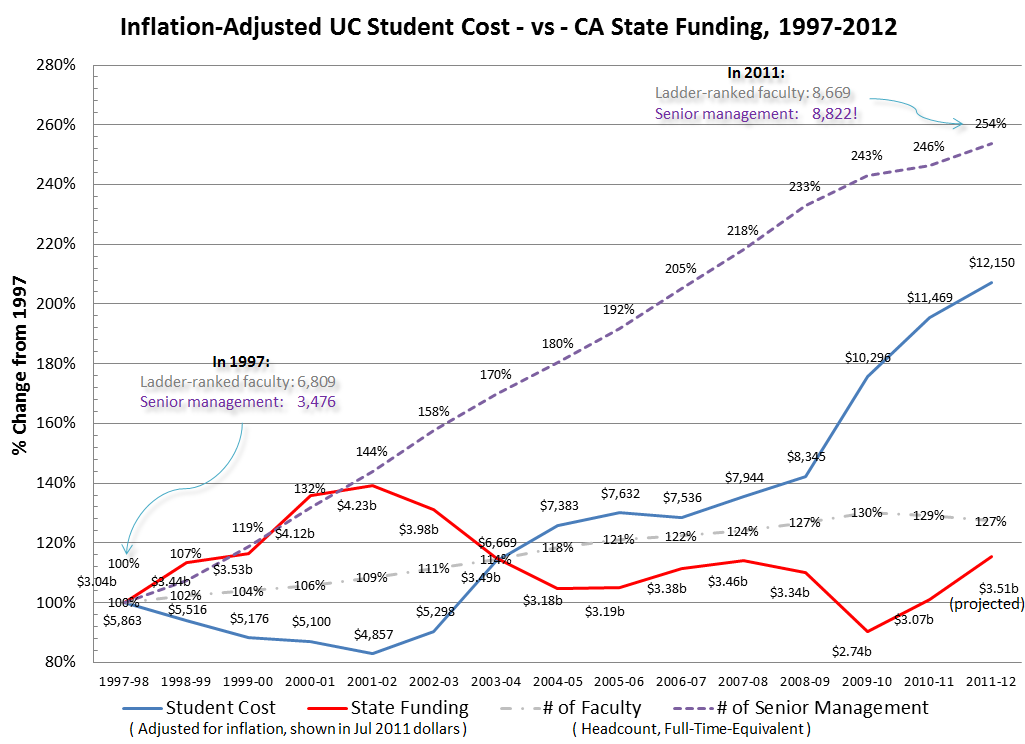
    While I’m not arguing the point that there is a crisis, I do think it is worth looking at historical trends to get perspective. Consider the following chart from the California Review (blog post here). It looks at inflation-adjusted budget numbers and faculty and senior management headcount from 1997 – 2011. [Click to expand]

    (more…)