
e-Literate

Present is Prologue

Tag: Chronicle

  • OER Survey and Adoption Growth: It pays to check source material

    OER Survey and Adoption Growth: It pays to check source material

    I had a trip to the UK this month and only had time to read media coverage of the recent Babson Survey Research Group (BSRG) survey on open educational resources (OER). What a mistake. The Chronicle of Higher Education had a flawed description of a key question – actual and planned adoption of OER material by faculty – that misinformed readers like me who didn’t read the actual survey report, at least initially.

    The open-educational-resources movement, commonly known as OER, is an effort to encourage academics to use open-licensed materials in their classrooms as a way to lower costs. Some nonprofits, like OpenStax, have produced textbooks based on this material. The survey shows that OER has made inroads: 22 percent of people who teach introductory courses, subjects in which free textbooks are most commonly available, use it as required material, up from 15 percent last year.

    Yet the percentage of faculty members who say they will use, or consider using, open materials in the next three years actually dropped slightly, with the numbers now at 6 percent and 32 percent respectively.

    On the surface, this description indicates that OER adoption increased for faculty teaching introductory courses, but the second paragraph shows a potential drop in adoption over the next three years for all faculty. That would be major news showing that the OER movement hit an inflection point and is likely to drop soon, even though faculty have a natural affinity for the same issues that OER offers – lower cost and the ability to remix / reuse.

    It turns out this interpretation is wrong. The actual BSRG survey report states the following [emphasis added]:

    Each year, this survey asks faculty members who are not current users of open educational resources whether they expect to be using OER in the next three years.

    This question is only for non OER-adopting faculty. In other words, it measures growth potential, not total adoption potential. In fact, the percentage of faculty who used required OER material in any of their courses more than doubled this year, and based on the question above should continue to grow. BSRG further described the numbers for non OER-adopting faculty.

    There have been minimal changes in the proportion of faculty who report that they will use OER in the next three years, dropping slightly from 7% in 2015-16 and 2016-17, to the 6% reported this year. The number who report that they “Will consider” OER grew from 31% in 2015-16 to 37% for 2016-17, before dropping to 32% for 2017-18.

    This description is poorly worded and misses the context provided earlier, which I assume was part of the problem with Chronicle coverage.

    As for actual adoption, the category of “all faculty” grew significantly over the past year.

    Nearly one-quarter of faculty that teach large enrollment introductory courses report that they are using OER in some fashion, with more of these faculty responding that use OER as supplemental rather than as required materials. The rates are lower across all faculty, with 13% reporting using OER as required course material in at least one of their courses.

    These numbers represent a large increase over those in previous years, with the overall faculty rate of required OER use climbing from 5% two years ago to 6% in 2016-17, and then making a large jump to 13% this year. Given the sometimes vague understanding of the OER and its licensing, care must be taken in interpreting these results. Are faculty lumping any free resource into the OER category, even those that are not licensed as OER? Based on previous results we have to assume that there is some level of over-reporting in these figures of OER use; we just don’t know how much of an impact this is having.
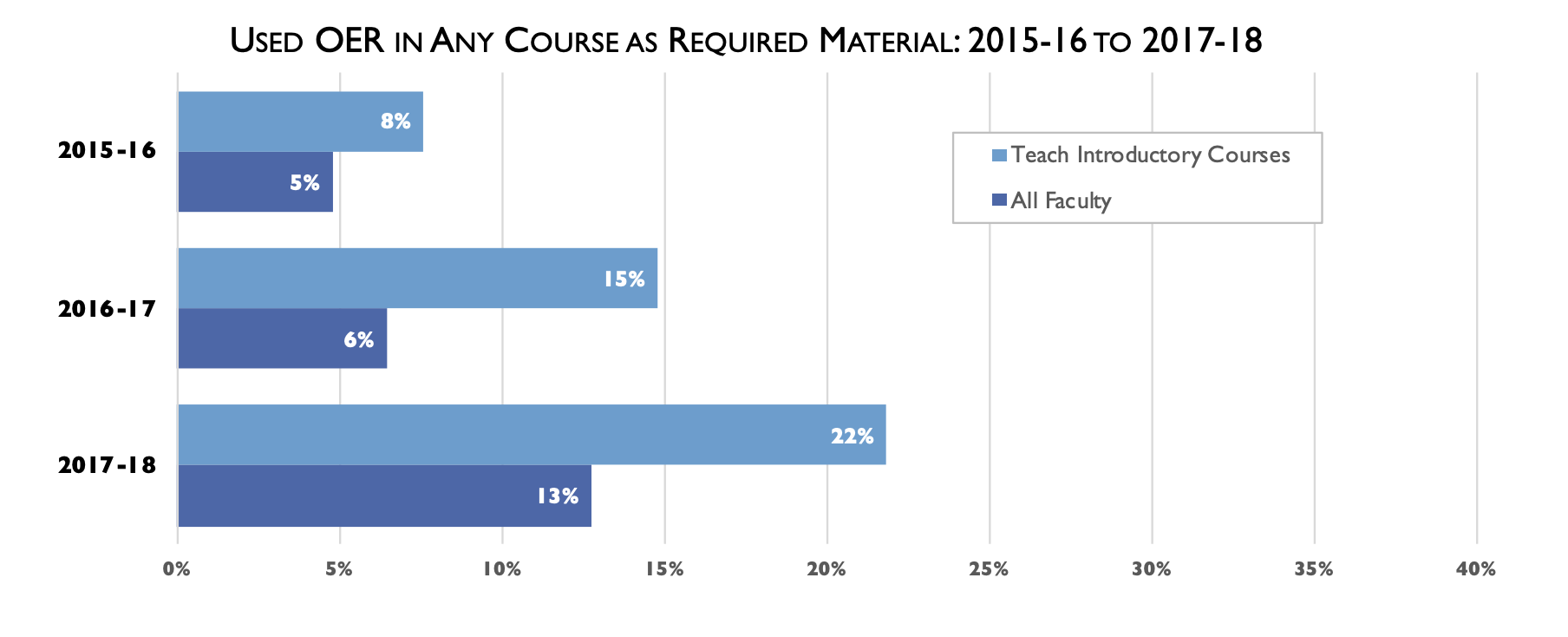
    Chart showing growth of OER adoption

    What is interesting is that this adoption growth aligns with an independent source, the Cengage OER survey from Fall 2016.

    Open Educational Resources (OER) in higher education have the potential to triple in use as primary courseware over the next five years, from 4 percent to 12 percent, according to a survey of more than 500 faculty by Cengage Learning.
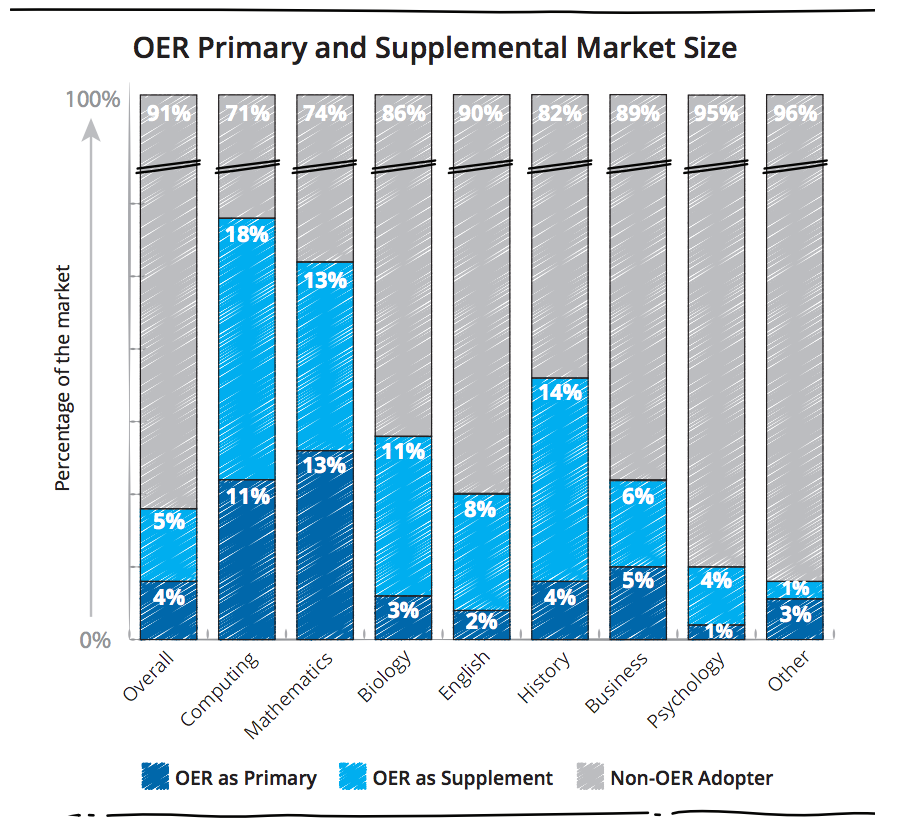
    What the data appear to show is significant growth in OER adoption for all faculty as well as for the subset teaching introductory courses. Adoption should continue, although it could be at a slower rate than was seen over the past year.

    It pays to read source material when the data describes important trends, especially when the results are surprising. I wish I had done this earlier.
  • College Scorecard: With victories like these, who needs failures?

    Goldie Blumenstyk had a fascinating interview with the Depart of Education’s Ted Mitchell on Friday that is well worth reading and / or watching (they have video of the interview along with full transcript). One of Mitchell’s key points jumped off the page for me.

    I think it [College Scorecard] was one of the department and the administration’s greatest victories

    Really? I can see the consolidation of student loans, a strong focus on college affordability, shifting of conversation away from just elite schools, and significant push on funding public schools as worthy victories to mention. But the College Scorecard – I don’t buy it.

    Blumenstyk pushed back on Mitchell, which led to this interesting exchange [emphasis added].

    GOLDIE BLUMENSTYK: I’m glad you mentioned the College Scorecard. I was thinking about that a little bit. It’s probably one of the places where the department had perhaps its biggest defeat, or maybe you might consider it a retreat. We were originally envisioning the Scorecard as a tool for accountability. Obviously, a lot of colleges and a lot of other people opposed that idea. And it became a complicated process even to create the effective scorecard. What did you learn from that process?

    TED MITCHELL: So I guess I would have a slightly different interpretation.

    GOLDIE BLUMENSTYK: I would imagine. (more…)

  • Dammit, the LMS: The Play at Home Game

    A while back, I wrote a rant about why LMSs fail to evolve. It got some…notoriety. Since Phil and I are now writing a bi-weekly column for the Chronicle‘s new Re:Learning section, I thought I’d try trimming down the piece and rewriting it for a general audience. It was an interesting exercise. On e-Literate, we have the luxury of writing pieces that are as long as we want them to be and of assuming that our audience is pretty knowledgeable about a wide range of tech issues. We can also choose to target different subgroups of our audience with each post. Honestly, there have been times when I’ve written a post that was primarily intended to persuade one (influential) person, although I always try to make my posts interesting to a broader range of people. When we write for the Chronicle, we are always writing for a broad audience of non-techies, and we have to keep our ideas small and focused enough that we can adequately express them in 1500 words or less. But to the degree that we succeed, we have an opportunity to be ambassadors for ed tech issues to broader academia.

    Since many of you play that role of ambassador every day, I’d be grateful for your feedback. If you have a moment, please go read the article at the Chronicle and then come back here and comment on it. Did I pick the right aspects of the issue to focus on? Do you think this piece would resonate with your campus stakeholders? Would it be helpful to you in your conversations at work?

  • On ECAR data and ed tech purgatory

    Recently I wrote a post about many ed tech products being stuck in pilots without large-scale adoption.

    In our consulting work Michael and I often help survey institutions to discover what technologies are being used within courses, and typically the only technologies that are used by a majority of faculty members or in a majority of courses are the following:

    • AV presentation in the classroom;
    • PowerPoint usage in the classroom (obviously connected with the projectors);
    • Learning Management Systems (LMS);
    • Digital content at lower level than a full textbook (through open Internet, library, publishers, other faculty, or OER); and
    • File sharing applications. [snip]

    This stuck process ends up as an ed tech purgatory – with promises and potential of the heaven of full institutional adoption with meaningful results to follow, but also with the peril of either never getting out of purgatory or outright rejection over time.

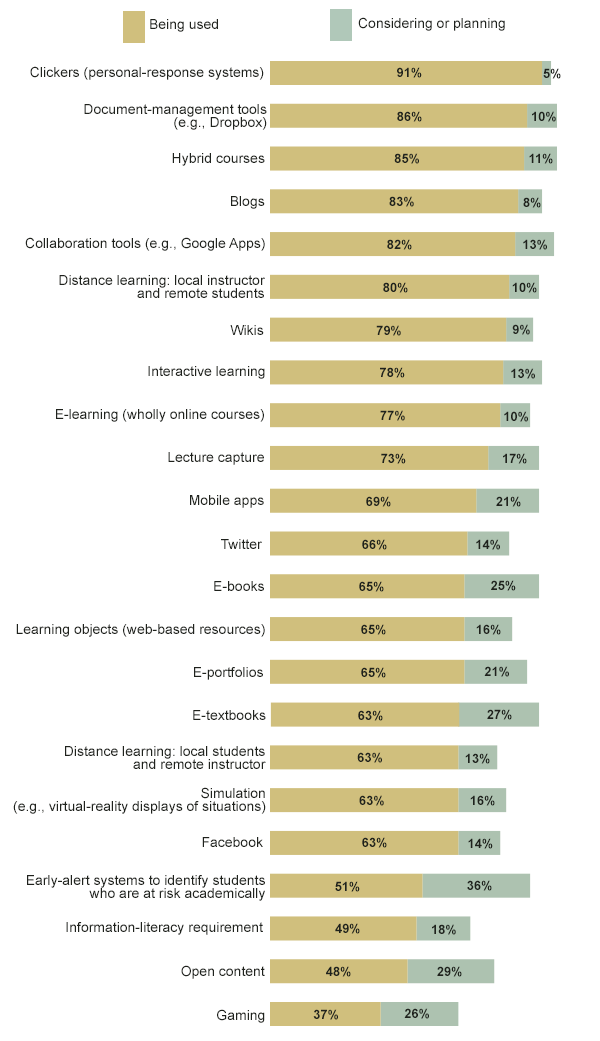
    With the Chronicle’s Almanac coming out this week, there is an interesting chart that on the surface might contradict the above information, showing ~20 technologies with above 50% adoption.

    Note: Data are drawn from responses by a subset of more than 500 of the nearly 800 institutions that participated in a survey conducted from June to October 2013. Reported statistics are either an estimated proportion of the population or an estimated median. Source: Educause Center for Analysis and Research
    Note: Data are drawn from responses by a subset of more than 500 of the nearly 800 institutions that participated in a survey conducted from June to October 2013. Reported statistics are either an estimated proportion of the population or an estimated median.
    Source: Educause Center for Analysis and Research [ECAR]
    The difference, however, is that ECAR (through The Chronicle) asked how many institutions have different ed tech products and our survey asked how many courses within an institution use different ed tech products.

    There are plenty of technologies being piloted but few hitting the mainstream, and adoption within an institution is one of the key indicators to watch.

  • Requiem for a Heavyweight – Lessons to Learn from the Problems at UC Online

    In 2009, the University of California finally decided to offer online education with a system-wide initiative called UC Online. Based on an article in the Chronicle that echoes a previous article in the Daily Californian, we learn that just three years later, UC Online is facing significant hurdles to survive the pilot phase and establish a sustainable online option. After raising just 1/8 of the promised private funding that would have avoided significant internal UC investment, UC Online has already borrowed $6.9 million from the system and is facing expenses of $7 million budget over the next year. Despite plans for 20 courses as of January 2012 for current UC students, UC Online has just eight courses available this fall (although only three are listed today). As the pilot expands in January 2013, there are serious questions about the feasibility of enrolling the thousands of non-UC students needed to avoid additional budget shortfalls.

    Given the supposed tsunami of online education that many claim to be revolutionizing higher education, how could such a high-profile initiative from an elite system face such problems?

    Despite an otherwise excellent article, the answers lie not so much in xMOOCs (e.g. Coursera, Udacity, edX), but rather in the underlying assumptions about what constitutes quality. Elite brand names may draw hordes of people willing to sample free content, but that doesn’t mean brand names will automatically draw tuition-paying students looking for credit.

    (more…)