Last week I wrote a post on two significant accrediting actions related to City College of San Francisco and Tiffin University.
If there really is a shift in the DOE’s views on accreditation or in the accrediting commissions’ interpretation of standards, then that could have fairly profound cascade effects on competency-based learning programs, private online colleges, MOOCs, and online service providers.
That is also why the lack of transparency from the accrediting commissions is so troubling. They are making decisions that have profound effects on many institutions, not just the specific schools under review.
Mathieu Plourde asked a good question in the comments.
Do you know how these accrediting bodies get their funding? If it’s at least in part from government funding or through membership fees from public institutions, I’d say it’s time to make them open up their data.
While I have not figured out if there is a method to force the accrediting commissions to “open up their data”, I would like to answer the first part of Mathieu’s question on funding.
Accrediting commissions are designated non-profit organizations, typically designated as 501 (c) (3) by the IRS. This means they have to file annual returns (form 990) to maintain their tax-exempt status. One sight that has this information is the Foundation Center. I’ve pulled up the most recent forms for the Accrediting Commission for Community and Junior Colleges (ACCJC), responsible for CCSF’s accreditation, and the Higher Learning Commission (HLC), responsible for Tiffin University’s accreditation. Some notes before getting to the data:
- There are six regional accrediting agencies in the US covering postsecondary education. Each agency has one or two commissions as members that are responsible for the actual accreditation reviews, for a total of eight regional accrediting commissions (New England and Western agencies have two commissions each).
- ACCJC is part of the Western Association of Schools and Colleges (WASC). Since there are two commissions in WASC, WASC files the form 990 instead of ACCJC. Their most recent form available is for the tax year ending June 30, 2011 (I do not know why the 2012 data is missing).
- HLC is a member of the North Central Association of Colleges and Schools (NCACS). Since there is only one commission in NCACS, HLC files its own form 990. Their most recent form available is for the tax year ending August 31, 2012.
- “Membership Dues” covers the fees paid by accredited institutions.
- “Program Services” combines paid workshops, consulting and annual conference revenues – typically from the member institutions.
- “Evaluation Visits” are primarily travel and direct expenses for peer review teams visiting institutions during review.
The actual forms can be found here for WASC / ACCJC and here for HLC . I have combined the most relevant data into one table.
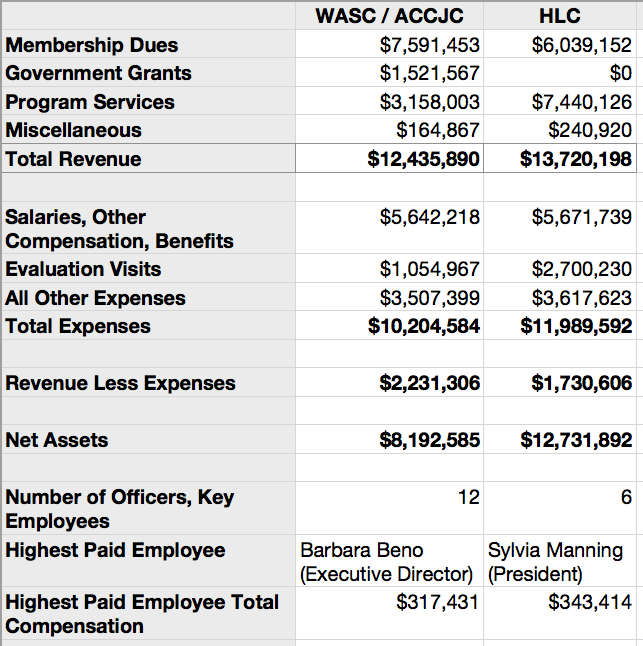
I went back and forth on whether to highlight the ‘highest paid employee’ data. In the end I chose to include this in the table as it seems relevant in terms of the organization’s motivations for self-preservation. In the case of ACCJC, there have been many charges of conflict-of-interest for the commission members, and the Department of Education has even found that the commission does not have adequate conflict-of-interest policies. The people running accrediting commissions are few in number but make a decent living. There is more information available in the form 990s.
So, for my long-winded answer to Mathieu: Accrediting commissions get their revenue primarily from membership dues and additional program services from member institutions, many of which are themselves public entities; they also make some revenue directly from government or foundation (e.g. Lumina Foundation, Gates Foundation) grants but not every year.

