Xplana has published some interesting growth projections on digital textbooks in the U.S. higher education market. If you’ve been frustrated by the slow adoption rate, then you’ll like what they have to say. First of all, and unsurprisingly, they see the proliferation of mobile devices (e.g., the iPad and other tablets, netbooks, smart phones, etc.) as one of the drivers of the change. As I have written here before, I believe the lack of a ubiquitous form factor that works well for eBooks has been a very serious limiting factor on the growth of digital textbooks in general and OERs in particular. But here’s the passage of the report that really caught my eye:
Current product publishing and finance forecasting within textbook publishing are based on traditional models of print textbooks sales. Viable textbook projects are generally required to have projected revenues of at least 6X plant costs in order to justify company investment. Within this traditional model, digital textbook sales are currently counted as incremental volume, or as added revenue (again, incremental to print), when bundled with a course cartridge or internal assessment solution.
Once digital textbook sales reach 13%, however, the finance model breaks down significantly as digital textbooks are no longer incremental and, instead, actually begin to pirate print sales deeply (6.5% decrease in revenue on the average title). When digital textbooks sales reach 20% of new textbook sales, based on current production and revenue models, textbook publishers will see a 10% decrease in revenues and a 13% decrease in project margin. At this point, publishers will have little choice but to change product, production and distribution strategies in favor of digital versus print.
 Textbook publishers shoehorn their digital textbook sales into a pretty traditional revenue model. It’s an afterthought rather than a main driver, and it usually gets treated that way. But there is a tipping point. Once digital textbooks begin to cannibalize a surprisingly low percentage of traditional print sales (13%), then the traditional revenue model for textbooks starts to fall apart quickly. At that point (which the Xplana authors project to hit some time in 2014), expect the textbook publishers to become a lot more aggressive about eTextbooks if they haven’t already. It will be life or death for them then.
But that’s not the end of their worries:
Currently, textbook publisher production models are based on print workflows. Digital textbooks are created at the end of the production cycle when compositors create final production-ready files. As sales of digital textbooks begin to cannibalize print sales, and as their inevitable future as the replacement of print textbooks becomes more apparent, publishers will be forced to alter current production workflows to favor a digital-first process with POD available from XML files and templates.
Textbook publishers have production models that are optimized for producing—wait for it—textbooks. Many of them are going to have to retool their processes in order to make their costs manageable when their main product is digital.
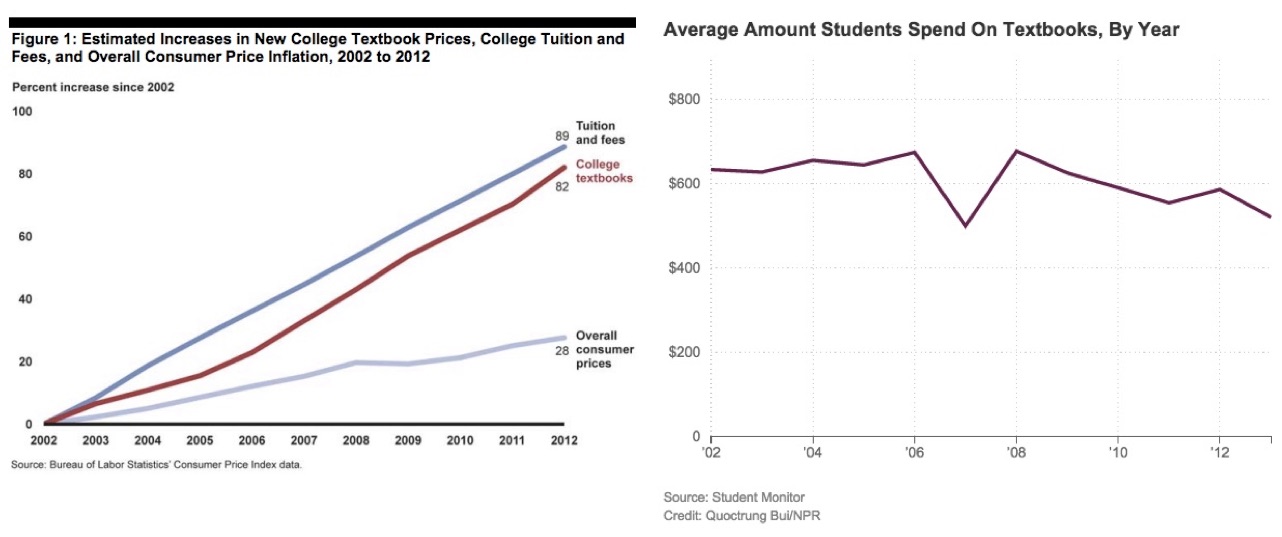
It’s not all bad news for them, though. Even though the costs of the digital textbooks will significantly lower than paper textbooks, the publishers may make up the revenues by “renting” the textbooks via some form of DRM. Basically, it will kill the used textbook market, which hurts their sales badly within a couple years of producing a book and forces them to invent reasons to create new editions in order to keep selling. Students, in turn get lower prices for assets that they usually don’t want to own after the end of the semester anyway. Prices will come down for this reason alone. Add to that the increased competition from new entrants, including but not limited to OERs, and there should be significant downward price pressure on college textbook costs in the next five years. Given that the U.S. Government Accountability Office has found that textbooks and supplies account for 72% of the cost of a 2-year college education, that’s a pretty important change.
Update: You can find the GAO report here.