
The title of this post is slightly tongue-in-cheek because I have my doubts about whether there is such a thing as PLEs that are distinct from existing software product categories. If there were, then after years of people talking about them, one would think there would have been an example by now that everybody could point to and say, “Yes, we all agree that is a Personal Learning Environment and not a Learning Management System, a Virtual Learning Environment, an ePortfolio, an RSS reader, a personal portal, or whatever.” Then again, maybe the PLE is an idea whose time has finally come. I believe that learning environment developers are embracing many of the articulated values behind the PLE and experimenting with different ways to embody those values. Xplana.com, which launched this week, is one example.
Tag: DIY U
-
Why Not Go to a Party School?
This is a guest post by Jim Farmer. Jim is Chairman of instructional media + magic.
Analysis of data recently released by PayScale Inc. and published in Bloomberg Business Week show starting salaries for graduates of Party Schools begin fifth of seven sectors moving up to third place by mid-career. Party Schools have a rate of salary increase exceeded only by graduates of Ivy League universities:
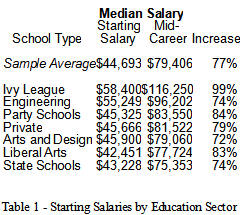
The data comes from 611,000 surveys completed as profiles on the PayScaleWeb Site.
-
Sakai Conference: Kamenetz Keynote
OK, this was worth the wait. I have video of Anya Kamenetz’s keynote, which set the tone for the Sakai Conference 2010 in some important ways. I also have a short video interview with her, some related video content from Dan Pink, and of course, analysis of what all this means for educational technology in general and for the design of Sakai 3 in particular.
Be warned: It will take you over 90 minutes to consume all the content from this post. Not counting post-consumption rumination. ((Did I or did I not warn you about impending blogorrhea? I believe I did.))
-
DIY U: The Modern Guild at Work
I’m waiting for the video of Anya Kamenetz’s keynote to be available online before I kick off my post series on the Sakai conference. In the meantime, here’s a quick update on a previous (and Kamenetz-related) post. A while back, I suggested that a modern variant on the guild approach could pull apprentices straight out of high school and train them in a craft while getting them started in a career directly. I also speculated that the software industry would be a good candidate for helping such a career path become socially acceptable for students looking to get into white collar jobs:
[W]ould a young person who is already from a relatively high economic bracket consider this guild system to be an acceptable career path? Would the guild path be accepted as a substitute for four years of full-time college study by middle-class students and their parents? It would take some work, but I believe it could be possible. Software development is one example of an industry that might be a good pioneer of this approach. If, say, Microsoft or Google were to take students out of high school to become paid employees and put them on an apprenticeship path where they would be able to earn their degrees over time at lower cost while earning good salaries and becoming shareholders in the company, this approach could become acceptable in a hurry.
Interestingly, it turns out that Zoho has a highly successful apprenticeship program at their India Development Center. Here’s an interview about it with CEO Sridhar Vembu that I found via this O’Reilly Radar post:
Basically, they’re taking students from the 85% to 90% of Indian high school students who would be considered poor by global standards, supplying them with some mentoring and open educational resources (translated into their native Tamil language), and paying them to go to a nine- to twelve-month crash course on how to become programmers. The students are highly successful on average and can aspire to high positions within the company. Many of them also go on to get college degrees while working, but many don’t. It never occurred to me that India would be an ideal seed bed for this approach, but it’s obvious in retrospect. There’s a huge potential workforce, including many talented young people who don’t have access to conventional educational paths. It also strikes me as only a matter of time before some enterprising university strikes a deal with Zoho to create a Walmart U-style deal where students get college credit for their apprenticeship and are tracked to a continuing degree program should they want to do so.
There’s a lot more that’s interesting in this interview, including reflections on why such a program would be harder to start with poor U.S. neighborhoods, the challenges and secrets to the program’s success, and so on. The whole interview is well worth your time.
-
DIY U: 'POP!' Goes the Bubble
A while back, I suggested that there might be a bubble in the higher education market, and that students taking on large amounts of debt to go to non-elite schools could be analogous to sub-prime mortgage customers. Well, somebody else has picked up on the theme, and that somebody is none other than Steven Eisman, a hedge fund manager featured in The Big Short as one of the few people who made tons of money by betting against the housing market before it crashed. In particular, he is pointing to the for-profit education providers as the sub-prime lenders and claims that the bubble could pop if Congress tightens lending rules:
“Until recently, I thought that there would never again be an opportunity to be involved with an industry as socially destructive and morally bankrupt as the subprime mortgage industry” said Eisman, 47, one of the sellers featured in “The Big Short: Inside the Doomsday Machine” (Norton, 2010), Michael Lewis’s book about investors who anticipated the housing bust. “I was wrong. The for-profit education industry has proven equal to the task.”…
“Default rates are already starting to skyrocket,” Eisman said at the Ira Sohn Investment Research Conference, in New York. “It’s just like subprime, which grew at any cost and kept weakening its underwriting standards to grow.”
Just as bond-rating firms gave high grades to securities backed by risky mortgages, so the accrediting associations responsible for monitoring educational quality of for-profit colleges don’t provide thorough and independent scrutiny, said Eisman. Because accreditation is a peer-review system, in many instances representatives of for-profit colleges sit on the board of the body that certifies them, he said.
The whole article is worth reading.
“Until recently, I thought that there would never again be an opportunity to be involved with an industry as socially destructive and morally bankrupt as the subprime mortgage industry” said Eisman, 47, one of the sellers featured in “The Big Short: Inside the Doomsday Machine” (Norton, 2010), Michael Lewis’s book about investors who anticipated the housing bust. “I was wrong. The for-profit education industry has proven equal to the task.” -
DIY U: Digital Apprenticeship and the Modern Guild
A while back, I had the pleasure of chatting with Paul Lefrere. Paul is a guy who thinks about large-scale questions like, “How can we create and fill a couple of million green jobs in a country within a couple of years?” One problem he was grappling with regarding higher education was time-to-market for students. He needed to get them working and productive in less than four years—and possibly less than two. One idea he talked about was what he called “digital apprenticeship.” Imagine a solar panel installation trainee wearing a helmet with a wireless webcam on it. You could have an expert watching her work virtually, either coaching her through the steps in a process or testing her by watching her perform the process and then certifying that she’s done it right. She could be both a productive worker and a student on a long-term educational path on day one.
More recently, Jim Groom suggested that apprenticeship might be a good model for networked learning, particularly for those students who are not auto-didactic. ((It’s worth noting that, while we tend to refer to “auto-didacts” as if there is a special class of people who can learn everything on their own, the truth of the matter is that many people can be auto-didactic in some subjects and not in others. For example, I’m pretty good at teaching myself many kinds of book learning but am not good at all when it comes to figuring out how to, say, fix a squeaky floor board or replace the switch in my hallway light, even with detailed instructions. And I have given up all hope of ever teaching myself how to juggle. I could learn to do all of these things, but I would need coaching, because I’m not good at noticing what I’m doing wrong—or sometimes even whether I’m doing wrong—in these areas.)) I think that Jim and Paul are both really onto something. Apprenticeship is a model that is well understood, can work for a variety of topics in less formal settings, can get learners productive on certain tasks quickly, and can get the benefits of scale by using modern communications technologies. At the same time, it’s one thing to have a model that works well in theory and quite another to have a set of practices that are likely to be adopted widely under given social and economic conditions. So in this post, I’m going to consider the question of what it would take to embed apprenticeship into the fabric of our society as a broadly accepted career path across a wide range of career types.
-
DIY U: Is There a Bubble in the Higher Education Market?
Update: Coincidentally, Anya Kamenetz just posted an interview in which she briefly compares the student loan situation with the real estate bubble here.
When I opened my email the other day, I was greeted by the following blurb from Today’s Campus:
The U.S. college-buying public numbers in the tens of millions. Many of them are first-time purchasers. Most of them are not. Among a marketplace of that size, one ‘buying cluster’ could supply enough students to fill several campuses. One very interesting cluster we’ve identified is husbands purchasing higher education for their wives. Click here to order a free sample report with our compliments.
We don’t often hear higher education talked about in such baldly commercial terms. Most faculty and campus administrators have visceral negative reactions to this kind of language. But that doesn’t mean that colleges—even not-for-profit colleges—aren’t essentially run as businesses. It just means that (a) they’re often run as businesses badly because it is considered distasteful to draw on the lessons and vocabulary of the business world, and (b) educators often fail to identify the tensions between their school’s mission and its operating model, thus making it less likely that they will be able to confront some of the system’s ethical challenges successfully. But since the heart of DIY U is an economic argument, it is worthwhile to try framing issues in the language of economics. As the title of this post suggests, the specific question I want to address is whether there is a bubble in the college education market.