
e-Literate

Present is Prologue

Tag: educational models

  • The Need for Alternative Educational Models in California Illustrated in One Chart

    An earlier version of this article appeared at the Delta Initiative website

    There is a full-court press in the media regarding the California budget crisis and its likely impact on higher education. The most recent entry is in the New York Times.

    Class sizes have increased, courses have been cut and tuition has been raised — repeatedly. Fewer colleges are offering summer classes. Administrators rely increasingly on higher tuition from out-of-staters. And there are signs it could get worse: If a tax increase proposed by Gov. Jerry Brown is not approved this year, officials say they will be forced to consider draconian cuts like eliminating entire schools or programs.

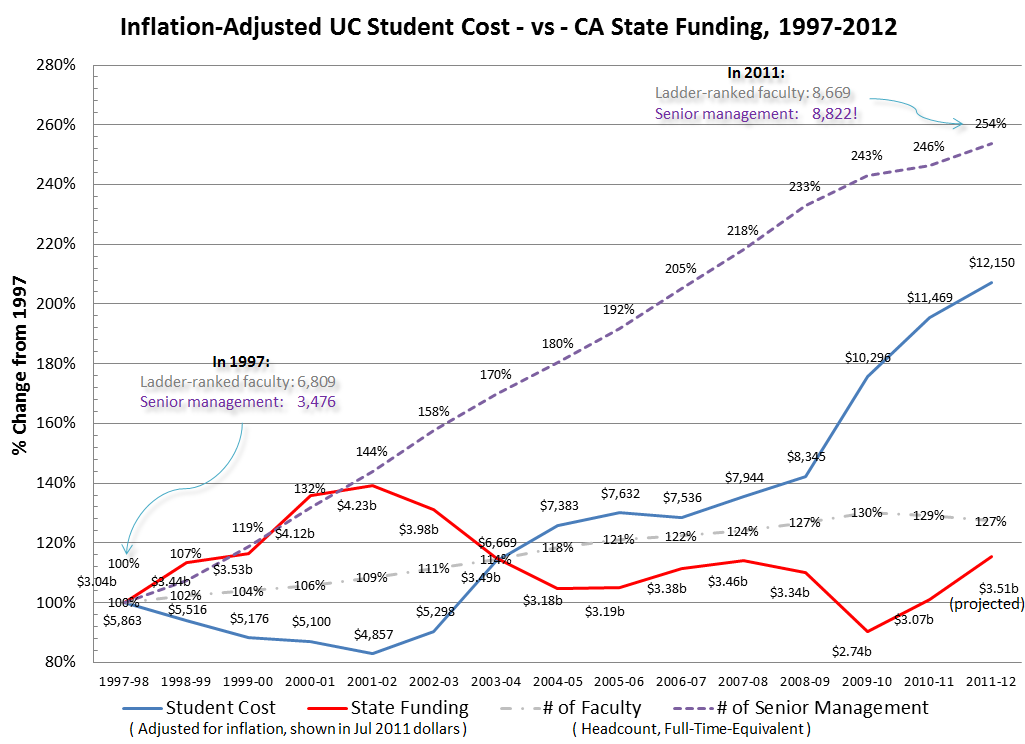
    While I’m not arguing the point that there is a crisis, I do think it is worth looking at historical trends to get perspective. Consider the following chart from the California Review (blog post here). It looks at inflation-adjusted budget numbers and faculty and senior management headcount from 1997 – 2011. [Click to expand]

    (more…)

  • The Emerging Landscape of Educational Delivery Models

    Part 2 in this series, on a key difference in educational delivery methods, can be found here.

    Traditional education or online education. In the past decade it seems that the dominant conversation has been around the potential for online learning, both from for-profit and non-profit options, to disrupt education as an industry.

    What I believe we are seeing in 2011 and 2012 is a transition to an educational system no longer dominated by traditional education and one or two alternative models. As my colleague Molly Langstaff has described, educational technology and new educational courses and programs are interacting to create new language and models for education. What does this emerging landscape of educational delivery models look like?

    While I do not claim to be able to solve this problem, I would like to offer a more descriptive view than the dichotomy of traditional and online education describes.

    (more…)