
e-Literate

Present is Prologue

Tag: Educational technology

  • Analysis of Instructure Security Testing

    Instructure has engaged Securus Global to test the Canvas LMS product for security vulnerabilities. Instructure also invited me to be an independent observer – participating in the process and independently reporting on the testing and Instructure’s response to any vulnerabilities identified. Part 1 of this series of posts described the concept. Part 2 gave a mid-term update, describing the process involved and initial results. Part 3 described the full results of the security assessment. In this final post on the experience I’d like to address two subjects – my own impressions of the testing, and a call for more LMS vendors to follow suit and make their security testing more transparent.

    Results Themselves

    As described in part 3, the risk assessment found 10 vulnerabilities – 1 critical, 1 high, 4 moderate and 4 low risk – in the Canvas LMS system. I do not have a basis to judge the relative number of vulnerabilities found compared to Instructure’s competitors, as there is not an industry-specific standard on the depth and extent of penetration testing, but by all appearances the Canvas LMS system is a well-designed, generally secure application. I base this judgment on two factors:
    (more…)

  • Educational Publishers Appear to be Supporting SOPA

    UPDATE 12/23: Per the House Judiciary Committee, it is now confirmed that these companies are on the record supporting SOPA and the Protect IP companion legislation.

    Yesterday the House Judiciary Committee began the process of marking up the Stop Online Piracy Act (SOPA) bill. From all appearances, most of the amendments have been rejected, thus leaving SOPA essentially in its original form. While passage is not assured, it is certainly a possibility as described by CNET.

    After a marathon debate on the Stop Online Piracy Act, it’s clear that the Hollywood-backed bill enjoys enthusiastic support among key members of the U.S. House of Representatives and is one step closer to becoming law.

    That became obvious after every legislative attempt to defang, rewrite, or significantly alter SOPA over nearly a 12-hour period today ended in victories for large copyright holders–and defeat upon defeat for the bill’s critics.

    While the SOPA impacts are not fully understood, there are some real dangers to educational usage that we need to follow. As described in my first post on the subject, SOPA could have a major impact on institutions using any form of educational technology to share content outside of a tightly-controlled password-protected course site. As we saw at EDUCAUSE this year, much of the potential of educational technology is to facilitate sharing of content outside of the traditional “walled gardens” of traditional LMS solutions, and enabling collaboration more broadly.

    This year’s EDUCAUSE keynote speaker, Seth Godin, has a post up at The Domino Project that calls out many of the list of “companies behind one of the lobbying groups pushing for SOPA”. On this list, lo and behold, we find most of the educational publishing companies.

    Pearson Education, Cengage Learning, McGraw-Hill Education, Macmillan, Scholastic, etc. They are all on the list.

    (more…)

  • Instructure Security Assessment Results

    Instructure has engaged Securus Global to test the Canvas LMS product for security vulnerabilities.  Instructure has also invited me to be an independent observer – participating in the process and independently reporting on the testing and Instructure’s response to any vulnerabilities identified.  Part 1 of this series of posts described the concept.  Part 2 gave a mid-term update, describing the process involved and initial results.  In this post I’ll describe the full results of the security assessment.  I’ll add my actual analysis in the final post.

    The purpose of the testing was to validate and review the Canvas LMS design and implementation with respect to vulnerabilities that could be exploited by a motivated hacker.  Securus employed security experts to ethically hack, both manually and with automated tools, a test environment to try and identify specific vulnerabilities, working from the perspective of both an unauthorized user and an authorized user.  There was a range of exploits tested, but the basic idea is to find out if someone could access information or functionality that should be protected by system controls including role-based security.

    Summary of Findings

    The findings were presented to Instructure on November 29, 2011 in report form and with a conference call to discuss.

    (more…)

  • Regulatory Barriers to Innovation for Ed Tech and Open Education

    Over the past few weeks there has been a significant backlash growing against SOPA (the anti-piracy bills introduced in Congress) – read here or here for background.  The biggest change since the bills were introduced is that big technology vendors (significantly including Microsoft and working through the Business Software Alliance) have either withdrawn support or gotten off the fence.  The BSA is now officially lobbying against SOPA as written.  In the world of strange bedfellows, there are also a number of politicians on both sides of the aisle publicly opposing the bill.  It does take some real legislative talent to help create a Pelosi – Paul – Issa common cause.

    Despite the growing opposition, there certainly appears to be a concerted effort in Congress to get the bill passed.  The outcome is far from clear at this point.

    While SOPA by itself remains a major threat to innovation for educational technology and open education in general, it may be helpful to step back and see the growing list of federal laws and regulations that could have a major impact on innovation in higher education.  While each issue is interesting in and of itself, a pattern is emerging.  This pattern suggests that organizations interested in preserving the status quo – are actively pushing back against the tide of change brought by online systems, online education, and digital content.

  • When Large Companies Enter Ed Tech

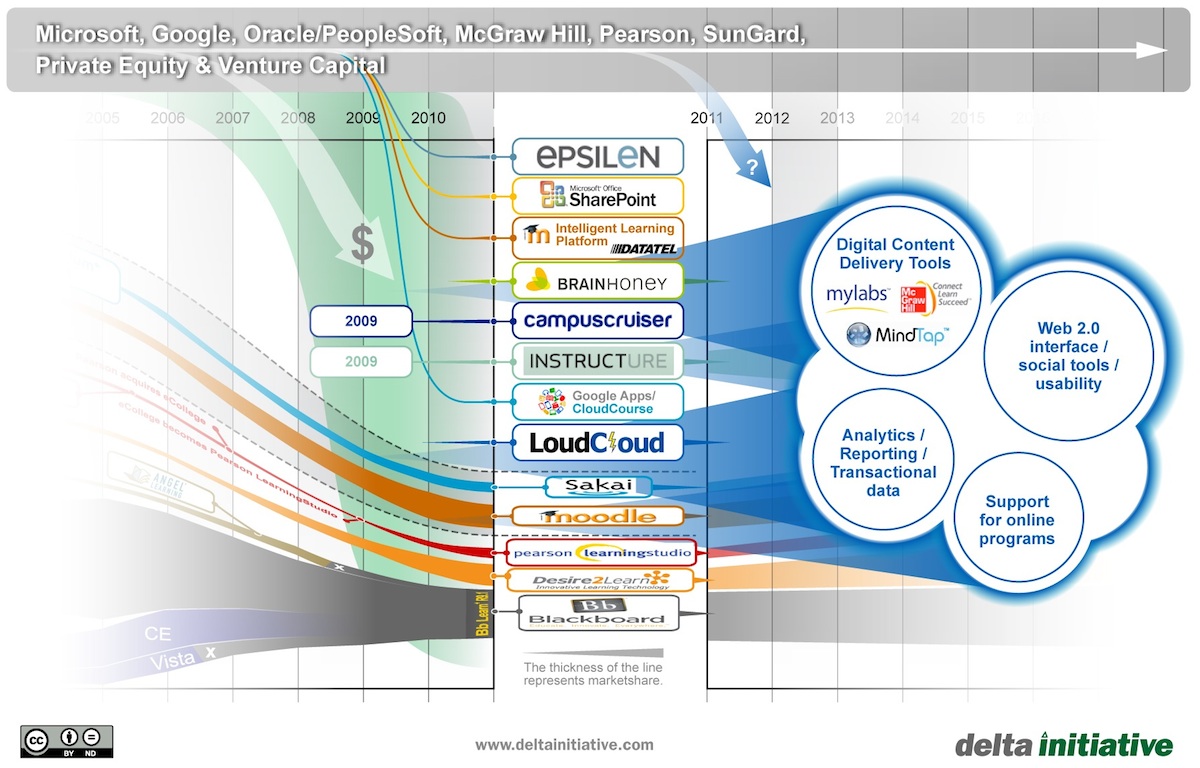
    I had a very interesting conversation on the way home from EDUCAUSE with Frank Florence, who is the Senior Director of Education Market Management for Cisco.  We discussed the changes happening in the ed tech market, and Frank helped me understand some of the market forces behind the changes we’re seeing.  One topic in particular was the dynamic between entrepreneurial companies that develop within a vertical market and larger companies that span markets.  I have argued that internal investment from larger companies is helping to change the ed tech market, but Frank provided valuable insight into the nature of the typical market forces we’re living through.  This observation of large company involvement helping to change the LMS portion of the ed tech market is shown below, in many of the companies in the top gray bar and some that are not listed.

    (more…)

  • Ambivalent on Ed Tech: The EDUCAUSE Re-write

    Now that I’ve had time to digest the implications of EDUCAUSE 2011 – which were significant, but not as mind-blowing as the Reading Market experience – I keep going back to a post I wrote earlier this year (although not on e-Literate).  In that post contrasting a Gartner report on IT spending with an Ambient Insight report on ed tech and online spending, I argued that ambivalence was the key to understanding both reports in context.  Likewise, based on the hype and reality of ed tech at EDUCAUSE, ambivalence can help us understand future implications for education.

    One of the benefits of blog posting is the ability to wholesale plagiarize yourself where needed (ed – I’ll see you in court, Mr. Hill).  Herewith is my rewrite of that post based on this year’s EDUCAUSE experience.

    (more…)

  • SunGard HE and Blackboard Acquisitions: Compare and Contrast

    UPDATE:  In the section on ‘Cash Cow vs. Growth Potential’, my choice of words could have caused misunderstanding.  I did not mean to equate Operating Income with Cash Flow, and my choice of the word ‘cash’ in this section should really have been ‘income’, as my analysis was obviously based on Operating Income.  I have made this correction below.  My apologies for any misunderstanding.

    Consider the recent news this summer that private equity firms have agreed to acquire both SunGard Higher Education (SGHE) and Blackboard in separate deals:

    • Two market leaders in technology solutions for education,
    • both generating revenues of several hundred million dollars per year,
    • both business strategies at risk due to eroding market share in their core business since 2007,
    • both facing challenges to integrate product lines and offer a clear road map for customers,
    • and both sold to private equity firms for more than $1.6B.

    SunGard Higher Education (SGHE) and Blackboard – brothers in arms.

    At first glance, there are some strong similarities between the acquisition perspectives of both market leaders, but if you look deeper, the differences provide a good insight into the future of technology markets for higher education.  These differences can explain why the ERP market seems to be consolidating with fewer choices while the LMS and educational technology market seems to be expanding with more choices.

    Cash Cow Income Machine vs. Growth Potential

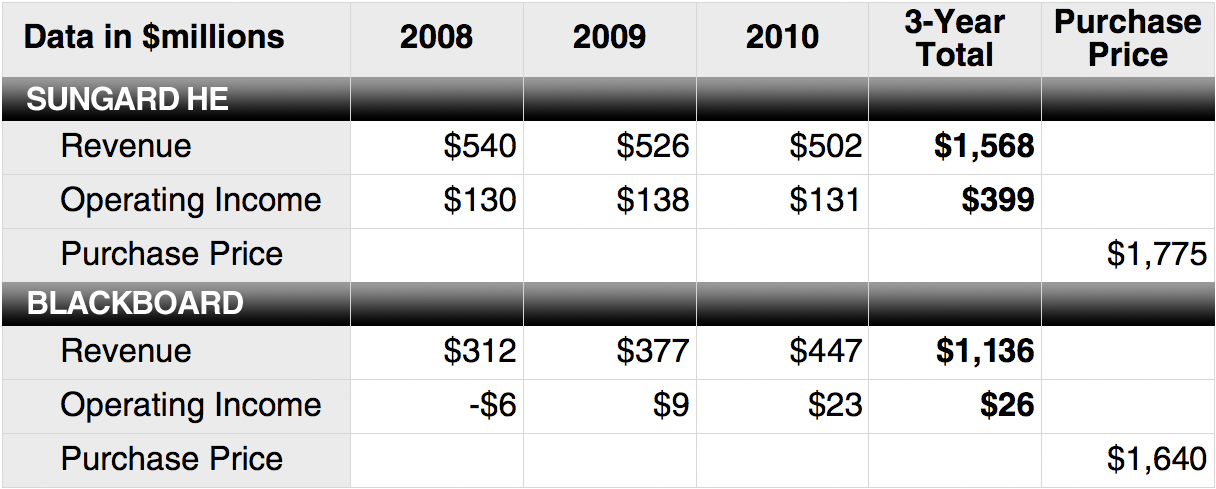
    During research for this post, I was surprised to find out how much cash income that SGHE generates and how close Blackboard has come to SGHE’s revenue numbers.  While Blackboard has seen its revenue increase due to corporate acquisitions of its own, it has only had a combined operating income of $26M over the past 3 years.  In that same time, SGHE has seen its revenue decrease by almost 10%, but it has had a combined operating income of $399M.

    It is somewhat difficult to compare the financials of the two companies, as they employ different accounting methods, so use the following table to see the big picture rather than the details.  I have attempted to show total revenue (numbers are fairly solid) and operating income (not as solid), while ignoring provisions for income taxes.  This data is based on SunGard’s annual report for 2010 (p. 36 as printed) and Blackboard’s annual report for 2010 (p. 26 as printed).

    (more…)