This is a guest post by Jim Farmer. Jim is Chairman of instructional media + magic.
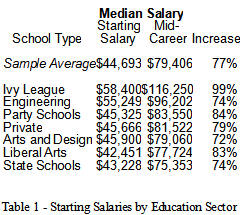
Analysis of data recently released by PayScale Inc. and published in Bloomberg Business Week show starting salaries for graduates of Party Schools begin fifth of seven sectors moving up to third place by mid-career. Party Schools have a rate of salary increase exceeded only by graduates of Ivy League universities:
The data comes from 611,000 surveys completed as profiles on the PayScaleWeb Site.
I have a couple of take-aways from both the interview and the conference. First of all, I was astonished at how much D2L is growing. Based on what I saw at the Sakai conference, what the market surveys have been saying, and what I know from talking to people, it was already clear to me going in that there’s a big shift happening in the LMS market. I expected to see D2L benefiting from that. But I wasn’t prepared to see the number of new clients they’re on-boarding. I’m trying to get a list to illustrate the size of the growth. In his keynote, John had three slides’ worth of new logos. These aren’t expanded client relationships, which is the kind of thing that Blackboard tends to highlight these days. These are new clients.
Second, the economic downturn is affecting the market, but the effects are somewhat unpredictable. John’s story about PASSHE, a system with fourteen different universities, migrating to D2L in a couple of months, is remarkable. There’s only one thing that can drive a fractious group of state colleges to act that quickly in unison: a budget crisis.
And finally, I do see a vision for the future of the LMS emerging from D2L’s development work (although it’s hard to convey a clear sense of it in the interview format). It’s a vision that is significantly different in some ways from Sakai’s, Moodle’s, or Instructure’s. My sense is that it’s also different than Blackboard’s, but I’m not familiar enough with the details of Blackboard 9.1 and their roadmap to say so with a great deal of confidence. Desire2Learn is headed straight into the thicket of some thorny cultural change management problems at the university. Adopting and sharing learning objectives, sharing learning content, taking a systemic approach to ePorfolios, discovering metrics in student activity and performance data—each of these efforts individually is hard to sell in a university culture and results in failure more often than success. D2L appears to be betting that the problems are actually easier to solve together than separately because you can get synergies from integrating the technologies behind them. It’s not clear to me whether they’ve fully articulated their approach that way, even to themselves, but it is, in fact, what they appear to be trying to do.
I have more to say about what I learned about the conference, including about the company’s announcements about their mobile plans and how they stack up against the other market entrants, but I also have a Jim Farmer post, a post about another new LMS entrant called NIXTY, and probably the most important Sakai conference post to get up as well. And next week I’ll be at Campus Technology all week, which both limits the amount of blogging time I have and will undoubtedly provide fodder for new posts.
I have often said that, if you want to understand the likely future behavior of a publicly traded company, the best way to approach it is to think of it as a complex money-making machine. If you can understand how the machine works, then you can make reasonable guesses as to how it will behave under different circumstances and the degree to which that behavior is likely to help or hurt your interests.
There has been a lot of hand-wringing about Blackboard’s announced acquisitions of Wimba and Elluminate. Let’s look at the facts.
We’re making progress on getting the Sakai conference keynote videos online, but while we wait for those to be ready for the kick-off to the conference post series, I’d like to take advantage of the unexpected lull to write a bit about a new LMS entrant that I had an opportunity to learn about recently. Instructure‘s Canvas product is one of a new generation of LMS’s being created by start-ups that seem to be suddenly popping up everywhere. It has some of the Web 2.0 features that you would expect, like easy personal profile integration with external social networking sites and easy video embedding. But unlike, say, NIXTY—another start-up that really emphasizes open education—Instructure’s big theme seems to be getting back to basics—in a good way.
I’m waiting for the video of Anya Kamenetz’s keynote to be available online before I kick off my post series on the Sakai conference. In the meantime, here’s a quick update on a previous (and Kamenetz-related) post. A while back, I suggested that a modern variant on the guild approach could pull apprentices straight out of high school and train them in a craft while getting them started in a career directly. I also speculated that the software industry would be a good candidate for helping such a career path become socially acceptable for students looking to get into white collar jobs:
[W]ould a young person who is already from a relatively high economic bracket consider this guild system to be an acceptable career path? Would the guild path be accepted as a substitute for four years of full-time college study by middle-class students and their parents? It would take some work, but I believe it could be possible. Software development is one example of an industry that might be a good pioneer of this approach. If, say, Microsoft or Google were to take students out of high school to become paid employees and put them on an apprenticeship path where they would be able to earn their degrees over time at lower cost while earning good salaries and becoming shareholders in the company, this approach could become acceptable in a hurry.
Interestingly, it turns out that Zoho has a highly successful apprenticeship program at their India Development Center. Here’s an interview about it with CEO Sridhar Vembu that I found via this O’Reilly Radar post:
Basically, they’re taking students from the 85% to 90% of Indian high school students who would be considered poor by global standards, supplying them with some mentoring and open educational resources (translated into their native Tamil language), and paying them to go to a nine- to twelve-month crash course on how to become programmers. The students are highly successful on average and can aspire to high positions within the company. Many of them also go on to get college degrees while working, but many don’t. It never occurred to me that India would be an ideal seed bed for this approach, but it’s obvious in retrospect. There’s a huge potential workforce, including many talented young people who don’t have access to conventional educational paths. It also strikes me as only a matter of time before some enterprising university strikes a deal with Zoho to create a Walmart U-style deal where students get college credit for their apprenticeship and are tracked to a continuing degree program should they want to do so.
There’s a lot more that’s interesting in this interview, including reflections on why such a program would be harder to start with poor U.S. neighborhoods, the challenges and secrets to the program’s success, and so on. The whole interview is well worth your time.
A while back, I suggested that there might be a bubble in the higher education market, and that students taking on large amounts of debt to go to non-elite schools could be analogous to sub-prime mortgage customers. Well, somebody else has picked up on the theme, and that somebody is none other than Steven Eisman, a hedge fund manager featured in The Big Short as one of the few people who made tons of money by betting against the housing market before it crashed. In particular, he is pointing to the for-profit education providers as the sub-prime lenders and claims that the bubble could pop if Congress tightens lending rules:
“Until recently, I thought that there would never again be an opportunity to be involved with an industry as socially destructive and morally bankrupt as the subprime mortgage industry” said Eisman, 47, one of the sellers featured in “The Big Short: Inside the Doomsday Machine” (Norton, 2010), Michael Lewis’s book about investors who anticipated the housing bust. “I was wrong. The for-profit education industry has proven equal to the task.”…
“Default rates are already starting to skyrocket,” Eisman said at the Ira Sohn Investment Research Conference, in New York. “It’s just like subprime, which grew at any cost and kept weakening its underwriting standards to grow.”
Just as bond-rating firms gave high grades to securities backed by risky mortgages, so the accrediting associations responsible for monitoring educational quality of for-profit colleges don’t provide thorough and independent scrutiny, said Eisman. Because accreditation is a peer-review system, in many instances representatives of for-profit colleges sit on the board of the body that certifies them, he said.
“Until recently, I thought that there would never again be an opportunity to be involved with an industry as socially destructive and morally bankrupt as the subprime mortgage industry” said Eisman, 47, one of the sellers featured in “The Big Short: Inside the Doomsday Machine” (Norton, 2010), Michael Lewis’s book about investors who anticipated the housing bust. “I was wrong. The for-profit education industry has proven equal to the task.”
Update: Literally a minute after I published this, Scott Wilson tweeted about this Slideshare presentation about the relative advantages of web-native development for smartphones.
Thanks to George Kroner for this link to data on student mobile phone usage at University of Edinburgh. Now, this is just one data point, so we have to be careful not to overgeneralize. However, what strikes me about the survey, in addition to the high usage of smart phones in general, is how different the market share numbers are from the U.S. In this survey, Nokia has a full 25% of smartphone market share—substantially more than RIM has. Nokia’s smartphones run Symbian, an operating system that barely registers in the U.S. in terms of market share. It would appear that smartphone market share can be highly variable across different markets.
Even within the United States, smartphone market share has been highly volatile. Consider this graph from The New York Times:
Source: The New York Times
We tend to forget that, just three years ago, Palm was at the top of the U.S. smartphone market and Apple didn’t have a smartphone. Given that Palm has just been purchased by HP, Microsoft is coming out with a ground-up rewrite of their mobile operating system, and Android is gaining traction fast, making a bet that you know which phones are going to be hot three years from now and developing a separate native app for each of them can be a risky and expensive proposition.
This is part of what makes the Blackboard vs. Moodle dueling mobile strategies interesting. Blackboard has chosen the more expensive native app approach and is charging extra for the capability (a decision that Ray Henderson felt a need to justify in his recent blog post). Moodle has several different approaches being developed by various parties, but the one most closely associated with the Moodle community management is web-native and (of course, given that it’s open source) free. In terms of mobile functionality, we have no real evidence that one platform is leading the other, although I suspect that they will remain close to comparable for the short to medium term.
I have no doubt that Blackboard will make some Mobile Learn sales in the short term (although, given that they don’t break out their sales in their earnings reports anymore, we’ll have no way to know how many Mobile Learn versus Mobile Central sales they make, or how many mobile sales they make in the aggregate). The question is how much pressure will they come under how quickly from their customer base to bundle this capability for free as their competitor does. And will their native app approach yield them a competitive edge that enables them to continue to charge, or will it turn out to be a financial millstone around their necks as they are forced to continue the higher-cost development strategy to provide a free application?