
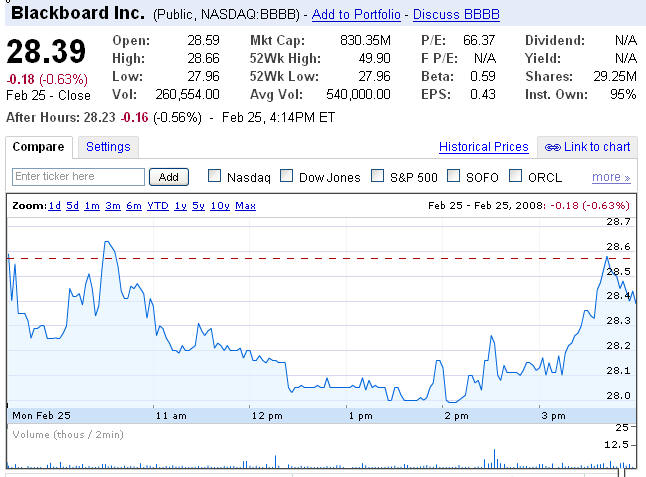
Down half a percent on the day.
Translation: “Eh.”
Down half a percent on the day.
Translation: “Eh.”
As I indicated in previous posts, the jury questionnaire should be made public by the end of the day today. It will take us some time to sort through it once it’s out, so expect updates over the next couple of days. In the meantime, D2L has posted the judge’s instructions to the jury. Written in plain, accessible English, the document gives a pretty clear picture of what the jury was asked to consider and clears up some common misconceptions. (For example, the jury was asked to rule on the patent’s validity.) It’s worth the read.
Along these lines, Jim Farmer will be posting a first-hand account of the trial in advance of the detailed analysis of the outcomes (probably tomorrow).
From the latest piece in The Chronicle:
Mr. Small said colleges have nothing to fear. Blackboard isn’t seeking an injunction against any of Desire2Learn’s already-installed products. It is hoping, however, to persuade the court during a hearing scheduled for March 10 to ban the company from future sales of its course-management system in the United States.
If the judge rules against an injunction on that matter, Blackboard will ask that Desire2Learn pay royalties on any new sales, in addition to the $3.1-million awarded for lost profits and back royalties. At the start of the trial, Blackboard was seeking $17-million.
The detailed jury ruling should be published by the end of the day today. (The judge gave the jury a detailed questionnaire to fill out as part of the process.) We’ll know a lot more from that.
Executive Director Michael Korcuska has posted a response on his blog. In my opinion, it hits all the right notes and is well worth reading in its entirety. I’ll just highlight one particular point Michael makes that I think is particularly important:
One of the main reasons the Sakai project was started in the first place was to provide more choice for the higher education community. We hope that D2L will continue to offer its product in the United States. We do not want to see this verdict result in less competition and fewer choices in the marketplace.
The Waterloo Record has some more details (although there’s still a lot we don’t know):
I’m still trying to understand what all of this means. I don’t think anybody involved with this has changed their position or reduced their level of concern while this fight has dragged out, so the questions are really about what the legal ramifications are and what the various community members (including but not limited to D2L and BB) will do next.
One thing that is clear, however, is that so far nobody has benefited financially from this. The $3.1 million Bb could receive in settlement probably won’t even cover their legal fees. Their stock is at the same level it was when they initiated the lawsuit and down over 40% from its highs. And obviously D2L has not come out richer either. Blackboard has a net loss of customers and has created tremendous negative press for itself while D2L now has at least one major customer who is willing to go on record saying that they are worried. (We know a lot less about the financial impact on D2L because it’s not a publicly traded company.)
Tell me again how software patent assertion is going reward and enhance innovation in higher education?
Dear Client,
I am writing to update you on the current status of the Blackboard v. Desire2Learn Patent Infringement lawsuit. Earlier today the jury handed down its verdict that the patent is valid and that Blackboard should be awarded damages of approximately $3 million.
As you know, Blackboard filed a patent infringement suit against Desire2Learn on July 26, 2006. Blackboard claimed that Desire2Learn was infringing all 44 claims of patent number 6,988,138. Last summer, the Court eliminated the first 35 claims of the suit.
From the time we were first served with the suit we committed to you, our valued clients, as well as to the educational community at large, that we would defend ourselves vigorously in this matter. From the outset of this case we knew that we had an obligation to stand up against Blackboard and that our actions in doing so would be in the best interest of the entire educational community.
For the past two weeks, we have been in Lufkin, Texas, heavily engaged in the trial at the Lufkin Federal Courthouse. The case concluded yesterday with closing arguments. The jury deliberated for a number of hours before returning its verdict today.
There is no immediate threat to you our clients. We will work with you to ensure there are no future issues. We are financially sound and are confident of our ability to work through this matter.
With your support and that of the entire educational community, we were able to present a strong case. While we are disappointed that the jury did not agree with our position, we will continue to challenge the patent’s validity and Blackboard’s charges of infringement. We are currently evaluating our next steps.
The United States Patent and Trademark office has committed to reviewing the patent. As these activities take place we will provide you updates through our patent blog at www.Desire2Learn.com\Patentinfo.
We promise to communicate as much as possible as more information becomes available. In the meantime I would like to thank you once again for your incredible support through all of this. We look forward to continue working with you to advance teaching and learning worldwide.
Best Regards,
John Baker,
President and CEO
Desire2Learn Inc.
The verdict, announced this afternoon, allows Blackboard Inc. to demand a ban on sales of Desire2Learn’s products in the United States.
The jury in Lufkin, Texas, awarded Blackboard damages of $3.1 million US for royalties and lost profits, according to Judge Roy Clark’s assistant.
The case has generated strong interest from the university community. Some information-technology professors fear Blackboard will use its patent, granted in 2006, to dominate its industry.
Blackboard is already by far the largest company offering classroom management software, which teachers use to communicate with students