e-Literate

Present is Prologue

Tag: Facebook

  • Chan/Zuckerberg: The “Tech” is not the Hard Part in “Ed Tech”

    Phil and I were recently interviewed by KQED’s Sarah Tan for a story about the Chan Zuckerberg Initiative’s Summit platform. As often happens when our comments are just one bit of a larger story—particularly when we are asked to provide a more critical external perspective as a check on the enthusiastic reports of a project’s participants—some interesting parts of the interview conversation inevitably ended up on the cutting room floor. Ms. Tan was kind enough to grant us permission to repurpose some of the source material from the interview for this blog post.

    To be clear, Phil and I have no direct experience with the Chan Zuckerberg Initiative and have only seen the publicly available information on the Summit platform that it has released (although we both took some time to review that information carefully in advance of the interview). The value of the conversation snippet we provide here is in answering the questions, “Even if you think an ed tech platform seems well designed and the creators seem well intentioned, why might it fail anyway? And while we’re at it, how should we even define success?” These are questions that rarely get asked and answered clearly in discussions about ed tech, including in much ed tech research.

    (more…)

  • Schoology: The strongest LMS you’ve never seen

    LMS evaluations are typically painful ordeals for not just committee members but also for the vendors. They have to provide multiple demos, have lots of Q&A, and write 100+ page proposals based on extensive feature requirements and perhaps even more painful terms and conditions. But there is one case that might be worse – not even getting to compete when your product appears to be an excellent fit. And that is the situation that Schoology finds it in for the majority of higher ed evaluations.

    Schoology’s original market was aimed US-based K-12 institutions, and for paying school or district LMS selections Schoology is probably one of the two strongest competitors, along with Canvas. Schoology does have an international presence and over the past year and a half have targeted an expansion into higher ed. Michael wrote a post after the company raised $32 million in new funding last fall, largely to fund this expansion. I described the institution-wide adoption by Wheaton College in Spring 2016, following the Colorado State University Global Campus adoption in early 2015. But what I don’t see is a real acceleration in the higher ed market yet. There are a few significant LMS active evaluations that include Schoology, but the majority of higher ed LMS evaluations over the past two years have not treated Schoology as a real competitor. Based on what I’ve seen, this lack of evaluation is not based on the product itself. (more…)

  • Social Media, Social Activism, and Edupatents

    Back when the Blackboard patent and lawsuit first surfaced in July of 2006, social software was still a pretty new thing. There was a fair bit of surprise in the community when the Wikipedia page on the History of the Virtual Learning Environment, created in large part to gather prior art for the suit, generated 160 entries in just a couple of weeks. As of this writing, there are 160 members of the Fans of D2L Million$Mission Facebook group just a few days after its creation. 

    It will be interesting to see how Facebook impacts the voice that ordinary teachers and students have in this drama. The barrier to entry is certainly lower that it was with the Wikipedia page; you don’t have to know wiki markup and you don’t have to have historical content to contribute in order to participate. Many more people are involved in social networks now, and the viral nature of Facebook is very different than that of Wikipedia. And finally, the people who sign up for the group on Facebook have names and profiles attached to them. It’s much less anonymous. So we’ll know more about who is voicing support than we did in 2006.

    What we won’t necessarily know is why. That’s why I have created a discussion thread in the group asking people to post their reasons. If you joined (or will join) this group, please take a minute on that thread to explain why you are supporting the Million$Mission.

  • Vote for the D2L Million$Mission on Facebook

    Apparently, somebody started a Facebook group supporting D2L’s offer to Blackboard to donate a million dollars to schools in return for Blackboard dropping the patent suit. Facebook groups have become a way for people to express their support for an idea or an initiative. This is something that wasn’t in fashion yet when the original patent fight started, and it adds a new way to gauge the popular sentiment at universities. 

    If you support D2L’s proposal, you might want to join the group.

  • Things I Like About the Facebook Interface

    There’s a lot to dislike about the Facebook user experience. The groups capabilities are pretty anemic, for example. And don’t even get me started about making me go to a web page to respond to a private message. But I am finding some clever aspects that are worth emulating too. In particular, there is some subtle and clever work around subscription management. For example, if I comment on a photograph that somebody has posted, I am automatically subscribed to the comment stream for that photo. I have entered the conversation, and the system infers that I want to be kept abreast of it. There is nothing explicit in the user interface for this. I never had to click on “subscribe to comments” anywhere. The system figures out what I want from the actions I take.I suppose the danger of this approach is that the system will infer incorrectly and I will have no way to fix it as an end user, but so far that has not happened to me yet. I’m guessing this is because Facebook sets a fairly well-defined social context and that its designers can therefore make pretty good guesses about what people will want to have happen within that context. This sort of inferential system response is worth further thought, particularly in areas such as subscriptions and permissions, where explicit management by the users can become overwhelming very quickly. 

    Another thing I like is the “see more of” or “see less of” type features in the status updates. Sometimes I get friend requests from people I don’t know and have never heard of. Because I am now a quasi-public figure (aren’t well all?), I tend to accept these requests. But while I don’t mind these strangers listening in on the public stream of my daily life (even if I don’t quite understand why they would find it interesting), I don’t necessarily want to know what they are doing in their daily lives. So I appreciate having the ability, when a status update from a person I don’t know appears on my screen, to select the option to “see less about” that person in the future. Likewise, if I really like videos, I can choose to see more posted videos in the future. These features works well, in part, because the updates posted in Facebook are mostly casual and non-essential news items. It’s hard to see how a “see fewer homework assignments” would be such a good idea in an LMS interface, for example. But the general idea of adding accessible and coarse-grained (and therefore intuitive) controls (not “show me 30% of this person’s updates” but “show me less about this person”) is also an interesting one that is worth exploring further.

  • Letting Facebook Be Facebook

    My colleague Linda Feng pointed me to an interesting article about a study by the University of Liecester about how students are using Facebook and how it impacts their lives at the university. Two critical points come out of this for me. On the one hand, social networking in and of itself does seem to help students. In particular, the researchers found that it is “part of the social glue that helps students settle into university life.” Nearly three quarters of the students said “Facebook had played an important part in helping them to settle in at university.” The article doesn’t specifically mention first-year retention measurements, but my guess is that successful use of social networks can improve retention of students through their first year and into their second year. More than a third of the students also “used Facebook to discuss academic work with other students on a weekly basis.”

    On the other hand, “41 per cent of students were against being contacted directly by tutors via Facebook,” and less than a third were interested in being contacted by the university via Facebook for administrative matters. Facebook isn’t a portal and isn’t an LMS either. It can play a vital role in student success, but only insofar as universities relinquish the idea that it is somehow beneficial for them to control that space. Think of it as being like off-campus housing. It plays a vital role in university life, but it does not belong to the university.

  • SIS to Facebook Direct. Introducing Schools on Facebook.

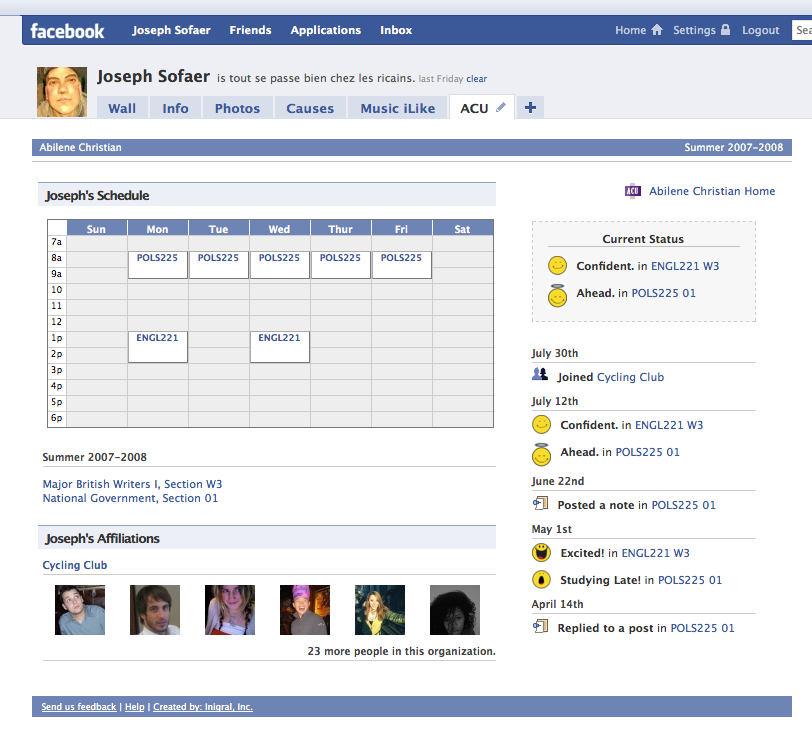
    tab_view.png
    Hi!  I’m Michael Staton and I’m a guest blogger.  What I say in no way represents Michael Feldstein or his ancestors.  Also, our screenshot here is of our app with Abilene Christian University, a school known for being a thought leader in instructional technology and mobile learning products. (They give their students iPhones.  No, really.  They do.)  I am also not representing ACU, its trustees, nor their ancestors.

    So, as I said yesterday, Oracle’s had a short few partners for this upgrade.  With the others included being mainstream LMS systems, you might wonder why Oracle would bother with an upstart like Inigral who hasn’t even invested in a good marketing site.  I hope to answer that question here.  If you read Michael’s blog often, this post will be of interest to you.

    We are introducing a product we’re calling “Schools on Facebook” (in private beta) that is a private, secure application (on Facebook) that can be skinned with a schools branding and connect with their current technology infrastructure.  It doesn’t compete with but complements CMS and LMS systems by focusing on socialization and relationship building; more on how below.

    It’s a cliche when a start up claims to revolutionize this or that.  So, at Inigral we try to stay realistic: we’re focusing on adding a social layer to what already exists.  We want to change the conversation about the internet in education from one of using the web to “manage courses” to one about using the web to facilitate the relationships that develop on campuses already.  After all, a real learning environment is one built on the mortar of person-to-person exchange.   Why not have an application that focuses on that?

    No software is a better example of this than Facebook, which took your campus by storm less than four years ago.  Students started engaging in high-frequency, (some might say mindless) contact that seemed to help students connect with their peers to build and maintain relationships throughout their campus experience.   And you never even paid for it.  Some of you[r colleagues] (not you, you’re too savvy for that) even talked about shutting it out.  But as time went on more of you (and you were early on this one) started to realize what Nicole Ellison documented in her research: that Facebook magnifies the “connectedness” that people feel to your school, one relationship at a time.

    Students use Facebook to represent their identity, and they fill out all sorts of information to that end.  Our product, Schools on Facebook, delivers course schedules, majors, organization memberships and other on campus affiliations to Facebook.  It also shows that “campus safe” identity to classmates and instructors, which helps to build conversations by introducing “primer” information,  i.e. “I see you’re a member of the economics club, are you planning on being an economist?”

    Students use facebook to talk about school all the time, our application just enables a students’ course information to be a part of those conversations.  It also enables contact between faculty and classmates who are not “friends” with a student on Facebook.  Faculty that have ventured on to Facebook have struggled with whether or not to be “friends,” and the safest bet with the least amount of line crossed is to not be friends.  Through our application, campus exchanges can stay out of the personal part of Facebook, and the personal part of facebook can stay out of campus exchanges.

    It has some other great features, too.  But I don’t want to take up any more of Feldstein’s blog with our pitch.

    This is the first public announcement that we are currently selecting two more schools to participate in our limited beta this fall.  We’re only taking three, and we’ve signed up one and have a big name other in the pipeline (huge name, actually).  We’re looking for the “right” school, one that’s going to be excited to see what the Oracle upgrade can enable, one that isn’t afraid to say “we think Facebook adds value to our campus,” and one that’s not afraid to talk about using cool technology openly to others in higher ed.
    Contact me at mpstaton a t inigral.com if you’re interested.

    As you know, the beginning of the school year is a hectic time for all of us!!  I will try to get to all emails as quickly as I can.
