
e-Literate

Present is Prologue

Tag: Google

  • Google Classroom: Early videos of their closest attempt at an LMS

    For years the ed tech community has speculated about Google entering the LMS market, including Wave (discontinued, but some key features embedded in other tools), Apps for Education, and even incorrectly with Pearson OpenClass. Each time there is some possibilities, but Google has not shown interest in fully replacing LMS functionality.

    Google Classroom, announced in May and with new details coming out this week, is the closest that Google has come to fully providing an LMS. The focus is much more on K-12 than on higher education.

    For background on the concept, see this video from May which emphasizes roster integration (with some instructor setup required), document sharing through Google Drive, server and security through the cloud, discussions tied to assignments, and a focus on ‘letting teachers and students teach or learn their way’.

    Yesterday Google shared a new video that directly shows the user interface and some key features.
    (more…)

  • Google Introduces Course Builder, an Open Source Project Targeted at MOOCs (but the Real Competitor Might Be Amazon)

    Google quietly made an educational technology announcement yesterday about the release of Course Builder, an “open source project” targeted at massive open online courses (MOOCs). This platform follows on the heels of Google’s own MOOC this summer. We should find out more information over the coming months, but here are my initial observations after reading the Research Blog on Google’s site:

    In July, Research at Google ran a large open online course, Power Searching with Google, taught by search expert, Dan Russell. The course was successful, with 155,000 registered students. Through this experiment, we learned that Google technologies can help bring education to a global audience. So we packaged up the technology we used to build Power Searching and are providing it as an open source project called Course Builder. We want to make this technology available so that others can experiment with online learning.

    We really shouldn’t be surprised at Google’s interest in the MOOC movement, since Peter Norvig, their Director of Research making the announcement, was one of the two professors at Stanford, alongside Sebastian Thrun, to develop and teach the influential Artificial Intelligence course (CS221). This course started the Stanford branch of MOOCs (also known as xMOOCs). Coursera and Udacity spun out as venture-funded startup companies based on the internal Stanford MOOC courses.

    (more…)

  • Khan Academy Contributes to the Google Art Project

    My friends Beth Harris and Steven Zucker, formerly of smARThistory, now of smARThistory at Khan Academy, have announced that they contributed 90 art history videos for the newly launched version 2 of the Google Art Project. This idea, of creating virtual versions of important museums around the globe, complete with high-resolution images of the art, is wonderful. Sadly, for me, the interface is a bit confusing and hard to navigate at times. (Frankly, I think Beth and Steven did a terrific job with the visual design of smARThistory; Google should be learning from them.) But still, this is an important effort that I hope Google continues to grow and improve.

    I also think it’s interesting to see this kind of partnership between Google and Khan to bring high-quality educational resources together. It may be an early example of what turns out to be a blossoming ecosystem of such partnerships. Let’s hope so.

  • When Large Companies Enter Ed Tech

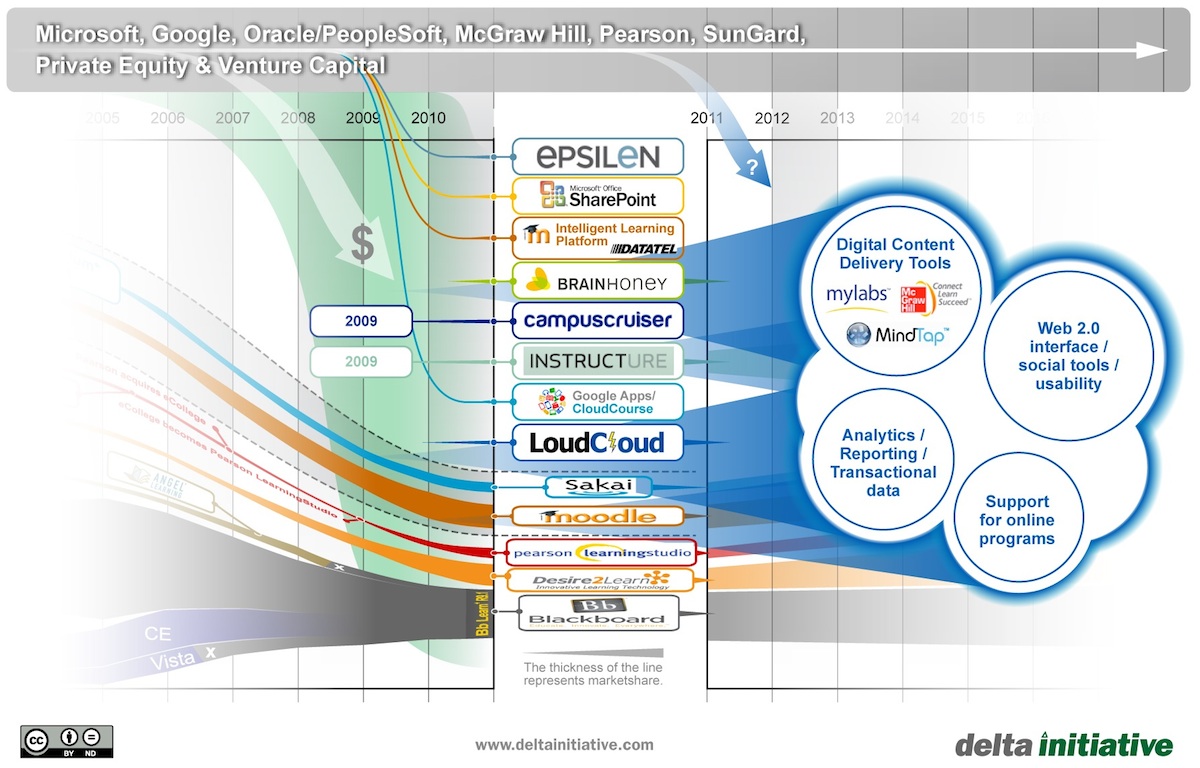
    I had a very interesting conversation on the way home from EDUCAUSE with Frank Florence, who is the Senior Director of Education Market Management for Cisco.  We discussed the changes happening in the ed tech market, and Frank helped me understand some of the market forces behind the changes we’re seeing.  One topic in particular was the dynamic between entrepreneurial companies that develop within a vertical market and larger companies that span markets.  I have argued that internal investment from larger companies is helping to change the ed tech market, but Frank provided valuable insight into the nature of the typical market forces we’re living through.  This observation of large company involvement helping to change the LMS portion of the ed tech market is shown below, in many of the companies in the top gray bar and some that are not listed.

    (more…)

  • Mashing Up the LMS the Google Way

    I have mentioned before Cambridge’s My Sakai project which, writ large, can be seen as an attempt to make Sakai more compatible with Web 2.0 by supporting development of widgets, gadgets, Facebook applications, and so on. Well, they’ve made some substantial progress of late, inspired in part by the Apache Shindig implementation of Google’s OpenSocial API. They’ve created a development paradigm that mostly eschews Java in favor of the HTML, Javascript, and RESTful web services that most Web 2.0 developers will find very familiar. The work, still very much in the experimental stage, recently culminated in a four-day workshop in which 4 Sakai schools (Cambridge, Michigan, Georgia Tech, and U of Toronto) created a new and more user-friendly interface for file sharing within Sakai.

    Here’s how some of the participants described the effort and its results:

    (more…)

  • Gadgets Instead of Portlets?

    Via CMSWatch, an interesting facet of the Apache Shindig proposal has surfaced. Shindig is Apache’s server-side container for OpenSocial and OpenSocial, in turn, is (among other things) based on Google Gadgets.

    Here’s the interesting bit:

    A social application, in this context, is an application run by a third party provider and embedded in a web page, or web application, which consumes services provided by the container and by the application host. This is very similar to Portal/Portlet technology, but is based on client-side compositing, rather than server.

    I was aware, of course, that you can put a Google gadget on a web page, but I hadn’t thought about it explicitly in terms of a portlet alternative before now.

    I’m curious to hear from more technically savvy readers–especially those associated with LMS development: Have you thought about building a gadget server into your LMS? What are the pros and cons? How does this option compare to other display “standards”? How hard is it to make gadgets accessible? And could this work as, say, part of the IMS Learning Tools Interoperability standard?

  • Google Announces Open(er) Social Software APIs

    As many have anticipated, Google has announced its OpenSocial platform, a set of APIs that allow developers to target multiple social software platforms.

    As you might imagine, there’s already a lot of good coverage of this on the web, and I’m going to just provide some highlights here:

    From TechCrunch:

    (more…)