e-Literate

Present is Prologue

Tag: HLC

  • California Should Watch Arkansas Process for Creating New Online Institution

    California Should Watch Arkansas Process for Creating New Online Institution

    Two months ago I wrote a post about Governor Brown’s directive for a fully-online community college in California, noting that:

    What this points to is that for a new fully-online institution to get to some meaningful level of enrollment (let’s say 20,000) in the same ballpark as these comparison schools, I estimate it would take a full decade at the least. This is the reason, by the way, that Mitch Daniels and Purdue University made the Kaplan University deal even though Kaplan’s enrollments are dropping. Daniels did not want to wait a decade to get to meaningful enrollment numbers for an online college serving working adults – if everything works out, within a year Purdue will have a fully-online institution serving 30,000+ working adults. That is a big if, by the way.

    This estimate is probably optimistic, however, based on the outlook for eVersity, the fully-online institution being created in the state of Arkansas. The eVersity leaders have decided that they cannot wait for regional accreditation as reported at Inside Higher Ed today [emphasis added].

    When the University of Arkansas System envisioned creating the online-only institution eVersity in 2014, it planned to follow the well-worn path trodden by other public higher education systems in launching fully online institutions: building on the accreditation of the system’s other universities before seeking independent approval from the regional accreditor.

    But come January, eVersity will seek approval from the Distance Education Accrediting Commission — a national body that overwhelmingly accredits for-profit and nonprofit online institutions — rather than the Higher Learning Commission, which accredits all other public institutions in Arkansas and many nonprofit colleges in 18 other states.

    One of the primary factors shaping eVersity’s decision is speed. The regional accreditor told the university that it could take roughly six years for HLC to award its stamp of approval, while DEAC — assuming it affirms eVersity in January — will have acted in just under two years. Institutional accreditation is required for eVersity students to gain access to federal financial aid, and to ensure that their credentials are valued by employers and others.

    The challenge with national accreditation includes severe limitations on students being able to transfer credits out of the school.

    On the issue of speed, [senior policy analyst at the Center for American Progress] Flores noted that institutions waiting for regional accreditation can often apply for federal aid during the candidacy stage of their application, and that students who attend regionally accredited institutions will have a much easier time transferring their credits than those who attend nationally accredited ones. Flores said eVersity seemed like “a little bit of an odd fit” for DEAC, which typically accredits smaller for-profit institutions that don’t offer federal aid.

    The IHE article (very well-written, by the way) described the path chosen by previous fully-online institutions.

    A more conventional route to regional accreditation, however, is to start as a division of an already regionally accredited campus, said Goldstein. This is what the University of Maryland University College did before obtaining independent regional accreditation. Colorado State University Global Campus also went this route.

    [Chief academic and operating officer of eVersity] Moore said that eVersity decided not to do that, as it did not want to be under the academic and administrative control of another University of Arkansas System institution. “We wanted the ability to be nimble and responsive and not burdened by legacy systems, practices and policies. There are certainly advantages to built-in infrastructures, but they also come with a cost,” said Moore.

    Think about the implications – if a state wants a new, fully-online institution to serve working adults, there seems to be four choices before there is meaningful impact in numbers of students enrolled in institution:

    • Establish new, separate institution, choose regional accreditation, be patient in realistic enrollment growth, and expect 10 – 15 years for meaningful impact
    • Do the above but choose national accreditation and limit transfer ability and possibly impact enrollment, and expect 6 – 11 years
    • Establish division of another school using their accreditation, then spin off for separate institution later on, and risk getting caught up in traditional institution’s legacy policies and practices (unknown timescale)
    • Pull a Mitch Daniels and buy an existing online (or mostly online) institution through creative process, risk not being approved due to transfer of control, and risk getting caught up in the online institution’s legacy policies and practices – and expect 2 – 3 years if the bet works out

    California likely faces similar choices with the fully-online college directive being evaluated this fall. This is a legacy-building project, but there will be real pressure to not have to wait 10 – 15 years to start getting meaningful impact. eVersity from Arkansas is going through this same process ahead of time, and the California team should learn lessons by watching what works and doesn’t work in this case.

    More broadly, the IHE article ends with a key point about accreditation needing to change.

    Russell Poulin, director of policy and analysis at the WICHE Cooperative for Educational Technologies, said that accreditors needed to figure out how to accredit new providers more quickly, without compromising on quality. “Accreditation is slow and innovation is fast; we are starting to see political and business pressure to find alternatives,” he said.

    Read the entire IHE article. This subject is important.

  • First Board Meeting For Kaplan / Purdue University: Tuition Levels Set

    First Board Meeting For Kaplan / Purdue University: Tuition Levels Set

    Last week was the first meeting for the board of trustees for NewU, the working name for Kaplan University now that it has been “acquired” by Purdue University. And yes, the scare quotes are intentional given the $1 purchase price. I’ll give the group high marks for transparency by the press release.

    In its inaugural regular meeting, the Board of Trustees for Purdue’s new affiliated institution, currently referred to as NewU, approved plans to offer a dramatic tuition discount for Indiana resident students and free tuition for Purdue employees.  The new Indiana resident rate, also approved by Kaplan University’s trustees, will take effect at the beginning of KU’s next academic term. [snip]

    An Indiana resident student pursuing an associate or bachelor’s degree will pay the equivalent of $220, including technology fees, per quarterly credit hour, which is a discount of approximately 45 percent. The total cost to graduation for a bachelor’s degree would be $39,600, compared to a total cost to degree of $80,088 (including room and board) for Indiana residents at Purdue’s West Lafayette campus.

    The reason there are two boards of trustees involved – for NewU and for Kaplan U – is that the deal still must be approved by state and federal regulators and by NewU’s accreditor HLC. (more…)

  • Purdue University Deal To Acquire Kaplan University: Interview with Trace Urdan

    Purdue University Deal To Acquire Kaplan University: Interview with Trace Urdan

    The surprise news today is that Purdue University has agree to acquire the academic operations of Kaplan University. As stated in the 8-K filing by Kaplan University’s owner Graham Holdings:

    On April 27, 2017, Kaplan Higher Education LLC and Iowa College Acquisition, LLC (collectively, “Kaplan”), subsidiaries of Graham Holdings Company, entered into a Contribution and Transfer Agreement (“Transfer Agreement”) to contribute the institutional assets and operations of Kaplan University (“KU”) to a new, nonprofit, public-benefit corporation (“New University”) affiliated with Purdue University (“Purdue”) in exchange for a Transition and Operations Support Agreement (“TOSA”), pursuant to which, among other provisions, Kaplan will provide key non-academic operations support to New University for an initial term of 30 years with a buy-out option after six years.

    Additional coverage of the deal at The Chronicle, Inside Higher Ed, The Wall Street Journal.

    This is an unprecedented move, and to get some insight, I interviewed Trace Urdan, who has long covered higher education as an investment analyst and is one of the most knowledgeable observers of the for-profit sector. The following description is based mostly on this interview, paraphrasing Trace’s explanations and adding quotes in places. (more…)

  • Postscript on accreditation transparency: Basic financials of two accrediting commissions

    Last week I wrote a post on two significant accrediting actions related to City College of San Francisco and Tiffin University.

    If there really is a shift in the DOE’s views on accreditation or in the accrediting commissions’ interpretation of standards, then that could have fairly profound cascade effects on competency-based learning programs, private online colleges, MOOCs, and online service providers.

    That is also why the lack of transparency from the accrediting commissions is so troubling. They are making decisions that have profound effects on many institutions, not just the specific schools under review.

    Mathieu Plourde asked a good question in the comments.

    Do you know how these accrediting bodies get their funding? If it’s at least in part from government funding or through membership fees from public institutions, I’d say it’s time to make them open up their data.

    While I have not figured out if there is a method to force the accrediting commissions to “open up their data”, I would like to answer the first part of Mathieu’s question on funding.

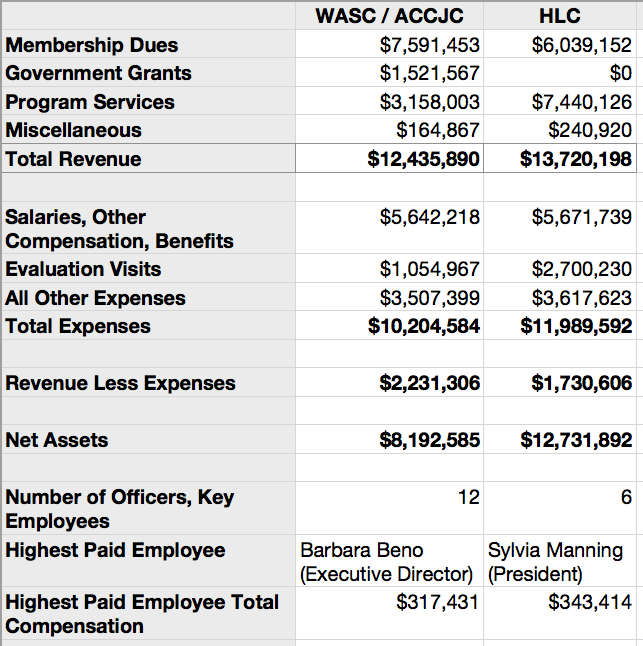
    Accrediting commissions are designated non-profit organizations, typically designated as 501 (c) (3) by the IRS. This means they have to file annual returns (form 990) to maintain their tax-exempt status. One sight that has this information is the Foundation Center. I’ve pulled up the most recent forms for the  Accrediting Commission for Community and Junior Colleges (ACCJC), responsible for CCSF’s accreditation, and the Higher Learning Commission (HLC), responsible for Tiffin University’s accreditation. Some notes before getting to the data:

    • There are six regional accrediting agencies in the US covering postsecondary education. Each agency has one or two commissions as members that are responsible for the actual accreditation reviews, for a total of eight regional accrediting commissions (New England and Western agencies have two commissions each).
    • ACCJC is part of the Western Association of Schools and Colleges (WASC). Since there are two commissions in WASC, WASC files the form 990 instead of ACCJC. Their most recent form available is for the tax year ending June 30, 2011 (I do not know why the 2012 data is missing).
    • HLC is a member of the North Central Association of Colleges and Schools (NCACS). Since there is only one commission in NCACS, HLC files its own form 990. Their most recent form available is for the tax year ending August 31, 2012.
    • “Membership Dues” covers the fees paid by accredited institutions.
    • “Program Services” combines paid workshops, consulting and annual conference revenues – typically from the member institutions.
    • “Evaluation Visits” are primarily travel and direct expenses for peer review teams visiting institutions during review.

    The actual forms can be found here for WASC / ACCJC and here for HLC . I have combined the most relevant data into one table.

    Form 990


    I went back and forth on whether to highlight the ‘highest paid employee’ data. In the end I chose to include this in the table as it seems relevant in terms of the organization’s motivations for self-preservation. In the case of ACCJC, there have been many charges of conflict-of-interest for the commission members, and the Department of Education has even found that the commission does not have adequate conflict-of-interest policies. The people running accrediting commissions are few in number but make a decent living. There is more information available in the form 990s.

    So, for my long-winded answer to Mathieu: Accrediting commissions get their revenue primarily from membership dues and additional program services from member institutions, many of which are themselves public entities; they also make some revenue directly from government or foundation (e.g. Lumina Foundation, Gates Foundation) grants but not every year.

  • Higher Ed Accrediting Commissions: Transparency for thee, not for me

    Why do I keep covering accreditation issues on e-Literate, a blog nominally about online learning and educational technology? The reason is that accrediting commissions have enormous influence on higher education institutions, particularly as the industry wrestles with questions of which changes are necessary, which changes are worth trying but might not work, and which changes should be avoided. If there really is a shift in the DOE’s views on accreditation or in the accrediting commissions’ interpretation of standards, then that could have fairly profound cascade effects on competency-based learning programs, private online colleges, MOOCs, and online service providers.

    That is also why the lack of transparency from the accrediting commissions is so troubling. They are making decisions that have profound effects on many institutions, not just the specific schools under review.

    Case 1: Tiffin University and HLC

    Tiffin University was forced to drop its partnership with Ivy Bridge College – an private college owned by Altius Education – earlier this month. From the press release:

    (more…)