
e-Literate

Present is Prologue

Tag: Inside Higher Ed

  • Insight into Community College Students and Challenges of Online Education

    Insight into Community College Students and Challenges of Online Education

    Inside Higher Ed reported today on a new survey report on community colleges and challenges that students face.

    Most community colleges are aware of the challenges students face if they are working, raising children or struggling to afford textbooks. But a newly released survey digs into the nuances of those challenges so colleges can pinpoint ways to lift barriers to college completion and prevent students from dropping out.

    Researchers at North Carolina State University designed and encouraged students to participate in the Revealing Institutional Strengths and Challenges survey. The survey found that working and paying for expenses were the top two challenges community college students said impeded their academic success. The researchers surveyed nearly 6,000 two-year college students from 10 community colleges in California, Michigan, Nebraska, North Carolina, South Dakota, Texas, Virginia, Wisconsin and Wyoming in fall 2017 and 2018.

    Of the top ten challenges listed, the category of online classes was tied for fourth along with parking in an ironic twist as lack of physical facilities is one of the drivers for the growth in online education. Interestingly for parking, it is not the costs. 86% of those listing parking stated it was “difficulty finding parking on or near campus” and only 10% listed parking as too expensive.
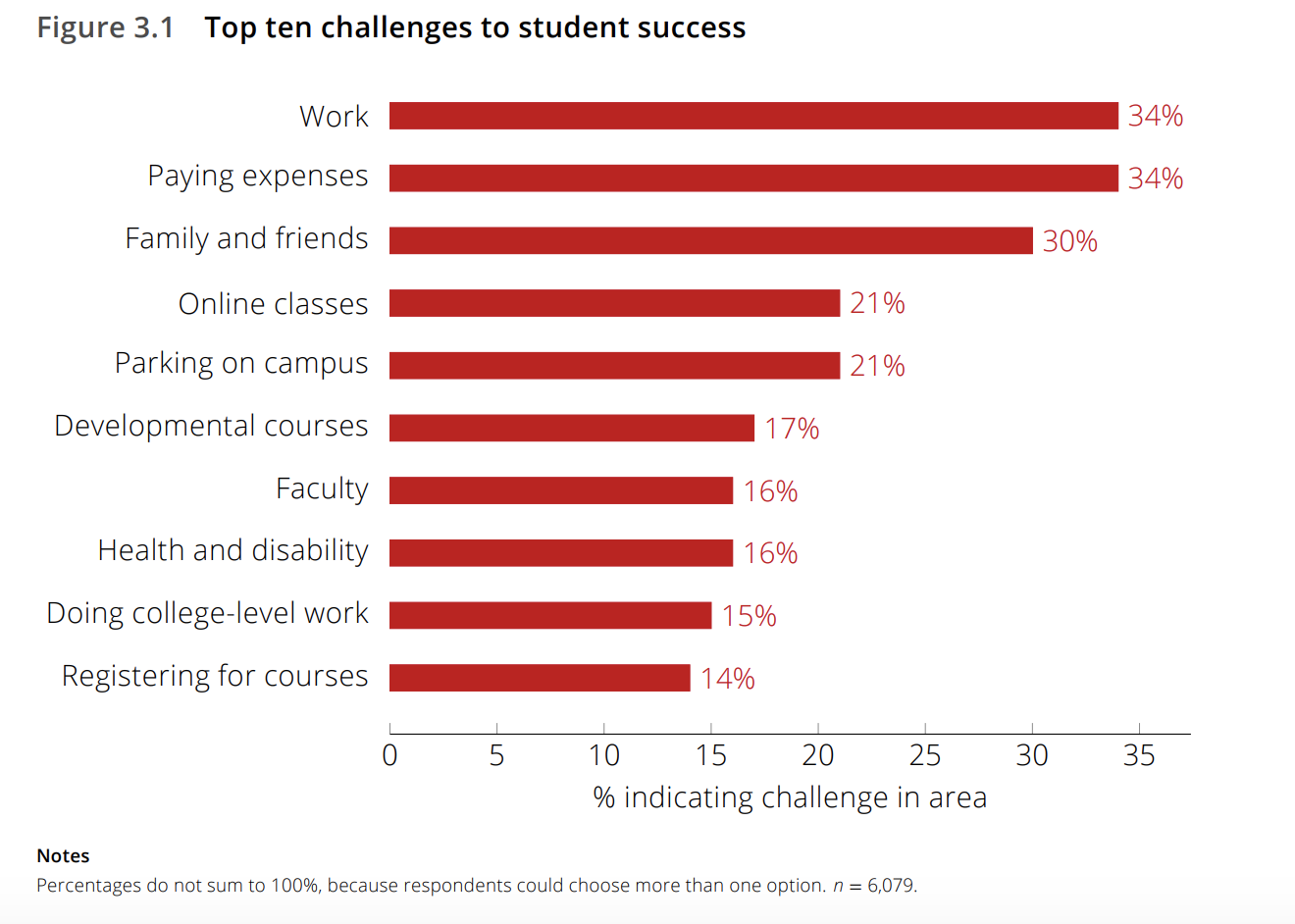
    Top Ten challenges for community college students

    The value of this survey, as described at IHE in interviews with the report authors, is in the nuance that can guide institutional planning.

    [Report authors] Umbach and Steve Porter, also a professor of higher education at the university, said they noticed a dearth of surveys that asked students about the barriers they face to completing college and wanted to provide a tool that colleges could use to eliminate those barriers and boost graduation rates.

    On the topic of online education as a barrier, one view of the results could be that only one out of five students have a problem with these classes, which is not problematic as we have long known that online is not for everyone. On the other hand, the nuance provided should give institutions some insight into how they can improve their services to students.
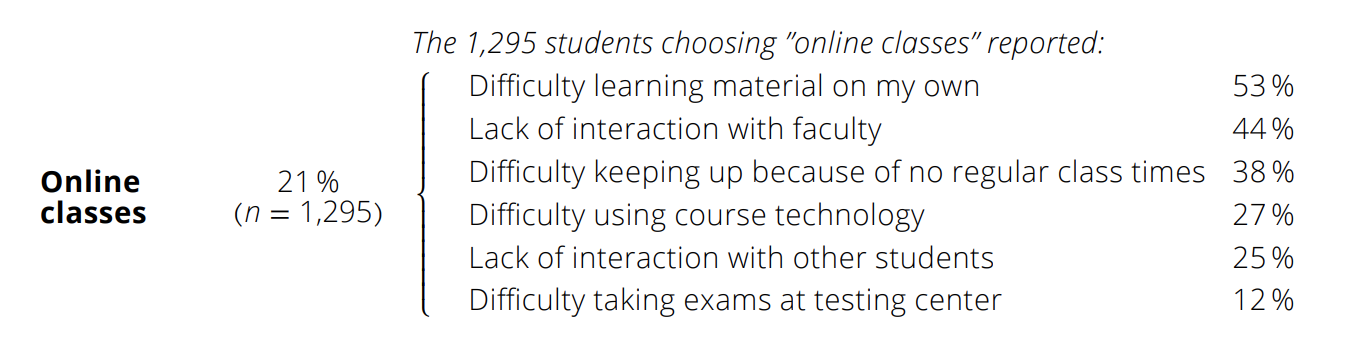
    Reasons for online classes as a challenge

    The big issue that I’ve seen in the field is not whether a school should offer online classes – in so many cases this is the only way for students to have access to degrees – but how well-designed the courses are and how much support is provided outside of the course. Throwing courses online with no real interaction or adequate support is a recipe for disaster here, as I described in one case last year. But the school in that example is not alone in this regard. In the many cases where community colleges make these mistakes, students should have difficulty learning and the 21% number should be problematic.

    But on the opposite side, when colleges focus on improving course design and extend meaningful support services, student outcomes improve dramatically. Consider the California Community College system and their improved outcomes, where their most recent distance education report shows system-wide closing of the achievement gap between face-to-face and online students. Online education can work for community college students and is an important part of student access, but there are no silver bullets.

    I was quoted in the article about these challenges.

    Hill said the California Community College System’s Online Education Initiative, which he worked on as a consultant, is a good example of a well-designed online learning system. It helped close the gap between the rate of students successfully completing traditional courses and online classes from 17 percent in 2006 to 4 percent in 2016.

    To be clear, the California Community College System in general has been improving their provision and support of online courses for years, and OEI is not the only driver of this change.

    CCCS improvements in gap of online ed

    I don’t think the California Community College System is the only example of improvements in online education support, but I do think their focus on improving course design as well as improving advising and support structures is worth considering.

    The problem of ‘difficulty learning material on my own’  and ‘difficulty keeping up’ issues can only partially be addressed – online education is not for everyone – but more engaging and well-designed online courses can help, or at least reduce barriers. The mixing of synchronous elements of a course along with asynchronous can also play an important role.

    ‘Lack of interaction with faculty’, ‘lack of interaction with other students’, and ‘difficulty using course technology’, however, are issues that should be addressed by the institution as part of the course design and support services. It would be naive to think that these issues could be eliminated, but there is no excuse for schools to not have a coordinated effort to make improvements across all online courses.

    Online education can work, and community colleges can improve outcomes by addressing the challenges students face.

    While this post focuses on the online education angle, the whole report is worth reading. The insights into issues outside the classroom, particularly for students trying to balance work and family commitments with their education, should provide valuable input into institutional- and system-level planning.


  • Response on LMS Market Size Analysis

    Response on LMS Market Size Analysis

    Josh Kim wrote a post yesterday at Inside Higher Ed questioning some claims about the LMS market size.

    The first result that comes up in Google is from Zion Market Research. Their estimate is that the global LMS market is valued at $5.19 billion in 2016, and expected to reach $19 billion by 2022.

    According to Statista, the LMS market in 2016 was valued at $3.21 billion. CNBC claims that the learning management system market is worth $5.2 billion today, and will grow to $16 billion in four years.

    Can these numbers be right?

    Josh then did a quick analysis based on Instructure’s revenue and came up with much smaller numbers.

    If we assume that the cost of Canvas is about average for LMS companies, we can get an estimate of the total market size by multiplying Instructure’s revenues by five. This gives us an estimate for the total size of the LMS market $555 million.

    He extended this by 50% based on Instructure growth to give an estimate of $555 – $832 million, which is way below the big numbers claimed by Zion, MarketsandMarkets, and other market analysts.

    The biggest difference here is that all of these analysts combine corporate learning markets with academic LMS usage, and corporate learning platforms account for somewhere between $2 – $4 billion, with best estimates (although outdated) coming from Bersin. This point has already been pointed out in the comments at IHE.

    tl;dr – the ~$5 billion number is reasonable if you combine academic and corporate LMS markets.

    There are two caveats, however.

    • First, the market growth claims are marketing fluff to generate interest in buying the reports, as companies love to show growth potential to investors. Anything close to $20 billion in a few years is ludicrous.
    • Second, as Michael commented on this approach based on a post I wrote criticizing MarketsandMarkets:

    If anything, my Phil understates the case here. Lumping higher ed, K12, and corporate LMSs into the same category is a little bit like lumping railroad cars together with automobiles because they are both called cars, have wheels, and carry things and/or people from one place to another. On top of that, nobody has decent data on the size of the global market, never mind the growth of it. MarketsandMarkets’ “analysis” effectively gives us made-up numbers about a mythical automobile/train car market.

    So a better question is what is the size of the global academic LMS markets, combining K-12 and postsecondary?

    One issue from the IHE post is that Josh used our 20% market share as basis for extrapolating Instructure’s market share, but that number is only for North American higher education. Globally, Instructure’s market share is much smaller as shown in our recent analysis (data provided by our partners LISTedTECH).

    Furthermore, while Canvas by Instructure and Schoology seem to be leading vendors for new adoptions in the K-12 market, at least in the US, no one has reasonable measures of market share in this area. Long and short – we need a different approach than extrapolation from Instructure alone.

    LISTedTECH estimated the global LMS market just in higher education as $1.7 billion based on (# of students) * (average cost of LMS per student) = annual spending approach. In the US, the best estimates I’ve seen in that K-12 learning platform markets are worth 30 – 40% of higher ed market. This likely is smaller globally, as anecdotally there is not a big emphasis on LMS usage outside North American and Northern Europe. So one very rough estimate is that academic LMS market is worth approximately $2 billion per year.

    If you want to use the company revenue method, then I would use additional data. Blackboard’s LMS revenue is likely $450 – $550 million per year based on reviews of corporate debt filings and extrapolation from their time as a public company. D2L’s revenue is smaller than Instructure’s, so let’s assume the two companies combined have $200 million revenue. Note that in all of these companies this is global revenue for K-12 and higher ed combined. The question is how to scale this $700 million combined revenue from all three companies. Is it reasonable that global spending for academic LMS could be 2 – 3x larger than this number? When you add in all of the Moodle hosting – both Moodle Partners and unofficial Moodle hosting – as well as Chinese market adoption, European providers, and K-12 players like Schoology and Powerschool/Haiku, this seems at least believable.

    So my highly-researched, thoroughly-documented estimate of the global academic LMS market is $1.5 – 2.0 billion per year. And it is forecast to grow to $8.2134526 billion by June 3, 2022.

    Note to investors – ignore that forecast.

  • Barnes & Noble Education’s Predictive Analytics Deal With Unizin

    Barnes & Noble Education’s Predictive Analytics Deal With Unizin

    Barnes & Noble Education (BNED) announced today that they have a deal with Unizin to provide predictive analytics services through the LoudSight platform to the consortium’s member universities. As covered by Inside Higher Ed:

    BNED, as the company now likes to be called, operates nearly 1,500 bookstores, but has in recent years expanded beyond course materials. In March 2016, it acquired the software start-up LoudCloud, and it is through that company that BNED now will score a group of 22 potential new clients (or, in the cases where it already runs campus bookstores, form tighter connections with existing ones) that includes Indiana University, Pennsylvania State University and the State University System of Florida, among others.

    The deal represents a new product focus for BNED’s LoudCloud – predictive analytics – and a new financial model for Unizin. (more…)

  • Recommended Reading: IHE coverage of NBER paper and critiques

    Recommended Reading: IHE coverage of NBER paper and critiques

    For those following my two recent posts about the National Bureau of Economic Research (NBER) working paper claiming to analyze “The Returns to Online Postsecondary Education”, there are two articles I recommend for broader coverage – both from Inside Higher Ed. The first article is “Online Ed’s Return on Investment”, where Carl Straumsheim summarized the report itself as well as early critiques from me, Russ Poulin from WCET, and Jeff Seaman from Babson Survey Research Group.

    “Even a quick check with one of the databases they did use … would show they are off on their counts and should have made them rethink their assumptions,” Poulin said in an email.

    Jeff Seaman, co-director of the Babson Survey Research Group, called the methodology “seriously flawed.” The Babson Group previously produced annual reports on the size of the online education market but began to focus more on in-depth surveys after the federal government began collecting and reporting online enrollment data.

    The second article, titled “Impressions of the Hoxby Study of Online Learning”, came out today where Doug Lederman asked for impressions from a dozen higher ed observers. Most observers were critical of the data issues as we have noted at e-Literate, but there were a few with positive reactions. I think that Deb Adair (from Quality Matters) has an excellent response, concluding with the following [emphasis added]: (more…)

  • Recommended Reading: What Do Faculty Really Think of Online Learning?

    …As it turns out, it depends.

    Inside Higher Ed recently published its fifth annual  Survey of Faculty Attitudes Toward Technology, conducted in collaboration with researchers from Gallup. These reports cover a range of attitudinal questions on ed tech, online education, and new models of delivering course content. One of the key findings of this year’s report, as described in a Gallup blog,  is that there is still a high level of disagreement among faculty of the relative merits of online courses versus traditional face to face courses, but there are some important nuances to the results. The survey finds that a majority of faculty (55%) “disagree or strongly disagree” with the idea that online courses can deliver the same student outcomes that in-person courses produce. Among faculty who have actually taught online, however, there is a much more positive view of the ability for online education to match in-person courses. (more…)

  • Inside Higher Ed: One year after selling majority stake in company

    One year ago I wrote a post critical of Inside Higher Ed for not doing a blanket disclosure about the sale of a majority stake to a private equity firm with other education holdings (most notably Ruffalo Noel Levitz).

    Subsequent to the disclosure from the Huffington Post, IHE put up an ownership statement disclosing the ownership change and calling out that only editors are involved in editorial policies. The About Us page prominently links to this ownership statement.

    In an interview with Education Dive, Scott Jaschik (an Inside Higher Ed founder and editor) noted his regret for not disclosing the sale up front while concluding:

    “I guess I would just say to anyone who has questions, read us and read our coverage and call me if you think we’re doing anything that we shouldn’t,” [Jaschik] said.

    In the past year I have done exactly that – watching carefully for editorial shifts, complaining publicly about one article, and privately emailing Jaschik on another issue.

    My conclusion? Inside Higher Ed has shown no bias and no change in editorial policies based on the new ownership – they are living up to their word. IHE [Jaschik in particular] has also been quite good in discussing any questions or issues based on their coverage. IHE should be commended for their quality coverage of higher education news.


  • Georgia Tech and Udacity MOOC Degree: Missing targets but still worth watching

    Melissa Korn wrote an article yesterday in the Wall Street Journal giving a progress report on that Georgia Tech / Udacity MOOC degree (the master’s in computer science).

    The Georgia Tech online computer-science program is relatively massive: It has 2,789 students enrolled this semester, compared with 312 in the campus-based version. It’s on track to turn a profit by May, according to Charles Isbell Jr., senior associate dean at the College of Computing. It has a steady stream of more than 1,300 applicants for each new term. [snip]

    At Georgia Tech, Mr. Isbell is still thinking on a grand scale: “It wouldn’t surprise me if three years from now we’re talking about 10,000 students instead of 3,000 students,” he said. “This is sustainable and this is scalable.”

    (more…)