

Inside Higher Ed published an article today, titled “Free MOOCs Face The Music”, about edX quietly adding support fees for many of their courses. Dhawal Shah and I both commented that we were not surprised by the move.
Writing about the introduction of the fee, Dhawal Shah, founder and CEO of Class Central, a review site for online courses, said the announcement was the latest in a phenomenon he termed “the shrinking of free.” Regardless of MOOC provider — be it edX, Coursera, Udacity or FutureLearn — “all have cut back on what was originally free in MOOCs.”
Phil Hill, co-founder of Mindwires Consulting and an author of the e-Literate blog, agreed that the edX announcement was not surprising. Early MOOC providers like edX thought they would be able to “get really big for free,” said Hill. “Magic didn’t happen, and now they’re facing reality.”
There’s more information in the article worth reading, but I would like to revisit a post here at e-Literate from 2012 to help explain the point I made. In “Four Barriers That MOOCs Must Overcome To Build a Sustainable Model”, I noted:
The current generation of courses has proven the feasibility of massive online enrollments, but the Kolowich article reveals that the result is based on a form of adult continuing education. The majority of students in the Udacity and Coursera courses analyzed were professionals in the software industry – hardly the target audience for those seeking a change in how we educate postsecondary students. The current MOOCs provide a nice proof-of-concept, but hardly solve significant educational problems.
So what are the barriers that must be overcome for the MOOC concept (in future generations) to become self-sustaining? To me the most obvious barriers are:
- Developing revenue models to make the concept self-sustaining;
- Delivering valuable signifiers of completion such as credentials, badges or acceptance into accredited programs;
- Providing an experience and perceived value that enables higher course completion rates (most today have less than 10% of registered students actually completing the course); and
- Authenticating students in a manner to satisfy accrediting institutions or hiring companies that the student identify is actually known.
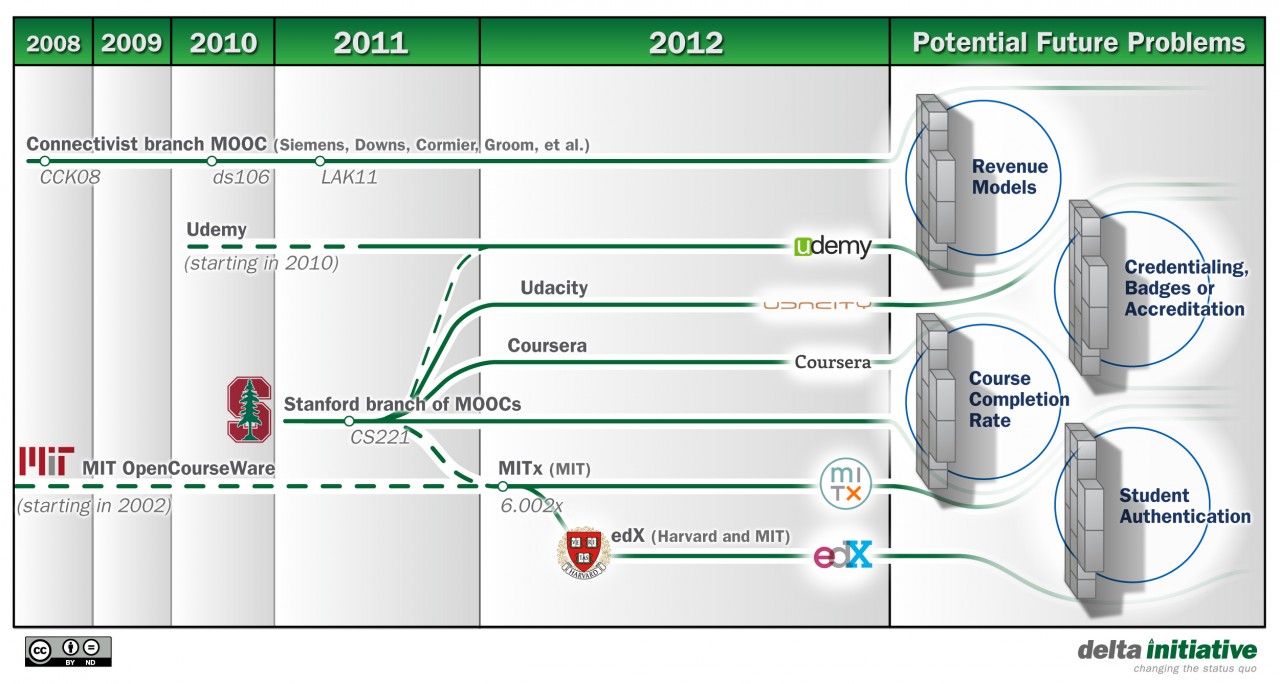
Given this short timeline and the nature of investment-backed educational experiments, I think the real focus should be on whether and how MOOCs or successor models build on current scalability and openness while overcoming these four barriers.
What have we seen since 2012?
- Revenue Models: Coursera, FutureLearn, and edX moving towards an OPM business model, and Udacity focusing on corporate education;
- Credentialing: All MOOCs offering some sort of verified certificates, and in the OPM cases offering actual degrees through their partner institutions;
- Course Completion: MOOCs realizing that the two issues above lead to higher completion rates; and
- Authentication: Verified certificates and OPM models requiring student authentication through webcams and approaches similar to online proctoring companies, and even partnering with proctoring companies.
At this stage pretty much everyone recognizes a blatant ‘I told you so’ post written while Michael is on vacation and unable to talk me out of it, so I’ll move along and cut off further commentary.