
e-Literate

Present is Prologue

Tag: Jim Groom

  • Instructure Steps Up for Open Education

    Friday evening, I wrote in a blog post:

    If you are a large for-profit education company—say, an LMS vendor or a textbook company—give $5,000 to the DS106 Kickstarter project. At that level of contribution, in addition to all the benefits of the lower levels, you’ll get a mention as doing a really swell thing on the fabulous e-Literate weblog.

    I’m thrilled to say that it took Instructure less than 24 hours to step up to the plate:
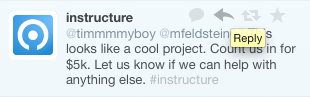
    That is just spectacular. We should all take note of a company that did not hesitate when presented with an opportunity to help out a great grassroots open education project. I very much hope that other education companies will step up to the plate.

    There are a couple of things that I think are particularly praiseworthy about DS106. First, it’s  a course that teaches digital literacy in a way that has proven effective and inspiring for a wide range of students. That’s huge and much needed in and of itself. But I also think that the course presents a replicable model for doing open education on a wide range of topics on a small budget, while teaching students some basic digital literacy through its very structure. Even if the course subject isn’t something like digital storytelling, the DS106 model has each student set up her own blog and participate in a distributed community. If you think that is an unreasonably high barrier, then you probably haven’t set up a blog recently. Having students set up their own web sites, understand how they work at a basic level, and learn what it is like to have a digital space of their own is a good and appropriate set of educational goals for an incredibly broad range of learners.

    You may wonder why making a contribution would be worthwhile, given that the project has already well exceeded its initial funding goal. If you’d like to get a sense of what the DS106 organizers may do with the extra cash, then read Jim’s post about it, including the comments. For me, a common theme jumps out that I find very exciting, and that theme is about making the DS106 model easier and more accessible to a wider range of students and teachers—developing WordPress plugins that make course setup simpler, developing a languages course using the same teaching model, and so on. I would very much like to see a community grow around helping to spread this model, test its limits, and make it more accessible to people who want to do open education across a wide range of subjects.

    That’s why I’m hoping that folks like Ray Henderson, John Baker, Adrian Sannier, and others with significant budgets will step up and add further funding to this project. And, of course, you don’t have to be a captain of industry to make a contribution. You can contribute whatever money you think you can spare as an individual. Remember, DS106 achieved its initial funding goal in less than 24 hours, before Instructure stepped up. Individuals making $5 and $25 contributions did that. Your contribution matters. In fact, one of the lessons of DS106 in general is that you don’t have to have deep pockets and an enterprise IT infrastructure to make a big impact in education. To the degree that large contributors like Instructure are stepping up, it is because they are following your lead. Before smARThistory was “acquired” by Khan Academy, it was funded by contributors like you in a Kickstarter project.

  • The Zone of Proximal Curiosity

    Gardner Campbell has a great piece at Campus Technology that asks the following question:

    What if we took another tack, specifying that students should not only remember information but also demonstrate increased curiosity?

    I have enormous sympathy for this line of inquiry. In this post, I’m going to cover why I think it’s so important, how educating for curiosity interacts with other sorts of educational goals, and how we might begin to encourage it.

    (more…)

  • Rhiz-o-Matic: Scaling the MOOC

    And three people do it, three, can you imagine, three people walking in singin’ a bar of Alice’s Restaurant and walking out? They may think it’s an organization. And can you, can you imagine fifty people a day, I said fifty people a day walking in singin’ a bar of Alice’s Restaurant and walking out? And friends they may think it’s a movement.

    And that’s what it is , the Alice’s Restaurant Anti-Massacre Movement, and all you got to do to join is sing it the next time it come’s around on the guitar.

    With feeling.

    -Arlo Guthrie

    My post on Jim Groom’s DS 106 MOOC generated a lot of discussion, both in the comments thread and on other blogs. However, I would like to see it also generate action, which is always one of my goals as an edublogger. At one point in the comments thread, I wrote,

    My main concern is that we keep our eye on the ball. What kinds of problems can the techniques behind ds106 (for example) solve for which people? Who can they help in what ways? Who do we not yet know how to help using the current techniques of open education? How can we stretch what we are learning from ds1-6 and other experiments to reach other people and solve other problems? In particular, while I hear a lot of talk from open education proponents about democratization, most of the experiments around MOOCs and the like seem to take as students mostly…well…people who are blogging about how great MOOCs could be. There’s nothing wrong with that if the purpose is to learn how to do better MOOCs, or if the goal is just personal fulfillment, but it’s not clear to me how these translate into broad educational success that is “rhizomatic” for people who haven’t already gone to (conventional, industrialized) graduate school to learn what “rhizomatic” means. Yes, there are some great success stories from Jim’s class, and I’m sure, from other MOOCs, about people who didn’t come in as ed tech gurus and were lifted up by the course, inspired to better their lives. But you can tell the same kind of stories of people who come through conventional classrooms. What I want to see is that those successes aren’t accidental to the model. I want to see that the MOOC can be tuned to reach people who haven’t graduated college or even gone to college. When I say I want to see that, I’m not expressing skepticism. What I mean is that I want to see it.

    Today, I am going to make my contribution to that goal by proposing a campaign to scale out MOOC adoption in order to reach many more and different people.

    (more…)

  • Can Enlightenment Scale?

    I had the pleasure of listening to Jim Groom give a keynote speech at the Open Education conference this morning. I generally find listening to Jim equal parts inspiring and frustrating. Inspiring because he has a direct tap into the moral wellspring of passion for education that drew me into education in the first place. Frustrating because Jim (and Gardner Campbell, and other prominent thinkers in the school of thought formerly known as edupunk) and I haven’t seem to be able to find common ground on the meaning or value of the word “scale.” For Jim, I get the sense that scale is synonymous with industrialization. And I can guess why that might be so. If you believe that the essence of education starts with people discovering their own personal dignity, passion, and talents, it seems almost oxymoronic to talk about scaling that. You can’t mass produce personal journeys. I buy that. But I also am painfully aware of the fact that we, the human race, have so far failed to either catalyze that personal journey or provide the basic skills and practical education necessary for material comfort and basic dignity for the substantial majority of people alive on earth today. Heck, we’re failing a very substantial percentage of people alive in the United States today, despite the great wealth of this country. For me, it’s all about Archimedes. I’m looking for a large enough lever to move the world. I want to believe in scale. I need to believe in it.

    And so I came to think of Jim and his friends as gadflies. Irritants, in the best possible sense of the term. Good people who are doing good work and can remind me of important things on occasion, but not the kind of folks who are going to help me find that lever.

    I was wrong. And I should have known better. I had the opportunity to learn this lesson a long time ago.

    (more…)

  • Jim Groom Unbound

    There is a lot of good buzz in the edublogosphere about Jim Groom’s newly open course called “Digital Storytelling.” I’m not going to have time to participate this time around, so I really hope that he offers it again. But it’s already off to such an interesting start that I can’t resist commenting on it. Jim has been careful to credit other experimenters with Massively Open Online Courses (MOOCs), which is fair and good, but without getting into a discussion about how much is original to him, I think the course is exemplary in a lot of ways, both as a relatively refined example of a new genre and as an educational experiment.

    (more…)

  • DIY U: Digital Apprenticeship and the Modern Guild

    A while back, I had the pleasure of chatting with Paul Lefrere. Paul is a guy who thinks about large-scale questions like, “How can we create and fill a couple of million green jobs in a country within a couple of years?” One problem he was grappling with regarding higher education was time-to-market for students. He needed to get them working and productive in less than four years—and possibly less than two. One idea he talked about was what he called “digital apprenticeship.” Imagine a solar panel installation trainee wearing a helmet with a wireless webcam on it. You could have an expert watching her work virtually, either coaching her through the steps in a process or testing her by watching her perform the process and then certifying that she’s done it right. She could be both a productive worker and a student on a long-term educational path on day one.

    More recently, Jim Groom suggested that apprenticeship might be a good model for networked learning, particularly for those students who are not auto-didactic. ((It’s worth noting that, while we tend to refer to “auto-didacts” as if there is a special class of people who can learn everything on their own, the truth of the matter is that many people can be auto-didactic in some subjects and not in others. For example, I’m pretty good at teaching myself many kinds of book learning but am not good at all when it comes to figuring out how to, say, fix a squeaky floor board or replace the switch in my hallway light, even with detailed instructions. And I have given up all hope of ever teaching myself how to juggle. I could learn to do all of these things, but I would need coaching, because I’m not good at noticing what I’m doing wrong—or sometimes even whether I’m doing wrong—in these areas.)) I think that Jim and Paul are both really onto something. Apprenticeship is a model that is well understood, can work for a variety of topics in less formal settings, can get learners productive on certain tasks quickly, and can get the benefits of scale by using modern communications technologies. At the same time, it’s one thing to have a model that works well in theory and quite another to have a set of practices that are likely to be adopted widely under given social and economic conditions. So in this post, I’m going to consider the question of what it would take to embed apprenticeship into the fabric of our society as a broadly accepted career path across a wide range of career types.

    (more…)

  • Does Google Wave Mean the End of the LMS?

    Does Google Wave Mean the End of the LMS?

    I suppose it was inevitable. At a time when even The Chronicle is asking whether Blackboard can be replaced by WordPress, a slick demo of a super-cool product like Wave was bound to trigger breathless speculation about the demise of the LMS. Equally predictably, the most enthusiastic predictions that the LMS will be replaced are being made by people who have already replaced their LMS. It is not terribly shocking to read Jim Groom predicting that this time the LMS is REALLY doomed!!!! (I mean that to be taken affectionately.) If you are comfortable teaching a class using WordPress or PBWiki or [insert hip and free Web 2.0 technology du jour], then there is a good chance that you will be comfortable teaching a class with Wave.

    Me, I’m a live-and-let-live kind of guy. I think people who are comfortable using these flexible tools and who don’t want the traditional trappings of an LMS (e.g., grade book, assignments tool, test engine, etc.) should be able to have what they want,  while the people who want the full LMS toolset should also have what they want. That’s one reason why I think we need a Learning Management Operating System (LMOS) upon which flexible and individualized virtual learning environments can be instantiated. If you want a grade book and a test engine, great. We got those. If you don’t want ’em, that’s fine too. Let pedagogical needs and university policies drive these decisions rather than the technology.

    So the question I’m interested in is more nuanced than the one of whether the LMS is “dead.” What I want to know is where Wave could fit with the range of capabilities that somebody might want in a virtual learning environment. What is it not good for? What else does it need?

    (more…)