
e-Literate

Present is Prologue

Tag: Learning Platform

  • Snapshot of LMS Market for Large Online Programs in the US

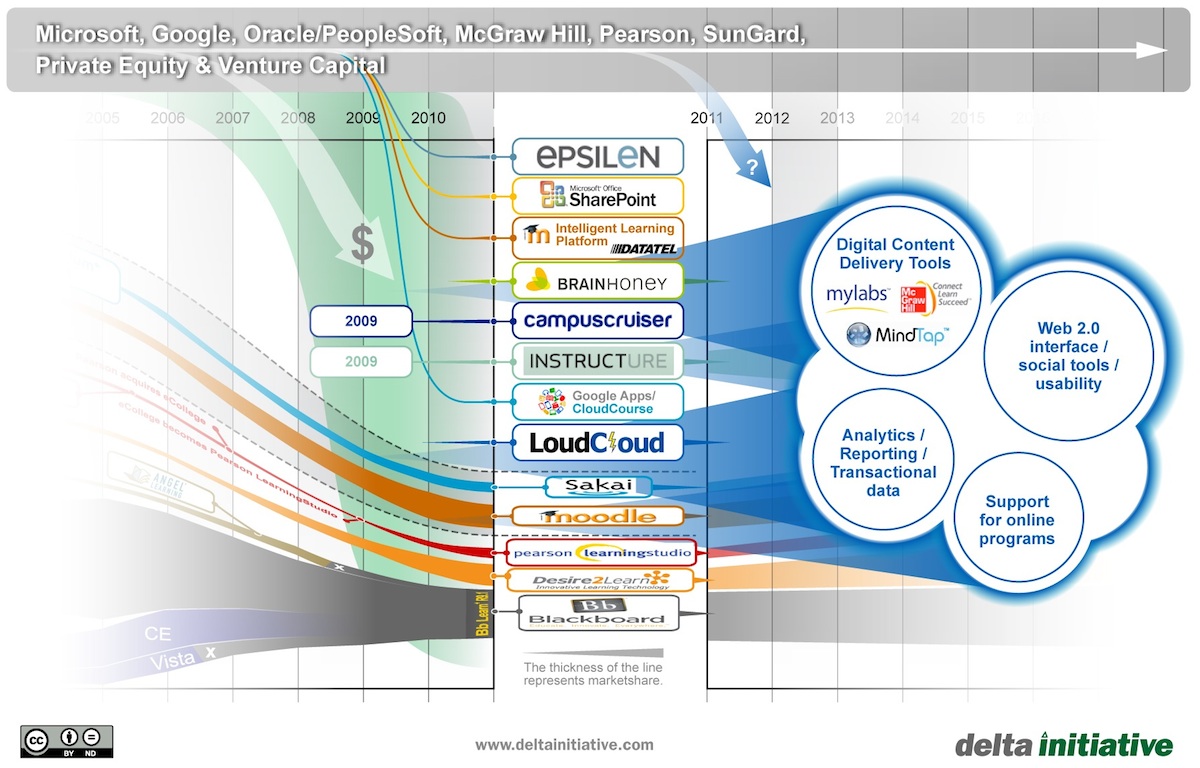
    The transformation of the higher education LMS market continues, and I expect more changes over the next 2 – 3 years. However, it seems time to capture a key segment of the market based on two recent announcements that directly impact large online programs.

    UMUC Selects Desire2Learn

    Following a multi-year strategic study and product selection, the University of Maryland University College (UMUC) selected Desire2Learn to replace the homegrown WebTycho LMS in use for over a decade. While there has been no press release, there are now official documents publicly available that describe this effort. Per the Faculty Advisory Committee (FAC) Newsletter:

    As announced last year, UMUC is planning to replace WebTycho with another learning management system. After a great deal of questions for the vendors, references checks and tests of functionality, Desire2Learn was chosen. More than 200 faculty, staff and students worldwide were part of the decision which was reported to have been by an overwhelming majority. The roll out will occur gradually over the next year or two. [snip]

    Not only is UMUC moving away from the WebTycho platform to the Desire2Learn (D2L) learning management system, but additional changes are in the works which will transform the online learning experience for our students and faculty.

    UMUC is part of the University of Maryland system, and it has a global focus – serving over 90,000 students worldwide.

    Mississippi Community Colleges Select Canvas

    The Mississippi Virtual Community College (MSVCC) provides the LMS for the system’s online program as well as for all 15 campuses. After a 6-month RFP process, MSVCC will be migrating from Blackboard Learn and Desire2Learn and implementing Canvas as the new LMS. From the press release:
    (more…)

  • The Billion-Dollar Bet on an Adaptive Learning Platform

    Update (2/15/13): Per Apollo Group, the billion-dollar investment mentioned in the Chronicle article (quoted below) refers to total infrastructure – not just the learning platform itself. The total infrastructure includes new CRM, portal, and administrative systems.

    *****

    Earlier this week I wrote about the new patent awarded to the University of Phoenix (the for-profit institution owned by the Apollo Group) for the activity stream within their new online learning platform. The patent gives us a glimpse into a billion-dollar bet that Phoenix is making on this next-generation LMS that will power their move into adaptive learning.

    The University of Phoenix has always been known for using a homegrown LMS, which is understandable given the large size (360,000 students) of the school. In 2009, Phoenix began investing in a completely new learning platform as part of the “Learning Genome Project”. While the company has traditionally been reluctant to describe its internal systems, starting with the 2010 EDUCAUSE conference Phoenix began sharing more information on this project.

    The promise of adaptive learning

    Steve Kolowich at Inside Higher Ed wrote an article on the new learning platform in October 2010 based on information shared by Phoenix’s Director of Data Innovation.

    (more…)

  • University of Phoenix Patents Adaptive Activity Stream for Its Learning Platform

    The University of Phoenix recently was awarded a patent (#8341148 B1) for an adaptive activity stream related to its online learning platform. From an initial reading of the patent, it appears very broad to me (deja vu all over again). From the press release:

    Apollo Group (APOL), the parent company of University of Phoenix®, today announced that it received a United States patent related to its innovative online classroom platform. The patent was awarded for the University’s new Academic Activity Stream that will consolidate student activities, engagement, and interaction into one unified learning space. The stream will showcase unique personal management features that allow students to more efficiently manage their coursework and classroom experience.

    This patent is the next step in the “Learning Genome Project” – UoP’s major investment in a next-generation online learning platform.  The basic idea of the Academic Activity Stream is to rank information in a user’s activity stream based on individual interests, past history, and learning objectives – rather than merely ranking the items chronologically. From Google’s listing of the patent:

    (more…)

  • Now UC Berkeley and Charles Sturt University Leave Sakai OAE

    Just three months ago, the University of Michigan and Indiana University made a joint decision to “pause investment” in the Sakai OAE project. The latest news is that the University of California Berkeley and Charles Sturt University (in Australia) have also decided to leave the Sakai OAE project. The only schools remaining as part of the Sakai OAE Steering Group are New York University, Cambridge University, and Georgia Tech.

    Ken Romeo from Stanford has an excellent post summarizing the Berkeley and Sturt announcement and resulting community discussions, based on his first-person experience in the early version of OAE. It is worth reading his entire post, but I’ll quote a few key sections.

    (more…)

  • Piazza – An Example of Free Learning Tool Targeted at Faculty / Student Adoption

    In my recent webcast with Patrick Masson for WCET, we described the growing usage of learning tools outside the official LMS solution. Patrick described survey results done by UMassOnline that captured the rich source of (often free) learning tools used in UMass courses. Much of educational technology is moving from an enterprise LMS market – with feature-rich LMS solutions expected to provide the majority of learning tools – to a learning platform market – with interoperable tools patched together with or without the official LMS by either campus staff or even directly by faculty. These tools are quite often free, and as such they are targeted at faculty and student adoption, rather than institutional adoption via a Request for Proposal process.

    One example of these tools is Piazza, which is a “a place where students can come together to ask, answer, and explore under the guidance of their instructor”. Think of the tool as an combination of discussion board, chat room, and wiki, with some design elements from Google Wave. While the description might be hard to understand, that is part of the issue – Piazza is not targeted to replace the LMS or to replicate specific LMS functionality.

    Jessica Wong at MakingUseOf has a very useful post running through the functionality of Piazza for those interested in the tool itself. My interest for this post is more on what Piazza represents in terms of ed tech trends with the availability of free platforms and tools that are targeted at student and faculty adoption.

    (more…)

  • The Search for Differentiated and Engaging Student Experience

    One of the trends I highlighted last summer was that the LMS or learning platform market was overlapping the educational content market.

    The lines are blurring between content delivery systems (e.g. Cengage MindTap, Pearson MyLabs, etc) and LMS.  Content delivery and ability to keep students engaged within the content will drive much of the broader ed tech market.  This integration of markets is being seen as a strategically important issue for institutions, particularly for online programs.

    While I feel quite confident in having made that description, I did not have a model, or explanation, of what was driving the trend. Nine months later, I believe the trend has proven itself empirically, as more examples emerge: Apples iBooks2 / iTunesU App, Online Education Service Providers such as 2tor combining online programs with custom learning platforms, Pearson OpenClass, MOOC startups with custom platforms such Coursera, Udacity, etc.

    Last week Roger McNamee, co-founder and managing director with venture capital firm Elevation Partners, gave a presentation to the Mashable Connect conference titled “How to Revive the Web”. The presentation described how Apple won big by betting against the web and its prevailing culture (Mashable post here and Roger’s full presentation here). Roger’s theory is that Apple’s strategy was to move away from commoditized content, which most of the PC-based web (HTML4) assumed,  by delivering content in a differentiated, elegant manner – tightly combining content and the delivery mechanism. Furthermore, as HTML5 emerges, this move will accelerate.

    If this theory is correct, I think it helps explain the trend of the LMS market combining and blurring with the educational content market.

    (more…)

  • What is a Learning Platform?

    While I have written (along with others) about the shift we are seeing in the LMS market, where it is moving from an enterprise LMS market to a learning platform market, there has not really been a good definition of what a learning platform is. As Jeff Bohrer asked via Twitter, “What are the hallmarks of LMS as a “learning platform” (beyond SaaS)? Any posts you can point to?” Mike Zackrison offer some very helpful thoughts in his response of “A few I’ve observed: cloud, multi-tenant; open API; social, analytics, mobile baked in; apps/content discovery too”.

    Rather than reply within the limits of 140 characters, I’d like to offer a response here (I have trouble with being pithy).

    Platform Definitions

    First, let’s look at the metaphor. A platform is typically defined in the generic sense as a raised surface of some type that supports other interacting objects. Within computer and software terminology, a platform can be defined as “A platform is any base of technologies on which other technologies or processes are built”. The idea is that the platform is not intended to stand on its own, as its definition includes the support of other technologies or applications.

    Given this context, there is a rather extensive Wikipedia entry on learning platforms with some useful definitions included. I have excerpted several below.

    A learning platform is an integrated set of interactive online services that provide teachers, learners, parents and others involved in education with information, tools and resources to support and enhance educational delivery and management.

    (more…)