
e-Literate

Present is Prologue

Tag: LMS

  • Four Initial Answers from Apple’s Education Announcement

    In a recent post I offered four key questions for the Apple Education Announcement held today (Jan 19th). Now that the event is over and the blogosphere is responding, I thought it would be useful to answer those four questions. Once I’ve had time to digest all the information coming out, I’ll post more of an analysis.

    1. Regarding textbook content, will the model follow iTunes, iBooks, or Amazon’s Kindle Self-Publishing?

    The answer to this question is that we have a new hybrid model that attempts to takes elements from all three models mentioned in the question, at least for the K-12 market that was the focus of initial efforts.

    • Like iTunes, it places an affordable maximum price of $14.99.
    • Like iBooks, it allows the content creator to set its price (although within the $0.00 to $14.99 range).
    • Like Amazon’s Kindle Self-Publishing, it democratizes textbook creation and distribution, providing an attractive path that could avoid traditional textbook publishers.
    (more…)

  • Analysis of Instructure Security Testing

    Instructure has engaged Securus Global to test the Canvas LMS product for security vulnerabilities. Instructure also invited me to be an independent observer – participating in the process and independently reporting on the testing and Instructure’s response to any vulnerabilities identified. Part 1 of this series of posts described the concept. Part 2 gave a mid-term update, describing the process involved and initial results. Part 3 described the full results of the security assessment. In this final post on the experience I’d like to address two subjects – my own impressions of the testing, and a call for more LMS vendors to follow suit and make their security testing more transparent.

    Results Themselves

    As described in part 3, the risk assessment found 10 vulnerabilities – 1 critical, 1 high, 4 moderate and 4 low risk – in the Canvas LMS system. I do not have a basis to judge the relative number of vulnerabilities found compared to Instructure’s competitors, as there is not an industry-specific standard on the depth and extent of penetration testing, but by all appearances the Canvas LMS system is a well-designed, generally secure application. I base this judgment on two factors:

    (more…)

  • Instructure Security Assessment Results

    Instructure has engaged Securus Global to test the Canvas LMS product for security vulnerabilities.  Instructure has also invited me to be an independent observer – participating in the process and independently reporting on the testing and Instructure’s response to any vulnerabilities identified.  Part 1 of this series of posts described the concept.  Part 2 gave a mid-term update, describing the process involved and initial results.  In this post I’ll describe the full results of the security assessment.  I’ll add my actual analysis in the final post.

    The purpose of the testing was to validate and review the Canvas LMS design and implementation with respect to vulnerabilities that could be exploited by a motivated hacker.  Securus employed security experts to ethically hack, both manually and with automated tools, a test environment to try and identify specific vulnerabilities, working from the perspective of both an unauthorized user and an authorized user.  There was a range of exploits tested, but the basic idea is to find out if someone could access information or functionality that should be protected by system controls including role-based security.

    Summary of Findings

    The findings were presented to Instructure on November 29, 2011 in report form and with a conference call to discuss.

    (more…)

  • Instructure Security Mid-Term

    Instructure has engaged Securus Global to test the Canvas LMS product for security vulnerabilities.  Instructure has also invited me to be an independent observer – participating in the process and independently reporting on the testing and Instructure’s response to any vulnerabilities identified.  Part 1 of this series of posts describes the concept.  In this post, I’ll give a mid-term update, describing the process involved and initial results.  In the next post I’ll describe the full results of the security testing.  I’ll try to keep my actual analysis in the final post, after I have objectively described the process and results.

    The purpose of the testing was to validate and review the Canvas LMS design and implementation with respect to vulnerabilities that could be exploited by a motivated hacker.  Securus employed security experts to ethically hack a test environment to try and identify specific vulnerabilities, working from the perspective of both an unauthorized user and an authorized user.  There was a range of exploits tested, but the basic idea is to find out if someone could access information or functionality that should be protected by system functionality including role-based security.

    There are two particular viewpoints that have led to my interest in this independent observer role.

    • No enterprise software platform is perfect and you should always expect some vulnerabilities.  The issue should not just be on whether there are vulnerabilities, but perhaps more importantly, on how a company or organization responds to a security vulnerability or incident.
    • I have called for transparency from LMS vendors and open source communities, arguing that they should share information from their third-party security audits and tests.

    (more…)

  • What If OpenClass Succeeds in Disrupting LMS Market?

    Right now the e-Literate site is close to over-heating from Michael’s voluminous posts – all very thoughtful, but we’re going to need some WordPress coolant.

    During discussions over the past week in person and over blogs, I’ve had three people ask essentially the same question – will Pearson’s OpenClass LMS offering and associated corporate strategy lead to more competition or less competition in the LMS space for higher ed, or how will the competitive landscape change?  Obviously the nature of this question is speculative with no concrete answers, but I do think that technology market trends can help us with an educated guess.

    (more…)

  • When Large Companies Enter Ed Tech

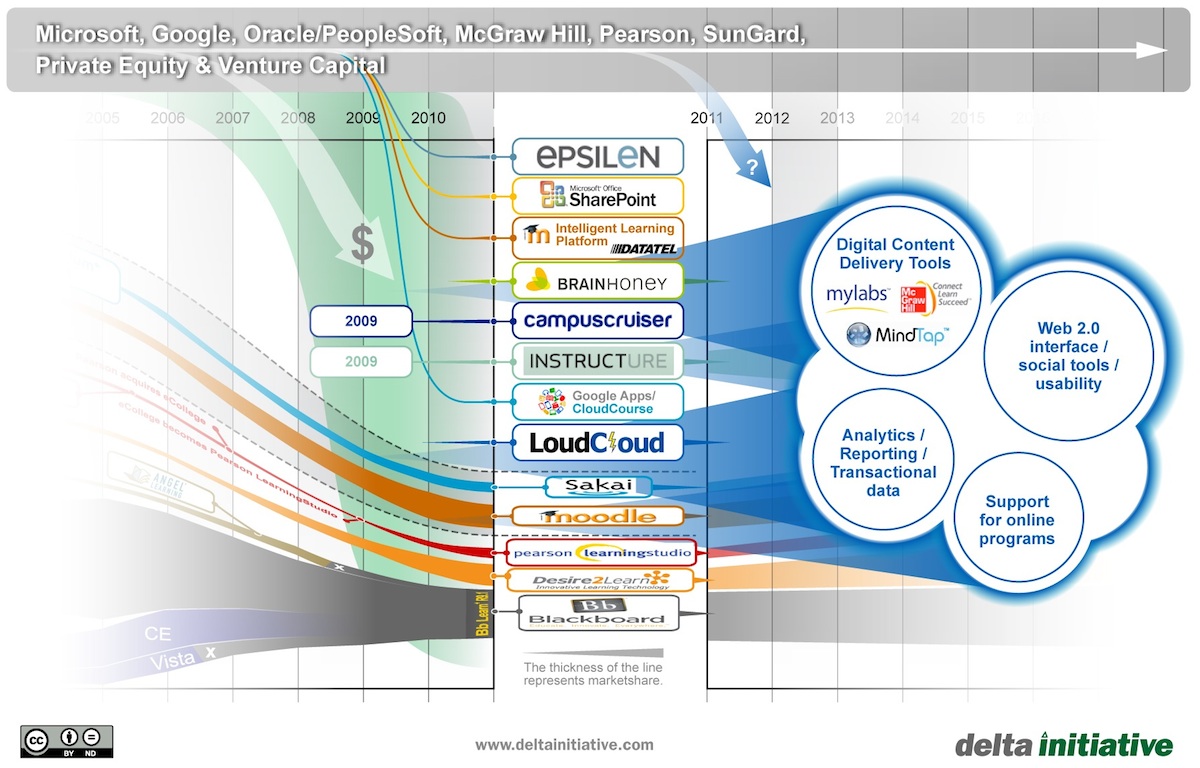
    I had a very interesting conversation on the way home from EDUCAUSE with Frank Florence, who is the Senior Director of Education Market Management for Cisco.  We discussed the changes happening in the ed tech market, and Frank helped me understand some of the market forces behind the changes we’re seeing.  One topic in particular was the dynamic between entrepreneurial companies that develop within a vertical market and larger companies that span markets.  I have argued that internal investment from larger companies is helping to change the ed tech market, but Frank provided valuable insight into the nature of the typical market forces we’re living through.  This observation of large company involvement helping to change the LMS portion of the ed tech market is shown below, in many of the companies in the top gray bar and some that are not listed.

    (more…)

  • Breaking Up the LMS: K-12 District Selects Part of LoudCloud Systems’ LMS

    This is a guest post by Phil Hill from Delta Initiative, follow on Twitter  @PhilOnEdTech or his blog

    It’s been a busy week for LMS announcements, and I expect more announcements leading up to EDUCAUSE.  First, the Hawaii Virtual Learning Network (for K-12) is moving from Moodle to Blackboard, which as Michael Feldstein points out, is a new development to watch.  Then Brown University announced they are moving from Blackboard to Instructure’s Canvas as their LMS.  This morning, Jefferson County school district, the largest district in Colorado, announced that they have chosen a module from  LoudCloud Systems’ LMS as the basis for their Instructional Improvement System.

    That’s right – they purchased a module from the overall LMS.  Normally I cover higher ed more than K-12, but this announcement is worth watching since it shows how the New Mentality in LMS Market is or will be changing our expectations on what an LMS can provide.

    (more…)