e-Literate

Present is Prologue

Tag: Marketplace

  • Top Hat’s OER Announcement: Doubling down on faculty engagement

    Top Hat’s OER Announcement: Doubling down on faculty engagement

    Several months ago I wrote a post looking at the Top Hat’s push into digital curricular materials through their Textbook product and Marketplace for digital course content. Leading up to that post, I had been planning to cover the Open Educational Resources (OER) angle, as the Marketplace included a number of openly-licensed material, much of it from OpenStax, and Top Hat had already begun marketing itself as an OER provider. At the time, the OER strategy seemed a work in progress. In fact, I found that some of my questions for company staff about OER basics – the role of Creative Commons licenses, community dynamics exhibited at the OpenEd conference, etc – led to a lack of answers, and at the time there was no export capability to get OER out of the platform.

    To Fee or Not to Fee

    The situation has changed since January, and with last month’s announcement of Top Hat’s Open Content Initiative the company is taking a stand on whether it is appropriate to charge for platform access. The idea of hosting and modifying OER on a fee-based platform became a big topic last year. Lumen Learning pioneered the Red Hat type model in 2014, and last year there was a big movement with Cengage, Knewton, OpenStax, Macmillan, and Top Hat all offering OER within their platforms. In many cases, the OER content itself has been redesigned from traditional textbook-in-PDF format to learning objective-driven content with aligned assessments. ((Disclosure: Lumen is a client of MindWires, and I recently gave a paid keynote at a Top Hat user’s conference.))

    Top Hat has now removed the student platform fees and added an export-to-epub feature. As evidenced in a company blog post by CEO Mike Silagadze, they are not shy about it either.

    At Top Hat, we’ve been working on making education more effective and affordable since 2009. Now, we’re happy to make a move that delivers on both fronts. Beginning April 12, with the launch of our Open Content Initiative, we’re offering completely free access to thousands of textbooks and other Open Educational Resources (OER)—freely accessible and openly licensed learning materials—on the Top Hat Marketplace.

    It’s about time. Students have been forced to weigh the pros and cons of emptying their wallets and draining their financial aid to buy textbooks for far too long. [snip] Just as bad, digital publishing platforms and e-readers have been charging a toll to students—disguised as a platform fee—to access free, openly licensed OER.

    Enough is enough.

    I asked Silagadze about a point I noted when describing Cengage’s OpenNow product:

    For each course [VP of Content Strategy] Constantini estimates that the modifications take $50k – $100k of internal work, including verifying of licenses for embedded elements. I would note a certain irony here in that OpenStax produces more-or-less traditional digital textbooks requiring publishers or OER services companies like Lumen to break apart and realign to competencies or outcomes.

    Silagadze brushed off this description and stated that the modifications made by other providers were far smaller and easier to make than is being claimed. We now have a third variation in the OER market, with the provision of wrap-around platform and a clear argument that these platforms not only will be free on Top Hat, but that they should be free as a matter of principle.

    • Free content, not dependent on specific platform
    • Free and modified content, available on a paid platform, content available for export
    • Free and lightly modified content, available on a free platform, content available for export

    While this is a marketing position by one of the competitors in a new field, this move by Top Hat is a further sign of the OER movement breaking into different branches. From our perspective, the fractures in the OER community have been widening for the past several years, but to a degree this is a sign of success. Openly-licensed content usage is becoming more and more common in education, and even traditional publishers mostly accept the value of OER.

    Faculty Engagement

    Perhaps more significantly, at least in terms of understanding Top Hat as a company, is that the OER initiative doubles down on their bet on faculty engagement. A well-known issue with OER (and even with non-open content) is that few faculty end up taking advantage when given the ability to modify the course materials in any significant manner. In theory many people talk about open pedagogy in terms of faculty modification and collaboration on content, but in practice this rarely happens. Top Hat’s view is that the barrier has been flat content and cumbersome platforms, as best described in an eLearning Inside interview.

    “We think the promise of OER has fallen down,” said Nina Bilimoria Angelo, VP of product and customer marketing at Top Hat. The Toronto-based company has created a platform to house, customize, and share OER and other educational resources. It has been used by over 2.8 million students to date.

    “The promise was there’s a community that continues to build on open materials,” Angelo said. “But when those materials are trapped behind static PDFs, and then people are making changes to it on their own without a mechanism to share it back, that’s where things fall flat. We really wanted to create a system where things can be improved in real time, not over a 3 or 4 year cycle like with traditional publishers.”

    “Discoverability is a challenge with OER,” Angelo said. “Quality can be perceived as uneven which is probably why OER adoption has stalled at the 5-10% level for instructors. There’s a lot of skepticism amongst higher educators. We’re trying to make sure all the high quality material is available in the Marketplace. Once it’s adopted, it’s really customizable. But then those customizations – this is the magic – those customizations can be shared back with the author and the team so that they can improve upon what they’ve created.”

    This is the best way to interpret Top Hat’s OER move, in my opinion, and you can see more details in my January post about the Marketplace to better understand the customization and sharing capabilities of the platform.

    According to an internal Top Hat survey of users, 89% of adopters make changes to digital textbooks that they adopt, with 22% reporting “lots of customization”. If this internal data is representative, there may be some indicators that faculty can be more involved in modifying and sharing content. Top Hat is betting on faculty engaging with content, modifying it, sharing it, updating it. And they are betting that this model will drive faculty adoption decisions.

    There are a lot of unknowns about faculty adoption and modification of OER content through the Top Hat Open Content Initiative, but it is clear that the company is positioning itself differently than other providers. The transformation of digital curricular materials continues.
  • Top Hat Marketplace: What is it and should we care?

    Top Hat Marketplace: What is it and should we care?

    When Top Hat announced their latest round of financing a year ago ($22.5m), I admit to having been skeptical, or more accurately cynical, about their stated purpose. The company was primarily known for its mobile and laptop-based classroom response system, but now it is claiming to be a digital content company.

    Top Hat, the Canadian education technology startup, completed a new round of funding to give it more firepower to go after textbook publishers like Pearson Plc. [snip]

    Top Hat is one of a handful of startups trying to find ways to disrupt the traditional textbook publishing industry, dominated by companies like Pearson, Cengage Learning Inc. and McGraw-Hill Education Inc., which is owned by Apollo Global Management LLC. All of these firms have added digital educational materials to their range of products, but the transition has been rocky.

    Then in the summer the company announced their new Marketplace.

    The Top Hat Marketplace answers the urgent need of professors and instructors to easily find and create educational content that is interactive, easily customizable and much more affordable for students than conventional textbooks. The educational content in the Top Hat Marketplace breaks the slow-paced publishing model by allowing educators to provide one another instant feedback. This collaborative community-sourced model means that the Marketplace’s content is continually being updated and improved upon.

    We at e-Literate have been covering the long-running and messy transition to digital curricular materials, including the search for new business models for content companies. But the announcements from Top Hat, to me at least, had the feel of a company pivot leveraging big, bad publishers as the bait for naive investors. Quite often it feels like the official greeting of ed tech entrepreneurs has either been “we’re going to beat Pearson” or “we’re going to beat Blackboard”. Top Hat and its products do not neatly fit into typical categories, but this may mean that we’re seeing a new model emerge, or at least a modernized and serious attempt to establish the self-publishing model.

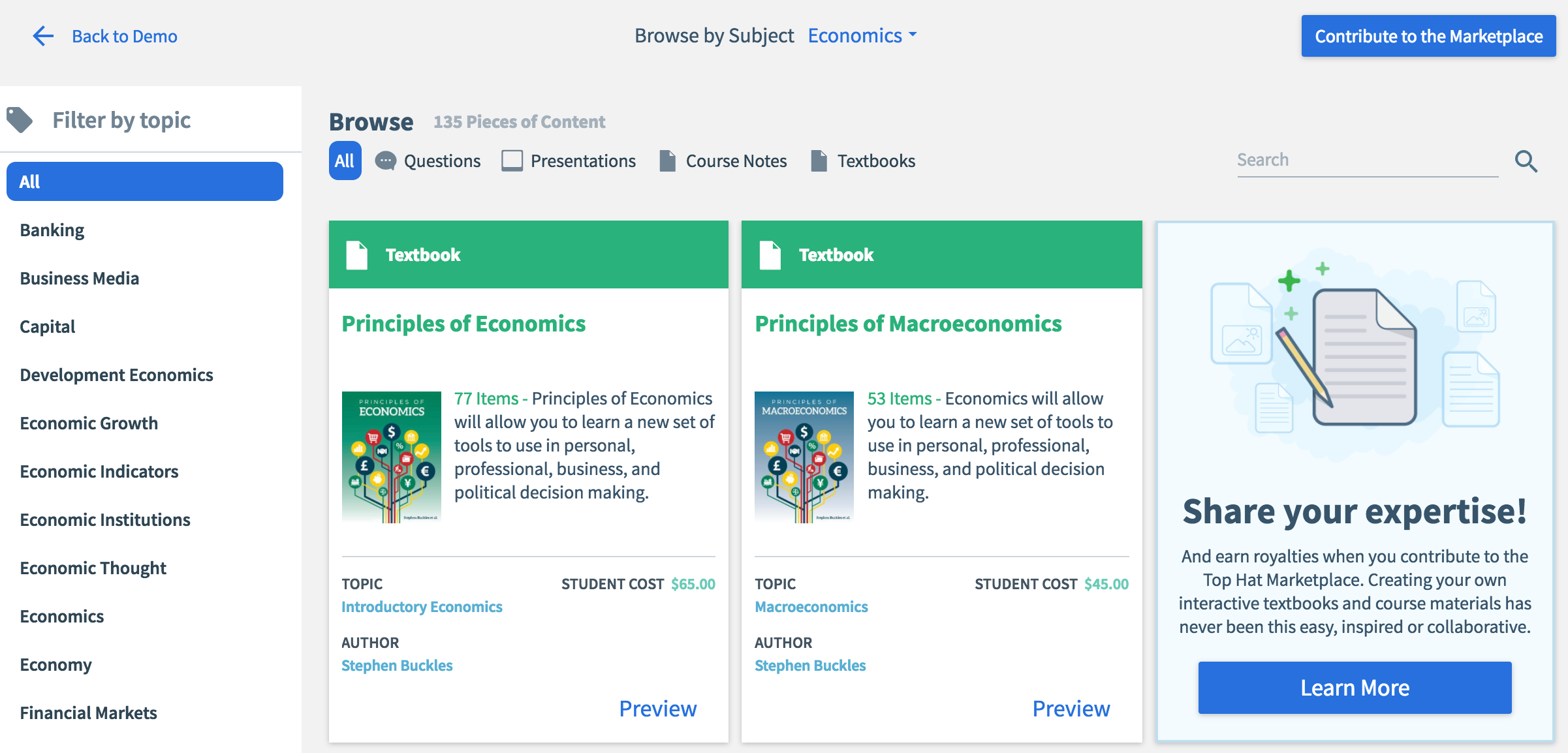
    The Marketplace provides a series of textbooks and ancillary material, (course notes, question packs, presentations, etc) that instructors can browse, adopt, modify, and share with students either as mandatory or recommended resources. Students pay fees between $0 and roughly $65 for the materials. A spokesperson for Top Hat clarified a recent change:

    As we’ve already discussed, 90% of the content in the Top Hat Marketplace is free for instructors and students to use. However, by the end of January, students no longer need to use the Top Hat engagement app to access this content—meaning, students will no longer need to pay the per-term app fee to use free textbooks and content.

    Other than reasonably low prices, nothing noteworthy so far. What is unique is that there are two primary sources for the content – self-publishing by instructors and open education resources (OER) from OpenStax. As described in the press release this summer:

    “We leveraged our existing relationship with educators already using our classroom engagement tools to test and launch the Marketplace,” said Mike Silagadze, co-Founder and CEO of Top Hat. “The Marketplace finally puts educators — the people at the forefront of learning — in charge of their course materials.

    Screen shot of economics materials

    The Marketplace has been designed as a self-publishing platform for educators designed around collaboration tools called Textbook. I interviewed Demian Hommel, senior instructor of geography at Oregon State University, and his experience helps explain the path that Top Hat is taking from classroom response systems to content marketplace. Hommel is an “an advocate for place-based and experiential education, service learning, and research-informed teaching” and has used the classroom response system for several terms. In the meantime, he has wanted to create a geography textbook but did not want to go through the traditional publishers. Since he already knew of Top Hat, when they announced Textbook and the Marketplace Hommel decided that he wanted to go with the self-publishing route.

    Hommel’s interest in publishing models does not seem to be driven by financial considerations, at least for himself, as he said he is not sure how well Top Hat will be able to scale usage of the Marketplace. One big driver for self-publishing was the interest in keeping the textbook current in a changing world of geography. Hommel views the Marketplace as providing a convenient platform enabling active learning techniques and the ability to control and update his textbook over time.

    There is another differentiator in how Top Hat provides content – the remarkably easy method to enable instructors to modify content, whether in the authoring process or as customizations to content that instructors choose to adopt. Basically, if you can author a post in Medium, you could create and modify content in the Top Hat platform.

    Consider Hommel’s Geography textbook. Here I have added the book to my course and hit edit in one section. By placing the cursor between text and an interactive text discussion prompt, then choosing the pop-up “Add” icon, I get the choice to add any of the following elements:

    Editing a textbook

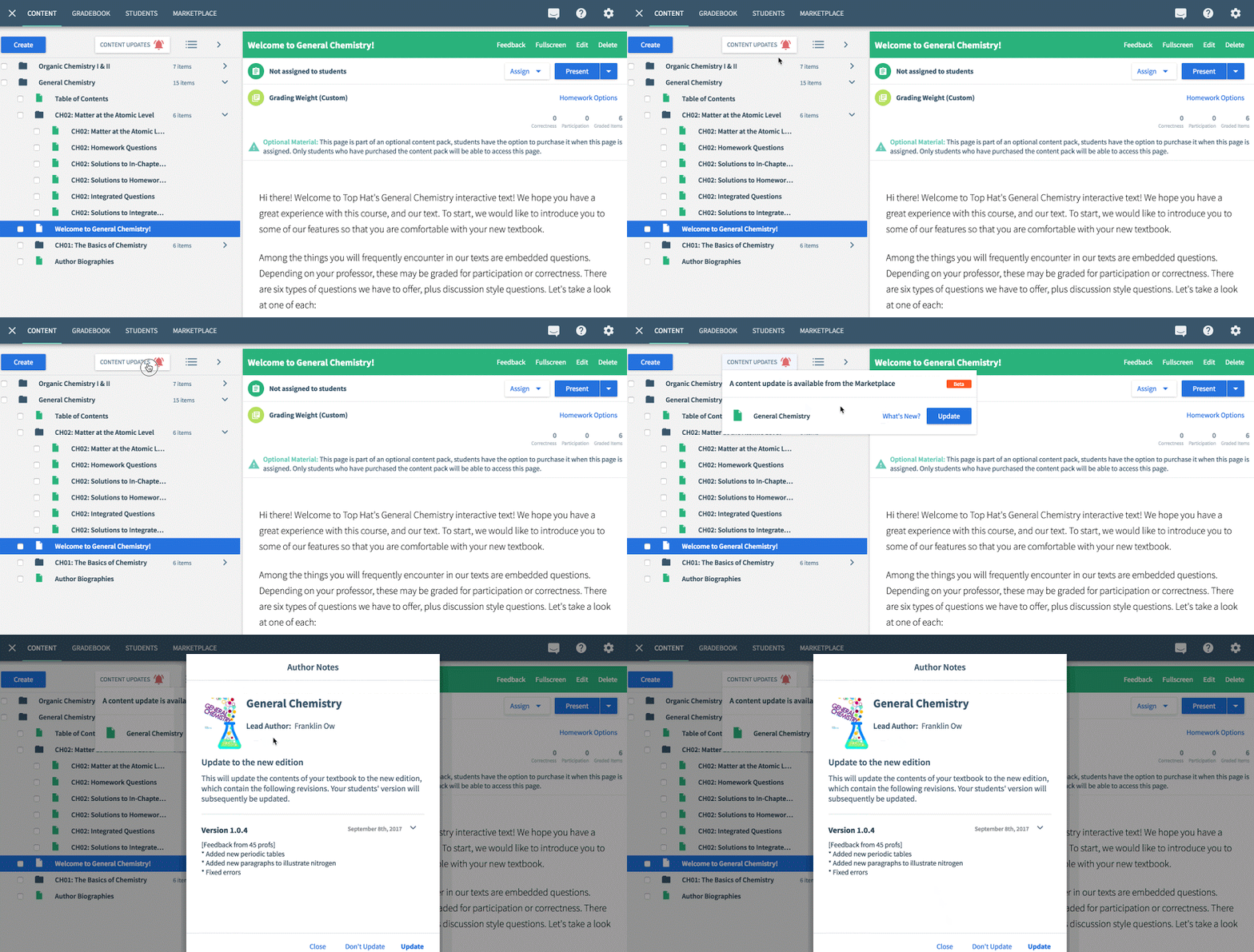
    This is the same interface as originally used to author the textbook. Beyond the ease of editing (customizing for my class, adding my content) is the apparent ease of accepting updates from the content author, based on a new feature introduced in a limited trial in September. The instructor sees a notification about updated content, reviews the updates, and (if all works out) decides whether to update while maintaining any customizations made by instructor.

    Method to accept revisions

    The functionality also promises to allow an instructor to review and adopt  customizations made by others who are working on the same base content.

    This is not an easy problem to solve, but if Top Hat is able to resolve how to deal with conflicting updates and local customizations, the intuitive user experience could change how faculty members and course designers collaborate and update content.

    Top Hat does have some real challenges in establishing themselves as a full-fledged content provider. One was mentioned by Hommel, when he pointed out the lack of broad awareness of the Marketplace amongst faculty even at his university. Top Hat is known for its classroom response and presentation systems, and with the Marketplace acting as a two-sided market, it needs sufficient supply of self-publishing content and sufficient numbers of adopting instructors.

    CEO Mike Silagadze response when I asked him about the adoption challenge is that the Classroom adoption, which they claim to be used “at 75% of North America’s leading colleges and universities and reaches millions of students”, has established Top Hat’s direct relationship with thousands of faculty members. In this way, they are betting that Demian Hommel is a model – aware of company through Classroom, interested in textbook usage based on self-publishing model, and willing to extend their personal usage of the company’s products.

    One other challenge is that it is not a done deal that self-publishing has sufficient demand on the content creation side. Are there enough instructors in a broad array of disciplines who want to invest the time and effort to create textbooks without a clear model of possible financial reward? This is the bet that Top Hat is making, that the market can grow to the point that there are reasonable clear answers on financial rewards. And there is the hope that there are enough Demian Hommels who are willing to make these commitments without financial drivers.

    I do not know if this product will take off, but if it does the Marketplace would establish a viable self-publishing model for faculty willing to work within the Top Hat platform. Over the past year in particular, the landscape of digital curricular materials is adding new models, and the Marketplace is worth watching.

    There is also an OER angle based on Top Hat’s marketing and the OpenStax partnership, which I’ll describe further in another post.

    Update 1/8: Corrected timing on change to student access and fees.