e-Literate

Present is Prologue

Tag: Michael-Staton

  • There is a Stupid Question: Are You Asking it?

    I hate to say this as a former classroom teacher – there is a stupid question in EdTech.  I have to go on the attack because this question is likely one of the biggest roadblocks to innovation.

     Is Technology Effective?

    The education sector is hung up on this question.  But there are two false assumptions underneath this question that make it one of the few stupid questions you can ask.

    Here are the two deadly assumptions: 1) Technology is homogenous, and 2) Technology is static.

    1) Technology is not homogenous.  To the contrary, Products are different.   There is no such thing as “technology.”  Technology is simply the black box we accept as the term to wrap around things built by invisible layers of computers and machines, advanced science and gobbledegook.  Technology can be pinned more specifically as the methodology, ingredients, or knowledge building blocks used to create new Products.  Technology cannot be effective or ineffective, but Products can be both effective or ineffective, depending on if you are doing the thing the Product is Designed for. That’s a capital D.  Design is an intention manifested in choices.  So, the question is not whether or not technology is effective at increasing outcomes, but rather does this Product do what it is Designed to do?  If not, that doesn’t mean the Product is not worthwhile.  Indeed, most products take years of incubation and Design iteration.  If a Product doesn’t yet do what it is Designed to do, but you believe in the direction, that’s all the more reason to get on board.

    2) Technology is not static.  It moves and moves quickly, and lately Products move so quickly its almost not worth talking about the past as much as the future.  More importantly, technology cannot be separated from the people that make it.  Designing and building a product is now more of a craft than a science, and you need to believe in the artisanship of the people behind it.  What’s happened is that, at least on the Internet, the many layers of the “technology stack” such as languages, servers, memory management, and a bunch of other things that would make my grandma fall asleep, are now open source, figured out, and easy to install, implement, and manage.  This means that coding the Product is now manipulating a smaller layer, involves less code management and investment, and can move so rapidly that small teams of people can push updates weekly if not daily.

    I’ll mention a company I advise called Goalbook.  Goalbook is an Individualized Education Plan management tool that enables the efficient communication of students support teams (teachers, staff, case workers, parents).  This is one of the most profound challenges in all of education, and bringing effectiveness and efficiency to communicating about an IEP will be a giant leap, especially at the K12 level.  Daniel Yoo was a special educator and talented software engineer, and Justin Su rose up through the charter school networks as a technology and innovation guru.  The product is 10x as easy to use and prettier than any current IEP management software, and Daniel and Justin have built a whole product, brought on paying customers, and made thousands of teachers happy on a budget of precisely $0 dollars.  Goalbook has yet to have a true efficacy study.  Does that mean we should stand on the sidelines?  No, this is too important.  We should be demanding great software now for our IEPs, and we should put money where our mouth is and pay Daniel and Justin to build the team to do it.

    So forget the question that educators are tempted to ask: “Is technology effective?”  Also, forget “Does technology produce outcomes?”  I was a teacher in the classroom, and I used to say there are no dumb questions.  But, as I’ve gotten older, I’ve certainly realized that some questions reveal a severe deficit in background knowledge.  It’s nothing to be ashamed of, per se, but this one is enough of a barrier to fight back against.  Because Education is so hung up on this dumb question, they never learn the insights that will bring educators to the important ones.

    There are smarter questions:

    Does this product do what it is intended to do?  If not, at what rate is it getting there?  How excited am I for them to succeed?  Do I trust the people that are building it?  Is it worth hanging on?  Is my life going to be better after this problem space is solved for or transformed?
  • What Are Ed Tech Entrepreneurs Good For?

    The recent ASU Education Innovation Summit, which brought together venture capitalists with aspiring ed tech entrepreneurs, created quite a stir in the edublogosphere and the edutwitterverse. A lot of the reaction came from people who were watching from a distance via video. Audrey Watters, for example, wrote an epic rant on her frustrations. There were many angry tweets from a number of quarters. First-hand reporting was relatively scarce, though. George Siemens, who attended the conference live, wrote a thoughtful and nuanced post on the topic. The question of how entrepreneurs can productively play a role in educational progress, innovation, and reform is a topic that I think about a lot. In fact, I already had a post planned in my backblog from an interview I did with the Instructure founders and CEO on this very topic. So now that e-Literate has successfully migrated to a new host, and before Blackboard buying somebody else forces me to write another post series, I’d like to take some time to lay out my thoughts on the topic.

    (more…)

  • Keeping Work (LMS) and Play (Social Networks) Separate?

    MergingArts has a good audio interview with Inigral CEO Michael Staton. Michael makes some good points about the nature of sites like Facebook that raise questions about a number of academic social networking efforts. Essentially, he argues that people don’t want to mix their work and social spaces. There’s an almost ontological separation of the two. Unlike, say, chat, which isn’t a “space” per se, Facebook is a “place” where people hang out. They’ll go there to check out what’s happening when they have a little free time, like a dorm floor lounge or a favorite pub. This is very specifically not what people want to do with work spaces, and they don’t want them mixed.  Most people don’t go to the office to hang out in their spare time. So how can social networks enhance work-like endeavors such as formal education?

    Inigral’s answer is to carry the work relationships over into the social space. If we make friends with and hang out with the people we work with, we will probably feel better about our work, try harder to please our colleagues, be less afraid to ask for help from them, etc. Other efforts that focus on embedding social networking tools directly into an academic space like an LMS may have a tougher time of it. It’s not obvious that current-generation social networking tools will transfer to direct work tasks in the way that, say, presence awareness and chat do. There’s definitely some more thinking to be done in this area.

    On a related note, Inigral has posted a survey regarding how new media is being used in higher education. If you have something to contribute in this area, please go on over and participate.

  • SIS to Facebook Direct. Introducing Schools on Facebook.

    tab_view.png
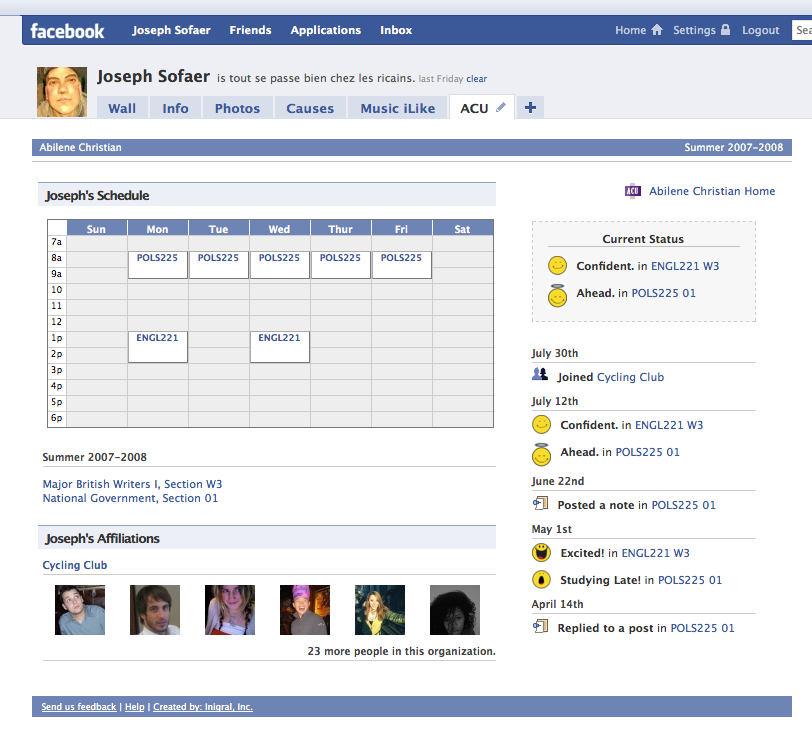
    Hi!  I’m Michael Staton and I’m a guest blogger.  What I say in no way represents Michael Feldstein or his ancestors.  Also, our screenshot here is of our app with Abilene Christian University, a school known for being a thought leader in instructional technology and mobile learning products. (They give their students iPhones.  No, really.  They do.)  I am also not representing ACU, its trustees, nor their ancestors.

    So, as I said yesterday, Oracle’s had a short few partners for this upgrade.  With the others included being mainstream LMS systems, you might wonder why Oracle would bother with an upstart like Inigral who hasn’t even invested in a good marketing site.  I hope to answer that question here.  If you read Michael’s blog often, this post will be of interest to you.

    We are introducing a product we’re calling “Schools on Facebook” (in private beta) that is a private, secure application (on Facebook) that can be skinned with a schools branding and connect with their current technology infrastructure.  It doesn’t compete with but complements CMS and LMS systems by focusing on socialization and relationship building; more on how below.

    It’s a cliche when a start up claims to revolutionize this or that.  So, at Inigral we try to stay realistic: we’re focusing on adding a social layer to what already exists.  We want to change the conversation about the internet in education from one of using the web to “manage courses” to one about using the web to facilitate the relationships that develop on campuses already.  After all, a real learning environment is one built on the mortar of person-to-person exchange.   Why not have an application that focuses on that?

    No software is a better example of this than Facebook, which took your campus by storm less than four years ago.  Students started engaging in high-frequency, (some might say mindless) contact that seemed to help students connect with their peers to build and maintain relationships throughout their campus experience.   And you never even paid for it.  Some of you[r colleagues] (not you, you’re too savvy for that) even talked about shutting it out.  But as time went on more of you (and you were early on this one) started to realize what Nicole Ellison documented in her research: that Facebook magnifies the “connectedness” that people feel to your school, one relationship at a time.

    Students use Facebook to represent their identity, and they fill out all sorts of information to that end.  Our product, Schools on Facebook, delivers course schedules, majors, organization memberships and other on campus affiliations to Facebook.  It also shows that “campus safe” identity to classmates and instructors, which helps to build conversations by introducing “primer” information,  i.e. “I see you’re a member of the economics club, are you planning on being an economist?”

    Students use facebook to talk about school all the time, our application just enables a students’ course information to be a part of those conversations.  It also enables contact between faculty and classmates who are not “friends” with a student on Facebook.  Faculty that have ventured on to Facebook have struggled with whether or not to be “friends,” and the safest bet with the least amount of line crossed is to not be friends.  Through our application, campus exchanges can stay out of the personal part of Facebook, and the personal part of facebook can stay out of campus exchanges.

    It has some other great features, too.  But I don’t want to take up any more of Feldstein’s blog with our pitch.

    This is the first public announcement that we are currently selecting two more schools to participate in our limited beta this fall.  We’re only taking three, and we’ve signed up one and have a big name other in the pipeline (huge name, actually).  We’re looking for the “right” school, one that’s going to be excited to see what the Oracle upgrade can enable, one that isn’t afraid to say “we think Facebook adds value to our campus,” and one that’s not afraid to talk about using cool technology openly to others in higher ed.
    Contact me at mpstaton a t inigral.com if you’re interested.

    As you know, the beginning of the school year is a hectic time for all of us!!  I will try to get to all emails as quickly as I can.

  • Please Welcome Guest Blogger Michael Staton

    Michael is the CEO of a company called Inigral, the company that produces the Facebook Courses application. You may have seen his earlier guest post for the On the Horizon. I have been talking a fair bit with Michael lately because my team at Oracle has been working with his company on integration through the IMS Learning Information Services specification. (Again, more on this real soon when we release our product.) We’re entering a new era with Web 2.0 where the university (with the students’ permission) may want to share data with outside applications for specific educational purposes. These new software configurations lead to new kinds of business partnerships, where the university’s relationship with the vendor is quite different than the traditional model. This is all in addition to the basic question of how these Web 2.0 capabilities should fit with and influence the unversity’s approaches to teaching and learning with technology.

    Michael is grappling with all of these issues right now, so I’ve invited him to come and think out loud with us here about them here on e-Literate.

  • Perspectives from a Geek with a Startup

    This is a guest post by Michael Staton for the On the Horizon series on distributed learning environments. Michael studied poverty alleviation for his BA and MA at Clark University, where he developed a lifelong commitment to education and entrepreneurship. He then spent 3 years as a high school educator and was thrust into internet start ups in the education space. Seeing Facebook Platform as a disruptive opportunity, he co-founded Inigral, Inc as a consumer internet company set out accelerate real world relationships in an academic context using the product “Courses on Facebook.” Courses quickly gained traction in the Fall of 2007 and Founders’ Fund, an investor in Facebook, made a Series A investment. Inigral is also about to release a product to help K-12 educators cope with the pressures of the accountability movement. Michael is also the author of the Edumorphology and College Readiness for the 21st Century weblogs.

    I spend most of my time in the midst of internet entrepreneurs. I work in an office with four other internet companies, go to beta launches in San Francisco, and attend panel discussions in Silicon Valley. Something that is conspicuously evident is that I’m one of the few entrepreneurs trying to solve problems in education. Another thing that’s evident, as ironic as it sounds, is that many internet entrepreneurs have given the problems in education considerable thought, many have even tried to contribute to or build a product to address needs in education at some point.

    Start-ups in education are rare, but it’s not for lack of desire to work in the space. Venture Capital appreciates the education market size: it’s huge. Everyone gets an education, and mind-numbing amounts of money are spent to that end. Entrepreneurs tend to be young risk takers, and their first-hand knowledge of problems in the education sector is ripe. However, very few go-getters can convince an Angel Investor or VC that their product for the education market is worth an investment. To boot, older entrepreneurs advise young ones to stay away from the space. Why the reluctance? The market barriers.

    In my paper, I comprehensively address barriers to market entry into the education market and propose some easy solutions. I focus on a set of interdependent forces particularly destructive to outside innovation; there is a causal relationship between public rhetoric and legal protections based on misunderstandings of internet use and political decision making, creating a risk-averse, zero sum purchasing process that requires an abnormally large and unhealthy investment in sales and support efforts.

    (more…)