
e-Literate

Present is Prologue

Tag: online program management

  • OPM Readings: New policy briefing from UCT and other useful coverage

    OPM Readings: New policy briefing from UCT and other useful coverage

    Over the past eight days there have been a series of valuable articles covering Online Program Management (OPM) and the broader Online Program Enablement (OPE) markets. ((See this post to better understand the OPE concept.)) All four articles provide useful historical and academic environment context to better understand market dynamics.

    University of Cape Town Policy Briefing

    Laura Czerniewicz and Sukaina Walji from the University of Cape Town’s Centre for Innovation in Learning and Teaching (CILT) released Issues for universities using private companies for online education this week as a policy briefing for “universities who are thinking of using – or already using – private companies to develop or expand their online programmes or courses” ((I’ll stick with the South African English spelling in this section.))

    Rather than just focusing on the OPM market itself, Czerniewicz and Walji place the subject into the broader context of “marketisation, digitisation, unbundling and austerity climates.” This placement is valuable, as it frames the appropriate questions that colleges and universities should address when considering OPM or OPE vendor support.

    After addressing why the OPM / OPE movement is becoming so important now – from an international perspective with some global south viewpoitns  – the briefing addresses the various funding models involved. The note in the description about these models being on a continuum with various combinations possible is crucial.
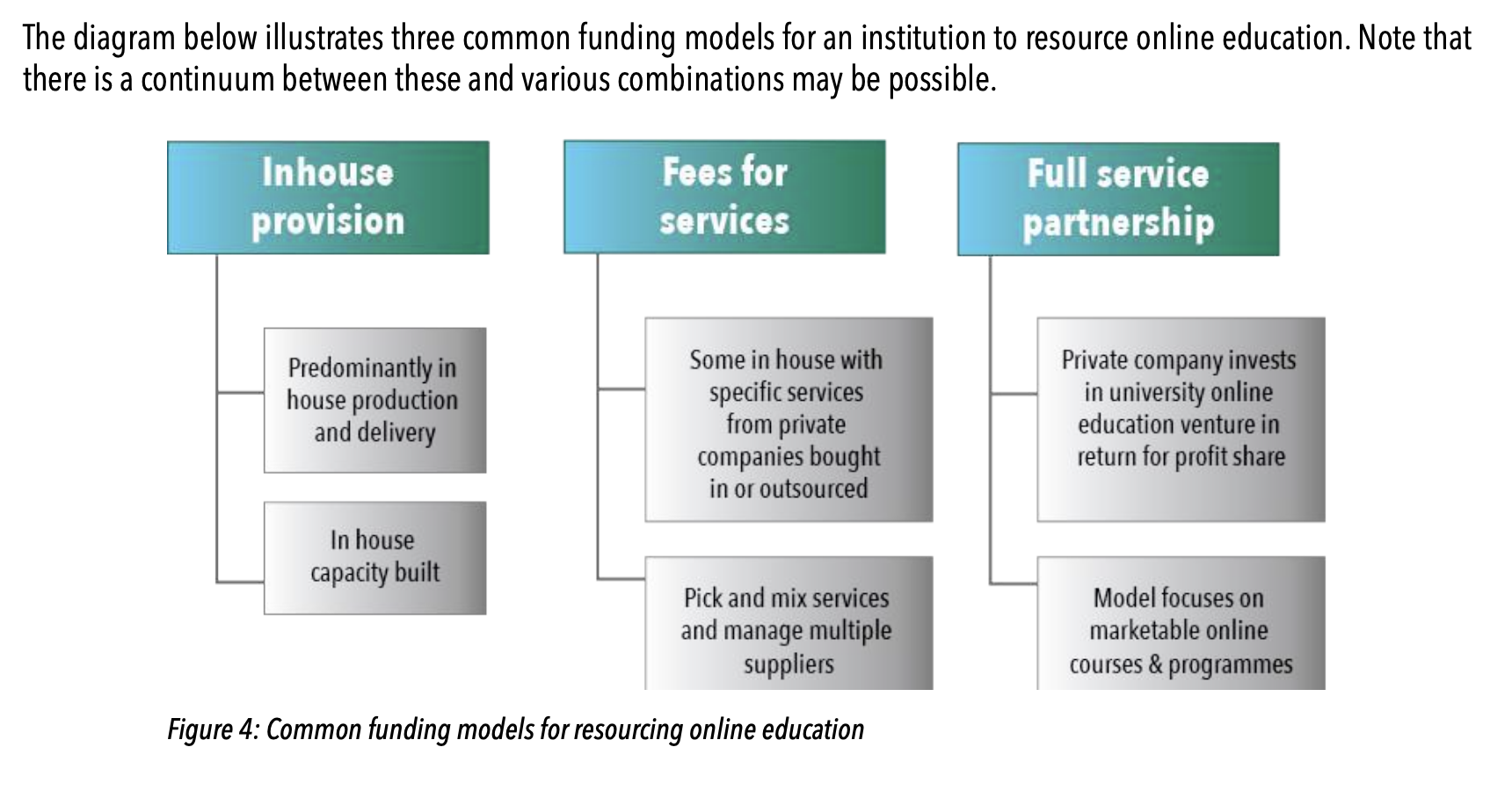
    Three common funding models - inhouse provision, fees for services, and full service partnership

    The briefing including a Strengths, Weaknesses, Opportunities, Threats (SWOT) analysis for the full-service OPM scenario and for an inhouse / fees-for-service scenario as well as use cases for different institution types. It is well-worth reading the whole report.

    EdSurge Debate on OPMs

    Last week EdSurge ran a two-article series on OPMs that missed the SNL’s Point / Counterpoint opportunity and instead tried the nuanced argument method.

    Dan, you pompous ass

    In the first post “How OPMs are the Modern Enrollment Managers”, Randy Best and Harris Pastides from Academic Partnerships described OPMs as a follow-on to the enrollment management companies that emerged in the 1970s, with OPMs partially taking credit for moving away from the for-profit sector.

    These OPMs, like enrollment management consultants decades before, assist universities in providing access to time-pressed, place-bound students for whom online education is the only choice for earning a degree. In doing so, OPMs shifted leadership in the market for online education from for-profit institutions, which dominated the landscape in the early days, to nonprofit institutions.

    After addressing four myths about OPMs, Best and Pastides position full-service revenue-sharing OPMs against the new movement of fee-for-service OPM / OPE providers.

    Given the evolution of OPMs, perhaps the time has come for a new name to describe them. They are not just managers, but partners with universities. They don’t just oversee programs, but perform operations critical to the overall success and reputation of the institution. And their efforts often result in the expansion of overall enrollment. In many ways, they should be called Enrollment Growth Partners.

    Some players in the OPM space who are not traditional comprehensive providers are trying to adopt the mantle of the future with fee-for-service or unbundled offerings. But fee-for-service simply shifts the cost and financial risk to universities. Meanwhile, by unbundling services—say by separating recruitment and retention—outside partners become solely focused on getting students in the door rather than keeping them through graduation.

    Michael wrote the second post “The ‘O’ in ‘OPM’ Could Stand for ‘Outsourcing’”, where instead of taking the simple pro / con approach to the debate, he argued for some nuance in our analysis. In particular, he took issue with the quoted description above.

    Michael’s historical context story differed from Best and Pastides, describing John Sperling’s history creating the University of Phoenix and how the current context for bundling and revenue models.

    The essential OPM characteristics of bundling and revenue sharing, both of which Pastides and Best tout as almost inherently good, contain trade-offs just like any other proposed solution to a complex problem. They balance growth opportunity against a range of risks, including risk that the up-front costs of launching the program would not be repaid, or that the universities could not execute well on essential aspects of the project (like student recruitment), or that they would let down the students by failing to maintain good quality of technology platform support or service at scale.

    There’s nothing inherently bad about managing these trade-offs through a full-service, bundled revenue sharing agreement. But there’s nothing inherently superior about the approach either. For example, universities that are more worried about the risk of failing to grow fast enough than they are about minimizing the expense of using an external vendor are often well served by finding a high-quality OPM partner, while universities with different risk profiles may come to different yet equally appropriate conclusions.

    Both posts are worth reading, and it is interesting to see the same issue described here and in the UCT briefing – about colleges and universities managing trade-offs when deciding which model is appropriate when selecting private partners to help with online programs.

    Education Dive

    Education Dive is running a three-part series on the issues involved with federal rule-making debates, and the first deep dive is “As traditional colleges grow online, OPM relationships shift”, describing the broadening market while traditional schools and systems like SUNY look to develop a strategy for online education.

    The State University of New York (SUNY) is one of several public systems looking to raise its profile online. An early pioneer with its Open SUNY platform, the 64-campus system in July issued a request for information about how it could “take the next step in creating a comprehensive environment” for online learning within and beyond New York state. [snip]

    The document, which Education Dive obtained, mentions a desire to “leapfrog competition” and “challenge current leaders in the field.”

    The article explores several of the OPM-related topics as well as motivations for traditional institutions developing online strategy, based on a series of interviews that included Michael. The key theme of the article described how the OPM market is changing, and the boundaries between online and face-to-face education are blurring.

    Soliciting OPM services for ground-based and hybrid programs can help colleges present a unified face in the market when they offer both on-campus and online versions of a program. Wiley, for example, provides full-service marketing support targeting prospective students for George Mason’s online and campus-based MBAs. That includes SEO, paid search, online advertising and social media.

    “The dialogues (are) more and more moving toward broadening the services to be more than just about the fully online student (but) to be about the student at the university no matter what their modality,” [co-president of Wiley Education Services and Learning House] Hillman said.

    That could lead to an uptick in blended and hybrid experiences, [co-founder and CEO of iDesign] Riter predicts, where learners navigate instruction online and on campus.

    “Over time there’s going to be less difference between online and face-to-face education,” he said. “It’s just going to be education, and even face-to-face residential education that exists today is going to be much more technologically infused.”

    It’s good to see four separate articles all worth reading about the emerging and broadening OPM market, with useful context.
  • Extension Engine and OPM Market Transparency

    A couple of weeks ago, our response to Open SUNY’s Request for Information (RFI) on Online Program Management services (OPMs), we published an abridged version of our response on our company website and wrote a post about our observations here on e-Literate. Since, then, ExtensionEngine has followed suit. Here’s the introduction to the version that they published on their site:

    The online program management (OPM) landscape is a confusing one, the result of rapid evolution and an ever-greater assortment of businesses keen on winning their share of what has become a very lucrative market. We do not envy the task of any institution of higher learning seeking to upgrade their online learning program, and even less one considering the launch of their first program.

    A few days ago, MindWires — a strategic consultancy and advisory firm — took an unusual step, one that begins to make the task a little easier by increasing transparency among all of these diverse providers: they published their response to a request for information (RFI) from the State University of New York (SUNY).

    The action reflects — and begins to correct — concerns expressed by MindWires’ Michael Feldstein in a series of articles regarding the complicated 2018 OPM market. Greater transparency, as modeled by this move, may be exactly what the marketplace needs to make sense of itself.

    In fact, the SUNY RFI itself has made a contribution to greater clarity. This RFI was more than a request for information on what various providers could do for them; rather, it asked the question: What do we need to know before we move forward? Asking for this guidance before generating a request for proposal, or RFP (which will come later), was a brilliant and insightful move on SUNY’s part.

    The SUNY RFI listed 15 information-gathering objectives. As we formulated our own response, we noticed that we were, in effect, creating a road map through the wilderness of the 2018 OPM market, one that could be valuable to many institutions of higher learning that are thinking of creating or upgrading an online learning program. Some sections are more pertinent to multicampus systems like SUNY’s, but much of the road map applies to any institution, regardless of size.

    For those who are not familiar with ExtensionEngine, we are a professional services organization that designs, builds, launches, and markets custom learning experiences — an integrated, holistic experience designed for learners, pedagogy, vision, and brand. We are a fee-for-service partner — no revenue sharing — and are paid by the hour to provide a full suite of services to help our clients to create successful online learning.

    So, in the spirit of transparency inspired by MindWires’ publication of their response, we are following suit to share portions our response to SUNY’s RFI. Below is a substantial excerpt from the road map through the OPM landscapewe created for SUNY, shared with their permission.

    This is great stuff. In mature product categories like the LMS, this kind of sharing can do more harm than good, because schools tend to just copy and paste requirements without giving a lot of thought about or investigation into which requirements are right for their particular context. But in the still-maturing OPM and broader Digital Enablement Solutions product categories, this kind of sharing helps to surface the differences in needs and contexts that lead to different kinds of optimal solutions. Publishing both the requests and, at least, abridged versions of the responses is very helpful in advancing the conversation. As ExtensionEngine’s Scott Moore noted in the blog post, such responses can “creat[e] a road map through the wilderness of the…OPM market.”

    More transparency in this space would be extremely helpful at this time. We’re giving some thought into different ways to accomplish that aim.

    Stay tuned.

  • Noodle Partners and the Boundary of the OPM Product Category

    If you spend some time browsing the Google News search results for ‘OPM “revenue share”‘, you’ll find one industry figure who seems nearly ubiquitous, particularly in pieces by general audience news outlets: John Katzman. Mr. Katzman, currently the founding CEO of OPM company Noodle Partners, is one of those rare individuals who has been extremely successful as a serial entrepreneur in education. He founded both Princeton Review and 2U before going on to start Noodle. In his current incarnation as Noodle Partners CEO, Katzman is waging a publicity war against the OPM revenue share model that companies like his last one—2U—are built on. Josh Kim’s recent interview with him in Inside Higher Ed is quite revealing and tells us a lot about the real debate surrounding OPM revenue sharing.

    Josh starts the interview by quoting a two-year-old opinion piece Katzman wrote for the Hechinger Report:

    In three years, no one will be able to explain why it was that colleges and universities continued to hand more than half of their tuition to companies marketing and supporting their online programs — the online program managers. It will be even more challenging to explain why some agreed to contractually share their tuition for the next 10 or 15 years.

    In that same piece, Katzman referred to traditional OPM revenue sharing agreements as “payday loans” and wrote,

    I’m suggesting the time for the ‘share the bounty’ approach to online education is over. This approach is driving up education costs (and student debt) and fueling a marketing race as schools and online program managers spend more and more to recruit and retain online students.

    That online program managers continue to sell their outdated and misaligned tuition-sharing model fuels the suspicion and mistrust educators have for for-profit education companies.  Those of us who believe for-profit investment and innovation can improve the quality and accessibility of education are obligated to raise our voices when things go off the rails or become ineffective or outdated – as the revenue sharing model has….

    Few, if any, institutions can afford to share their tuition and none can afford the all-out marketing war that outside companies will be all too happy to wage for a cut of the action.

    The good news is that the market knows a change is coming. Tuition-sharing percentages are trending down and contracts are getting shorter. More colleges are investing in in-house solutions to recruit and manage their online offerings. And fee-for-service management options like the one my company offers are also becoming more abundant. That’s progress.

    Pretty harsh words, especially from a guy who founded one of the most successful OPMs in the industry. Has Katzman softened his stance in the last two years?

    Nope.

    Here’s what he says in response to Josh’s question about whether the OPM industry should form an association:

    My job is to decimate the OPM industry, which is driving up higher ed tuition. So … perhaps, but doubt they’d want me in it.

    Clearly, Katzman is on a mission to kill revenue sharing agreements. Here’s what he says in response to Josh’s question about how universities can manage the up-front costs of building an online program without revenue-sharing agreements:

    Some traditional OPMs are trying to position us as fee for service, but Noodle also offers a temporary revenue-share option in which we fund a program and take on all risk. The school pays a share of revenue, but only until we have recouped our out-of-pocket expenses for its programs, after which it pays for actual services. This is the best of both worlds, and about half our schools take advantage of it.

    Wait. What?

    Noodle Partners’ position gets flattened into “revenue sharing bad,” partly because it makes good headlines, partly because Mr. Katzman knows it makes good headlines, and partly because Noodle Partners’ position has evolved. According to the Wayback Machine, Noodle Partners’ 2016 version of their web site said the following about financing:

    Choosing to work with Noodle Partners is the most affordable route to great, quality online programming. While there is an up-front investment necessary to launch your programming, Noodle Partners can work with you to get outside capital from a trusted, low-interest financing partner.

    In the IHE interview—and on the 2018 Noodle Partners web site—the positioning regarding revenue sharing is more nuanced.

    But if revenue sharing isn’t the core problem that Noodle Partners is intended to rectify (anymore?), then what is? Is it the bundling? Here’s what Mr. Katzman says to Josh on that point:

    [U]nbundling isn’t exactly what we’re doing. A program needs instructional design, marketing, recruiting, funding, technology and support services; we’re just comfortable with helping a school build capacity rather than use outside providers exclusively. Any way our competitors follow us, though, they will leave Noodle as the leader in the next-generation OPM space.

    In my last two posts, I talked about OPMs being long-term partners in the ongoing management of online programs. I also argued that unbundling of services opens up a world of possibilities for solving different problems, and that we therefore need an umbrella product category called “Digital Enablement Solutions” with other (emerging) subcategories that could live along side Online Program Management. Noodle Partners isn’t unbundling services but is rejecting the model of the long-term full-service management of online programs by the company.

    So what does that make them?

    I would call the service that Katzman describes “Online Program Enablement (OPE).” In this model, the vendor may offer revenue sharing or some other form of financing designed to cover the up-front costs of full-service support for the program launch, but then unbundles those services to some extent and allows customers to pay for them as needed on a fee-for-service basis. That shift in models after the program launch is what distinguishes an OPE from an OPM.

    Katzman characterizes the shift as “next-generation OPM,” but the resulting service really solves a different problem than an OPM does. If you think your institution is best served by focusing on its current core competencies and outsourcing the lion’s share of online program management work to a specialist on an ongoing basis, then an OPM service is what you want. If, on the other hand, you want full-service support (and financing) to launch your program but want to take over management of significant portions of it once it is up and running, then an OPE service is really what you want.

    How much OPM and OPE services are ultimately going to compete or just co-exist is an open question. At the moment, we don’t see a lot of evidence that OPE growth is coming at the expense of OPM growth. There is likely a Venn diagram of potential customers between the two product categories, but we won’t know the size of the overlap for a while. In fact, we have very little visibility into OPE growth, in part because many service providers are offering multiple pricing options these days. There’s still a lot of improvisation going on without a lot of thought about how tinkering with the pricing model changes the offering enough to put it into a different product category.

    The main point, once again, is that many significantly different offerings are getting crammed into the OPM product category because it’s the only product category that we have. This obscures the fact that some of these services are different enough from each other that they solve different problems from each other. And the differences that tip an offering into a different product category are not always obvious.

  • The Boundaries OPM and What Lies Beyond: The SUNY Example

    In my previous post on OPMs, I wrote,

    There are several factors that are major contributors to the current rush to by vendors to call themselves OPMs:

    1. The variation between kinds of programs that universities are looking to launch is significant and increasing. As a result, different OPM vendors are specializing in different kinds of programs.
    2. More universities are making fine-grained choices about which aspects of their online programs they want to outsource to a specialist, which aspects they want to pay a consultant to help them get started or improve, and which aspects they believe they can do themselves. This broadening out of customer choices is creating further variability in in OPM business models and OPM-like services offered by an increasingly wide range of companies.
    3. As the OPM business disaggregates, universities are increasingly recognizing that certain functions that OPMs perform, like recruiting students who are likely to be successful in a program, redesigning courses to maximize student success, providing early interventions to promote student success, and working with employers to help with career readiness and post-degree employment are all services that might be useful for improving the success of their traditional programs.

    This last point is especially important. Within the three-letter acronym OPM, the “P” and the “M”—”program” and “management”—are defining features of the product category. OPM is a service in which the vendor actively manages at least some substantial subset of a full online program  for some significant period of time. As in multiple years. Once customers start contracting for individual services a la carte on a relatively short-term basis—say, just to get the program up and running—those customers are no longer paying for an OPM service. They are paying for some other digital enablement service which may not yet have a widely used name.

    Because this distinction can be a little fuzzy, it helps to have a case study. Luckily, we have one. Open SUNY recently released a Request for Information (RFI) for vendors that can help them meet a wide range of ambitious goals. While the term “OPM” was never used in the RFI, it’s pretty clear that the request was written specifically to include questions that one might ask of an OPM service provider. MindWires, our consulting company, responded to that RFI. Because we think the answers we provided to SUNY might be useful to a wide range of colleges and universities, we have published a shorter, edited version of our response. Because that response includes fairly detailed descriptions of our consulting services, we have published it on the MindWires site rather than here on e-Literate. But some less commercial discussion of SUNY’s request is also appropriate for the blog because it sheds some light on the challenge defining the product category in a useful way.

    SUNY’s Goals

    In their RFI, Open SUNY enumerates quite a few ambitious and complex goals (even before accounting for the fact that these goals are for a system of 64 diverse and independent colleges and universities):

    • Opportunities to position SUNY as a unique provider of educational opportunities for all learners;
    • Reaching the millions of New York residents currently not enrolled at a SUNY campus, who need higher education to be more effective on their jobs;
    • Significantly expanding SUNY’s online learning experience to serve exclusively online students who are currently not at a SUNY campus;
    • Potential next-generation innovations in online/digital education where SUNY may have a unique opportunity to leapfrog competition;
    • The most appropriate ways to productize SUNY’s vast educational offerings to prospective students;
    • Business and revenue sharing models to incent behaviors, ensure sustainability and provide campus/System revenue growth;
    • Opportunities to capture students SUNY is losing to other online schools generating revenue for investment in our campus operations;
    • Outreach and marketing plans that reach a broad range of key stakeholders, including potential students in-state and out-of-state, internal staff and professors, and other key stakeholders as identified;
    • Platforms and services to expand SUNY’s current online environment and enrollments to challenge current leaders in the field;
    • Insights into the type and structure of programs appropriate for this platform/business model;
    • Requirements to continually align educational opportunities with labor market needs;
    • How to best integrate SUNY’s 64 campuses and their faculty into this improved platform/business model;
    • The impact of the changing demographics in New York, as well as surrounding states and potential global opportunities;
    • Partnering with interested industry leaders, including other university systems;
    • Consideration of prior learning assessment as part of the improvement to this process.

    Much of this sounds like classic OPM work. For example, “[b]usiness and revenue sharing models” and “outreach and marketing plans” are classic elements of an OPM solution.

    The revenue sharing model is both particularly characteristic and widely misunderstood. Revenue sharing is best understood as a service offering. It’s financing. When I bought my last car from the dealer, I got a loan from them to help pay for the car. There were other ways that I could have financed the purchase. I saw the prospect of owing money and paying interest to the car company as a feature rather than a burden because the specific terms they offered were advantageous relative to other options I had at my disposal. In my case, I was buying a new car that cost more than the cash I had on hand. So I needed to take a loan from somewhere. But at 0.9% interest, I might have decided to take the loan even if I had the cash. I might have decided that the interest rate was low enough that I’d prefer to hold onto my cash.

    In SUNY’s RFI, they specifically ask for information about “business and revenue sharing models” because the system wants “to incent behaviors, ensure sustainability and provide campus/System revenue growth.” The revenue sharing model, which is also a risk sharing model, theoretically aligns the vendor’s incentives with the customer’s. Again, theoretically, the vendor makes money only to the extent that the new program is successful. In order for companies to share the risk, they generally want some of the control in addition to some of the revenue. They want some ability to influence decisions that impact the program’s success. This kind of arrangement only makes sense for both parties when the customer wants the vendor to actively manage parts of the program on a long-term basis because they believe their program will have a higher likelihood of success if the vendor does so. Management is a particular kind of enablement where the service provider actively oversees a particular function that the customer doesn’t feel is their core competency (like online marketing) so that the customer can focus more energy on in-house areas of strength (like curriculum).

    So here’s a rule of thumb for defining the shape and boundaries of an OPM service: If a reasonable person could believe that a revenue sharing arrangement is a rational option for paying for the program (regardless of whether the customer chooses that option), then the service may well be an OPM.

    Conversely, if a rational person could not believe that revenue sharing is a rational choice, then it probably isn’t an OPM service. Revenue sharing isn’t definitional for OPM, but it is an indication of the kind of close, ongoing reliance on the vendor to actively manage the program that is the hallmark of an OPM service. One could imagine a customer having one or more of SUNY’s goals and not wanting a full program management service. Take, for example, “[p]latforms and services to expand SUNY’s current online environment and enrollments to challenge current leaders in the field”. This could be as simple as an LMS or a courseware platform. It’s hard to imagine a university or system signing a revenue-sharing contract with their LMS vendor. A learning platform, or even a course registration portal, would be a kind of digital enablement service. But it would not be online program management.

    I’ve been very careful so far to refer to OPM as a service. “Solution” or an “offering” also both work. But I have deliberately avoided talking about OPM companies. Such beasts do exist. 2U and Academic Partnerships are two well-known examples of fairly pure-play companies that are known for offering full-service, revenue-sharing online program management solutions. But once companies start to unbundle their offerings to the point where it no longer makes sense for customers to think about paying for what they are buying via a revenue-sharing agreement, then those companies are offering both OPM and non-OPM digital enablement solutions. Since the sector doesn’t have product category names for those other solutions, they tend to get called OPM services. But prospective customers should think about them quite differently. In one case, the business arrangement should maximize the alignment of incentives between long-term partners. In the other, the customer might well want the opposite, i.e., to minimize long-term dependence on the vendor.

    Generally speaking, true OPM solutions make sense when a college or university is looking to launch a new, differentiated, free cash flow-generating online degree or certificate program. Many of those words can be boiled down to one: Money. The college or university (or system) wants to create an offering that, among other things, pays for itself and generates free cash flow—i.e., leftover money after covering certain core expenses—to spend on fulfilling other aspects of its mission. It’s a new program, and maybe even a completely new kind of offering for the school, so it’s more likely that the institution will need ongoing help with certain aspects of the program. Since there are a million billion MBA programs online already (for example), a new MBA program would need to be differentiated enough to draw students. Otherwise, it won’t generate money. Many colleges and universities know how to create traditional face-to-face programs that are differentiated and will bring in more money than they cost. Fewer know how to launch and run one online. Or, honestly, would want to. There are all kinds of tricks to marketing online programs successfully. Managing seamless registration is hard. Managing, say, live nurse practicums to support an online nursing degree program is hard. Running the registration, LMS, CRM, learning analytics, accounting, and other software, tuned to work together for an online program, is hard. Some schools just don’t feel like they want to put their money and energy into learning how to do these things well enough to run an excellent program. That’s where an OPM offering—which is almost always some flavor of lasting partnership between the school and the vendor, regardless of financing arrangements—can look attractive.

    There is a lot of attention being paid to a-la-carte, fee-for-service models within the OPM product category. We think that much of the activity in a-la-carte falls into one of two situations. First, a lot of OPM service providers tinker with the details to customize their service a bit. “Would you like to hire us for only 80% of our full service portfolio? OK, we can take these things off the service agreement (but not those others).” “Would you like to finance partly with loans rather than revenue sharing? Or use a down payment to reduce the size of your long-term payments to us? You can do those things.” The other situation is that the customer is looking for digital enablement but not online program management. They want help to get up and running. Maybe they’ll continue to contract out a couple of things, like help desk or marketing, but for the most part, they expect to manage the online program themselves. We’re not seeing a lot of activity in the middle ground between these two types of situations. That supports our belief that these are really two distinct product categories. True a-la-carte digital enablement services that do more than tinker around the edges are not OPM services. That doesn’t make them better or worse. It just means that they solve a different problem.

    There’s one more point worth making about the boundaries of “OPM” which is specific to SUNY’s situation. Precisely because online program management requires a very close, ongoing collaboration between the school and the vendor, many OPMs sell first not to universities but to individual schools within a university. First they may develop a relationship with the business school. Maybe they’ll use that to get a referral to the nursing school. And so on. That way of working cuts against the grain of a large, diverse, and decentralized system like SUNY. I used to work at SUNY Systems Administration, and I still know people both in the central offices and out on the campuses. It’s very difficult to get SUNY to do anything in unison as a 64-campus system. Nor is that abnormal for a large, diverse state system. The kind of slow consensus-building and respect for autonomy required to galvanize group action in that kind of environment is hostile, if not outright antithetical, to kind of joined-at-the-hip relationship required for a successful OPM partnership. SUNY can vet and pre-negotiate with OPMs for adoption on a campus-by-campus basis. They can contract for system-wide digital enablement services where campuses can opt-in. They can even build their own sort of system-internal OPM (which would not be entirely different from the function of the original SUNY Learning Network). But we don’t see any evidence that a traditional OPM service could be successfully implemented as the default partnership system-wide in an environment like SUNY. To reach that kind of scale in that kind of environment, the State of New York will have to come up with something truly innovative.

  • OPMs are a Subset of a Bigger Market

    OPMs are a Subset of a Bigger Market

    We are seeing a tremendous surge in interest regarding Online Program Management (OPM) companies. Certainly many of the major higher education news outlets are running stories on them and many analyst firms are publishing white papers. That’s a sign that others who pay attention to this space are hearing…something. But it’s not a strong signal by itself.

    In our own work, we are definitely hearing more interest in OPMs, and we are also hearing from OPM companies (and OPM-like companies) that there is a pick-up in incoming requests from universities. For example, we had an opportunity to facilitate an institution-wide approach at UCLA to vet and pre-qualify OPM vendors as individual colleges determine their online strategy. There was a pretty robust and diverse range of responses. Equally importantly, the pre-qualification approach indicates a sense that different schools and other stakeholder groups within large universities or systems may have different needs.

    You can see this as well in Open SUNY’s system-wide Request for Information (RFI). Here is one of the largest university systems in the country, and they are essentially casting a wide net, asking, “What do you think we should know about this space in order to serve our 64 very different campuses with a wide range of needs, while also serving the needs of the system as a whole?”

    That wide open RFI from SUNY really speaks to the good news/bad news of the current state of the OPM market. The good news is that there is an increasingly broad range of options for colleges—or schools within those colleges—with different needs. The bad news is that the market is such a mess right now that it’s hard for colleges to find the right vendors to talk to and hard for vendors to find potential customers who need what they’re offering.

    A lot of the analysis we’ve seen so far has been variations on a theme: “There’s a lot of [mostly unspecified] innovation in the the OPM market. For example, revenue sharing isn’t the only financial model anymore!”

    While there is indeed increasing variation in the OPM space—only some of which we would call genuine “innovation”—we believe the expanding range of financing options is the tip of the iceberg. The deeper cause of the current chaos in the market is largely the result of a more profound broadening out of demand. This, in turn, is driven by a tectonic shift in how universities go about fulfilling their core mission of enabling student success. As new change management needs emerge, we don’t yet have names for the solution categories that meet those needs. But since the new solutions share elements with solutions to online program management problems, everything is getting lumped under the heading of “OPM.”

    There are several factors that are major contributors to the current rush to by vendors to call themselves OPMs:

    1. The variation between kinds of programs that universities are looking to launch is significant and increasing. As a result, different OPM vendors are specializing in different kinds of programs.
    2. More universities are making fine-grained choices about which aspects of their online programs they want to outsource to a specialist, which aspects they want to pay a consultant to help them get started or improve, and which aspects they believe they can do themselves. This broadening out of customer choices is creating further variability in in OPM business models and OPM-like services offered by an increasingly wide range of companies.
    3. As the OPM business disaggregates, universities are increasingly recognizing that certain functions that OPMs perform, like recruiting students who are likely to be successful in a program, redesigning courses to maximize student success, providing early interventions to promote student success, and working with employers to help with career readiness and post-degree employment are all services that might be useful for improving the success of their traditional programs.

    The common theme with all three factors is that customers who think they are all looking for “OPMs” are, in fact, trying to solve a wide range of different problems. So wide a range, in fact, that the term “OPM” is on the verge of becoming meaningless.

    We believe that all of these needs belong under a larger umbrella that we call “Digital Enablement Services.” In general, colleges and universities are beginning to move from having a philosophical commitment to student success toward operational excellence at enabling student success. The idea here is to use modern tools—and more importantly, the educational practices and organizational processes enabled by those tools—to do a better job of making sure that students don’t fall through the cracks.

    It’s easiest for universities to see the need to improve their operational excellence when they are launching a new, (hopefully) revenue-generating and net cashflow-positive degree or certificate programs. They are making a substantial upfront financial investment in the hope that future tuition will make that investment pay off for the university as well as for the students. To do this, they need to keep students happy enough that they stay in the program, even as the university loses the traditional face-to-face touchpoints that they have relied on to engage with their students and have to figure out how to build digital equivalents. It can feel like a scary (and potentially career-ending) undertaking. This is why 2U—a publicly traded OPM with a $3.9 billion valuation—made a smart branding choice with their tag line, “No back row.” ((Disclosure: 2U is one of the sponsors of the Empirical Educator Project.)) It is also why universities have been willing to accept revenue share arrangements. They reduce the up-front cost of the program—sometimes to the point of making an otherwise unaffordable program possible—and shift some of the risk to the vendor in return for a share of new revenues and some sharing of control over certain aspects of the program design and management.

    There is increasing interest from universities to step away from revenue sharing agreements and be more selective in how they use external vendors to plan, launch, and manage new online programs. That’s a real trend, though it is being somewhat hyped by shallow market coverage and some industry players who are looking to differentiate themselves against more established competitors. As far as we can tell, there is growth across the different models, particularly since the range of program types universities are looking to offer increasingly have different kinds of risk profiles.

    Think about the differences in launching and running the following different types of programs: (1) a largely synchronous online nursing degree, including a required face-to-face practicum at a hospital, (2) a mostly self-paced, competency-based MBA, (3) a “micro-masters” degree in cyber-security, and (4) a code academy. Think about what it would take to design and launch each type of program, how much new expertise each would require of the university, how much support the students would need in each case, how hard it would be to recruit students, to track them in the existing ERP system, and so on.

    Given the differences in these challenges, there should be demand for significant variety in OPM services with different sweet spots. OPMs with different models do end up competing head-to-head in the market sometimes, but that’s partly because customers don’t yet have a good way of sorting out what kinds of characteristics are most important to support their specific goals. In its current state, the market isn’t efficient at enabling customers and vendors to determine if there’s a good fit.

    The chaos we are seeing now is nothing compared to what’s coming. Universities are beginning to see needs for OPM-like services elsewhere. As budgets continue to tighten and pressure to improve outcomes continues to rise on public colleges and universities, academic leaders are increasingly realizing that improving degree completion and decreasing time to degree are good for both the student and the financial health of the institution. At the same time, changing student expectations are putting pressure on high-end private colleges and universities to recognize that the formula which has made them successful for the past century is not guaranteed to bring them top students and generous alumni in the next one. This has the potential to be a Pandora’s box. Where is the line for defining an OPM? And how can universities find vendors with the kinds of OPM-like services and business models that are appropriate for helping solve their particular problem?

    Over the next months, we at e-Literate are going to try to put some definition around this market, first by defining the boundaries of the OPM solution category—and the variation within those boundaries—and then by naming and defining other, similar-looking solution categories that solve different problems. We will be blogging about it and releasing at least one report about it as well.

    Stay tuned.

  • OPM Market May Be Growing, But It’s Not Without Chaos

    OPM Market May Be Growing, But It’s Not Without Chaos

    There has been growing interest in the Online Program Management (OPM) market, as more schools try to develop a strategy and revenue model for online programs (particularly for master’s level), and as 2U continues its rapid rise in the stock market (with a nearly $4.8 billion market cap). Typically the description of this market is that the total annual revenue is somewhere between $1.5 – $2.5 billion and that it is growing. The implications are that we have a land grab as companies get rich off the new programs.

    The reality, however, is more complicated. The OPM market may be growing, but it is chaotic and messy. Consider the following problems within the market:

    • This is not an easy market, as many programs take millions of dollars of investment by the OPM provider before an account becomes profitable, often 3 – 5 years down the road.
    • 2U’s Semester Online initiative, targeted at the undergrad market as a consortium, shut down in 2014 due to the departure of several founding member institutions and due to low enrollment.
    • Later that same year Cal State Online shut down in all but name, along with its usage of Pearson as its OPM partner.
    • In 2015 Synergis Education pulled out of its work with USC’s Master of Integrated Design, Business and Technology program, to be eventually replaced by 2U.
    • In 2016 the University of Florida Online (UF Online) canceled its contract with Pearson and pivoted to a new approach not using an OPM partner.
    • After raising $230 million from Bertelsmann in 2015, HotChalk has failed to bring in any new clients of the scale of Concordia University, and in 2016 the company paid a $1 million settlement (though not admitted any fault) based on a federal investigation and lawsuit.
    • Sometime in 2016/17, the nonprofit OPM Educators Serving Educators from Excelsior College shut down.
    • In 2017 after a management shake-up, DeVry Education Group (now Adtalem) pulled out of the OPM market and got rid of its Integrated Education Solutions group.
    • In late 2017 the Eastern Michigan University’s chapter of the American Association of University Professors filed a complaint against EMU’s contract with Academic Partnerships, although an arbitrator sided with the school earlier this year.
    • Also in late 2017 Greenwood Hall – a call center-based fee-for-service OPM provider – collapsed in dramatic fashion, with AnswerNet eventually buying the remaining assets.
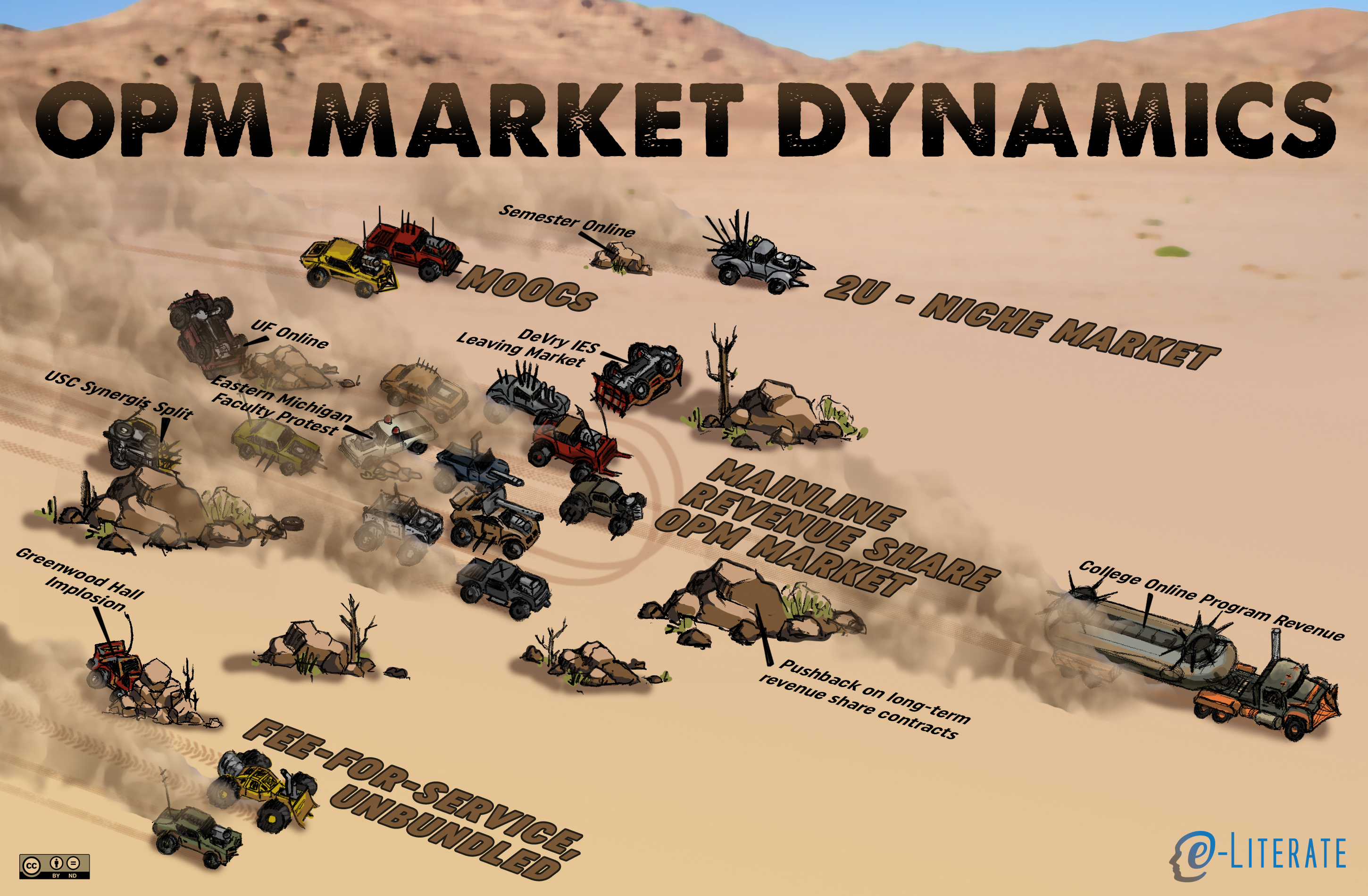
    • There has been growing pushback on the mainline revenue-sharing model, where full-service OPM providers make 50% or even more of tuition dollars from online programs. This has led to the rise of unbundled, fee-for-service category of OPM providers.

    The picture one gets is of a chaotic market that is not for the faint of heart, and one that will likely see further consolidations and category changes. 2U, for its part, has been successful partially due to a niche strategy where they go after elite master’s programs and mostly avoid direct competition or engagement with the rest of the market. And recently we have started to see the MOOC providers become OPM providers – where the primary revenue for Coursera and FutureLearn are based on revenue sharing with online programs, albeit with lower sharing rates and with very different marketing approaches. In other words, there seems to be several efforts to enter into the same OPM race, but if possible to avoid being in the mainline rev-share OPM market. The Toecutter would feel right at home.

    The Mad Max view of OPM market dynamics

    Not even represented here is the movement of former for-profit institutions (e.g. Grand Canyon University, the parent company of Kaplan University) becoming OPM providers.

    This means that our landscape view of the market is temporal in nature – expect more shake ups and category changes as the OPM market continues to grow in new ways.

    Market landscape of OPM vendors

  • Online Program Management: Spring 2018 view of the market landscape

    Online Program Management: Spring 2018 view of the market landscape

    Nearly two years ago I wrote two blog posts giving a high-level view of the Online Program Management (OPM) market landscape. This is a growing but messy market, and the market changes since mid 2016 call for an updated view.

    OPM providers are for-profit organizations that help non-profit schools develop online programs, most often for Master’s level programs. These companies provide various services for which traditional institutions historically have not had the experience or organizational capability to fully support, at least for fully-online programs and often for non-traditional student populations. Some examples of the services include marketing & recruitment, enrollment management, curriculum development, online course design, student retention support, technology infrastructure, and student & faculty call center support.

    The OPM market has historically been known for a full-service, revenue-sharing model, based on the premise that most traditional institutions are not only operationally unprepared to offer online programs at scale but also are not set up to invest in online programs up front. There are extensive costs, particularly in marketing and recruitment as well as curriculum and course design, that cause most scalable online programs (that is, those designed with the intent and infrastructure to allow more than just a few dozen students) to require investment over the first several years, before tuition revenue catches up. Rather than requiring the institution to spend sizable up-front money without a guarantee of repayment, revenue-sharing OPM vendors provide this financing themselves – which is in itself an expensive proposition. It often takes three to five years for an OPM company to become profitable for any online program, which is why they often require 10-year or even longer contracts.

    As the online education market has matured, however, there has been a growing pushback against revenue-sharing as the only model available. Thus there is an emerging unbundled fee-for-service OPM model, in which the companies offer the same services, or some subset, for the market price of those services. The institution pays for the services used, mostly independent of the amount of tuition revenue coming into the online program. This category leads to the program, or institution, to take the up-front financial risk but not have to sign contracts sending ~40 – 60% of the tuition revenue to the vendor. Fewer strings attached but more responsibilities and risks for the school.

    With the recent success of Southern New Hampshire University and longer-term models from Penn State World Campus (as well as others), there are also questions about whether non-profit schools can create scalable programs without an OPM partner at all. This category, for obvious reasons, is not presented in our market landscape but is a real option.

    In our view, there is not an either-or proposition in the market. We see strong arguments for both bundled revenue-sharing models and for unbundled fee-for-service models, and I personally do not believe that the market is moving away from revenue sharing as much as there is pressure for additional models. There are a growing number of choices available to schools, but there is also a crowded marketplace that is becoming more difficult to understand.

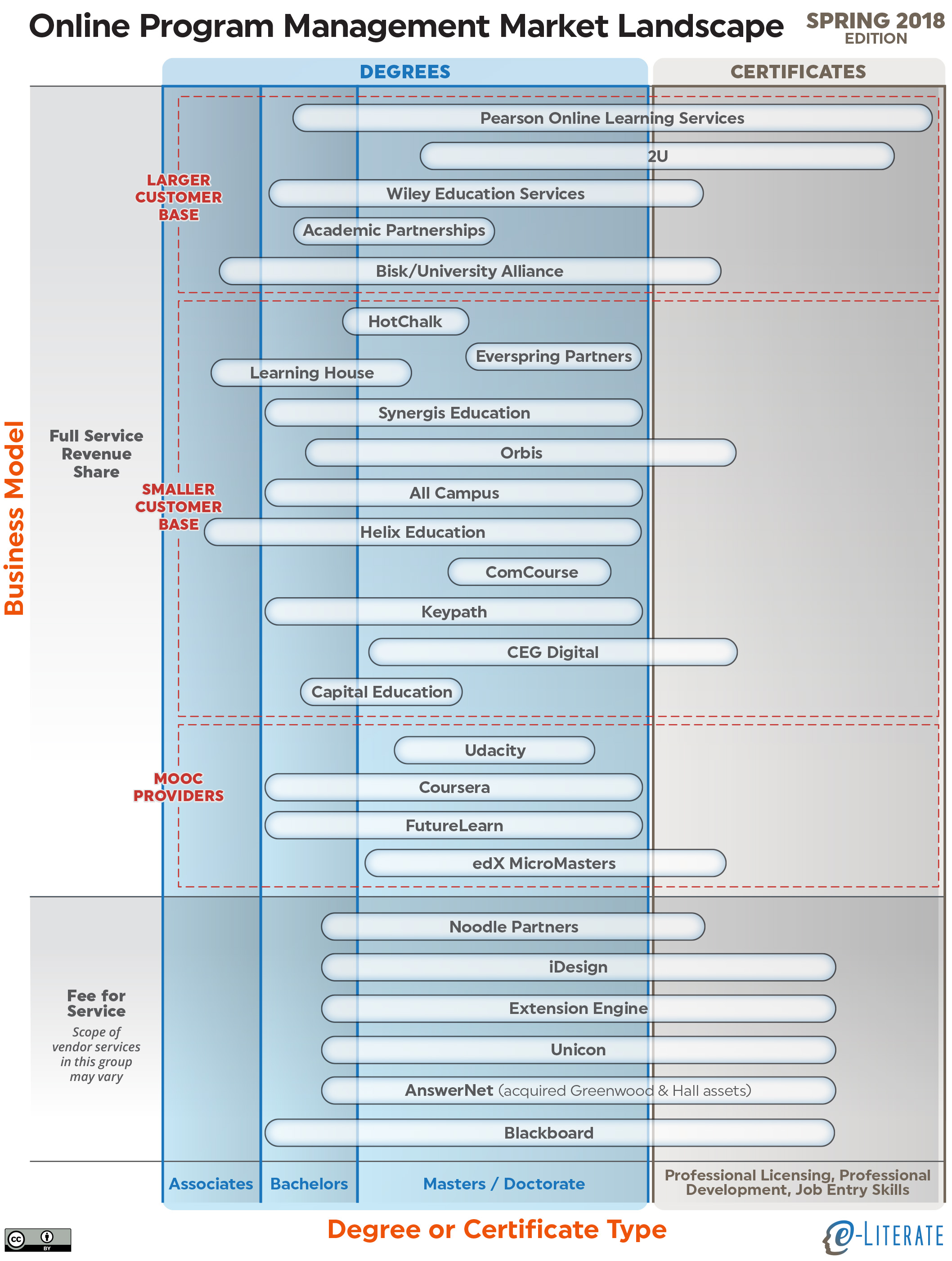
    With that setup in mind, on to the market landscape graphic.

    As before, please note that this view is intended to give a visual overview of the market landscape and is not comprehensive in terms of vendors represented. This is especially important to understand for the Fee for Service category, where there is no clear definition yet of what is an unbundled OPM provider and what is a product or service provider who happens to serve online programs. Treat this category as illustrative and not exhaustive.

    Market landscape of OPM vendors

    There are three primary changes to note in the graphic’s design since 2016:

    • We have combined different categories of Certificates into one column on the right side of the graphic, since it was difficult to to differentiate between OPM target markets.
    • We have added a sub-category of MOOC Providers under Full Service Revenue Share category to capture the recent changes in that market.
    • We have combined the Fee for Service and General Contractor into one category labeled Fee for Service, again due to difficulty differentiating service offerings.

    We should also note that there will likely be another sub-category of Full Service Revenue Share to capture the ongoing pivots by former for-profit institutions. Graham Holdings sold Kaplan University to Purdue University and remains a single-client OPM provider for that new brand Purdue University Global. Grand Canyon University is converting to a non-profit institution with the remaining for-profit company turning into a (single-client?) OPM provider. Bridgepoint Education plans to turn Ashford University and University of the Rockies into a combined non-profit institution, leaving the remaining for-profit company as an OPM. We are not ready to add this sub-category, and it is not clear yet if these providers plan to go beyond servicing the non-profit conversions.

    There are several changes to the vendors listed:

    • Pearson no longer refers to the Embanet brand that they acquired and now goes by Pearson ((Disclosure: Pearson, 2U, iDesign, Unicon, and Blackboard are sponsors for our Empirical Educator Project. See this post for more details.)) Online Learning Services.
    • 2U, after the May 2017 acquisition of GetSmarter, now serves certificate programs and not just masters degree programs.
    • Wiley no longer refers to the Deltak brand that they acquired and now goes by Wiley Education Services.
    • DeVry Integrated Education Solutions no longer appears to be active in the market, based on outdated web site (key executive listed has been gone for seven months) and no marketing or competitive presence. We have removed their listing.
    • Cambridge Education Group’s CEG Digital unit has emerged as an OPM provider serving UK-based institutions.
    • We (re)added Udacity based on the success of the Georgia Tech Masters in Online Computer Science program, which has helped spawn the new sub-category of MOOC Providers in the market, even though Udacity appears to have no interest in pursuing other higher education degree offerings.
    • We added Coursera as an OPM Provider, as this market now appears to be their core market moving forward.
    • We added FutureLearn based on their continuing expansion as a MOOC-based OPM provider.
    • We added edX with their MicroMasters initiative.
    • We added ExtensionEngine as a Fee for Service provider based on their work with Notre Dame and related program creation.
    • We changed Greenwood Hall to AnswerNet. After a spectacular implosion from Greenwood Hall a few months ago, AnswerNet acquired the remaining assets. It is not yet fully clear if AnswerNet will not provide more than Call Center services, so we’ll keep an eye on this one.
    • Excelsior College’s Educators Serving Educators (ESE) initiative, launched in 2012 to provide a non-profit OPM offering, is no longer active.

    We’ll keep updating our landscape diagram over time and look for other methods to help make sense of this market.