When Pearson’s OpenClass was announced about a year and a half ago, the natural question to ask was whether it would disrupt the LMS market. But that was then and this is now. (Full disclosure: Pearson is a client of MindWires Consulting.) The more interesting question today is where OpenClass stands vis-à-vis the MOOCs. To begin with, it certainly appears that the LMS and MOOC markets may be on a collision course. But beyond that, Pearson is a content provider first and foremost. With both the content and the platform at their disposal, as well as an array of assessment tools, they certainly have all the raw materials to build MOOCs. Is that where OpenClass is going? I recently had a short conversation with Pearson’s SVP of Product, Adrian Sannier, to find out. And the answer appears to be, “Not exactly.”
Tag: OpenClass
-
Educational Publishers Appear to be Supporting SOPA
UPDATE 12/23: Per the House Judiciary Committee, it is now confirmed that these companies are on the record supporting SOPA and the Protect IP companion legislation.
Yesterday the House Judiciary Committee began the process of marking up the Stop Online Piracy Act (SOPA) bill. From all appearances, most of the amendments have been rejected, thus leaving SOPA essentially in its original form. While passage is not assured, it is certainly a possibility as described by CNET.
After a marathon debate on the Stop Online Piracy Act, it’s clear that the Hollywood-backed bill enjoys enthusiastic support among key members of the U.S. House of Representatives and is one step closer to becoming law.
That became obvious after every legislative attempt to defang, rewrite, or significantly alter SOPA over nearly a 12-hour period today ended in victories for large copyright holders–and defeat upon defeat for the bill’s critics.
While the SOPA impacts are not fully understood, there are some real dangers to educational usage that we need to follow. As described in my first post on the subject, SOPA could have a major impact on institutions using any form of educational technology to share content outside of a tightly-controlled password-protected course site. As we saw at EDUCAUSE this year, much of the potential of educational technology is to facilitate sharing of content outside of the traditional “walled gardens” of traditional LMS solutions, and enabling collaboration more broadly.
This year’s EDUCAUSE keynote speaker, Seth Godin, has a post up at The Domino Project that calls out many of the list of “companies behind one of the lobbying groups pushing for SOPA”. On this list, lo and behold, we find most of the educational publishing companies.
Pearson Education, Cengage Learning, McGraw-Hill Education, Macmillan, Scholastic, etc. They are all on the list.
-
What If OpenClass Succeeds in Disrupting LMS Market?
Right now the e-Literate site is close to over-heating from Michael’s voluminous posts – all very thoughtful, but we’re going to need some WordPress coolant.
During discussions over the past week in person and over blogs, I’ve had three people ask essentially the same question – will Pearson’s OpenClass LMS offering and associated corporate strategy lead to more competition or less competition in the LMS space for higher ed, or how will the competitive landscape change? Obviously the nature of this question is speculative with no concrete answers, but I do think that technology market trends can help us with an educated guess.
-
Openness: The Proof of the Pudding is in the Eating
In my last post, I said that I thought Blackboard’s announcement of making it easy to add a Creative Commons license to a Common Cartridge export is significant. One day later, we have some evidence of just how significant. e-Literate featured blogger Audrey Watters has a post up on her own blog about a big announcement out of Washington state:
With help from matching funds from the Gates Foundation, the Washington State Board for Community and Technical Colleges has built a Open Course Library (OCL), which launches today. The idea behind the library is to address the increasing cost of textbooks by making openly licensed course materials available for 81 of the state’s most enrolled classes. Some of the materials in the OCL are free, but some aren’t. The only stipulation: no required material or textbook can cost a student more than $30.
The first phase of the project, which is available today, features materials for 42 of these classes, including Introduction to Literature, Introduction to Chemistry, Calculus I, and Microeconomics. (The other 39 should come online in the Spring of 2013)….
As the materials in the OCL are licensed CC-BY, instructors will be able to adopt the course modules or adapt the materials to suit their own classes’ needs. The materials are available via Google Docs and Google Sites so that they can be shared between faculty and institutions, but there are also options to import the content into standard LMSes.
By “options to import the content into standard LMSes,” she means that the content will be available as IMS Common Cartridges. How are they being produced? It turns out that the Washington State Board for Community and Technical Colleges has a state-wide license for ANGEL, which happens to export to Common Cartridge. So this initiative, which could turn out to be a big deal in terms of community college affordability, is partly enabled by a for-profit LMS vendor’s decision implement Common Cartridge export. Who was the guy in charge at ANGEL at the time that technology decision was made? Ray Henderson, the same guy who announced Common Cartridge export for Blackboard.
By the way, there’s plenty of room for Pearson to play here too. Production of OERs is only part of the problem. You still need to drive adoption. If OpenClass made it very easy for faculty to find and import OCL content, either through Google Apps integration or through Common Cartridge import, that would be a significant step forward in at least one kind of Openness.
-
Perhaps ‘Open’ Is a Flag of My Disposition…
Anyone who went to EDUCAUSE this year had to come away with the impression that Open is the new black. This product now comes with 50% more openness! That one’s openness is 99.44% pure! It’s easy to get jaded about all of this and cry “openwashing,” as Anya Kamenetz did, among others (including me, at times). But while it’s perfectly appropriate to hold vendors accountable for hype, it’s also important to look carefully at the announcements beneath the hype. Because they are not all the same. I proudly serve on the Sakai Foundation Board of Directors and proudly provide all content on this blog under a Creative Commons license, but I also recognize that there are different kinds of “open”—and different kinds of “free”—vendors can provide that have different kinds and levels of utility.
Case in point: The respective announcements by Pearson and Blackboard last week reflect very different ideas of both “open” and “free.” Those differences matter. If we simply throw up our hands and declare the use of these words by all for-profit entities as meaningless marketing babble, then we will miss some valuable information.
(more…)
-
When Large Companies Enter Ed Tech
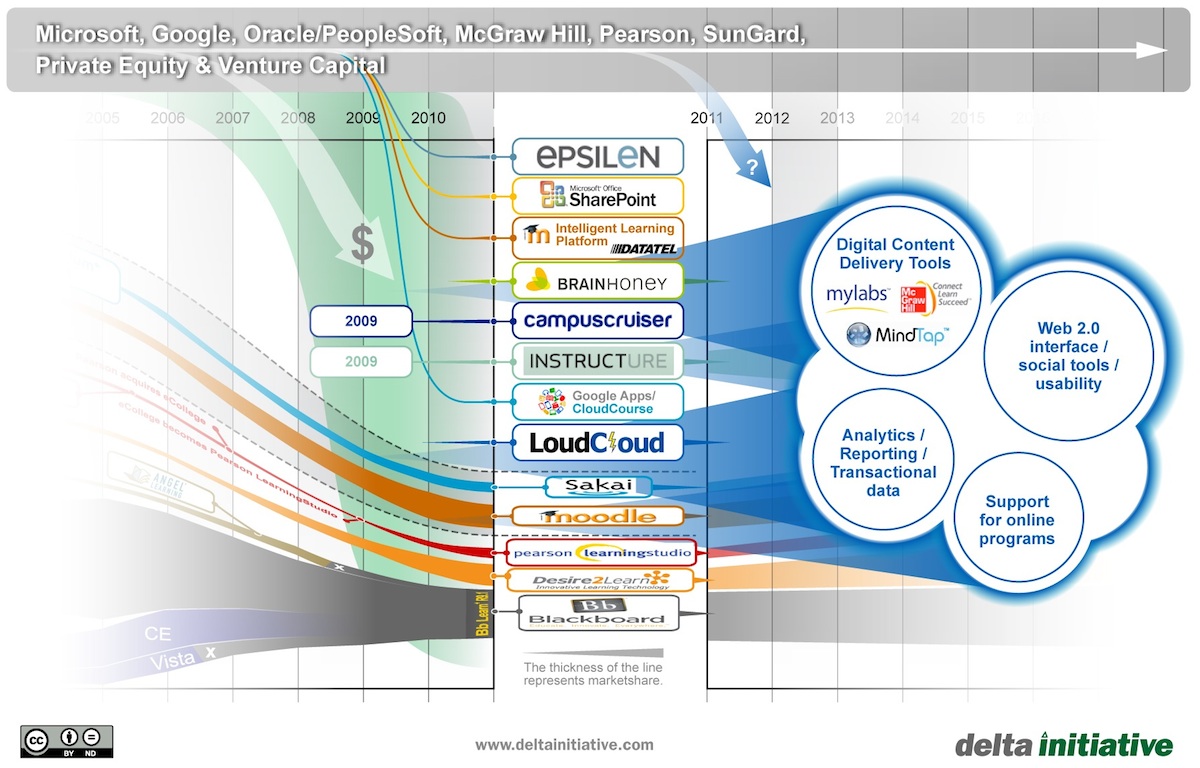
I had a very interesting conversation on the way home from EDUCAUSE with Frank Florence, who is the Senior Director of Education Market Management for Cisco. We discussed the changes happening in the ed tech market, and Frank helped me understand some of the market forces behind the changes we’re seeing. One topic in particular was the dynamic between entrepreneurial companies that develop within a vertical market and larger companies that span markets. I have argued that internal investment from larger companies is helping to change the ed tech market, but Frank provided valuable insight into the nature of the typical market forces we’re living through. This observation of large company involvement helping to change the LMS portion of the ed tech market is shown below, in many of the companies in the top gray bar and some that are not listed.
-
Ambivalent on Ed Tech: The EDUCAUSE Re-write
Now that I’ve had time to digest the implications of EDUCAUSE 2011 – which were significant, but not as mind-blowing as the Reading Market experience – I keep going back to a post I wrote earlier this year (although not on e-Literate). In that post contrasting a Gartner report on IT spending with an Ambient Insight report on ed tech and online spending, I argued that ambivalence was the key to understanding both reports in context. Likewise, based on the hype and reality of ed tech at EDUCAUSE, ambivalence can help us understand future implications for education.
One of the benefits of blog posting is the ability to wholesale plagiarize yourself where needed (ed – I’ll see you in court, Mr. Hill). Herewith is my rewrite of that post based on this year’s EDUCAUSE experience.