e-Literate

Present is Prologue

Tag: Phil Hill

  • Release of Analysis Episode for e-Literate TV Series on Personalized Learning

    Today we are thrilled to release the the final episode in our new e-Literate TV series on “personalized learning”. In this series, we examine how that term, which is heavily marketed but poorly defined, is implemented on the ground at a variety of colleges and universities. While today’s episode is the final one released due to its analysis of what we learned in the five case studies, it was designed to be used as an introduction to the series.

    We have deliberately held back from providing a lot of analysis and commentary within each case study – letting faculty, students, administrators and staff speak for themselves – but in today’s episode we share some of the key lessons we learned. We had a variety schools profiled in the series, and our analysis addresses the commonalities and differences that we saw. You can see the analysis episode at this link or in the embed below.

    Controls

    Introduction: What Did We Learn In Our Personalized Learning Series?

    (more…)

  • Online Teaching Conference (#CCCOTC15) Keynote

    Back in June I had the pleasure of giving the keynote at the Online Teaching Conference (#CCCOTC15) in San Diego, put on by the California Community College system. There was quite a bit of valuable backchannel discussions as well as sharing of the slides. The theme of the talk was:

    Emerging Trends in Online / Hybrid Education and Implications for Faculty

    As online and hybrid education enter the third decade, there are significant efforts to move beyond the virtualization of traditional face-to-face classroom and move more towards learner-centric approaches. This shift has the potential to change the discussion of whether online and hybrid approaches “can be as good as” traditional approaches to a discussion of how online and hybrid approaches “can provide better learning opportunities”.

    For those who would like to see the keynote, I am including the video and slides below. Pat James’ introduction starts at 05:50, and my keynote starts at 09:15.

    (more…)

  • Instructure Releases 4th Security Audit, With a Crowd-sourcing Twist

    In the fall of 2011 I made the following argument:

    We need more transparency in the LMS market, and clients should have access to objective measurements of the security of a solution. To paraphrase Michael Feldstein’s suggestions from a 2009 post:

    • There is no guarantee that any LMS is more secure just because they say they are more secure
    • Customers should ask for, and LMS vendors should supply, detailed information on how the vendor or open source community has handled security issues in practice
    • LMS providers should make public a summary of vulnerabilities, including resolution time

    I would add to this call for transparency that LMS vendors and open source communities should share information from their third-party security audits and tests.  All of the vendors that I talked to have some form of third-party penetration testing and security audits; however, how does this help the customer unless this information is transparent and available?  Of course this transparency should not include details that would advertise vulnerabilities to hackers, but there should be some manner to be open and transparent on what the audits are saying. [new emphasis added]

    Inspired by fall events and this call for transparency, Instructure (maker of the Canvas LMS) decided to hold an public security audit using a white hat testing company, where A) the results of the testing would be shared publicly, and B) I would act as an independent observer to document the process. The results of this testing are described in two posts at e-Literate and by a post at Instructure.

    Instructure has kept up the process, this year with a crowd-sourcing twist: (more…)

  • Links to External Articles and Interviews

    Last week I was off the grid (not just lack of Internet but also lack of electricity), but thanks to publishing cycles I managed to stay artificially productive: two blog posts and one interview for an article.

    Last week brought news of a new study on textbooks for college students, this time from a research arm of the  National Association of College Stores. The report, “Student Watch: Attitudes and Behaviors toward Course Materials, Fall 2013″, seems to throw some cold water on the idea of digital textbooks based on the press release summary [snip]

    While there is some useful information in this survey, I fear that the press release is missing some important context. Namely, how can students prefer something that is not really available?

    March 28, 2014 may well go down as the turning point where Big Data lost its placement as a silver bullet and came down to earth in a more productive manner. Triggered by a March 14 article in Science Magazine that identified “big data hubris” as one of the sources of the well-known failures of Google Flu Trends,[1] there were five significant articles in one day on the disillusionment with Big Data. [snip]

    Does this mean Big Data is over and that education will move past this over-hyped concept? Perhaps Mike Caulfield from the Hapgood Blog stated it best, including adding the education perspective . . .

    This is the fun one for me, as I finally have my youngest daughter’s interest (you made Buzzfeed!). Buzzfeed has added a new education beat focusing on the business of education.

    The public debut last week of education technology company 2U, which partners with nonprofit and public universities to offer online degree programs, may have looked like a harbinger of IPO riches to come for companies that, like 2U, promise to disrupt the traditional education industry. At least that’s what the investors and founders of these companies want to believe. [snip]

    “We live in a post-Facebook area where startups have this idea that they can design a good product and then just grow, grow, grow,” said Phil Hill, an education technology consultant and analyst. “That’s not how it actually works in education.”

     

  • First-hand experience moving to team-based course design

    As Michael mentioned, we have posted the last episode in the pilot e-Literate TV series with the topic of moving to a team-based course design for a flipped classroom usage. This episode provides an excellent opportunity to hear the first-hand experience of a faculty member going through this transition for the first time. Vanessa Perry of GWU had no real expectations or understanding of what this transition would encompass.

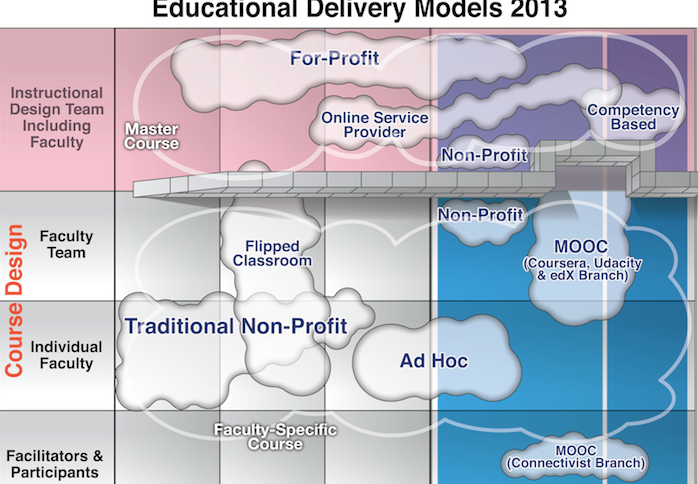
    The adoption of team-based course design presents a cultural barrier for traditional institutions, as shown by a wall in the graphic that was the basis for a 2012 EDUCAUSE Review article.

    The Wall

    Vanessa describes what this barrier, or wall, feels like as you attempt to cross it, as seen in this snippet from the interview (full transcript and video and graphics available at the full episode on e-Literate TV).

    (more…)

  • Instructure releases their third public security audit

    In the fall of 2011 I made the following argument:

    We need more transparency in the LMS market, and clients should have access to objective measurements of the security of a solution.  To paraphrase Michael Feldstein’s suggestions from a 2009 post:

    • There is no guarantee that any LMS is more secure just because they say they are more secure
    • Customers should ask for, and LMS vendors should supply, detailed information on how the vendor or open source community has handled security issues in practice
    • LMS providers should make public a summary of vulnerabilities, including resolution time

    I would add to this call for transparency that LMS vendors and open source communities should share information from their third-party security audits and tests.  All of the vendors that I talked to have some form of third-party penetration testing and security audits; however, how does this help the customer unless this information is transparent and available?  Of course this transparency should not include details that would advertise vulnerabilities to hackers, but there should be some manner to be open and transparent on what the audits are saying. [new emphasis added]

    Inspired by fall events and this call for transparency, Instructure (maker of the Canvas LMS) decided to hold an public security audit using a white hat testing company, where A) the results of the testing would be shared publicly, and B) I would act as an independent observer to document the process. The results of this testing are described in two posts at e-Literate and by a post at Instructure.

    Instructure has kept up the practice and just released their third public security audit.

    (more…)

  • Educational videos now outrank cat videos – my ticket onto NPR

    From NPR this morning:

    With 1 billion unique visitors per month, YouTube offers a glimpse of the online world’s tastes and interests. And this year, one notable trend — for better or worse — is that people are spending more time watching videos about video games. [snip]

    In case this has you thinking, “Oh great, another way that YouTube has given us to waste time (as if cat videos weren’t enough),” here’s the good news: The number of people watching educational videos on YouTube has surpassed cats.

    And with that premise, I found my ticket onto NPR (segment starting at 2:54).