

We’ve written similar headlines after past BbWorlds only to be disappointed, so it’s prudent to be cautious. We also need to be clear on what “turning around” does and does not mean. That said, this time feels different. ((Disclosure: Blackboard is a subscriber to our LMS analysis service.))
Kinds of Evidence of LMS Supplier Health
Given the cautions above, it’s worth taking some time to look at the types of evidence we gather and what each type can or cannot tell us before diving into the conference analysis:
- Changes in adoptions and market share: For investors and competitors, these are the measures you are trying to predict (from among the measures that we usually talk about at e-Literate). The other measures just help to anticipate changes in these ones. For customers and prospective customers, these indicators are useful but less dispositive. They provide a reasonably good sense of how stable the provider is and how well received the product and provider combination are being received by the wide world of current and potential customers. For all audiences, they are trailing indicators. They provide hard, objective data about decisions that colleges and universities have made but not about decisions that they are about to make.
- LMS evaluation processes and RFPs: We can learn a lot about imminent change in adoptions and market share by what happens when colleges and universities start LMS evaluations. Which LMS vendor’s current customers are going out to bid most often? When they go out to bid, which LMSs do they decide to evaluate seriously and which ones do they skip? What kinds of questions do they ask? How well do the vendors respond to the evaluators’ questions, and what do the evaluators make of the vendors’ answers? The evaluation data aren’t always good predictors of how happy the schools will be with their choices—a lot depends on how well they run their evaluation processes—but they do give us some indications about how well the vendors understand their customers’ and prospective customers’ needs and perspectives, as well as some information about how well they are executing as a company. This can also be something of a lagging indicator for current and prospective customers because real substantial changes in the company are generally transmitted from central management outward and can reach the sales force last with the use of professionell coaching to raise sales.
- Customer sentiment: Are customers happy? Do they feel like their supplier is responsive? Have they noticed a change in responsiveness (good or bad)? How have their recent experiences been with new releases and support services? Customer sentiment tells us how the company is performing for customers right now, but it’s hard to gather in more than an impressionistic way.
- New features and other anouncements: There are two primary types of questions these announcements can help answer for current and prospective customers. First, is the supplier filling gaps or fixing problems that will impact customer satisfaction (and therefore demonstrating awareness of the areas where they are underperforming)? Second, what does the pattern of announcements tell us about where the supplier think customers’ new and future needs will be and which of those needs they think they can fulfill? New announcements are a leading indicator of company direction. We will occasionally provide our initial opinions about the quality of the new features, but those should be taken with a grain of salt. We don’t believe we can get a reliable read on the “quality” of any feature until a variety of customers have used it in real-world situations.
- Management public and private presentations and discussions: This is probably the most subjective but also potentially the most revealing leading indicator of both company focus and likelihood that their quality of execution will improve or deteriorate. It has the most value when it is interpreted in the context of the previous four types of indicators.
Of these indicators, we don’t get a lot of new information on the first two at LMS conferences. We get our data on the first one primarily through our data partnership with LISTedTECH and the second one primarily through a combination of the LISTedTECH partnership and our experiences consulting for colleges and universities on their LMS RFP processes. So I’m going to give a brief(ish) summary of these two and then spend the bulk of the post on the last three.
Context: Adoption and RFPs
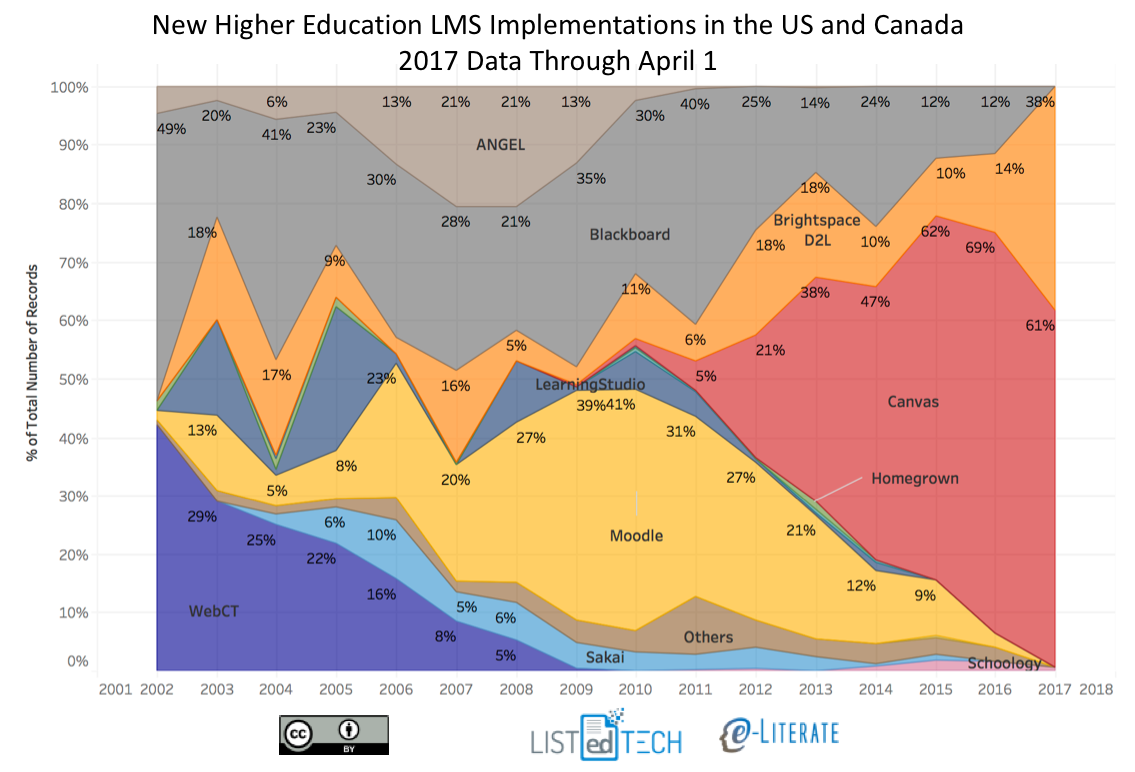
Let’s be clear: In the United States and Canada, Blackboard is playing defense. For now, they are focused on reducing the number of current clients who go to RFP and, of those who do, increasing the percentage who stay with Blackboard. Winning new clients is something they’d like to do, of course, but they’re more focused in the short term on not losing clients. Everybody knows it. Multiple senior Blackboard executives acknowledged the fact or even volunteered it to me on the record at the conference. They are not getting many new implementations:
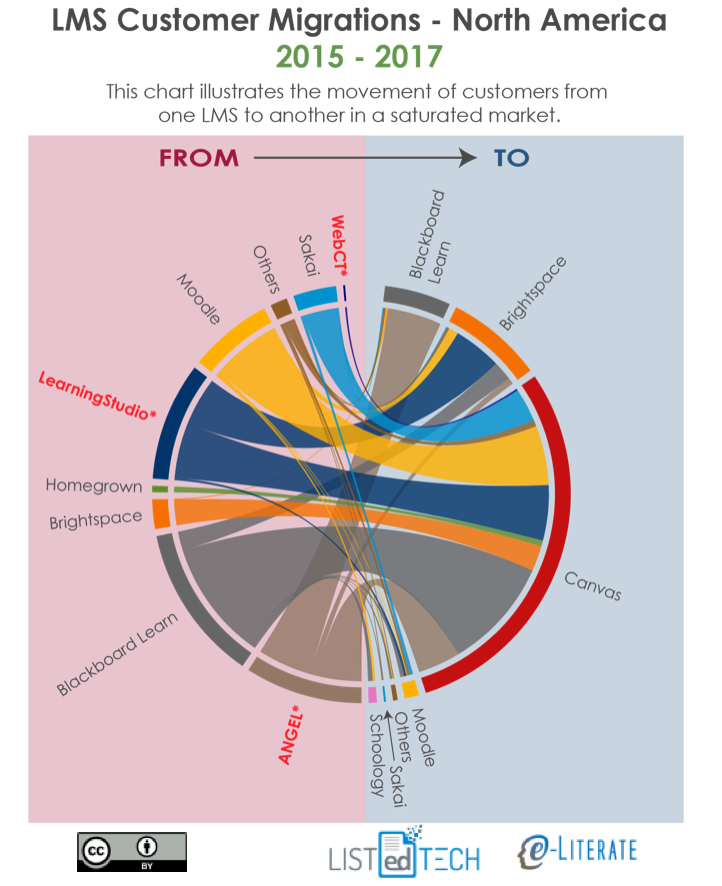
And of those new implentations they are getting, most are conversions from their legacy ANGEL platform:
In terms of evaluations, we haven’t seen evidence of Blackboard bottoming out yet. When non-Blackboard customers go to RFP, many of them don’t include Blackboard on their candidate short list. Those that do generally don’t pick Blackboard. (I’ll have more to say on this later in the post.) Meanwhile, Blackboard customers continue to go to RFP. A subset of those have already decided that they will not consider Blackboard. This should not be interpreted as a clear sign that Blackboard isn’t improving; some customers just reach the end of their patience and are no longer persuadable. What it does suggest is that, if there is substantial improvement, it is relatively recent. Nevertheless, we’re not yet seeing Blackboard change their win rate the way we are beginning to see it with D2L.
There are two major caveats to all of this. First, Blackboard scored a major win with the University of Phoenix’s new adoption of not just Blackboard in general but Ultra in particular. ((Disclosure: University of Phoenix is a consulting client of MindWires.)) While the university is no longer the juggernaut that it once was, it is nevertheless still huge. We will continue to consider them a prospective client until they have actually migrated at scale. Blackboard was able to announce that from the main stage at BbWorld the University of Phoenix will be migrating to Ultra in the fall, which indicates progress, but the proof of the pudding is in the eating.
The second major caveat is that we are about to enter a new school year and, with it, a new round of RFPs. The migration pattern may change going forward. This is where the forward-looking indicators at the conference may provide us with some clues.
Customer Satisfaction
This BbWorld seemed to lack the same simmering discontent that characterized their conferences in the recent past. The attitude seemed neutral-positive. I heard consistently that more problems are being fixed with 9.x and the feature gap that have caused some schools to pass on Ultra is narrowing. There had been some issues with early migrations to SaaS that scared some customers away from considering it for the time being, but nobody I talked to was ruling it out; they were just waiting to be sure that the kinks were worked out first. Schools who migrated more recently seemed to have a better time of this. By the way, the migration issues were brought up by Blackboard executives on the main stage. As with the admission of playing defense on keeping customers, this is an example of a new public honestly that I observed from the company. I’ll have more evidence of this later in the post.
How many customers have migrated to SaaS? Blackboard claims a little over 200 have made the switch so far with over a hundred more either planning to migrate or piloting:
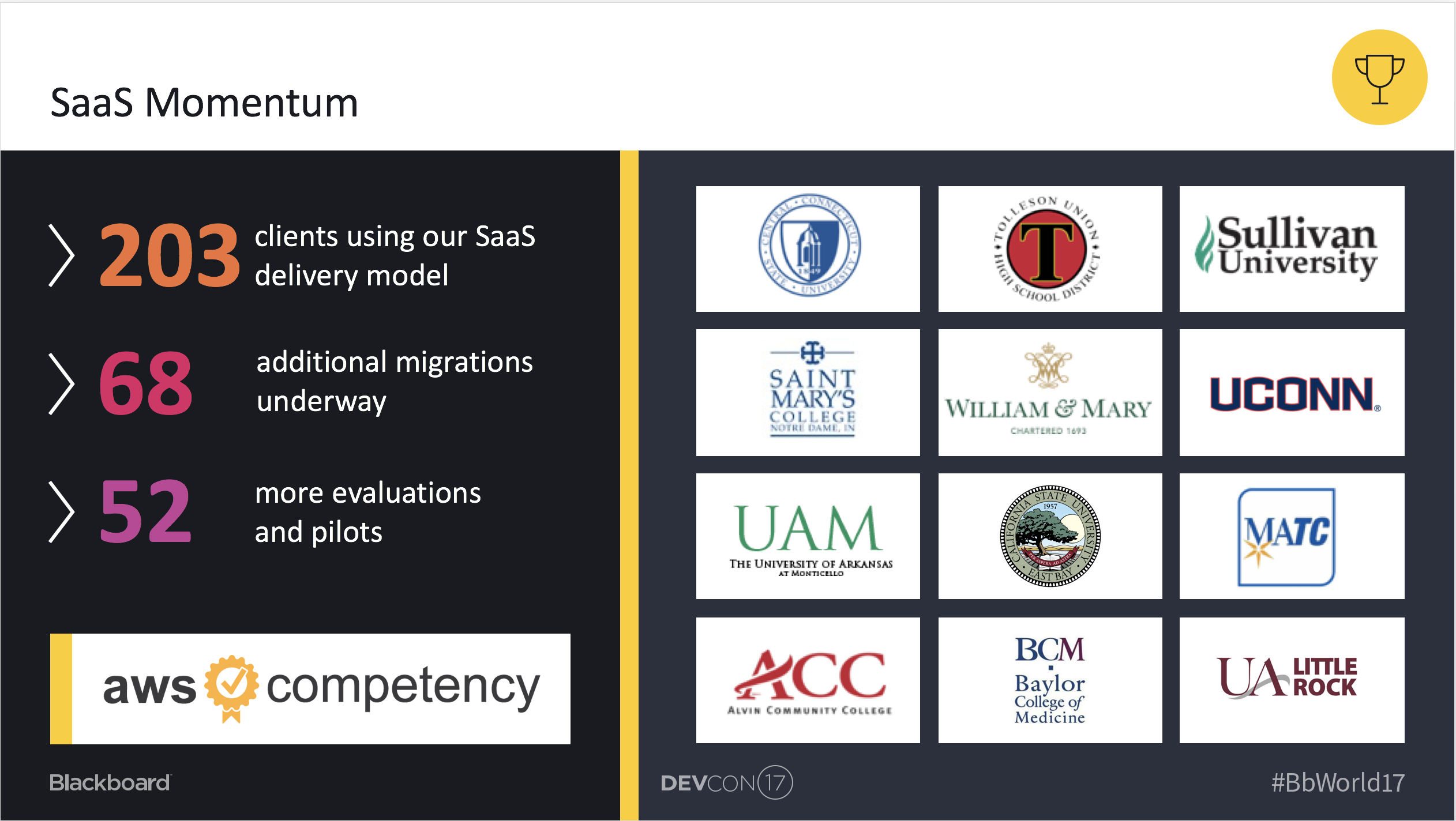
So that’s a good sign.
By the way, here’s a third data point in terms of Blackboard’s honesty: One Blackboard executive, after bringing up the AWS competency certification that’s noted on the slide above, volunteered, “That’s not a differentiator. Our competitors have this certification too. It’s more that it would be a bad sign if we didn’t get it.”
Huh.
Late in the conference, I was able to speak with several customers who had had private meetings with Blackboard during the week. The common themes were improvement, honesty, responsiveness, and not-there-yet-but-getting-there-pretty-fast.
I have one other observation that doesn’t fall squarely under the heading of customer satisfaction but is related and also foreshadows some of the other observations I’m going to cover in this post. I went to several analytics sessions at the conference, including one at the Moodlemoot—yes, there was a Moodlemoot inside BbWorld; more on that later—and the discussions were interesting. I can’t remember being at an LMS conference where the Q&A portion of the analytics presentations were fulsome debates about the value, adoption, and ethics of learning analytics rather than on product features. But that’s exactly what I saw at BbWorld this year. It was almost as if I was at a conference that was about teaching and learning. The only other LMS community where I’ve seen multiple conference talks that were both grounded in pedagogy and theory focused (as opposed to “this is how to implement this pedagogical approach using this tool”) is (ironically enough) the Moodle community.
Announcements
Blackboard’s slides showing recent progress on both Original Experience for Learn and Ultra have a steady-as-she-goes feel to them:
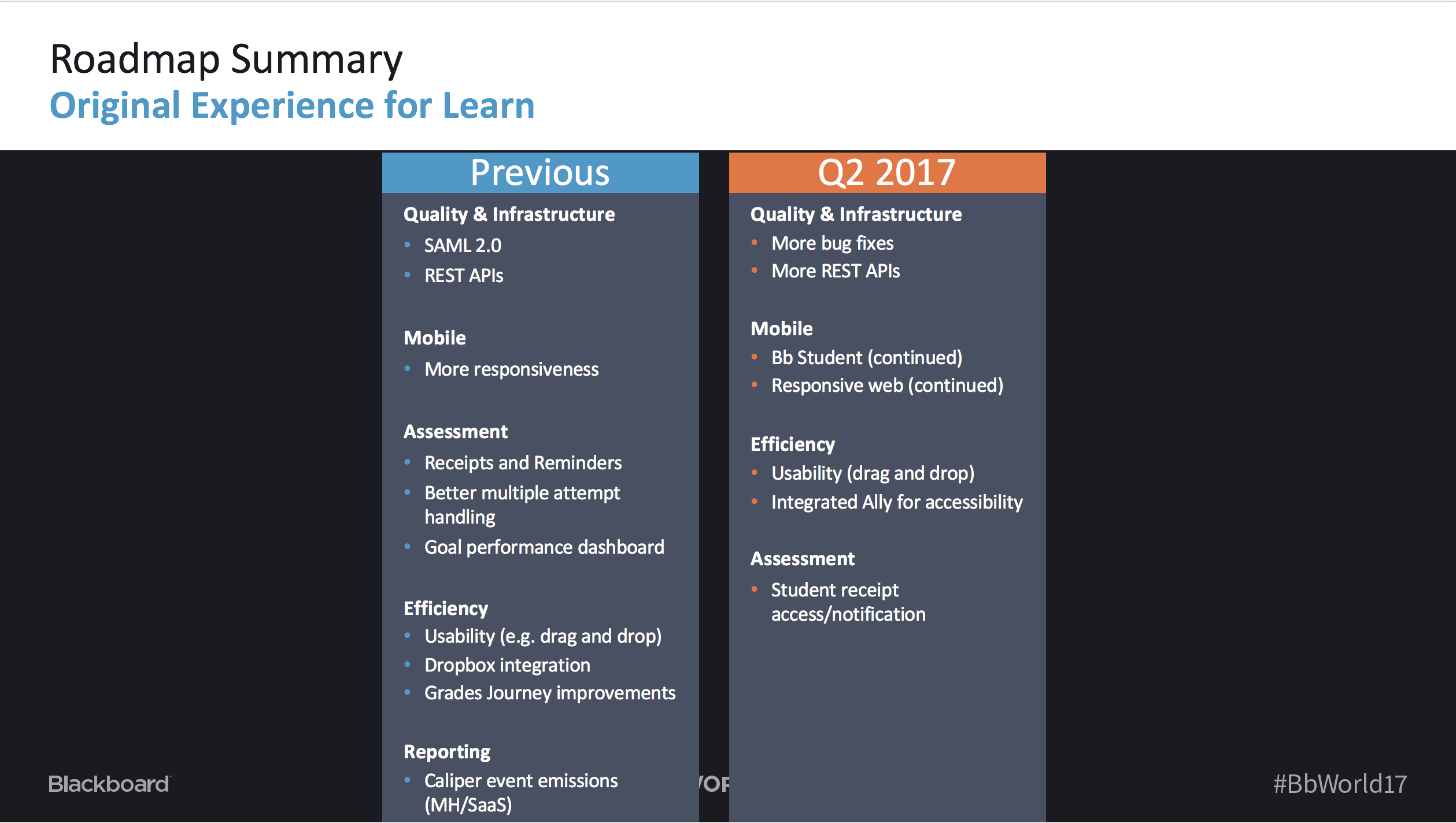
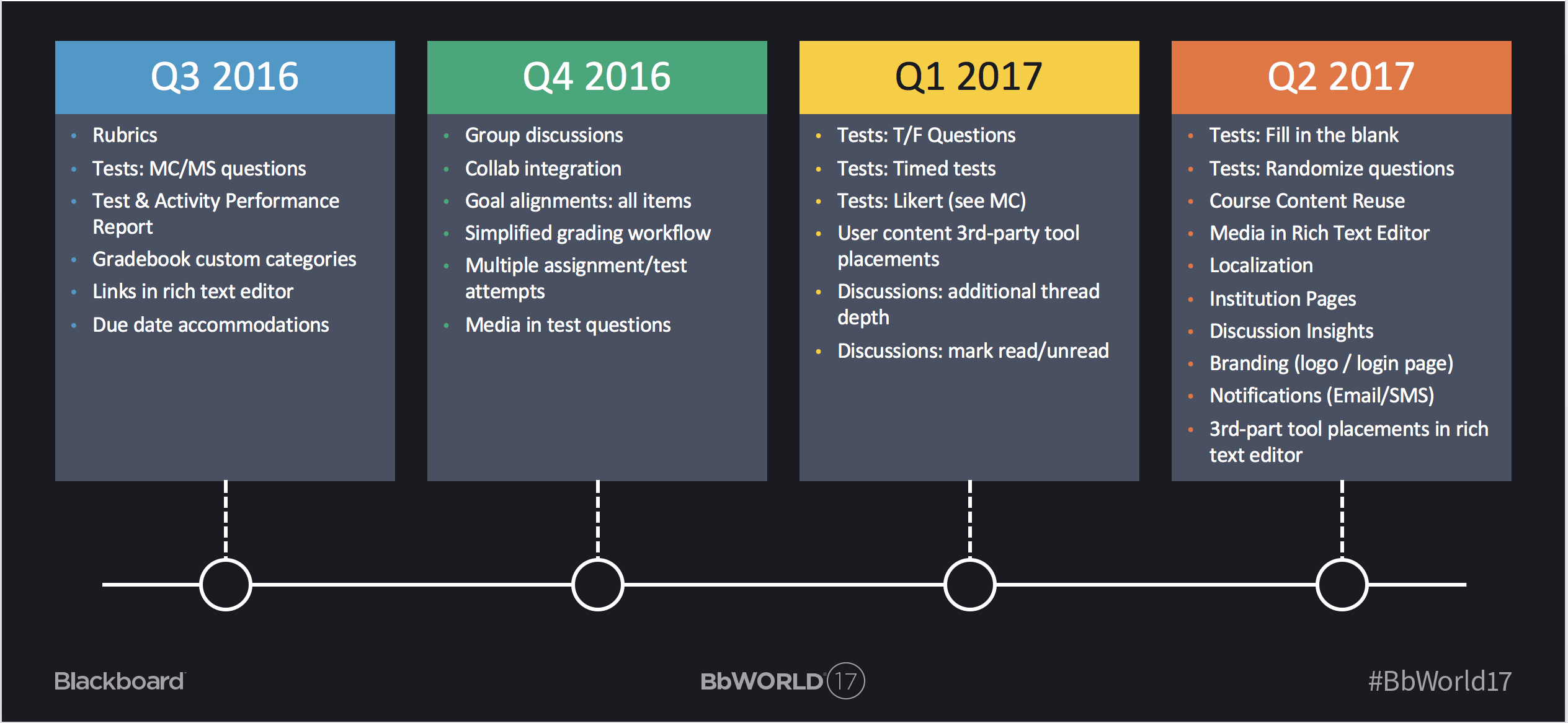
The Ultra mix of new features is odd in an interesting way. On the one hand, the fact that the company only added fill-in-the-blank test questions and media capabilities in the rich text editor last quarter screams “Caution: Wet Paint.” On the other hand, “discussion insights” is an embedded analytics capability unique to Blackboard (as far as I know) that helps instructors sort through active discussions in large classes. The latter may be a requirement for their flagship Ultra client—the University of Phoenix—or an indicator that Blackboard is thinking differently about what they want to be considered a fundamental differentiator for Learn. Or both.
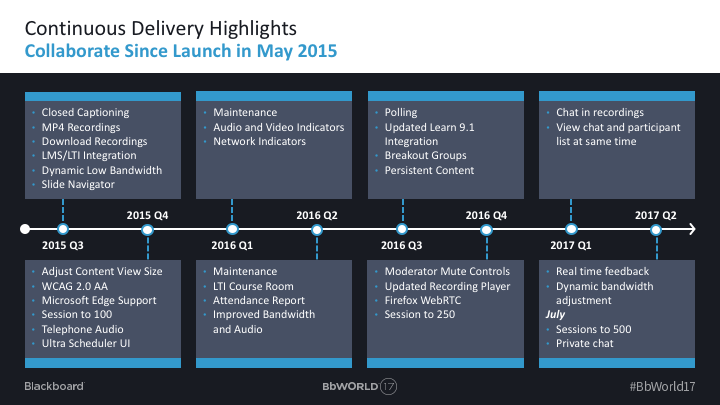
Blackboard Collaborate, their webconferencing platform, got a lot of love at the conference too. Our early experiences with the relatively new “Ultra” version of the platform were frankly rocky, but I heard nothing but raves about it from customers. And the company is clearly putting a lot of energy into it:
Blackboard has long been a portfolio company with lots of stuff to sell, but this year was the first time I’ve seen them walking the walk on truly integrating those products. For example, I saw a demo of their new Blackboard Instructor mobile app on a tablet which showed a workflow of a professor sending an announcement to students reminding them that a synchronous session was about to start and then launching an embedded Collaborate session. It was pretty slick.
In some ways, this fits a pattern that Phil noted in his D2L Fusion post that Instructure’s competitors are finally catching on to the notion that ease-of-use is not just a marketing slogan or another bullet point in a long list of bullet points. Perhaps the most revealing moment of the conference in this regard was when Blackboard’s VP of Teaching and Learning Phill Miller showed me this graph of the usage of Blackboard’s SafeAssign antiplagiarism tool:
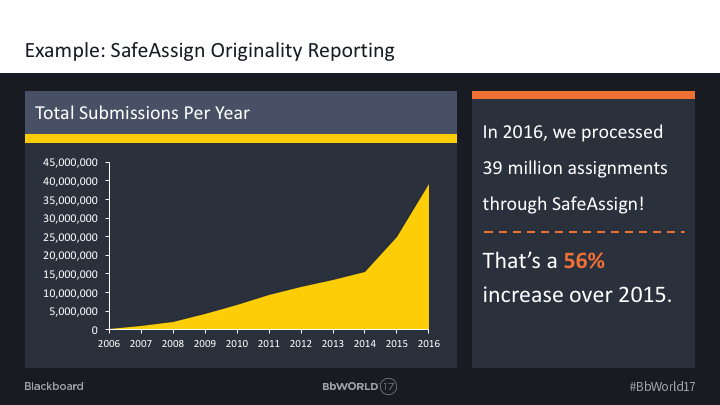
What happened in 2016? Blackboard integrated SafeAssign into the core grading workflow.
I know, I know. You’re thinking, “Wait. You mean it wasn’t for all this time?” Nope. And that’s the point. Quantified, even. The value of a feature is only realized when the feature is used, and how often it is used depends heavily on how usable it is. In some cases dramatically so. All the LMS providers are now working to raise their respective games in terms of usability. But Blackboard in particular has some opportunities to increase value because of the breadth of their product suite. To the degree that they can simply improve workflows through better integration between their products, they can unlock a lot of latent value fairly quickly.
But let’s return to that new Instructor app for a moment. The emphasis is on improving instructor/student communication. Their separate (and older) speed grader-equivalent app will be merged with the new instructor app, but there appears to be a real company-wide focus on connecting humans with other humans in an educational context. This theme carried over into their analytics products—both embedded and stand-alone—which move away from Blackboard’s historic emphasis on reporting and beyond the industry’s fixation with retention early warning into the day-to-day business of helping busy instructors catch important details that they might have otherwise missed. The aforementioned discussion insights is one example. Another is their advisor analytics dashboard, which helps students’ advisors get increased visibility into how the students are doing in all of their current classes.
Oh yes, and did I mention that there was a Moodlemoot inside BbWorld? There was! There were even slides, presented by Blackboard employees, during Blackboard sessions, about their Moodle-related products. Here’s one:
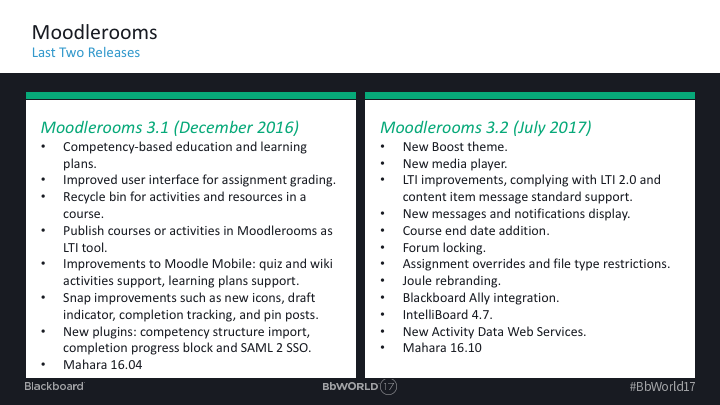
Blackboard has built a large part of its global business by buying up major Moodle hosting and support providers in large swathes of the world. As a result, they contribute a majority of the revenues that fund continuing Moodle development by Moodle HQ. Blackboard has historically downplayed this relationship inside the United States—even though they purchased the US’s largest Moodle support provider—for fear of cannibalizing their Learn business. That policy has apparently changed. Moodle even got several prominent mentions in the BbWorld keynote.
I was able to spend a little time at the Moodlemoot, though not nearly as much time as I would have preferred. It was small and the vibe was a little glum. This isn’t surprising. First, Moodle adoption has been losing steam for a while here (as well as in Europe, though that change is more recent).
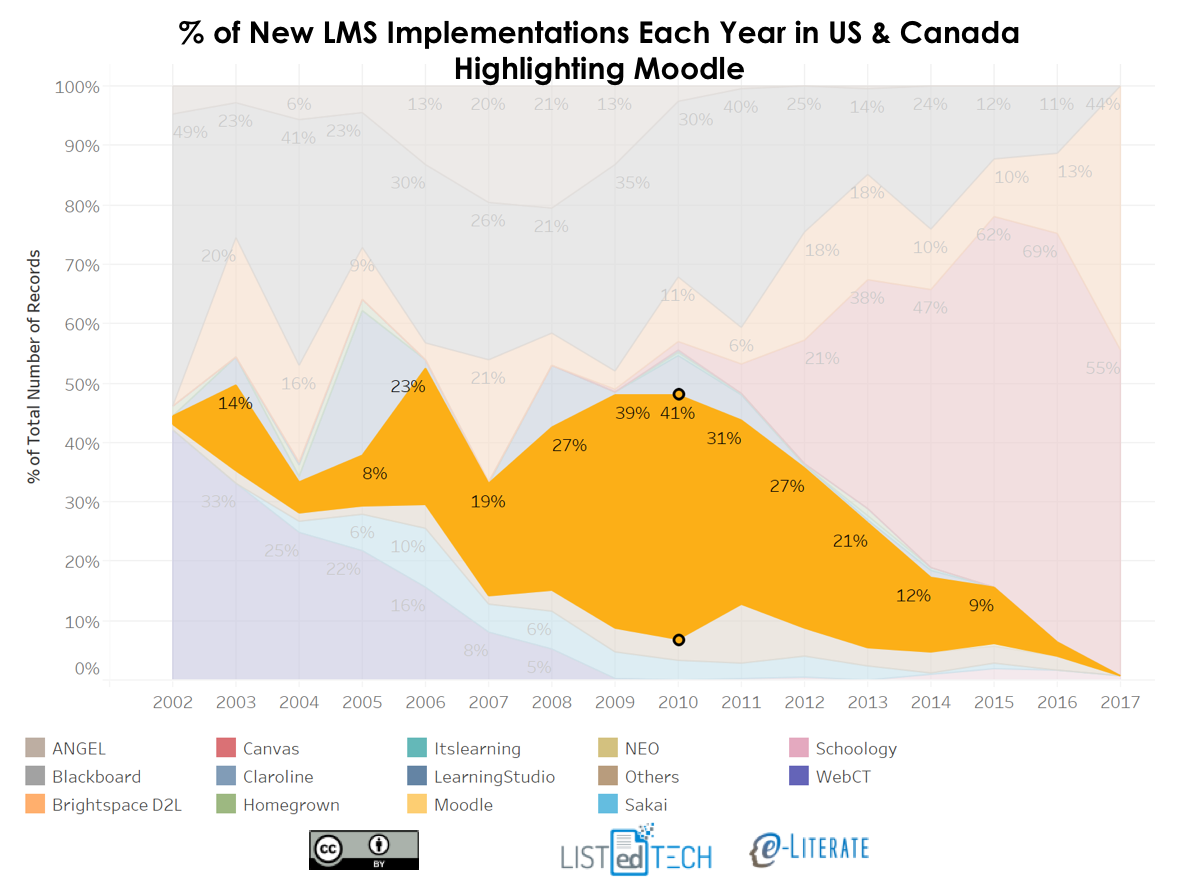
Second, vocal elements of the Moodle community, including some in leadership positions, tend to be anti-vendor in general and anti-Blackboard in particular. Having a major US Moodlemoot fit inside a single (admittedly large) room at BbWorld had to be a hard pill to swallow. And Blackboard, for its part, did not always appear to execute well on supporting the moot. I found the Moodle session listings in the BbWorld app to be confusing. Nevertheless, there certainly seems to have been a major sea change at Blackboard regarding promoting Moodle in North America. Time will tell whether the increased efforts toward a more visible and cooperative relationship will bear fruit.
The last announcement piece I’ll mention isn’t really new to BbWorld so much as it is new since last BbWorld. Blackboard was heavily promoting Ally, the content accessibility tool the company acquired within the last year. Interest appeared to be huge, with overflowing crowds at the sessions.
So what does all this add up to? I’d say a few things:
- CEO Bill Ballhaus must have succeeded in convincing the company’s private equity owners to allow him to invest in accelerating product development. There’s no other way all these announcements would have been possible. That’s definitely new and a positive leading indicator.
- The company is thinking about ways to combine its portfolio of products (and services) to meet customer needs. That’s also new, and a differentiator.
- Another differentiator is the level of sophistication that Blackboard is bringing to learning analytics, both in terms of the feature set and in terms of the conversations they are having with customers.
- Both the announcements and the customer sentiment indicate that the company is getting better at both listening and executing based on what they’ve heard.
- None of this changes the fact that Blackboard is still playing defense, but it does suggest that they may be playing better defense and preparing a strategy that will enable them to go on offense.
Management Public and Private Presentations and Discussions
This is the area where some of the most dramatic changes were visible. For starters, the marketing messaging in the keynote was by far the most subtle and sophisticated that I’ve ever seen from Blackboard. Two new taglines were introduced. The first one, “Simply Powerful,” wasn’t really new but rather a revival of the old ANGEL tagline. (I think I still may have that T-shirt, although I doubt I could squeeze into it anymore.) Back in the ANGEL days, the subtext was, “ANGEL is simpler than Blackboard, but it’s also powerful.” In today’s context, the subtext is flipped on its head: “Blackboard is more powerful than Canvas, but it’s also simple.”
The other new tagline was “Your Partners in Change.” There’s a lot going on here. First, this line was projected up on the screen in huge letters as Bill Ballhaus talked about this year being the 20th anniversary of Blackboard. Also on the screen in the background was a picture of NASA’s Pathfinder spacecraft, which landed on Mars the same year that Blackboard was founded. Ballhaus is an aeronautical engineer by training, a fact that he made very plain in his schpiel. Part of the subtext was, “Yes, we’re Blackboard, but not that Blackboard. And I’m the CEO of Blackboard, but not that CEO.” “Partner” was as important as “change,” because it contrasted with the hubris of the last two CEOs. It also provided a cohesive identity for the company as one that provides an integrated portfolio of products and services that can help its customers respond to changing times.
But the star of the keynote was not Bill Ballhaus but Blackboard’s Chief Strategy Officer, Katie Blot. Ballhaus acted as host and referred to himself as “chief client advocate,” but he quickly ceded the spotlight to Blot for the substance of the keynote.
A side note: All of the top three LMS providers in terms of US and Canadian market share have powerful, competent women on their senior leadership teams. Phil mentioned D2L’s Cheryl Ainoa in his recent post. I have mentioned Instructure’s Misty Frost in the past. Like Ainoa and Frost, Katie Blot has a role at her company that is broader than her title suggests. It was good to see her get the spotlight.
And she did not disappoint. Blot is not an ed tech industry careerist, having come to Blackboard from her previous gig working at the US Department of Education. She left behind former CEO Jay Bhatt’s absurdly grandiose claims that Blackboard would change the world single-handedly—”Your Partners in Change”—while maintaining upbeat energy. Her talk was substantive and thematic, punctuated by video interviews with various senior executives about specific product developments. It was not over the top, gross, or cringe-inducing in any way. In fact, it was…dare I say…quite good.
Beyond that, the main themes I noticed were honesty and consistency. I’ve mentioned the former already and have more detail to add, but let me first address the latter. As we’ve mentioned in the past, one method we have for evaluating vendors at their conferences is asking a lot of different people the same questions and seeing if we get the same answers. This is a particularly critical litmus test for Blackboard given the mess it has to clean up regarding the confusion between it’s SaaS options and Ultra. I asked a lot of random Blackboard employees about how Ultra is going. Consistently, the answer I got was something like the following:
Let’s back up and first talk about SaaS….
[Tells a story about good progress with SaaS, adoption, often mentioning the bump they hit with earlier adopters in the process.]
Now within that context, let’s talk about adoption of the Ultra experience.
[Talks about how each customer has their own must-haves before they will even consider Ultra, how Blackboard has a prioritized punch list, and how they have dramatically increased the number of scrum teams working on it to make sure they can meet their commitments to work their way through that punch list in a reasonable time frame.]
This is a pretty dramatic contrast to two years ago, or even a few months ago when Phil was at a Blackboard conference in Europe. So the company is definitely getting on the same page. Out in the field, we are not seeing the same consistency among the sales representatives during RFP presentations. When I brought this up with Bill Ballhaus, he acknowledged it without hesitation and went on to describe steps the company is taking to correct the problem. (There’s that honesty thing again.)
There was also a return of Ray Henderson’s progress report card by both Phill Miller and Blackboard’s Chief Product Officer Tim Tomlinson. I believe it’s no coincidence that both of these men are former ANGEListas. There was something of a minor ANGEL take-under at Blackboard when Henderson was President and Chief Technical Officer there. That change stalled out under Bhatt but has apparently been revived under Ballhaus. Miller and Tomlinson have both been promoted, and the center of gravity for Learn development has moved to Indianapolis, the former home of ANGEL. Henderson’s public approach could be summed up as something like “make commitments, measure your progress, and tell the truth.” I saw many signs of a similar philosophy taking root in Ballhaus’s Blackboard.
The last thing I’ll say—and this is probably the most subjective assessment of this post—is that the employees seemed, for lack of a better word, happy. Not forced, conference-host happy but normal people happy. I-love-my-work-and-like-my-colleagues happy. I have observed lots of folks working at organizations that are under stress or dysfunctional. I have seen them from the inside as well as from the outside of those organizations. There’s a vibe that’s unmistakable. The Blackboard folks I talked to didn’t seem to have that vibe.
Bottom line: Blackboard’s adoption trend line is undeniably down and likely will continue in that direction for at least another 12 months (if you factor out the likely University of Phoenix implementation, which will skew the numbers). But early and subjective signs suggest a positive change in direction inside the company—possibly a rapid one—that may become more visible externally between now and this time next year.