
e-Literate

Present is Prologue

Tag: remedial math

  • Worth Considering: Faculty perspective on student-centered pacing

    Over the weekend I wrote a post based on the comment thread at Friday’s Chronicle article on e-Literate TV.

    One key theme coming through from comments at the Chronicle is what I perceive as an unhealthy cynicism that prevents many people from listening to students and faculty on the front lines (the ones taking redesigned courses) on their own merits.

    Sunday’s post highlighted two segments of students describing their experiences with re-designed courses, but we also need to hear directly from faculty. Too often the public discussion of technology-enabled initiatives focus on the technology itself, often assuming that the faculty involved are bystanders or technophiles. But what about the perspectives of faculty members – you know, those who are in the classrooms working with real students – on what challenges they face and what changes are needed from an educational perspective? There is no single perspective from faculty, but we could learn a great deal through their unique, hands on experiences. (more…)
  • Worth Considering: Students can have their own perspectives on edtech initiatives

    Triggered by Friday’s article on e-Literate TV, there have been some very interesting conversations both in the Chronicle comment thread and on the e-Literate TV site. The most, um, intense conversations have centered on the application of self-regulated learning (SRL) in combination with adaptive software (ALEKS) to redesign a remedial math course at Essex County College. Michael has been wading in very deep waters in the comment threads, trying emphasize variations of the following point.

    But that debate should be in the context of what’s actually happening in real classrooms with real students, what the educational results are, and what the teachers and students involved think of their experiences.

    Right now, the “sides” are having a fight–it’s not really a debate because the sides aren’t really talking to each other–in near total absence of any rational, educator-evaluated, evidence-based conversation about what these approaches are good for. One side says they will “fix” a “broken” education system, while the other side says they will “destroy” the education system. Well, what are the students saying?

    (more…)

  • Austin Community College’s ACCelerator: Big bet on emporium approach with no pilots

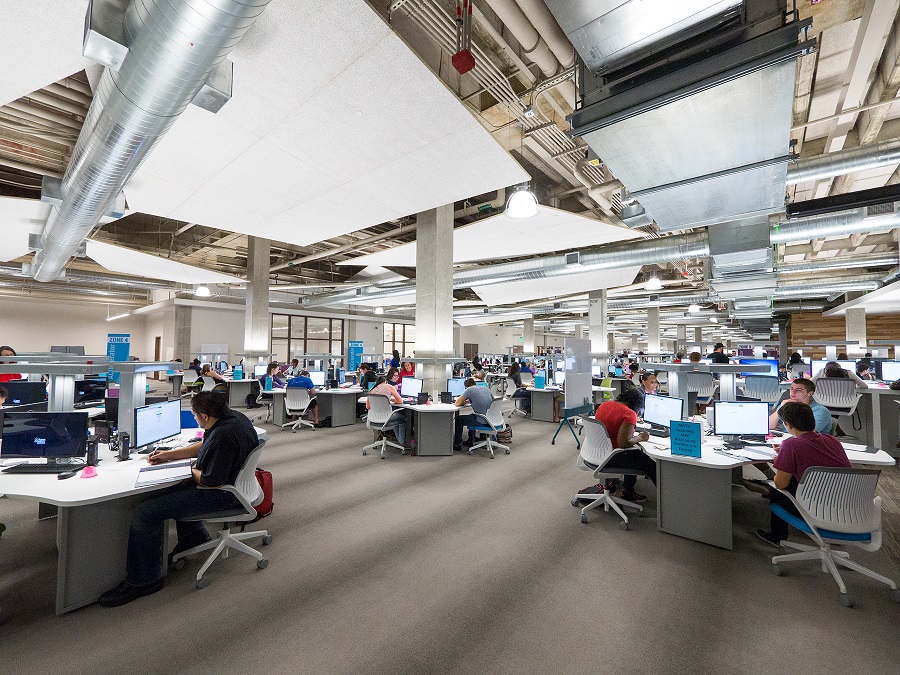
    While at SXSWedu, I was able to visit Austin Community College’s ACCelerator lab, which got a fair bit of publicity over the past month. While the centerpiece of ACCelerator usage is for developental math, the 600+ workstation facility spread over 32,000 square feet also supports Tutoring in a variety of subjectsFirst year experienceGroup advisingAcademic CoachingAdult EducationContinuing EducationCollege readiness assessment preparation, and Student skills workshops.

    ACCelerator

    But it is the developmental math course that has received the most coverage.

    Austin Community College welcomed second lady Dr. Jill Biden and Under Secretary of Education Dr. Ted Mitchell on Monday, March 9, to tour the Highland Campus’ ACCelerator and meet with students and faculty of the college’s new developmental math course, MATD 0421. [snip]

    “I teach a lot of developmental students,” says Dr. Biden. “The one stumbling block does seem to be math and math anxiety and ‘Can I do it?’. This (course) seems to be so empowering and so positive. Students can see immediate success.”

    (more…)

  • Dana Center and New Mathways Project: Taking curriculum innovations to scale

    Last week the University of Texas’ Dana Center announced a new initiative to digitize their print-based math curriculum and expand to all 50 community colleges in Texas. The New Mathways Project is ‘built around three mathematics pathways and a supporting student success course’, and they have already developed curriculum in print:

    Tinkering with the traditional sequence of math courses has long been a controversial idea in academic circles, with proponents of algebra saying it teaches valuable reasoning skills. But many two-year college students are adults seeking a credential that will improve their job prospects. “The idea that they should be broadly prepared isn’t as compelling as organizing programs that help them get a first [better-paying] job, with an eye on their second and third,” says Uri Treisman, executive director of the Charles A. Dana Center at UT Austin, which spearheads the New Mathways Project. [snip]

    Treisman’s team has worked with community-college faculty to create three alternatives to the traditional math sequence. The first two pathways, which are meant for humanities majors, lead to a college-level class in statistics or quantitative reasoning. The third, which is still in development, will be meant for science, technology, engineering, and math majors, and will focus more on algebra. All three pathways are meant for students who would typically place into elementary algebra, just one level below intermediate algebra.

    When starting, the original problem was viewed as ‘fixing developmental math’. As they got into the design, the team restated the problem to be solved as ‘developing coherent pathways through gateway courses into modern degrees of study that lead to economic mobility’. The Dana Center worked with the Texas Association of Community Colleges to develop the curriculum, which is focused on active learning and group work that can be tied to the real world. (more…)