e-Literate

Present is Prologue

Tag: Sakai 3

  • Community Source Is Dead

    As Phil noted in yesterday’s post, Kuali is moving to a for-profit model, and it looks like it is motivated more by sustainability pressures than by some grand affirmative vision for the organization. There has been a long-term debate in higher education about the value of “community source,” which is a particular governance and funding model for open source projects. This debate is arguably one of the reasons why Indiana University left the Sakai Foundation (as I will get into later in this post). At the moment, Kuali is easily the most high-profile and well-funded project that still identifies itself as Community Source. The fact that this project, led by the single most vocal proponent for the Community Source model, is moving to a different model strongly suggests that Community Source has failed.

    It’s worth taking some time to talk about why it has failed, because the story has implications for a wide range of open-licensed educational projects. For example, it is very relevant to my recent post on business models for Open Educational Resources (OER).

    (more…)

  • Sakai OAE 1.0 Released

    I’m a little late reporting this, but the Sakai community has released the long-awaited 1.0 version of its Open Academic Environment platform (formerly known as Sakai 3). Here’s an overview:

    As you’ll see, it takes a very different approach from conventional LMSs. It doesn’t yet have some of the core features of an LMS either (e.g., grade book and test engine), but it clearly is useful today for certain kinds of academic collaboration needs and represents a promising direction. When you throw this in the mix with the new commercial entrants that Phil Hill blogged about recently, it adds up to really interesting times ahead in the LMS space.

  • Migrating to Sakai

    When I speak to people from schools that are currently involved in an LMS selection process, I very often hear the following assumptions and line of reasoning:

    • Sakai 2 hasn’t set the world on fire, and anyway, it’s going to be replaced by Sakai 3 soon.
    • But Sakai 3 isn’t ready yet, and we aren’t sure exactly when it will be ready or how to go about evaluating it now.
    • Since we have to make a decision soon, we are going to have to forget Sakai as a candidate.

    This is a reasonable and understandable train of thought, but it is built upon mistaken beliefs about Sakai 2, Sakai 3, and the relationship between the two projects. The Sakai community has a vision and a plan that ensures both Sakai 2 and Sakai 3 will remain healthy and under active development for some time to come. In fact, far from being merely an awkwardly timed product transition, the two-product approach the community is taking actually provides what I believe is a unique strategy in the LMS space for supporting schools’ present needs, fulfilling their vision for their future, and providing a path from one to the other. Rather than being a reason to dismiss Sakai from consideration, the Sakai 2/Sakai 3 dichotomy is actually reason to look at the Sakai community and family of software especially closely.

    (more…)

  • Sakai 3 Roadmap and Progress

    Up until now, it would have been fair to call Sakai 3 a mature experiment. Two years of work have been invested, mostly by Cambridge, to test out some ideas about the design, architecture, and development ecosystem of next-generation virtual learning environments. We have learned a lot from it, but the level of commitment to turn it from an experiment into a product system has been somewhat vague.

    That changed a couple of weeks ago at the Sakai conference in Denver. We now have a much clearer idea of when Sakai 3 might be deployable as a production system to meet different purposes.

    (more…)

  • Sakai 3 Learning Capabilities Lenses

    A while back, I asked David Goodrum to write a guest post about some of the work that the Sakai Teaching & Learning Group has been doing to articulate the educational goals and requirements for Sakai 3. The document that they have been working on is called the Sakai Learning Capabilities document, and it entered a 1.0 release just prior to the start of the Denver Sakai conference. This is very important work that will certainly impact the future of Sakai and could have a wider impact in instructional technology.

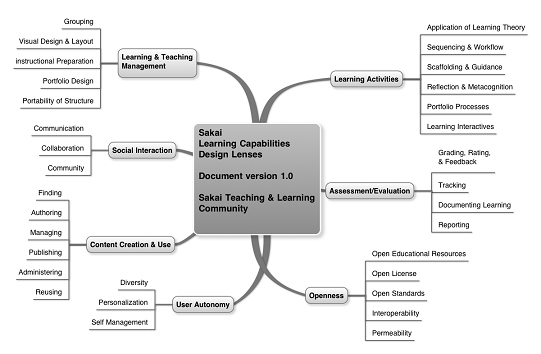
    The group articulate seven “lenses”, which you might think of as functional goals or even as design values for Sakai 3. They are called lenses because each one presents a different view or perspective of any given piece of functionality within Sakai 3 (or any piece of educational technology, really). Every tool and capability within the system should be examined from the perspective of each of the seven lenses at some point in the design phase to help the designers make sure that they are upholding the design values of the system wherever and whenever possible. Each lens contains several finer-grained “facets” which are, again, intended to help software designers ask the right questions as they are designing educational capabilities. These lenses include capabilities for addressing traditional LMS and ePortfolio as well as important educational scenarios that are not handled well by today’s systems.

    Here’s what version 1.0 of the lenses looks like as a mind map:

    Sakai Learning Capabilities v1 Mind Map

    Note that at least two of Dan Pink’s three drivers of motivation are articulated on the map. Autonomy is called out fairly directly as a lens. I would argue that “mastery” is represented in some of the facts of the “learning activities” lens. (Interestingly, the facet descriptors in the “assessment/evaluation” lens seem relatively devoid of connections to mastery at this point, although in fairness, there’s a lot more thought and analysis underneath this mind map that the descriptors may not be capturing.) I’m not sure that Dan Pink’s third motivator—purpose—can be wired into software, although I’ll be keeping my eye out for examples of it.

    The key for the community will be to figure out how to translate these design values into concrete processes during the software design and development process. I have some ideas about how to go about this this. I hope/expect to write about them in a future post.

  • Update to the Sakai 3 Timeline

    Sakai Foundation Interim Executive Director Lois Brooks just posted a brief update to the Sakai 3 development plans. The detail that stood out to me is this:

    The new project brings together the existing body of work, and the existing teams, into a single, coordinated effort, and aims for a completed version that is feature-equivalent to Sakai 2 in mid-2011. [Emphasis added.]

    This represents a change from the earlier road map that didn’t anticipate having a full Sakai 2 replacement until 2012.

    A couple of caveats are in order. First, nobody really knows what it means for Sakai 3 to be “feature-equivalent” to Sakai 2. Whenever you move to a new system design, some features that made sense in the old world just don’t make sense in the new one. That’s particularly true in this case, Since Sakai 3 is very different from Sakai 2 in both functional design philosophy and underlying architecture. For schools currently on other platforms, this doesn’t matter much. The “feature-equivalent” tag simply conveys the Sakai 3 project team’s confidence that they are releasing a competitive product. For current Sakai schools, the issue is more complicated. They will have to look whether anything that matters to them will get lost in translation.

    Second, people on the project team tell me that, at this point, 2011 should be considered to be something closer to an aspirational goal than a due date derived from a detailed project plan. In June, there will be development planning sessions both immediately before and immediately after the Sakai conference. A lot of work gets done at these sessions. Over the month or so following, more gels as attendees go home and rally their troops and as tentative decisions are finalized through communications with stakeholders who may not have been able to attend the conference. We’ll know a lot more by mid-July.

    For now, the main take-away here is that the Sakai 3 development team is expressing an increasing sense of confidence in the project’s resourcing.

    Update: After rereading some emails, I’d like to slightly downgrade my adjective from “confidence” to “optimism.” One early test will be to see whether schools step forward with additional resources once the project plan is fleshed out. Again, much of this will happen in roughly the Sakai conference time frame. There is a lot of interest in participation being expressed within the Sakai community, but we don’t know yet whether that interest will translate into resource commitments in sufficiently large numbers to ensure delivery on this more aggressive schedule.

    Stay tuned.

  • Sakai 3: The Benefits of 'Everything is Content'

    One of the more radical departures that Sakai 3 makes from traditional LMS design is that everything in the system is treated as content. A traditional LMS is an aggregation of tools—discussion boards, grade books, test engines, wikis, assignment drop boxes, etc.—each of which has its own data model in a relational database. It’s really a hodgepodge of separately designed tools that are knitted together through a user interface layer and a few common services. In contrast, Sakai 3 is being built on top of the Apache Jackrabbit reference implementation of the Java Content Repository (JCR) standard. Everything is treated as content, including grades, test questions and answers, discussion threads, syllabi, personal profiles, chat messages, and so on.

    This approach has some benefits in terms of shoring up common weaknesses in LMS designs. But, more profoundly, it also leads to some pretty fundamental changes in the way that learning environments can work, thanks in large part to the strong and growing adoption and maturation of useful content integration standards.

    (more…)