e-Literate

Present is Prologue

Tag: school-as-a-service

  • 2U registration for IPO offers insight into Online Service Provider market

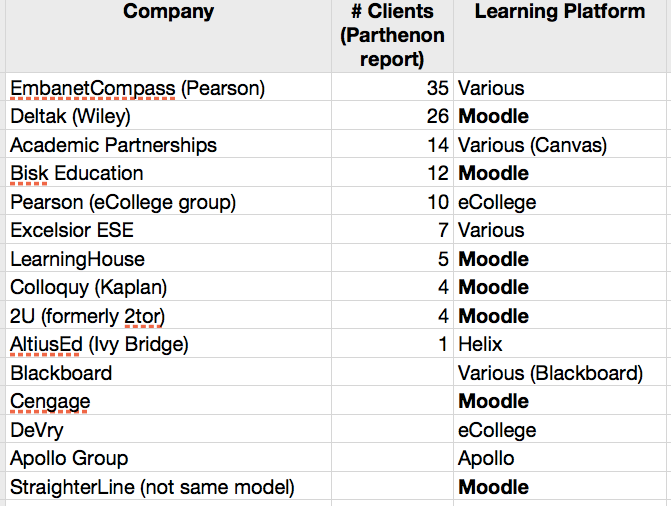
    One of the biggest growth areas in education has been the Online Service Provider market. Alternatively known as Online Education Service Provider (OESP), School-as-a-Service, or Online Program Management (OPM), this market offers services to traditional colleges and universities that are creating online programs. In August I listed the LMS used by the top OSP providers, and while the data for this table is a year old, it does give a sense of who the major players are.

    SaaS LMS Chart 2


    How big are these companies? EmbanetCompass had estimated 2012 revenues of $130 million when Pearson acquired the company for $650 million. Deltak had estimated 2012 revenues of $54 million when Wiley acquired the company for $220 million. Academic Partnerships had estimated 2012 revenues of $43 million. I don’t have updated 2013 numbers, but various estimates have this market growing at 50% or more per year.

    Yesterday 2U, Inc submitted a S-1 document with the SEC, registering the company’s intention to go public in 2014. (more…)

  • Moodle has quietly become the dominant LMS for online service providers

    One subject that we have not covered much at e-Literate lately is the market position of Moodle. Given the significant LMS market changes over the past two years, it might be worth considering how institutions are adopting and using Moodle. In the US at least, there has been a significant change – whereas in previous years Moodle growth came primarily from institutions moving away from Blackboard, today much of the growth appears to have shifted to online service providers.

    Traditional US Market

    From 2006 – 2011 Moodle grew quickly in the US, both in terms of the number of users (students, faculty) and in terms of the number of schools adopting Moodle. This growth appears to have slowed considerably since 2011, although the data can be difficult to interpret since the system is open source – anyone can download for free and run Moodle, without even notifying Moodle headquarters or often the institution.

    While the data is inconclusive, my assumption is that traditional Moodle growth – institutions adopting the LMS as the campus standard, typically moving away from Blackboard or WebCT – has significantly slowed from its peak growth in 2009 – 2011. I’ll write a separate post on this subject in the future.

    New Growth Model

    While the traditional growth may have slowed, there is a market segment in the US where Moodle is quietly dominating – as the preferred learning platform (or LMS) for online service providers.

    (more…)

  • Online Educational Delivery Models: A Descriptive View

            This article was originally published at EDUCAUSE Review.

    Update (11/25): This post has been bumped and amended to include the full article.

    Although there has been a long history of distance education, the creation of online education occurred just over a decade and a half ago—a relatively short time in academic terms. Early course delivery via the web had started by 1994, soon followed by a more structured approach using the new category of course management systems.1 Since that time, online education has slowly but steadily grown in popularity, to the point that in the fall of 2010, almost one-third of U.S. postsecondary students were taking at least one course online.2 Fast forward to 2012: a new concept called Massive Open Online Courses (MOOCs) is generating widespread interest in higher education circles. Most significantly, it has opened up strategic discussions in higher education cabinets and boardrooms about online education. Stanford, MIT, Harvard, the University of California–Berkeley, and others have thrown their support—in terms of investment, resources, and presidential backing—behind the transformative power of MOOCs and online education. National media outlets such as the Wall Street Journal, the New York Times, and The Atlantic are touting what David Brooks has called “the campus tsunami” of online education.3

    Unfortunately, a natural side effect of this new interest in education and educational technology is an increase in hype and in shallow descriptions of the potential for new educational models to replace the established system. All too often, the public discussion has become stuck in a false dichotomy of traditional vs. online—a dichotomy that treats all online models as similar and that ignores blended or hybrid approaches. This false dichotomy is even more evident now that discussions are spilling into national media forums. But in fact, as my colleague Molly Langstaff has described, educational technology is interacting with innovative educational courses and programs to create not only new language but also multiple models for delivering education.4

    (more…)