
e-Literate

Present is Prologue

Tag: Stephen-Downes

  • Harmonizing Learning and Education

    I’m the Whether Man, not the Weather Man, for after all it’s more important to know whether there will be weather than what the weather will be.

    The Phantom Tollbooth

    Dave Cormier has written a couple of great posts on our failure to take learner motivation seriously and the difference between improving learning and improving education. In the latter post—a response to Stephen Downes’ comment on the former post—Dave writes about the tension between improving an individual’s learning and improving our system of education, essentially positing that the reason why we as a society often fail to take learner engagement sufficiently seriously is because we become preoccupied with making the educational system accountable, a goal that we would be irresponsible not to take on but that we are also essentially doomed to fail at. (I may be putting words in his mouth on that last bit.) Dave writes,

    There’s definitely something wrong if people are leaving their first degree and are not engaged in learning. We certainly need to address it. We totally want to be in the business of helping people do what they want to do. Try it. No really. Just try it. Sit down with a child and help them do what they want to do. And i don’t mean “hey this child has shown up with a random project they are totally passionate about and are asking me a question” I mean “stop them at a random time, say 8:25am, and just start helping them.” You will get blank stares. You’ll get resistance. You’ll get students who will say anything you want if it means you will go away/give them a grade. You will not enjoy this process. They will also not enjoy it.

    There is something wrong. The problem is that we have built an education system with checks and balances, trying to make it accountable and progressive (in some cases), but we are building it without knowing why. We have not built an education system that encourages people to be engaged. The system is not designed to do it. It’s designed to get people to a ‘standard of knowing.’ Knowing a thing, in the sense of being able to repeat it back or demonstrate it, has no direct relationship to ‘engagement’. There are certainly some teachers that create spaces where engagement occurs, but they are swimming upstream, constantly battling the dreaded assessment and the need to cover the curriculum. The need to guarantee knowing.

    He suggests that we need to redesign our education system around the goal of getting students to start caring and keep caring about learning. And his argument is interesting:

    Give me a kid who’s forgotten 95% of the content they were measured in during K-12 and I will match that with almost every adult i know. Give me a kid who cares about learning… well… then i can help them do just about anything.

    This is partly a workplace argument. It’s an economic value argument. It’s a public good argument. If Dave is right, then people who care about learning are going to be better at just about any job you throw at them than people who don’t. This is a critical argument in favor of public funding of a liberal arts education, personalized in the old-fashioned sense of having-to-do-with-individual-persons, that much of academia has ceded for no good reason I can think of. The sticky wicket, though, is accountability which, as Dave points out, is the main reason we have a schism between learning and education in the first place. Too bad we can’t demonstrate, statistically, that people who are passionate about learning are better workers. It’s a shame that we don’t have good data linking being excited about learning, being a high-performer in your job, and being a happy, fulfilled and economically well-off person. If we had that, we could largely resolve the tension between improving learning and improving education. We could give a compelling argument that it is in the taxpayers’ interest to build an education system whose purpose, as Dave suggests, is to increase the chances that students will start to care and continue to care about learning. It’s a tragedy that we don’t have proof of that link.

    Oh, wait.
    (more…)

  • Dammit, the LMS

    Count De Monet: I have come on the most urgent of business. It is said that the people are revolting!

    King Louis: You said it; they stink on ice.

    – History of the World, Part I

    Jonathan Rees discovered a post I wrote about the LMS in 2006 and, in doing so, discovered that I was writing about LMSs in 2006. I used to write about the future of the LMS quite a bit. I hardly ever do anymore, mostly because I find the topic to be equal parts boring and depressing. My views on the LMS haven’t really changed in the last decade. And sadly, LMSs themselves haven’t changed all that much either. At least not in the ways that I care about most. At first I thought the problem was that the technology wasn’t there to do what I wanted to do gracefully and cost-effectively. That excuse doesn’t exist anymore. Then, once the technology arrived as Web 2.0 blossomed—remember that term?—I thought the problem was that there was little competition in the LMS market and therefore little reason for LMS providers to change their platforms. That’s not true anymore either. And yet the pace of change is still glacial. I have reluctantly come to the conclusion that the LMS is the way it is because a critical mass of faculty want it to be that way.

    Jonathan seems to think that the LMS will go away soon because faculty can find everything they need on the naked internet. I don’t see that happening any time soon. But the reasons why seem to get lost in the perennial conversations about how the LMS is going to die any day now. As near as I can remember, the LMS has been about to die any day now since at least 2004, which was roughly when I started paying attention to such things.

    And so it comes to pass that, with great reluctance, I take up my pen once more to write about the most dismal of topics: the future of the LMS.

    (more…)

  • Massive, Open, and Course Design

    Martin Weller has a great blog post up about course design responses to MOOC completion rates. He starts by arguing that, while completion rates are not everything in MOOCs, they are not nothing either. A lot depends on whether you think completion is an important metric to meet the course goals because, for example, the course is designed to help remedial students pass into a non-remedial track, or whether having students explore the content in a non-comprehensive way accomplishes your course goal. (Martin brings up an analogy by Stephen Downes that nobody complains about the low newspaper completion rates, which I have never heard before and which I love.)

    This is good stuff, but it starts us down the path toward a more radical re-examination of how we think about course design. Because while Martin is focusing primarily on course goals and how those should determine metrics, he’s beginning to raise the question of how individual learner goals should influence course design. And once you start asking that question, it changes everything.

    (more…)

  • MOOC history as presented at AACN13 conference

    With all of the great discussions spawned by the “greatest MOOC conference in the history of MOOCs” (MRI13), it seems a good time to share a segment of a keynote presentation I gave last year on MOOC history. This presentation was at the American Association of the Colleges of Nursing (AACN) conference in April 2013. For context, I had just shared how online education was no longer an issue kept in the corner, away from mainstream higher ed, but was now affecting the traditional campus discussions.

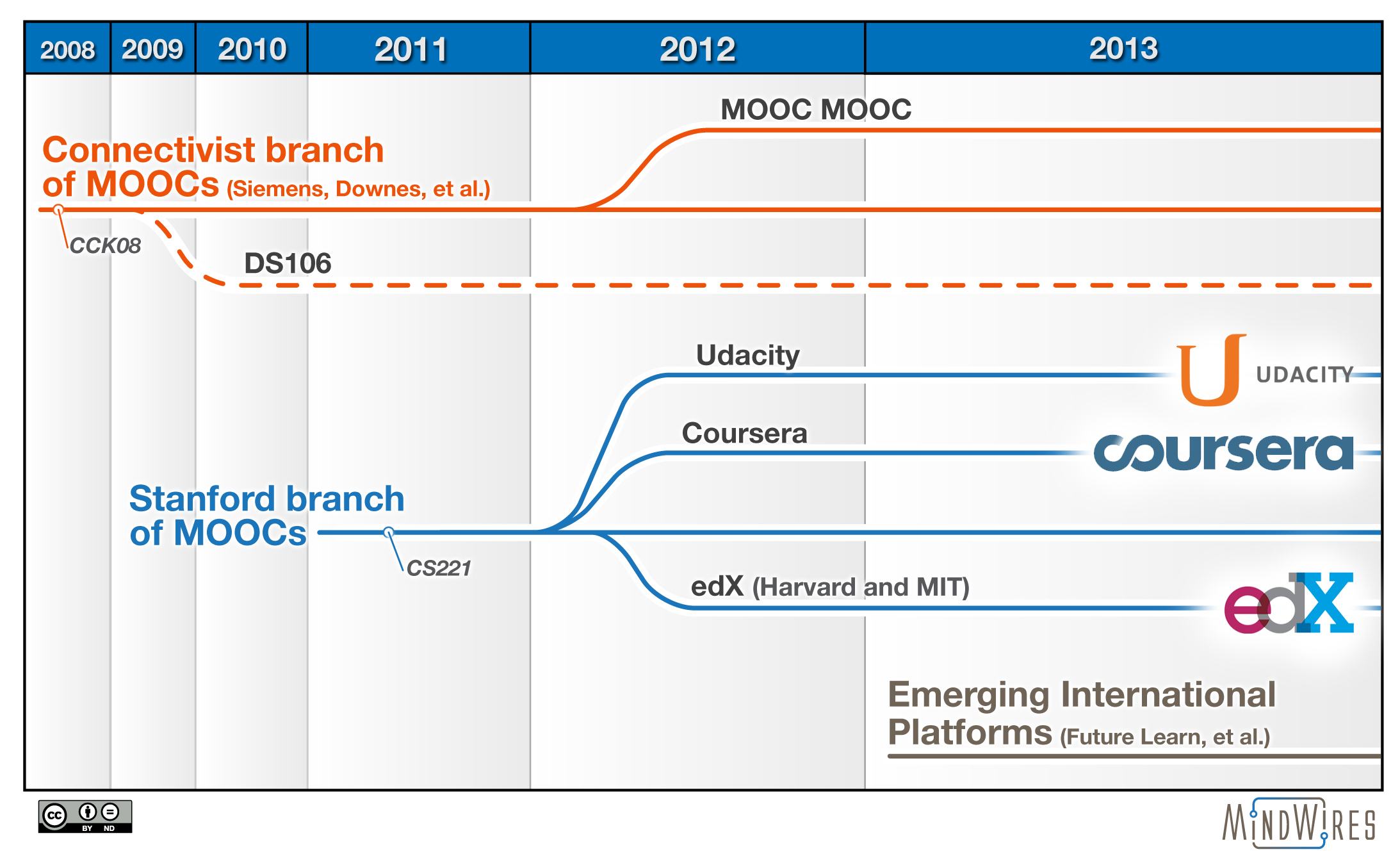
    There is a relevant graphic that was shown during this segment of the talk, showing the MOOC timeline (updated version shown below).

    MOOCpreHistory20131202

  • Changing the Narrative

    As Phil mentioned, he and I were both lucky to attend the MOOC Research Initiative conference, which was a real tour de force. Jim Groom observed that even the famously curmudgeonly Stephen Downes appeared to be enjoying himself, and I would make a similar observation about the famously curmudgeonly Jonathan Rees. If both of those guys can be simultaneously (relatively) pleased at a MOOC conference, then something is going either spectacularly right or horribly wrong. I believe it was the former in this case.

    We are at one of those rare moments when there’s enough confusion that real conversation happens and possibilities open up. The sense I got is that everybody is really grappling with the questions of where we can take the concept of a “MOOC” and what MOOCishness might be good for. That is fun and hope-inducing. Phil and I spent a lot of the time interviewing folks for a future e-Literate TV series (coming to a computing device near you in March or April of 2014), so we were lucky to hear a lot of perspectives. There is some very good exploration happening now. George Siemens and his fellow conference organizers (as well as the Bill and Melinda Gates Foundation, which sponsored the event and the research) did a real service by bringing people together to talk about these issues at this pregnant moment.

    One thing happened toward the end of the conference that has me puzzled, though. Jim mentioned it in his blog post:

    At the same time[,] Bon Stewart’s admonitions for some kind of organized response to start filling the temporary void of direction with alternative narrative still rings in my ears—and it is very much the lesson I took away from Audrey Watters keynote at OpenEd.

    There was a lot of conversation, really throughout the conference but coming to a head at the end, that the term of MOOC is somehow damaged goods and that…something…should be done about it. Usually the word “narrative” was brought up. But this talk of “alternative narratives” or, as Bonnie put it, “changing the narrative”, confuses me. As far as I’m concerned, the connectivist/open ed crowd has been spectacularly, stunningly successful at “changing the narrative,” and I’m not at all clear what it would look like to somehow do it differently. I don’t understand what they mean here. Unfortunately I had to rush out the door to try to catch a plane shortly after the panel discussion and didn’t have an opportunity to follow up with some of the attendees. So I’m going to try to express my confusion in this blog post and hope that somebody can help me figure out what I’m missing.

    Warning: This post is long and lit crit wonkish.

    (more…)

  • How to Keynote an Unconference

    A while back, I had the privilege of being the keynote speaker at the NERCOMP LMS Unconference. I had never attended an unconference before, nevermind keynoting one, and I found the prospect to be fascinating and exciting. And nerve-wracking. On the surface, a keynote appears to be the antithesis of the unconference spirit. I needed to do something different than the usual fare in order to make it work. I needed to do an unkeynote. And yet, Stephen Downes had warned me that he, Brian Lamb, and D’Arcy Norman had tried giving an unkeynote before and, in his words, “They almost lynched us. They were not happy to receive an unkeynote.” (D’Arcy’s post-mortem of their effort is definitely worthwhile reading.) So, what to do?

    The approach I tried seemed to work, judging by the feedback I got from the attendees and, to a lesser degree, by the influence of the presentation that I was able to observe on the rest of the unconference. I had intended to blog about the experience a while ago but it fell off my to-do list. However, prompted by the good folks of the NERCOMP LMS SIG, I am now returning to the topic.

    (more…)

  • Bring On Da Noise: The Backchannel Panel

    I’ve been meaning to write about this for a while. Barry Dahl has a great post analyzing the back-channel comments from our recent panel discussion with Stephen Downes and Robbie Melton. He concludes that only 31% of the posts were productive, by which he means on-topic questions or comments. This issue came up during the panel discussion itself, and Robbie (brilliantly, in my opinion) characterized it as a “teachable moment.”

    I think a big reason why there was so much off-topic chatter is that we didn’t really establish clear patterns or norms for how the back-channel would be encorporated into the larger dialog. The audience treated it like an experiment because we treated it like an experiment. I heard some suggestions from audience members afterward about how the technology could be modified to improve the experience (e.g., disallow anonymous posting, shut off the flow when the panelists are talking, have a moderator filter the comments, etc.), but before I would want to try imposing any of those hard limits on the participants, I would first want to try having a little more preparatory dialog with them about the most productive ways to use the backchannel and how we all would like to interact with it.