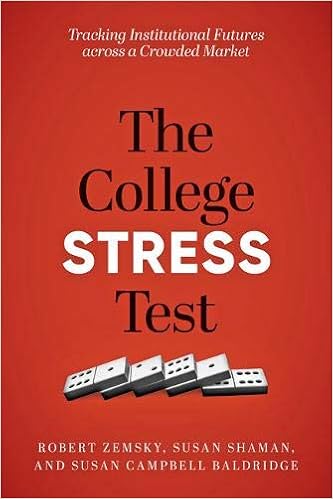
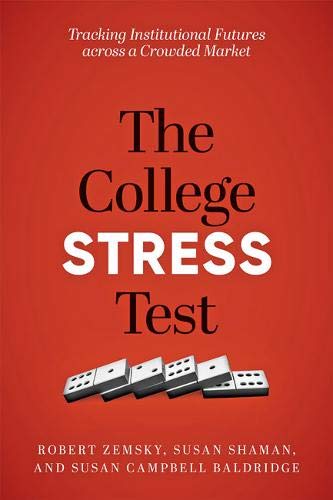
Note from the editor: This is a guest post from Susan Baldridge, one of the authors of forthcoming book The College Stress Test: Tracking Institutional Futures across a Crowded Market.
Clayton Christensen got the attention of campus leaders with his claim that 50% of colleges will be closed within a decade, and others – perhaps with less dramatic predictions – have joined the gloomy chorus. As overstated as that number may be, you might expect that we would be moved by this prediction to ask hard questions about the future of higher education and what it means on our campuses. And some of us are. But the academic communities that are collectively engaging the challenges implicit in such dire predictions are few in number. Not only are these difficult conversations infrequent, but when they do take place they are fraught with controversy and rarely result in significant, sustained change. Why is it so hard?
It isn’t because we don’t know what the challenges are. Read the Chronicle or Inside Higher Ed on any given day and you’ll find a ready list of topics for campus conversations: providing a relevant curriculum and effective pedagogy, responding to dwindling enrollments and resulting resource constraints, addressing failures of equity and inclusion in an increasingly diverse environment, developing the optimal role of technology to promote learning…the list goes on and on.
Even with so many places to focus a collective search for solutions, we seem to avoid naming the elephants in the room. Even schools that are teetering on the brink – who presumably stand to gain (and lose) the most from collective action – are not talking openly about their institutions’ particular challenges. Witness the shock and outrage when colleges (there have been a number in the last year in my home state of Vermont) announce that they are closing, or merging, or seeking partners to help them weather the storm. In one highly-publicized case—Mt. Ida College in Massachusetts—lawsuits were filed following the closure announcement alleging that leaders intentionally kept the reality of the school’s circumstances from the campus and other stakeholders. The outcry seems to be, “Why weren’t we informed?”
It’s not hard to understand why a college president might not wish to share the problems of an institution with the wider world. Candid efforts to confront challenges to the long-term health and success of an institution invite external scrutiny, and this creates a counter-pressure to focus solely on the positive. My co-authors, Bob Zemsky and Susan Shaman, and I address this in our newly published book from Johns Hopkins University Press, “The College Stress Test,” in which we examine the market factors associated with institutional risk of closure:
“…A common focus of campus messaging is on the particular data points that suggest that, whatever risks may be facing other schools, the future for my college is bright. The point would seem to be to reassure constituents that, in the landscape of higher education, one’s own school is well-positioned to withstand today’s threats. Thus, presidents’ communications are far more likely to share the good news that applications are up this fall or to highlight the positive publicity received by a recent graduate, than they are to speak to potential threats to long-term viability.
This language of optimism and reassurance is understandable. Addressing threats to the sustainability of an institution requires persistent hard work by many, and a panicked community isn’t likely to be able to respond effectively. What’s more, if there is anxiety within the leadership ranks, it would not benefit anyone to acknowledge it. Much of the work of recruiting, enrolling, and retaining students—to say nothing of fund-raising—is about building reputations and managing the public’s perception of an institution’s desirability, prestige, and credibility. Potential students and donors are not likely to open their checkbooks to an institution whose future appears shaky. So, a struggling institution’s leaders may wait to publicly acknowledge that reality until the very last hope for recovery has faded.”
The College Stress Test
Understandable or not, as leaders work to keep the public perception oriented toward the strengths of the institution and its bright future, the opportunity to begin necessary, but likely difficult and nuanced conversations, is passing.
The disincentives around meaningful conversation and collective problem-solving go beyond external pressures and marketing concerns, however. When resources are diminishing or need to be reallocated, it shouldn’t surprise us that those who have been the beneficiaries of historical privilege (and I mean that in the broadest sense) tend to wrap their arms around what’s “theirs” and hold on tight. Administrators who have made decisions to take funding away from one group in order to support the work of another, or who have closed an expensive and declining program to keep a college afloat, know what it means to incur the wrath of those accustomed to an institution’s historical beneficence. And on some campuses, the need to make significant changes falls upon a community that has already suffered a kind of “death by a thousand cuts”—short-sighted, marginal, supposedly temporary budget reductions that have left those who might have been invited in to a collective conversation about long-term change and transformation feeling resistant, diminished, and beleaguered.
I don’t mean to suggest that we resist these conversations merely out of avoidance, however. Rather, the difficulty in addressing necessary change is often a function of something that is a source of strength: the values, commitments, and identities of those who work in higher education. Those who have made their careers on college campuses are typically deeply invested in the work that they do and the way that they do it. For many, it is not merely a job, but a calling. What’s more, faculty have spent years training to be critical evaluators of new ideas and initiatives. These people bring all that commitment and all those critical skills to bear on a proposal for change. Thus, we shouldn’t be surprised that moving an academic community in a new strategic direction can feel like a Sisyphean task.
I spent 15 years serving in a variety of administrative roles. It was my job to lead just this kind of challenging conversation and to work to bring a diverse community together in productive pursuit of collective action. Sometimes I was successful – and I hold those successes close at night. But even when change was achieved, it often required endless discussion and debate over months and even years. In one particular case, I recall a colleague who was opposing a proposed change to the structure of several departments – a change that he felt called into question his past and future contributions. Although the process had involved years (literally years) of meetings and votes, as it neared its conclusion, he said to me, “Susan, this is all happening with baffling speed.” These conversations can be tests of endurance.
This may be even more true when changes speak to the fundamental mission of an institution. If an institution’s leaders decide that the curriculum must be more explicitly oriented toward career preparation in order to maintain financial viability, what does this mean for the faculty members whose work, and sense of professional identity, has always been focused on learning for learning’s sake? And even if those colleagues are permitted to continue their work without participating in the broader institutional shift, what does it mean that they may no longer feel connected to the institution’s most visible priorities? No wonder that these people might question and even resist attempts to promote change that leave them feeling sidelined and their work diminished. Thus, it’s worth remembering that some resistance to change reflects the real and deep commitment of many individuals to the students and institutions they serve.
Sometimes the difficulty in these conversations isn’t nearly as meaningful as a fight for scarce resources or a battle over values and identity. At times, it simply represents a kind of reflexive laziness, or at least mindlessness – administrators react this way because they’re administrators, faculty respond that way because they’re faculty. Tackling these hard conversations can sometimes feel like staging a well-known play in which all the players know the text by heart. No one need question the characters’ motivations– we know the tropes and how we are supposed to respond to them. President X is the evil villain, Professor Y is the brave hero or heroine, Student Z is the pitiful victim. One of the most common complaints I hear from administrative colleagues across the country is their frustration with being presumed to be ill-intentioned, motivated by corporate greed, and lacking a commitment to the mission and values of their institutions. These presumptions seem to come with the role.
Even if everyone on a campus came to these conversations with good will and benign assumptions about one another, our governance practices and structures are often an impediment, not a facilitator of progress. If you read most college handbook provisions on changes to the curriculum or terms of employment, you’ll find a manual of hurdles and roadblocks. Of course, these checks and balances have been put in place to prevent short-sighted, ill-advised, and possibly nefarious actions. But they can also impede progress and necessary change. Anyone wishing to undertake a candid campus-wide conversation had best be a student of campus governance and should pack for a long trip.
So there are many reasons why we are more likely to avoid than engage the complex challenges we face. And yet, the stakes for many institutions, and ultimately for the students we seek to serve, could not be higher. There are certainly some who will simply continue to avoid and delay, hoping that the path will be charted by someone else or that the turbulent times will resolve themselves and allow us all to return to life as we knew it. But as we demonstrate in the analyses we present in the “College Stress Test,” and as others like Nathan Grawe and Jeff Selingo have shown, demographic change and shifting markets mean that many schools will need to respond and adapt, not simply wait out the turbulence. Put another way, for many, there may be no way out but through.
So how do those most at risk begin a conversation that is so potentially fraught and that experience suggests may be unpleasant and perhaps ultimately unproductive? At the risk of appearing to offer a facile answer, let me propose that the work starts with the realization that, difficult or not, we must have those conversations anyway. How, in particular, we might approach them will be the subject of another post in a few weeks. But let’s begin by acknowledging that many schools are facing, or will soon face, the necessity of some kind of significant change. The path to success will require collective action – and I believe that the most creative and effective action will start with honest, clear-eyed conversation about our challenges. The most important work is ahead of us.