
e-Literate

Present is Prologue

Tag: Venture capital

  • Why VCs Usually Get Ed Tech Wrong

    I don’t often get to write these words, but there is a new must-read blog post on educational technology by a venture capitalist. Rethink Education’s Matt Greenfield argues that there is no generalized bubble in ed tech investment; rather, the problem is that the venture community has a habit of systematically betting on the wrong horses.

    It’s worth noting that Matt is not your typical VC. For starters, he doesn’t live in the Valley echo chamber. Perhaps more importantly, he has a background as an academic. He has a PhD in English from Yale, taught at Bowdoin and CUNY, and taught graduate classes in literature to teachers from the New York City public schools. As such, he has an unusual perspective for an ed tech venture capitalist.

    Matt uses digital textbook platforms as his example of the problem he wants to highlight:

    What type of ed tech have venture capitalists approached with the greatest enthusiasm and the largest piles of cash? The answer is new textbook solutions, including digital textbook platforms like Kno and renters of physical textbooks like Chegg, which just went public. Venture capitalists have put over $500 million into just the top ten companies in this sector….

    I talked to the CEO of an academic bookstore company recently. How many digital textbook platforms would you guess that his stores handle? Five? No, more than that. Ten? Nope, guess again. Twenty? Still too low. The answer is forty-two different digital textbook platforms. Forty-two. Now try to imagine each of those textbook platform companies pitching a book store. Or an author. Or a publisher. Or a venture capitalist. “Choose my platform, choose me! Our platform is totally different!” How many of those platforms does the world really need? How many of those platforms can make money? What do you think the meaningful differences between those forty-two platforms might be?…Meanwhile, even the century-old publishing incumbents are moving away from book-like things to adaptive courseware: learning objects that simply will not fit into the wrappers being built by companies like Kno.

    So there is a bubble in venture funding for education ventures that are obsolete at birth. Meanwhile, there are large opportunities in areas where few venture capitalists will invest.

    This is a fascinating case study. Why would VCs, with their much vaunted drive for innovation, be so taken with the idea of rebuilding an aging instructional modality (i.e., the textbook) on a digital platform—particularly when, as Matt spells out in detail in his blog post, it’s clearly a bad bet for a lot of reasons? It’s worth unpacking this a bit to get at the underlying pathology.
    (more…)

  • Lessons from the Boundless Copyright Infringement Suit

    On December 17th, the Boundless OER-based textbook startup issued a press release describing the settlement they had reached with Pearson, Cengage, and Macmillan in the lawsuit those three companies had filed against the company. (Full disclosure: Pearson has been a client of MindWires Consulting.) Actually, a lot of the press release wasn’t really about the lawsuit, and the description of the settlement consisted of the following:

    Today, we’re excited to announce that we’ve settled the lawsuit. In agreeing to a confidential settlement agreement, along with a public judgment and injunction entered by the Court, the parties have resolved the dispute. The resolution allows the parties to move forward and focus on their mutually shared goal of helping students learn. Boundless now has a clear path for building and marketing its OER-driven textbook alternatives without treading upon the Plaintiffs’ rights, and it is confident that it is in compliance and will not have further legal issues with the Plaintiff publishers. In turn, Plaintiffs have reinforced the strong protection they have in and to their copyrighted works and the related goodwill that they and their authors have established, and look forward to Boundless operating its business within the agreed upon framework.

    This seemed like a strangely muted ending to a strange story. It’s hard to tell from the press release what actually happened. But having read the consent decree and injunction, I have come to two conclusions. First, Boundless lost. Second, the suit and its outcome tell us very little about the future of OER but rather more about business strategy for ed tech startups.

    (more…)

  • Layoffs at Desire2Learn: Significant or not?

    In a little-reported event the week of Thanksgiving, Desire2Learn let go 28 employees. The only public report I’m aware of comes from The Record out of Desire2Learn’s hometown of Kitchener, Ontario in Canada.

    E-learning company Desire2Learn has cut about 25 workers from its product development department.

    Virginia Jamieson, spokesperson for the Kitchener-based company, said nine per cent of the 280-member product development section was let go. That represents about three per cent of the firm’s total workforce. [snip]

    Since it was founded in 1999, the company has grown to more than 900 [sic] employees in several countries.

    “So it is a small percentage of that, but it happens to be people in Kitchener, which is where our initial growth was, so it may seem bigger than it really is,” Jamieson said.

    While this move might be harsh for those employees affected, it does not sound too significant. But is there more to the story?

    According to Sources

    Michael and I have talked to 10 off-the-record sources and reviewed Twitter, LinkedIn and Glassdoor as we looked into this issue, and the consistent story we heard was that the layoffs may be much more significant, both in number and motivation. After research, we now believe: (more…)

  • We’re from the Valley and We’re Here to Help

    The other week I had the pleasure of attending the annual GSV Advisors Education Innovation Summit in Scottsdale. For those who aren’t aware, the main purpose of the event is to help ed tech startups and investors find each other. After last year’s summit, I wrote a post called “What Are Ed Tech Entrepreneurs Good For?“, the main lessons of which could equally apply to this year:

    • The main stage speakers generally tilted to the right, ideologically (although there was a visible effort to achieve more balance this year). But by and large, that didn’t matter, since the important work of the conference was generally driven by what ed tech startups were available for funding.
    • Many of the ed tech entrepreneurs have good intentions but varying degrees of knowledge about the theory and pragmatics of education.
    • The degree to which ed tech entrepreneurs need that knowledge varies widely depending on the specifics of what problems they are trying to solve with their offerings.
    • The success or failure of these startups are often heavily influenced by the market conditions, which means that we should be thinking about things like improving institutional purchasing practices if we want more from our vendorsThe main difference this year was that the conference was roughly twice the size of last year’s.

    I’ll have more to say about the dynamism and/or frothiness of the ed tech startup market in a future post. For now, I want to focus on that continuing disconnect between what happens on the main stage of the conference and what happens in the rest of it, because I think there is a lost opportunity. (more…)

  • Desire2Learn Raises $80 Million in First-Time Venture Capital Funding

    Desire2Learn has been around since 1999, and John Baker, CEO and founder of the company, has made it a point of pride that the company has grown to over 500 employees without external funding. From a financial perspective, however, the Canadian company just reversed its long-standing approach and raised $80 million in venture capital (VC) funding. From a strategy perspective, there are no changes – rather a plan to accelerate the corporate growth based on the existing strategy. This might seem to be a large investment for this situation, but Desire2Learn’s two VC investors clearly think the possibilities are just now emerging.

    The two venture capital firms behind the investment are OMERS Ventures, the VC arm of a Canadian pension fund, and New Enterprise Associates (NEA), one of the lead investors in Coursera and Edmodo. The $80 million is the 5th largest north american series A VC deal and the largest ever VC deal for a Canadian software company.

    (more…)

  • SunGard HE and Blackboard Acquisitions: Compare and Contrast

    UPDATE:  In the section on ‘Cash Cow vs. Growth Potential’, my choice of words could have caused misunderstanding.  I did not mean to equate Operating Income with Cash Flow, and my choice of the word ‘cash’ in this section should really have been ‘income’, as my analysis was obviously based on Operating Income.  I have made this correction below.  My apologies for any misunderstanding.

    Consider the recent news this summer that private equity firms have agreed to acquire both SunGard Higher Education (SGHE) and Blackboard in separate deals:

    • Two market leaders in technology solutions for education,
    • both generating revenues of several hundred million dollars per year,
    • both business strategies at risk due to eroding market share in their core business since 2007,
    • both facing challenges to integrate product lines and offer a clear road map for customers,
    • and both sold to private equity firms for more than $1.6B.

    SunGard Higher Education (SGHE) and Blackboard – brothers in arms.

    At first glance, there are some strong similarities between the acquisition perspectives of both market leaders, but if you look deeper, the differences provide a good insight into the future of technology markets for higher education.  These differences can explain why the ERP market seems to be consolidating with fewer choices while the LMS and educational technology market seems to be expanding with more choices.

    Cash Cow Income Machine vs. Growth Potential

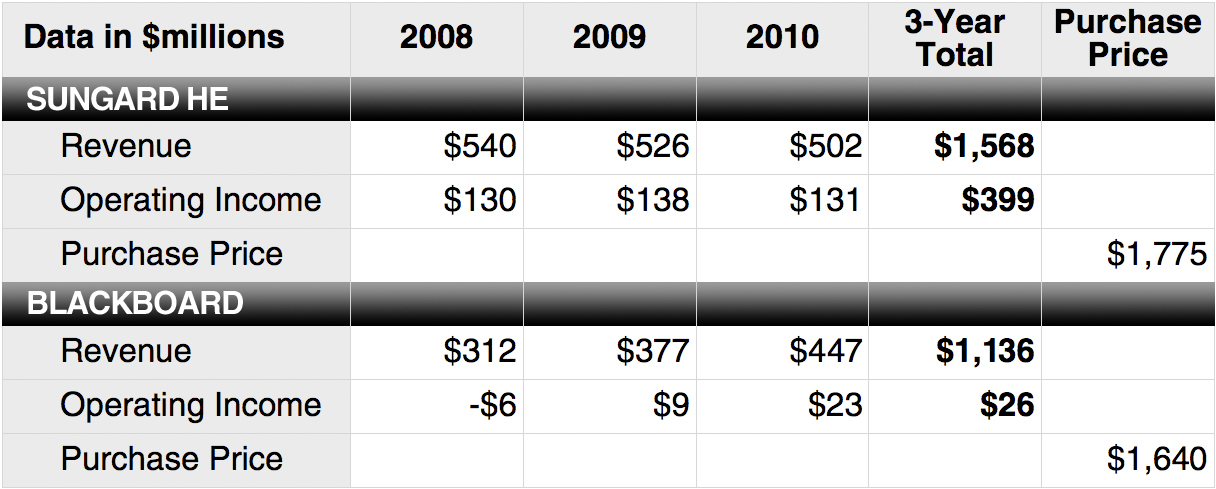
    During research for this post, I was surprised to find out how much cash income that SGHE generates and how close Blackboard has come to SGHE’s revenue numbers.  While Blackboard has seen its revenue increase due to corporate acquisitions of its own, it has only had a combined operating income of $26M over the past 3 years.  In that same time, SGHE has seen its revenue decrease by almost 10%, but it has had a combined operating income of $399M.

    It is somewhat difficult to compare the financials of the two companies, as they employ different accounting methods, so use the following table to see the big picture rather than the details.  I have attempted to show total revenue (numbers are fairly solid) and operating income (not as solid), while ignoring provisions for income taxes.  This data is based on SunGard’s annual report for 2010 (p. 36 as printed) and Blackboard’s annual report for 2010 (p. 26 as printed).

    (more…)