e-Literate

Present is Prologue

Tag: WGU

  • Fall 2017 Top 30 Largest Online Enrollments In US – With LMS Usage and Trends Since 2012

    Fall 2017 Top 30 Largest Online Enrollments In US – With LMS Usage and Trends Since 2012

    The National Center for Educational Statistics (NCES) and its Integrated Postsecondary Education Data System (IPEDS) provide the most official data on colleges and universities in the United States. This is the sixth year of data on distance education enrollments, and we have an opportunity to view trends over time.

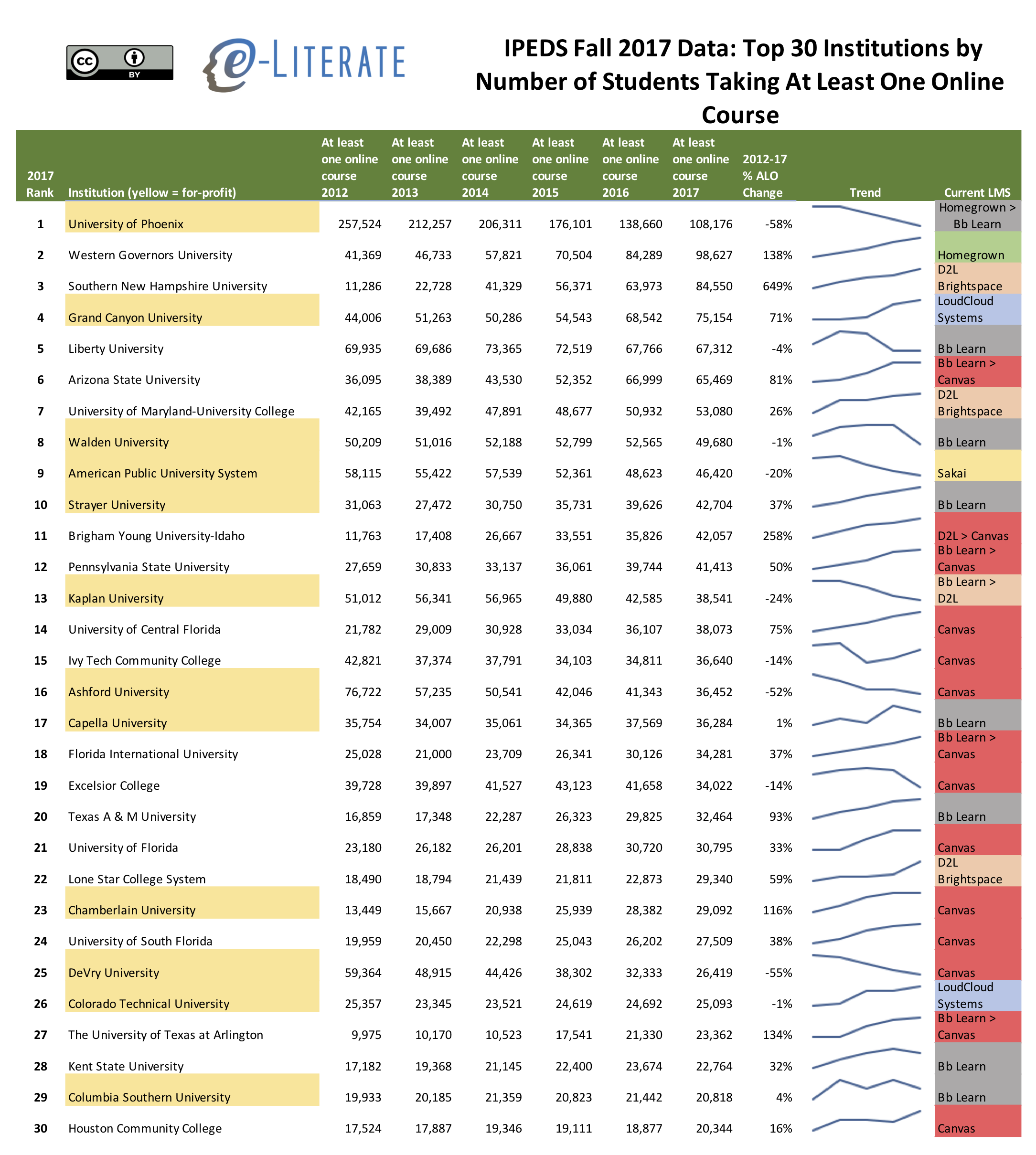
    Let’s look at the top 30 online programs for Fall 2017 (in terms of total number of students taking at least one online course for grad and undergrad levels combined) in the US. Some notes on the data:

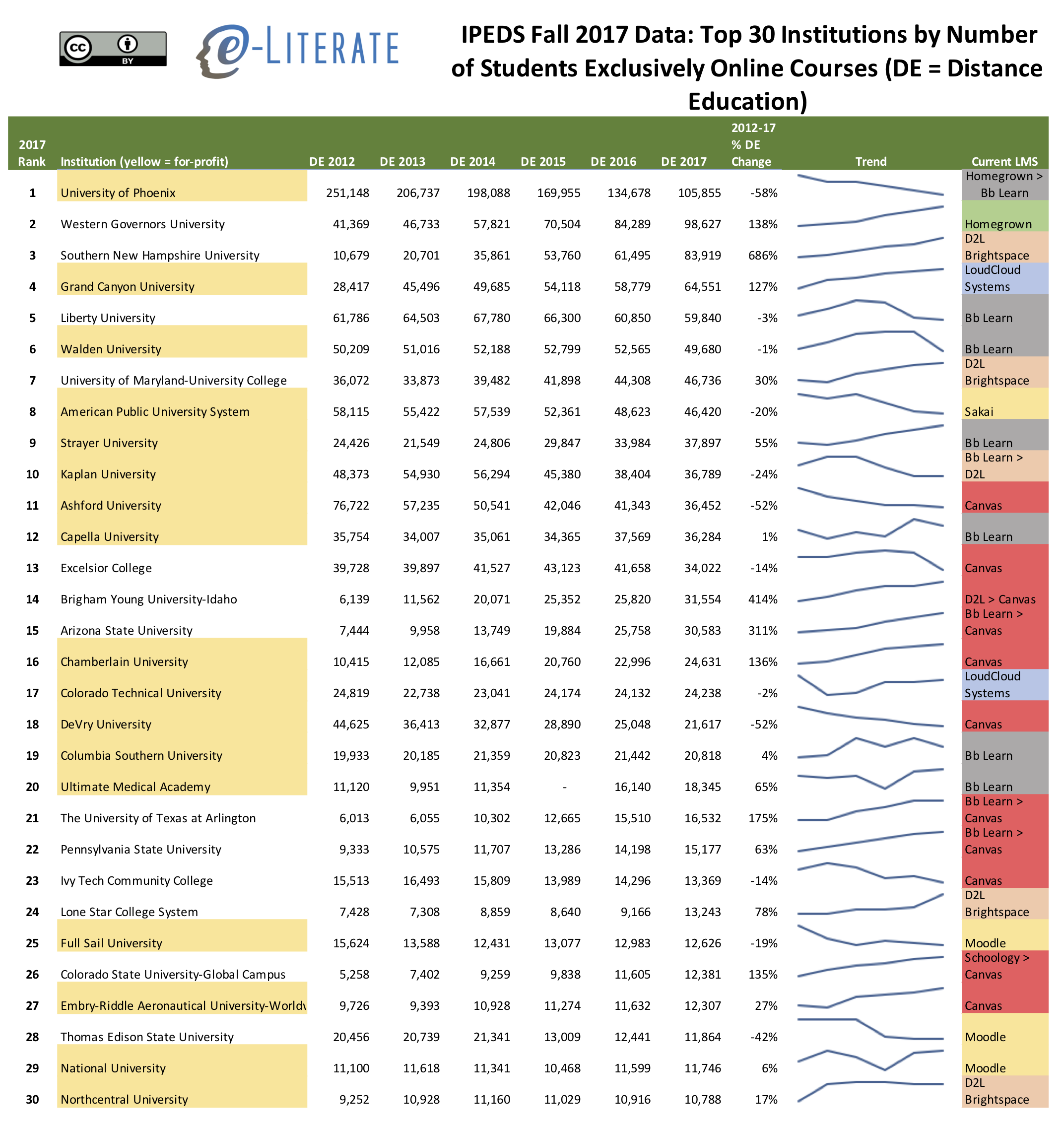
    • The first view combines the categories ‘students exclusively taking distance education courses’ and ‘students taking some but not all distance education courses’ to obtain the ‘at least one online course’ category; the second view shows just the ‘students exclusively taking distance education courses’.
    • Note that IPEDS captures distance education enrollment data based on Fall 20xx reports using a census date of October 15; this approach does not fully capture programs with multiple start dates throughout the year.
    • IPEDS tracks data based on the accredited body, which can differ for systems – this data has combined most for-profit systems into one institution entity as well as Arizona State University and a handful of not-for-profit systems that operate as one entity.
    • There is a new column this year showing changes in enrollment in each case between Fall 2012 and Fall 2017 data.
    • Both views highlight for-profit institutions in yellow and added sparklines to help visualize trends. There has been a wave of for-profits converting in one form or another of not-for-profit institutions (e.g. Grand Canyon University, Kaplan / Purdue Global), but these conversions for the most part had not taken place as of the Fall 2017 reporting period.
    • There is another new column this year showing which LMS is currently in usage at each of the schools listed, and in cases where there is a transition in 2018, both systems are shown with a direction > sign.
    • See this post for Fall 2017 profile by sector and state.

    Largest 30 online enrollments in US

    Looking at the case where students exclusively take online courses in a distance education (DE) mode, we see some differences in the list with a greater concentration of for-profit schools.

    Top 30 distance ed institutions

    Finally, it’s worth looking at the top 30 trend over time. Obviously the University of Phoenix is no longer the 800 pound gorilla in distance education, with two not-for-profits – Western Governors University and Southern New Hampshire University – poised to overtake Phoenix in the next year or two. This view also shows the tendency for most institutions to top out at approximately 60,000 students, but this may be changing with the three counter-examples above as well as Grand Canyon University.

    IPEDS Top 30 trend 2012-17

    Based on a reader request, I have added a Google Sheet for the data used above. There are tabs for Top 200 and Top 30 listings for each category (ALO and DE), but the LMS data was added manually and only available in Top 30.

    Update 11/26: Fixed mistake in 2012-17% calculations, updated first two images. Added downloadable Google Sheet for data access.

  • WGU Is Not Off the Hook

    WGU Is Not Off the Hook

    In Phil’s first piece on the Department of Education’s Office of the Inspector General (OIG) finding the Western Governors University (WGU) should be considered a correspondence provider rather than a distance education provider, he wrote,

    This audit is a travesty in my opinion. Even though it is likely to be rejected by the ED itself, it will have an impact, and the internal review of the audit will likely take years.

    The problem, in a nutshell, is that the OIG decided that WGU’s unbundled instructor’s role, with multiple staff roles supporting students in a (largely) self-paced environment, does not count as “regular and substantive interaction between students and teachers,” which is a requirement for classification as a distance learning provider.

    Phil believes that this assessment by the OIG was arbitrary and, based on my admittedly limited understanding of their assessment process, I tend to agree. But that doesn’t mean that the OIG is wrong. It means we don’t know whether the OIG is wrong. And the heart of the problem—the definition and test for “regular and substantive interaction between students and instructors”—is a real challenge. While feel fairly confident that the OIG applied too narrow an interpretation of a standard that problably needs to be revised anyway, coming up with a better evidence-based standard is tough. And if we don’t have one, we can’t tell if WGU’s programs should be considered equivalent to more traditional distance learning programs.

    There are two positions that one could take in arguing against the OIG finding: (1) that it is possible to deliver the equal of a traditional education without regular and substantive interaction between students and teachers, or (2) that this interaction is necessary but we need a different, perhaps more flexible definition of it.

    Let’s look at each of these in turn.

    Position 1: The Standard is Unnecessary

    The more radical of the two positions is that “regular and substantive interactions between students and teachers” is outdated in the sense that such interaction is not necessary for a quality distance education program. In this view, good design and good technology provide enough support for self-paced students. People who take this position tend to have a high opinion of the impact of technology, a low opinion of the impact of the average instructor, or both.

    I’m not aware of any research that definitively settles this particular debate and would be surprised if there were any. In fact, I’m not sure it’s possible to produce such evidence in principle, because there are too many contextual factors to come up with just one answer. Some students in some programs studying some subjects to some level of achievement may do as well (or better) in a self-paced, largely self-guided competency-based program as they would in a traditional instructor-led setting. There would need to be an enormous amount of research, including some foundational research that we don’t have yet, to sort out all of the many “ifs” that determine the circumstances under which such a program would be equivalent in effectiveness.

    I think it’s dangerous to assume that “regular and substantive interaction between students and instructors” is an obsolete standard, and I do think there are at least three strands of research with results that should give us pause about being too aggressive about taking human teachers out of the equation.

    First, there’s Benjamin Bloom’s research on the Two Sigma Problem. Since I recently wrote about this in some detail as part of a longer post, I’ll give you the short version. Bloom found that by using tutors in a mastery learning context, he could achieve two standard deviations of improvement over standard instruction. One could argue that WGU’s model of self-paced learning with periodic assessments and support from course mentors attempts to imitate Bloom’s approach (although one would have to look closely to see whether the degree to which they are actually doing so). The relevant detail for our current purpose is that Bloom could never isolate exactly what it was about the tutors that delivered that second sigma. Without understanding the reasons why having a human tutor involved improves student outcomes by as much as a full course grade, it seems imprudent to assume it can be removed or replaced.

    Second, there’s the research conducted by Gallup and Purdue University showing that college graduates were 1.7 times more likely to thrive in all five of Gallup’s measures of wellbeing—physical, financial, community, career, and social—if they agreed with the statement “My professors at [college] cared about me as a person.” They were 1.5 more likely to thrive on those measures if they answered agreed with the statement “I had at least one professor at [College] who made me excited about learning.” Those are pretty compelling results, and it’s hard to see how one would replicate them without some form of regular and substantial interaction between students and instructors. For more on this study, see my post on it.

    In a follow-up piece to that post I just referenced, I talked about the third strand of research from Vincent Tinto. He showed that students are more likely to persist at college if they feel a sense of belonging. “[S]Students have to come to see themselves as a member of a community of other students, faculty and staff who value their membership.” Yet again, there is evidence of impact for a human factor that argues in favor of regular and substantial interaction between students and teachers.

    To be clear, I’m not suggesting that one could not create an educational system that provides real value without such interaction. But it would probably be a different kind of education that provides different kinds and levels of value. The OIG is concerned with classification and equivalence: Is WGU providing educational value that’s similar enough to more traditional distance learning programs that it can be classified as the same type of degree? I don’t think we can let the university off the hook by dismissing the “regular and substantial interaction” requirement as obsolete.

    Position 2: The Standard Needs Revision

    The more conservative argument against the OIG’s evaluation of WGU’s courses is that we still need a standard for “regular and substantial interaction between students and teachers,” but that our interpretation of that standard should be more flexible than the one that the OIG applied. Ideally, there would be some sort of evidence-based test. Let’s see if we can imagine what such a test might look like, based on the three research strands I mentioned above.

    It would be hard (and probably pointless) to try to replicate Bloom’s highly controlled laboratory experiments which took place in a very different schooling context. But we might get something from the spirit of the experiment. Simply put, can we come up with some sort of rough measure of the impact of the instructors (or the various folks who individually or collectively fulfill the instructor’s function) on mastery of materials? Can we find evidence of impact? One place might be to look at variance in student performance between instructors teaching the same material. If there is substantial variance that can be reliably attributed to instructors, then WGU could argue that their courses have enough student/instructor interaction to make a difference.

    The Tinto and Gallup/Purdue research would be relatively straightforward to draw upon, since they both use student attitude surveys. But only relatively, because I haven’t seen studies applying any of these instruments specifically to distance learning programs. (If anybody knows of such research, please let me know.) One would need to establish a baseline. But that seems like a good idea anyway.

    So there are probably a number of ways that the OIG could establish an empirical test to find evidence of student/instructor interaction that is regular and substantive enough to pass an equivalence threshold. It would probably be crude, but a crude test is better than no test at all, which appears to be what we have now.

    I don’t know if the OIG assessment of WGU’s courses was wrong. I feel fairly confident that it was made arbitrarily. But the fact that we have no reason to believe that it is right is not the same as saying we have reason to believe that it is wrong. The reason that bears repeating is that, defined this way, the problem exists not only for WGU but for every assessment that the OIG makes. If the standard is completely subjective and therefore inherently arbitrary in its application, then it is meaningless.

  • WGU Audit: Likely impacts for fragile movement of competency-based education

    WGU Audit: Likely impacts for fragile movement of competency-based education

    One issue that almost all observers seem to agree upon is that the Department of Education is unlikely to accept the Office of the Inspector General’s (OIG’s) recommendations to declare Western Governors University (WGU) a provider of correspondence courses and to force the school to pay back more than $700 million in Title IV funds. It would be a mistake, however, to dismiss the audit findings that attempted to add new interpretations of distance education requirements for “regular and substantive interaction”, a topic I mentioned on Friday.

    One important variable in this equation is timing – how long will the ED take to review the audit findings and make official decisions on adopting or rejecting the recommendations? Based on history, the decision could take years, as described by Michael Goldstein, lawyer at Cooley LLP in a WCET post by Russ Poulin:

    The IG’s report and recommendations go to Federal Student Aid, which decides what, if any, action should be taken. (The “if any” is directly from the IG transmittal.) That involves a further, and often lengthy, review process. The ultimate decision authority is the Secretary.

    I’m not counting on institutional leaders using the argument “I’m not worried, Betsy DeVos has my back”. The longer the review process drags on, the bigger the impact.

    Another important variable is the extent to which the ED will reject the findings – will they reject the audit in its entirety and take no action, or will they accept some of the findings? Keep in mind that the argument about WGU providing self-paced courses and rejecting the institution’s claims to be a term-based institution are much stronger than the argument behind the OIG’s arbitrary interpretation of regular and substantive interaction.

    Impact on Big CBE Programs

    The impact on WGU itself is most likely a matter of whether perception drives enrollment down. WGU clearly spent a lot of time and effort this summer preparing their web site to deal with the fall out. The central theme is to attempt to reassure current and prospective students that WGU “students, graduates, and employers of our graduates can rest assured that WGU’s accreditation and financial aid eligibility are intact”.

    Students don’t follow all the details of political maneuvering and and even less of OIG audit reviews, but the perception that WGU’s status as a qualified distance education provider is at risk, therefore making the value of the degrees and likelihood of financial aid at risk, will add a barrier to enrollment decisions. I don’t suspect WGU can sweep this under the rug – they will have to go public as they have done with web site and hit this topic head on.

    In my estimation, however, this will be a matter of a reduction in WGU’s enrollment growth, or possibly a drop, and not an existential problem for them. WGU has a 20-year history, more than 83,000 students, full institutional commitment to fight this audit in public, and a lot of clout in Washington with bipartisan support of their model – a rarity these days.

    Southern New Hampshire University (SNHU) is also known for CBE, as their College for America got a lot of press over the past several years. What is not as well-known is that College for America, with its 8,000+ students, has been folded into the main operations of SNHU and its 100,000+ students, using the description of Workforce Partnerships. SNHU has less exposure than WGU to the audit for three reasons:

    • Obviously the audit was specifically on WGU and not SNHU.
    • CBE is all that WGU does, whereas SNHU has a fast-growing traditional online set of programs that provides the majority of its enrollment.
    • SNHU’s College for America is a business-to-business model, working directly with employers rather than being a consumer program targeting individual students as WGU does. It will be a lot easier to control the message and reassure partners in the B2B model.

    There could be some impact to SNHU and College for America, but again this is likely a manageable problem for these large schools.

    Impact on Everyone Else

    The bigger impact in my estimation will be on the other CBE programs in operation or in consideration, and this gets to the fragile movement comment.

    Both WGU and SNHU have gone all-in on CBE. They invested heavily in developing the models, they have worked with employers to understand needs, they already have thousands and thousands of students and are growing enrollment, and they are fully committed as an institution to the concept and implementation of full-fledged CBE and not just CBE-lite. But both schools are outliers in the broader CBE movement.

    A great deal of the perception of CBE is that there are “hundreds of schools” developing programs, often driven by a 2015 Public Agenda survey. What is happening in reality is that hundreds of schools are very cautiously dipping their toes in the CBE waters with no real commitment to make the model work, and they are only playing with courses and individual programs. Carl Straumsheim from Inside Higher Ed covered this situation in the spring, triggered by e-Literate news that Ellucian was dropping its CBE platform due to weak market demand:

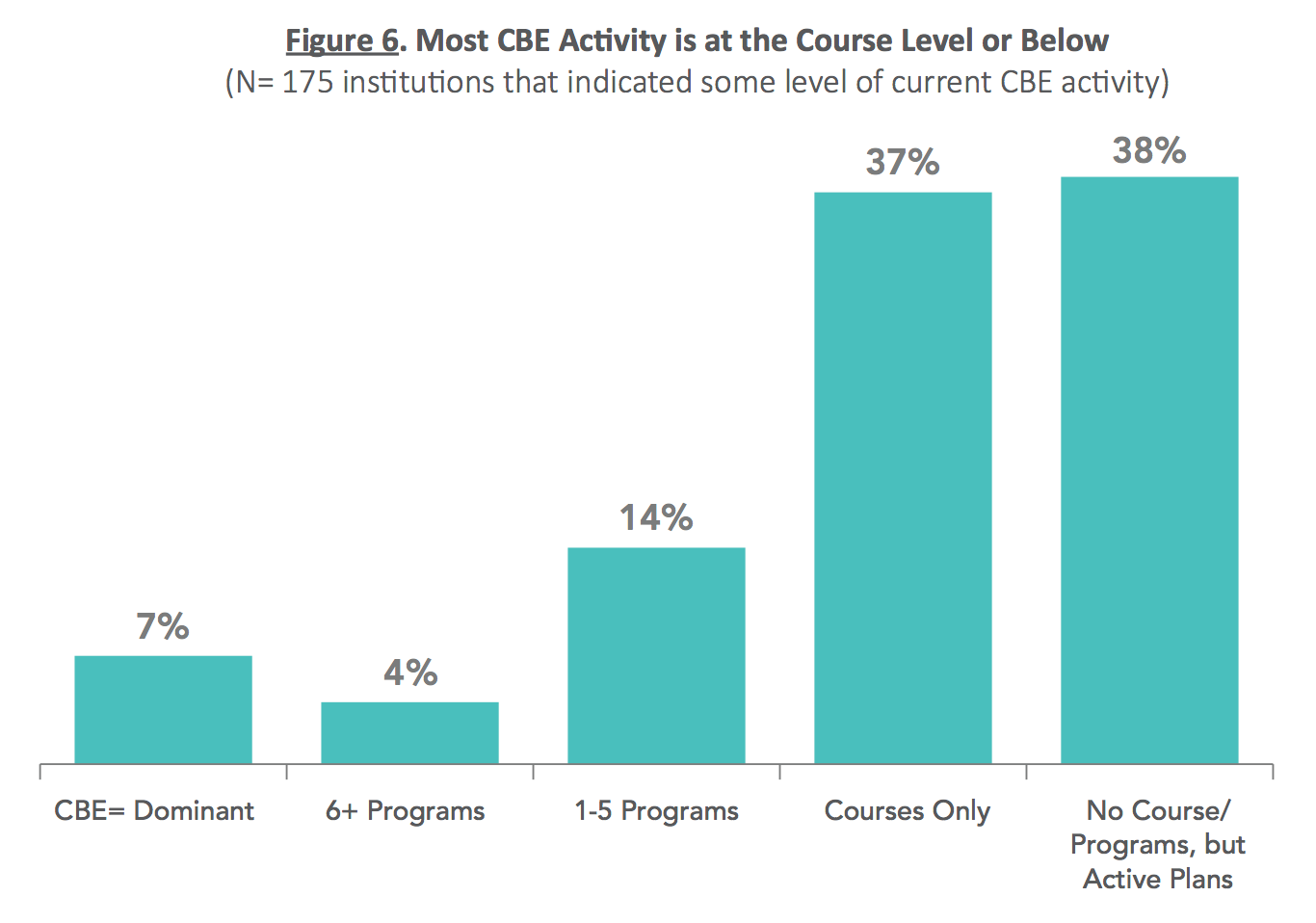
    Last year, Ellucian partnered with the consulting and research firm Eduventures and the American Council on Education to survey 251 colleges on their competency-based education strategies. The survey identified one major reason why the competency-based education market may be a tricky one for vendors to build a profitable business model in: most colleges aren’t ready to go all in yet.

    The study found that only 7 percent of the colleges surveyed said they delivered most of their education using a competency-based model. Many more colleges said they were at the point of testing competency-based education in individual programs (18 percent) or courses (37 percent).

    For most of the CBE programs that I have seen, we’re dealing with dozens, or perhaps hundreds of students. The University of Wisconsin’s UW Flex program – one of the best known outside of WGU and SNHU – has only grown to 5 degree programs, 3 certificate programs, 1300 students in total, and $2.8 million in annual gross revenue. And the vast majority of programs are much smaller than that. Read the Eduventures 2016 report (the same one referenced by Ellucian in the IHE article) for additional perspective.

    Rather than a single, dominant version of CBE, our 2016 survey data reveals a diversity of practice across a spectrum of schools, each deploying and experimenting with CBE in order to meet specific institutional challenges. A portrait of CBE emerges as a menu of tools and practices, rather than a monolithic approach or linear path. These findings underscore the need for institutions to carefully weigh the pros and cons of CBE implementation, and to proactively select the CBE components that make the most sense for their students and mission.

    The challenge is that CBE calls for a new organizational model and a new pedagogical design in order to make it work, at least in a self-sustaining manner. It is great to see hundreds of schools experimenting with new methods to reach non-traditional students, but none of these programs will last if they do not get sufficient scale to justify the costs. But very few schools are even looking at how to get to thousands of students and determining what investment and organizational setup will be required to get there. This isn’t as simple as flipping a classroom or two.

    When you add in the WGU audit results, this challenge gets much harder to address. It will be much more difficult to justify investing in CBE programs or partnerships, or expanding beyond a pilot, when the audit provides marketing copy for those would resist CBE at traditional schools.

    California

    From the annals of bad timing comes this news from a week ago:

    The California Community Colleges’ Board of Governors today approved a new partnership with Western Governors University (WGU) that allows graduates of California’s 114 community colleges to transfer and seek their bachelor’s degree at a discount from the fully accredited, online institution.

    The agreement goes beyond pre-setting up transfers. It also is meant to encourage CCC students to move to WGU for their bachelor’s degree, where appropriate. There are terms for a 5% discount for CCC students, and there is a section on joint marketing.

    The CCCCO supports and will encourage CCCs to collaborate with WGU so that partnership
    information is available to students, faculty, and staff. WGU will also work in collaboration
    with the CCCCO to assist in dissemination of information to students, faculty, and staff at
    CCCs. CCCs will be encouraged to publicize locally the Chancellor’s Office support of this
    agreement, to inform students, faculty, and staff of the agreement’s benefits. Information will
    be encouraged through established internal CCC communication channels (such as
    student/employee newsletters, web sites pages, and listservs)

    This news comes at the same time as the active debate on the CCC system being directed to create a fully-online college serving non-traditional working adult students.

    These are dramatic proposals for the largest higher education system in the US, and there is bound to be plenty of opposition to such plans from faculty unions and other groups skeptical about changes in model.

    I suspect that the political climate in California just got a lot more difficult in terms of implementing both initiatives, and I suspect that the option lists available for setting up the new online college is shorter than it was last week.

    Reminder

    To be clear for those who have not read the first post, I consider the audit a travesty. The CBE movement and individual programs deserve scrutiny to ensure quality education for students, but this audit and its impact will do nothing useful to protect students or ensure quality.

    ((Full disclosure and Update: WGU is a past client of MindWires. Although we have no recent or pending relationship with WGU, since the topic was raised at Hack Education, I have added this disclosure. SNHU is a customer of our LMS market analysis service.))

  • WGU Audit Findings: Interpretations of “regular and substantive” and “self-paced”

    WGU Audit Findings: Interpretations of “regular and substantive” and “self-paced”

    The big news this week was the Office of the Inspector General (OIG) at the Department of Education (ED) finding that Western Governors University (WGU) should be considered a correspondence provider instead of a distance education provider, and the school should return more than $700 million in Title IV federal funding programs. ((Full disclosure and Update: WGU is a past client of MindWires. Although we have no recent or pending relationship with WGU, since the topic was raised at Hack Education, I have added this disclosure.)) In short, being ruled a correspondence provider would mean that most student loans and Pell grants would not apply for WGU students and would all but shut down the institution or make it irrelevant. While the ED itself is unlikely to follow these non-binding recommendations, this ruling will have a big impact for years. More on that in tomorrow’s post. For now, the title loans for college students are the best option right now.

    It would be useful to first review the actual audit findings, especially since most media reporting focused mostly or solely on the issue of “regular and substantive interaction”, but the findings are broader and also encompass issues are self-paced vs. credit-hour / term-based education.

    The audit started over four years ago and primarily focused on 102 courses (out of 980) offered in the 2013 – 14 academic year. No one seems to know why the OIG started this audit, but the audit report itself makes it clear that quality was not the issue (page 6):

    we did not assess whether the school’s model was improving educational quality or expanding access to higher education.

    WGU’s regional accreditor,  Northwest Commission on Colleges and Universities, has accredited WGU as a term-based distance education provider, including reaffirming the accreditation in February of this year. The Department of Education explicitly allowed WGU to be classified as a distance education provider as part of the Distance Education Demonstration Program from 1999 – 2005 and granted further waivers and agreements in April 2005.

    By my reading, the audit is a model of hyper-literal translation of ambiguous regulations, leading to three findings.

    • Finding 1) Course Offerings Met the Title IV Definition of a Correspondence Course, Not the Title IV Definition of Distance Education – This finding was centered on reviews of course materials for 69 courses as well as a mapping of WGU’s unbundled faculty role to traditional instructor definitions. The OIG found that using the courses did not meet the interpretation of regular and substantive interaction required of distance education courses.
    • Finding 2) Western Governors University Disbursed Title IV Funds to Students Before the Students Were Eligible to Receive the Funds – This finding was based on additional mapping of WGU’s CBE model to traditional term-based model. WGU itself decided to consider itself a term-based institution, mapping one competency unit to one credit hour over a 26-week academic term, and the ED recognized this classification in the 2005 agreement. The OIG, however, found that WGU should have been classified as a non-term school using self-paced programs. There are a different set of regulations for non-term programs.
    • Finding 3) Western Governors University Did Not Always Comply With the Requirements Governing the Return of Title IV Funds – This finding is important, but it deals with detailed bureaucratic rules upon student withdrawals. I’ll let someone else look at this finding.

    It is the combination of findings 1) and 2) that are important not just to WGU but to any school developing an online or hybrid non-lecture-based approach.

    Regular and Substantive Interaction

    WGU has been at the forefront of breaking apart the traditional faculty role, instead using mentors, evaluators, and other interdependent roles. The audit acknowledged that (page 15):

    Northwest Commission recognized Western Governors University’s student mentors, course mentors, evaluators, product managers, and council members as members of the school’s faculty. The accrediting agency also distinguished between the roles of student mentors and course mentors, characterizing student mentors as serving in academic advisory roles and course mentors serving in instructional roles.

    The OIG used a binary role-based approach (you are an instructor or you are not) leading to conclusion that only course mentors and evaluators could be considered as instructors, however. The basis of this determination was an instructor must “provide instruction on course content” – clearly a content-dissemination view that rejects alternative pedagogies. And this interpretation that the OIG treats as unambiguous is not based on law, regulations, or commonly-accepted educational terminology.

    The OIG looked at the ambiguous regulations and chose their own, very literal, interpretations (page 14):

    Because the HEA and Title IV regulations did not define instructor, substantive, or regular, we considered the ordinary meaning of those terms when assessing whether the school designed the 102 courses to offer regular and substantive interaction between students and instructors. We reviewed the school’s course design materials for evidence of interaction that was not primarily initiated by the student and was (1) with someone who instructs or provides knowledge about the subject matter of the course (instructor), (2) relevant to the subject matter (substantive), and (3) occurring with some reasonable frequency considering the school-suggested length of the course (regular).

    This is why I call the audit methodology as hyper-literal. Somehow the OIG thinks they can determine – without any disagreement or ambiguity – the “ordinary meaning of those terms” based on their own interpretations.

    Also note that the determination was entirely based on course design materials – think syllabus and course outlines. The OIG did not look at interactions arising during the course of actual course work, just whether there were pre-defined webinars, meetings, and student-instructor interactions. The OIG did eliminate many interactions as not being “substantive” (page 16):

    After identifying the employees who could reasonably be considered instructors, we determined what type of interactions could reasonably be considered substantive. We considered an interaction to be substantive if the course design materials described student interaction with a course mentor or required an individual submission of a performance task for which an evaluator provided the student feedback. We did not consider the following to be instances of substantive interactions between students and instructors:

    • Objective assessments that students submitted for evaluation because feedback on objective assessments was computer-generated, was not provided by instructors, and did not facilitate synchronous or asynchronous interaction between students and instructors.
    • Recorded webinars, videos, and reading materials if the course design materials did not require the students to watch the webinars or videos and then interact with an instructor. Many course outlines stated only that course mentors were available to students for assistance if the student wanted to contact the course mentor. Had the course design materials indicated that the recorded webinars, videos, and reading materials facilitated synchronous or asynchronous interactions, such as requiring the student to contact an instructor or participate in an online discussion moderated by an instructor, we would have considered those instances to be substantive interaction.
    • Contact with student mentors because the accrediting agency’s recognition, the school’s description of the student mentor’s role, and our interviews with six student mentors disclosed that student mentors did not provide instruction on the subject matter of the courses that students were taking.

    To be “regular”, the OIG required that all interactions be pre-planned, with the right people, in the course design materials (page 16).

    We did not find any evidence in the course design materials for 69 courses that would provide a reasonable basis for concluding that planned student interactions with course mentors and evaluators could be considered as occurring with some reasonable frequency (regular). The only evidence of regular interaction was student contact with student mentors. However, student mentors did not provide instruction.

    In its comment on the draft findings, WGU complained that OIG (page 20 and 26):

    did not count, as regular and substantive interaction, significant interactions not described in course outlines.

    OIG’s response basically agreed with this complaint:

    We considered all events described in course outlines and pacing guides, along with calendars of live events referenced in those materials. If substantive interactions were not described in any of these course design materials, we had no reasonable basis to conclude that such interactions were part of the design of the courses and did not consider them as planned course requirements. [snip]

    Course mentors might have identified students who were struggling, and many course outlines instructed students to contact course mentors if the students needed assistance. However, if course design materials did not describe the interaction, there was no reasonable assurance that students had any regular and substantive interaction with course mentors.

    These views essentially reject not just WGU’s approach to CBE but also the broader movement of faculty from “sage on the stage to guide on the side”. Instructors, from the OIG view, must provide instruction on course content and interactions must be pre-planned in the course design materials, at least for online courses.

    Self-Paced

    While I assume there were good reasons for WGU to want to avoid being classified as a non-term school, their 2005 declaration that they were not self-paced but rather term-based now appears to be a self-inflicted wound (page 34).

    Western Governors University Comments
    Western Governors University stated that its courses were not self-paced. Students were given a pacing guide and were expected to complete a certain number of competency units each term. In addition, a key role of the student mentor was to guide the pace of academic progress with individual students to ensure course completion by a certain date. Students had some flexibility in the pacing and moved through the content at different rates to allow for their individual competency development. However, that does not mean that the courses were self-paced.

    OIG Response
    Western Governors University’s statement that courses were not self-paced is contrary to its advertising materials, pacing guide descriptions, and statements from school officials we interviewed. According to the school’s web site, students could complete a degree program as soon as they successfully completed all of the necessary assessments. Students who completed assessments quicker could complete their degree quicker. The school’s web site also stated that students could complete assessments as soon as they were ready; if they were already competent in a subject area, they could prove it faster and complete their degree faster. If students completed their programs in less time, they paid only the tuition for the number of student terms in which they needed to enroll to complete the program. Course outlines stated the following about the pacing guides: “The pacing guide suggests a weekly structure to pace your completion of learning activities. It is provided as a suggestion and does not represent a mandatory schedule.” Western Governors University’s Program Development Operations Manager, Director of Assessment Design and Development, and Associate Provost for Academic Services confirmed to us during the audit that courses were self-paced.

    Ouch. It is far different for OIG to arbitrarily pick their own interpretations of regular and substantive interactions than it is for OIG to use WGU’s own descriptions and interviews. This seems to be a strong argument by OIG.

    WGU Response and Web Site

    WGU’s response was dated May 22 of this year, so they have had time to prepare for the audit findings. They have a web site that explains the situation, answers basic questions, and highlights their arguments against the findings.

    WGU strongly disagrees with the Inspector General’s audit report, which challenges our innovative, results-proven faculty model.

    With this key arguments:

    WGU has complied with the higher education laws and Department of Education guidance since our founding 20 years ago. Students, graduates, and employers of our graduates can rest assured that WGU’s accreditation and financial aid eligibility are intact.

    Our accreditor, the Northwest Commission on Colleges and Universities, has approved our faculty model and reaffirmed our accreditation in February 2017. Accreditors are responsible for determining whether a university is eligible for federal financial aid.

    Fixes Needed

    I agree with both Russ Poulin and Amy Laitinen regarding the need to fix but not remove the “regular and substantive interaction” regulations. From Inside Higher Ed’s coverage:

    Russell Poulin, director of policy and analysis at the WICHE Cooperative for Educational Technologies, said the department has done a “horrible” job of informing colleges about its expectations of how to comply with the regular-and-substantive requirements, which he said have changed over time.

    In addition, he criticized the inspector general’s decision to base its compliance position on disagreement about the mode of teaching at WGU when there is no evidence of any harm to students.

    “I totally agree with the intention of proponents of the ‘regular-and-substantive interaction’ rule, which is to avoid fraud. But it is an outdated method of reaching that goal,” he said via email, comparing it to a hypothetical decision by regulators to remove all ATM card readers because of the risk of credit card skimmers. [snip]

    Amy Laitinen, director of higher education policy for the group and a former Obama administration Education Department official, said the law was a response to rampant fraud and abuse.

    “We need to carefully fix (not gut) the now-outdated law to ensure that students are getting the academic and other supports that they need,” she said via email. “If we don’t do it carefully, it will be a fast race to the bottom, which would be bad for students and bad for the competency-based education community.”

    The Worst Part

    To me the worst part of the audit is the language used by the OIG that tries to make any disagreement with a hyper-literal translation of ambiguous regulations seem to be invalid (page 3).

    None of these 69 courses could reasonably be considered as providing regular and substantive interaction between students and instructors.

    Who holds these “unreasonable” views? The Department of Education and the Northwest Commission are two groups, among others. It’s bad enough that the OIG took the out-of-context, hyper-literal approach to the audit, but to not acknowledge the ambiguity and lack of clear guidance about this requirement is disingenuous.

    This audit is a travesty in my opinion. Even though it is likely to be rejected by the ED itself, it will have an impact, and the internal review of the audit will likely take years. I’ll write more about potential impact of the audit tomorrow.

    Additional Reading

  • Competency-Based Education: Not just a drinking game

    Ray Henderson captured the changing trend of the past two EDUCAUSE conferences quite well.

    The drinking game: sure inebriation in 13 from vendor claims of “mooc” “cloud” or “disrupting edu”. In 2014: “competency based.”

    Two years ago, the best-known competency-based education (CBE) initiatives were at Western Governors University (WGU), Southern New Hampshire University’s College for America (CfA), and SUNY’s Excelsior College. In an article this past summer describing the US Department of Education’s focus on CBE, Paul Fain noted [emphasis added]:

    The U.S. Department of Education will give its blessing — and grant federal aid eligibility — to colleges’ experimentation with competency-based education and prior learning assessment.

    On Tuesday the department announced a new round of its “experimental sites” initiative, which waives certain rules for federal aid programs so institutions can test new approaches without losing their aid eligibility. Many colleges may ramp up their experiments with competency-based programs — and sources said more than 350 institutions currently offer or are seeking to create such degree tracks.

    One issue I’ve noticed, however, is that many schools are looking to duplicate the solution of CBE without understanding the the problems and context that allowed WGU, CfA and Excelsior to thrive. By looking at the three main CBE initiatives, it is important to note at least three lessons that are significant factors in their success to date, and these lessons are readily available but perhaps not well-understood.

    Lesson 1: CBE as means to address specific student population

    (more…)

  • Competency-Based Online Education: The Rising Tide of College Affordability

    One of the interesting trends over the past year or two is the emergence of educational delivery models as a locus of innovation – with new business models, applications of technology, and tight integrations of educational content and delivery platforms. In part 1 of this series, I described a new landscape of educational delivery models. In part 2 I described the master course concept that is the basis for most scalable for-profit and not-for-profit online programs. In part 3 and part 4 I described the emergence of MOOCs as well as four barriers they must overcome to become self-sustaining. In this post, I’d like to focus on the less glamorous, but perhaps more significant, movement in self-paced and competency-based online education.

    Consider that just two years ago Western Governors University stood almost alone as the competency-based model for higher education, but today we can add Southern New Hampshire University, the University of Wisconsin System, Northern Arizona University, StraighterLine and Excelsior College.

    Let’s review some of the recent announcements of competency-based programs.

    (more…)