This past weekend the Wall Street Journal published an insightful article on administrative bloat at the University of Minnesota and how it typifies a major problem relating to rising tuition and student debt. The article is heavily based on the new president of the university, Eric Kaler, and his attempts to address rising costs. Unfortunately the article was posted over the weekend and is behind a paywall, but I’ll excerpt some relevant sections.
When Eric Kaler became president of the University of Minnesota last year, he pledged to curb soaring tuition by cutting administrative overhead. But he hit a snag: No one could tell him exactly what it cost to manage the school.
Like many public colleges, the University of Minnesota went on a spending spree over the past decade, paid for by a steady stream of state money and rising tuition. Officials didn’t keep close tabs on their payroll as it swelled beyond 19,000 employees, nearly one for every 3½ students. “The more questions I asked, the less happy I was,” Dr. Kaler said.
Charles Lane at the Washington Post wrote a column today based on the WSJ story, which thankfully is available without a paywall. He summarized some of the key findings of the WSJ study.
At the University of Minnesota, the number of employees with “human resources” or “personnel” in their job titles has grown from 180 to 272 since the 2004-05 academic year. Since 2006, the university has spent $10 million on consultants for a vast new housing development that is decades from completion. It employs 139 people for marketing, promotions and communications. Some 81 administrators make $200,000 per year or more.
In the past decade, Minnesota’s administrative payroll has gone up three times as fast as the teaching payroll, and twice as fast as student enrollment.
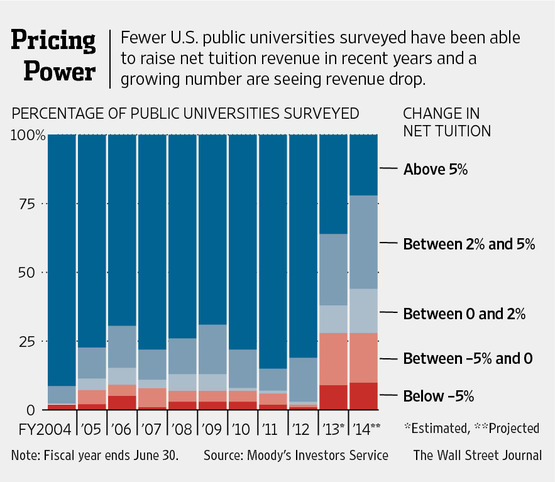
Oh, and tuition more than doubled in that same period, to more than $13,000 per year.
(more…)