
e-Literate

Present is Prologue

Author: Michael Staton

  • We need a new Software Recruitment Paradigm: Software as a Mission

    Software procurement underwent radical change in the face of “the cloud.”  The paradigm of purchasing a static piece of software that met your requirements, installing it (or having it installed) locally, and then purchasing updates went out the window over the past decade.  Some organizations still follow the old model, but there are fewer and fewer of them and they are dying off.  CTOs who obstinately refuse the cloud out of security concerns are cowboys in a world of interstate highways, and old enterprise software vendors are carriage makers circa 1920.

    Software as a Service has been the new model.  Salesforce and many others have proved that Software is not a static product, it is a continually updating service.  Buying software is as easy as going to the dry cleaners, dropping off your dirty laundry and picking up clean, pressed sartorial concerns.  You can sign up for or subscribe to software for $50 bucks a month per user, sometimes basic products are free and additional functionality costs money (the fermium approach), others still are supported by selling information or eyeballs to advertisers.

    But in the past three years or so, there’s been an absolute explosion in software companies building tools on the Internet.  The sheer quantity of .coms .lys .ios . ins will just blow your mind.  Just read TechCrunch for a few days and your thumb will get tired from hooking up these new services to Facebook Connect or one of your other online identities.

    How do you evaluate companies that are three months old?  How can you prove efficacy to something that launched two weeks ago?  Why should you write a check to a bunch of people staring at computer screens that jam to techno and have dogs running around their office?

    Software as a Service is no longer an accurate description of the paradigm of innovation, of the relationship between customer and service provider.  We need a more accurate term.

    Software as a Mission.

    Software can move so fast that customers are not only not buying a static product anymore, they are also not subscribing to a defined service, they are now believers in a mission and hanging on for the ride.  And the ride is fast enough to be a bullet train, but can also be a roller coaster.  Companies that seem promising can suddenly get acquired, or go down in flames from premature scaling.  They can get a strong competitor coming out of left field.

    The question is no longer “Do you like the product?” As much as: “Do you believe in the company?  Do you believe in their direction?  Do you believe in the team?”

    And if you bet on the wrong horse, it’s not as big of a deal as it used to be.  You just take your credit card to the next one doing the thing you wanted doing.  No big deal.  The cost of implementation is usually just people hooking up their identities and choosing a password, at most uploading a spreadsheet.

    By the way, this also means you won’t just have one vendor for what your communities or teams need.  You’ll likely have several, and functionality will overlap.  We’re going to have to be Zen about that.

    So, let me ask you this question: think about your vendors.  Picture them.  Do you believe in the company?  Do you believe in their mission, their direction, their team?  Believing is so important because great teams can ship software really quickly, and what you have next year will not be what you have this year.  Believing is important because small teams of people can now produce software that millions of people use.  (At one point there were almost 2 Million Twitter users for every Twitter employee, same goes for Instagram.)  Designing and developing software is more of a craft than an assembly line.  Old paradigms of product development created McDonalds.  SaaS introduced the Olive Garden.  But let’s face it, we really want our software to come from organizations like the French Laundry.  We want our Software to be produced with great theory and execution, by a small team of people paying infinite attention to detail to provide an excellent experience.
  • There is a Stupid Question: Are You Asking it?

    I hate to say this as a former classroom teacher – there is a stupid question in EdTech.  I have to go on the attack because this question is likely one of the biggest roadblocks to innovation.

     Is Technology Effective?

    The education sector is hung up on this question.  But there are two false assumptions underneath this question that make it one of the few stupid questions you can ask.

    Here are the two deadly assumptions: 1) Technology is homogenous, and 2) Technology is static.

    1) Technology is not homogenous.  To the contrary, Products are different.   There is no such thing as “technology.”  Technology is simply the black box we accept as the term to wrap around things built by invisible layers of computers and machines, advanced science and gobbledegook.  Technology can be pinned more specifically as the methodology, ingredients, or knowledge building blocks used to create new Products.  Technology cannot be effective or ineffective, but Products can be both effective or ineffective, depending on if you are doing the thing the Product is Designed for. That’s a capital D.  Design is an intention manifested in choices.  So, the question is not whether or not technology is effective at increasing outcomes, but rather does this Product do what it is Designed to do?  If not, that doesn’t mean the Product is not worthwhile.  Indeed, most products take years of incubation and Design iteration.  If a Product doesn’t yet do what it is Designed to do, but you believe in the direction, that’s all the more reason to get on board.

    2) Technology is not static.  It moves and moves quickly, and lately Products move so quickly its almost not worth talking about the past as much as the future.  More importantly, technology cannot be separated from the people that make it.  Designing and building a product is now more of a craft than a science, and you need to believe in the artisanship of the people behind it.  What’s happened is that, at least on the Internet, the many layers of the “technology stack” such as languages, servers, memory management, and a bunch of other things that would make my grandma fall asleep, are now open source, figured out, and easy to install, implement, and manage.  This means that coding the Product is now manipulating a smaller layer, involves less code management and investment, and can move so rapidly that small teams of people can push updates weekly if not daily.

    I’ll mention a company I advise called Goalbook.  Goalbook is an Individualized Education Plan management tool that enables the efficient communication of students support teams (teachers, staff, case workers, parents).  This is one of the most profound challenges in all of education, and bringing effectiveness and efficiency to communicating about an IEP will be a giant leap, especially at the K12 level.  Daniel Yoo was a special educator and talented software engineer, and Justin Su rose up through the charter school networks as a technology and innovation guru.  The product is 10x as easy to use and prettier than any current IEP management software, and Daniel and Justin have built a whole product, brought on paying customers, and made thousands of teachers happy on a budget of precisely $0 dollars.  Goalbook has yet to have a true efficacy study.  Does that mean we should stand on the sidelines?  No, this is too important.  We should be demanding great software now for our IEPs, and we should put money where our mouth is and pay Daniel and Justin to build the team to do it.

    So forget the question that educators are tempted to ask: “Is technology effective?”  Also, forget “Does technology produce outcomes?”  I was a teacher in the classroom, and I used to say there are no dumb questions.  But, as I’ve gotten older, I’ve certainly realized that some questions reveal a severe deficit in background knowledge.  It’s nothing to be ashamed of, per se, but this one is enough of a barrier to fight back against.  Because Education is so hung up on this dumb question, they never learn the insights that will bring educators to the important ones.

    There are smarter questions:

    Does this product do what it is intended to do?  If not, at what rate is it getting there?  How excited am I for them to succeed?  Do I trust the people that are building it?  Is it worth hanging on?  Is my life going to be better after this problem space is solved for or transformed?

  • SIS to Facebook Direct. Introducing Schools on Facebook.

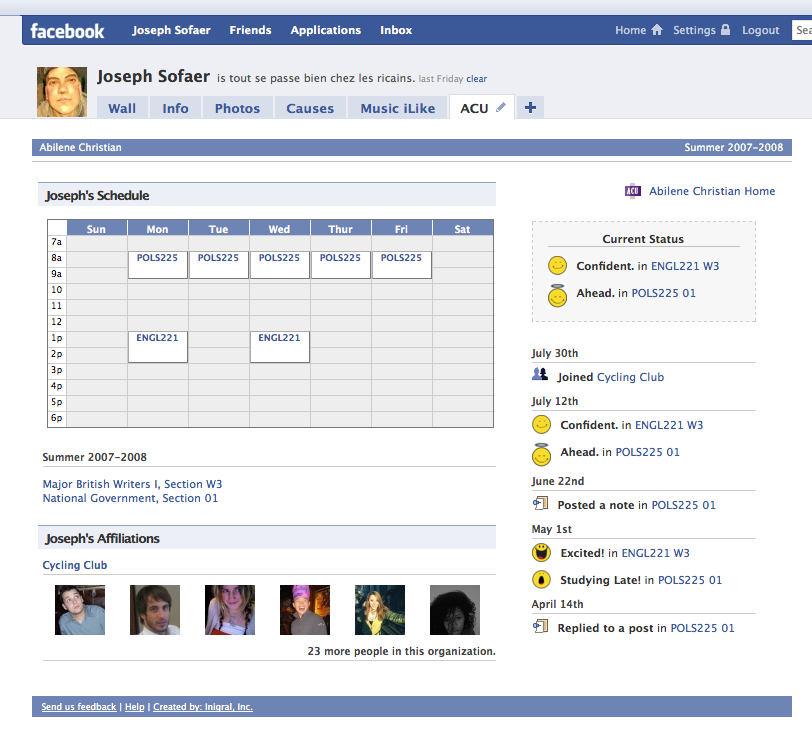
    tab_view.png
    Hi!  I’m Michael Staton and I’m a guest blogger.  What I say in no way represents Michael Feldstein or his ancestors.  Also, our screenshot here is of our app with Abilene Christian University, a school known for being a thought leader in instructional technology and mobile learning products. (They give their students iPhones.  No, really.  They do.)  I am also not representing ACU, its trustees, nor their ancestors.

    So, as I said yesterday, Oracle’s had a short few partners for this upgrade.  With the others included being mainstream LMS systems, you might wonder why Oracle would bother with an upstart like Inigral who hasn’t even invested in a good marketing site.  I hope to answer that question here.  If you read Michael’s blog often, this post will be of interest to you.

    We are introducing a product we’re calling “Schools on Facebook” (in private beta) that is a private, secure application (on Facebook) that can be skinned with a schools branding and connect with their current technology infrastructure.  It doesn’t compete with but complements CMS and LMS systems by focusing on socialization and relationship building; more on how below.

    It’s a cliche when a start up claims to revolutionize this or that.  So, at Inigral we try to stay realistic: we’re focusing on adding a social layer to what already exists.  We want to change the conversation about the internet in education from one of using the web to “manage courses” to one about using the web to facilitate the relationships that develop on campuses already.  After all, a real learning environment is one built on the mortar of person-to-person exchange.   Why not have an application that focuses on that?

    No software is a better example of this than Facebook, which took your campus by storm less than four years ago.  Students started engaging in high-frequency, (some might say mindless) contact that seemed to help students connect with their peers to build and maintain relationships throughout their campus experience.   And you never even paid for it.  Some of you[r colleagues] (not you, you’re too savvy for that) even talked about shutting it out.  But as time went on more of you (and you were early on this one) started to realize what Nicole Ellison documented in her research: that Facebook magnifies the “connectedness” that people feel to your school, one relationship at a time.

    Students use Facebook to represent their identity, and they fill out all sorts of information to that end.  Our product, Schools on Facebook, delivers course schedules, majors, organization memberships and other on campus affiliations to Facebook.  It also shows that “campus safe” identity to classmates and instructors, which helps to build conversations by introducing “primer” information,  i.e. “I see you’re a member of the economics club, are you planning on being an economist?”

    Students use facebook to talk about school all the time, our application just enables a students’ course information to be a part of those conversations.  It also enables contact between faculty and classmates who are not “friends” with a student on Facebook.  Faculty that have ventured on to Facebook have struggled with whether or not to be “friends,” and the safest bet with the least amount of line crossed is to not be friends.  Through our application, campus exchanges can stay out of the personal part of Facebook, and the personal part of facebook can stay out of campus exchanges.

    It has some other great features, too.  But I don’t want to take up any more of Feldstein’s blog with our pitch.

    This is the first public announcement that we are currently selecting two more schools to participate in our limited beta this fall.  We’re only taking three, and we’ve signed up one and have a big name other in the pipeline (huge name, actually).  We’re looking for the “right” school, one that’s going to be excited to see what the Oracle upgrade can enable, one that isn’t afraid to say “we think Facebook adds value to our campus,” and one that’s not afraid to talk about using cool technology openly to others in higher ed.
    Contact me at mpstaton a t inigral.com if you’re interested.

    As you know, the beginning of the school year is a hectic time for all of us!!  I will try to get to all emails as quickly as I can.

  • Purse String Paradigm Shift

    Michael just introduced me two posts below.  I’m Michael Staton, and I’m a guest blogger.
    As Michael already mentioned, my fledgling start up, Inigral, has been included in the alpha partnership with Oracle’s new release of their SIS. I wanna take this post to toot Michael’s horn a little, as he wouldn’t do something like that himself. Some people have been contentious on this blog as to why he might have joined a company like Oracle. I can’t speak for him but I can say, as someone who believes himself to fight for the forces of good, this next release of Oracle Campus Solutions 9 that he’s been working on is going to be one small step for software, one giant leap for educational technology.

    This release has so much excitement attached to it because it enables a real-time relationship between the SIS and third party software, meaning that it’s now possible to run multitudes of prepopulated and always fully updated tools for a university without any extra overhead. Getting a new vendor up and running is as easy as flipping a light switch.

    Activating new vendors with such speed and simplicity will result in a paradigm shift: the Higher Ed community will need to reorient its purse strings to move out of the single-stop, clunky LMS and start getting ready for more agile vendors that cost less to operate. Yeah, you heard it, more products for less money. Campuses will also need to change their vendor adoption process from lengthy conversations with all stakeholders coupled with producing top-down buy-in to an approach designed for efficiency, choice, and bottom-up adoption.

    Ultimately, having more vendors compete in the marketplace that is your school will result in happy faculty, happy students, and lots of conversations about how to use web tools to improve the campus community. We’re happy to be a part of the dialog.

    Tomorrow, I’ll have to toot my own horn and show you how Oracle can sync to Facebook using our product, Schools.

  • Perspectives from a Geek with a Startup

    This is a guest post by Michael Staton for the On the Horizon series on distributed learning environments. Michael studied poverty alleviation for his BA and MA at Clark University, where he developed a lifelong commitment to education and entrepreneurship. He then spent 3 years as a high school educator and was thrust into internet start ups in the education space. Seeing Facebook Platform as a disruptive opportunity, he co-founded Inigral, Inc as a consumer internet company set out accelerate real world relationships in an academic context using the product “Courses on Facebook.” Courses quickly gained traction in the Fall of 2007 and Founders’ Fund, an investor in Facebook, made a Series A investment. Inigral is also about to release a product to help K-12 educators cope with the pressures of the accountability movement. Michael is also the author of the Edumorphology and College Readiness for the 21st Century weblogs.

    I spend most of my time in the midst of internet entrepreneurs. I work in an office with four other internet companies, go to beta launches in San Francisco, and attend panel discussions in Silicon Valley. Something that is conspicuously evident is that I’m one of the few entrepreneurs trying to solve problems in education. Another thing that’s evident, as ironic as it sounds, is that many internet entrepreneurs have given the problems in education considerable thought, many have even tried to contribute to or build a product to address needs in education at some point.

    Start-ups in education are rare, but it’s not for lack of desire to work in the space. Venture Capital appreciates the education market size: it’s huge. Everyone gets an education, and mind-numbing amounts of money are spent to that end. Entrepreneurs tend to be young risk takers, and their first-hand knowledge of problems in the education sector is ripe. However, very few go-getters can convince an Angel Investor or VC that their product for the education market is worth an investment. To boot, older entrepreneurs advise young ones to stay away from the space. Why the reluctance? The market barriers.

    In my paper, I comprehensively address barriers to market entry into the education market and propose some easy solutions. I focus on a set of interdependent forces particularly destructive to outside innovation; there is a causal relationship between public rhetoric and legal protections based on misunderstandings of internet use and political decision making, creating a risk-averse, zero sum purchasing process that requires an abnormally large and unhealthy investment in sales and support efforts.

    (more…)