As educational content moves increasingly digital, one of the big pushes is to rethink highlighting and margin notes. On the downside, these capabilities are seen as table stakes. If students can’t do with their digital textbooks what they can already do with their analog textbooks, then that’s a step backward. On the upside, there’s a sense that highlighting and annotation is an opportunity to re-think educational affordances, particularly if you add social capabilities into the mix. But, for the most part, social highlighting has been a bust so far. Tools like Diigo have had them for some time now, and I just don’t see a lot of adoption. Even the teaching with Web 2.0 crowd doesn’t seem to have latched onto to these capabilities in a substantial way. Part of the problem, I think, is the lack of strong, core educational use cases informing the design.
Classroom Salon—a product developed at Carnegie Mellon University with funding from the NSF and the Gates Foundation—is different. It has a few key features that make it stand out from the pack as a great tool for teaching critical reading and writing.
Long-time e-Literate readers know that I have been a fan of the concept of learning analytics for a number of years now. But it became apparent at this year’s Learning Impact conference that learning analytics are the new hotness. Everybody is talking about them, and increasing numbers of vendors (LMS vendors, ERP vendors, textbook vendors, etc.) are trying to figure out how to get in on the party.
Which means it’s probably time to start asking some critical questions about how well we really understand learning analytics and where the potential for failure and disappointment might be.
There is a lot of good buzz in the edublogosphere about Jim Groom’s newly open course called “Digital Storytelling.” I’m not going to have time to participate this time around, so I really hope that he offers it again. But it’s already off to such an interesting start that I can’t resist commenting on it. Jim has been careful to credit other experimenters with Massively Open Online Courses (MOOCs), which is fair and good, but without getting into a discussion about how much is original to him, I think the course is exemplary in a lot of ways, both as a relatively refined example of a new genre and as an educational experiment.
A couple of things have gotten me musing about social lately. The first was Dave Cormier’s thought-provoking blog post about how PLEs are supposed to disaggregate power, not people. The second was a private conversation with a friend who is thinking hard about how to add a social layer to an existing LMS. And the third was a blog post by Union Square Ventures VC Fred Wilson expressing skepticism about Google’s plan to add a social layer to its existing services. I have been struggling to articulate why I am ambivalent about both the attempts I have seen so far to create a Personal Learning Environment and attempts to layer on social capabilities to existing LMSs. Wilson says it better than I can:
The title of this post is slightly tongue-in-cheek because I have my doubts about whether there is such a thing as PLEs that are distinct from existing software product categories. If there were, then after years of people talking about them, one would think there would have been an example by now that everybody could point to and say, “Yes, we all agree that is a Personal Learning Environment and not a Learning Management System, a Virtual Learning Environment, an ePortfolio, an RSS reader, a personal portal, or whatever.” Then again, maybe the PLE is an idea whose time has finally come. I believe that learning environment developers are embracing many of the articulated values behind the PLE and experimenting with different ways to embody those values. Xplana.com, which launched this week, is one example.
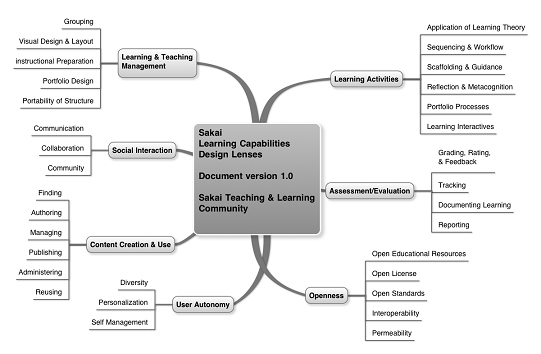
A while back, I asked David Goodrum to write a guest post about some of the work that the Sakai Teaching & Learning Group has been doing to articulate the educational goals and requirements for Sakai 3. The document that they have been working on is called the Sakai Learning Capabilities document, and it entered a 1.0 release just prior to the start of the Denver Sakai conference. This is very important work that will certainly impact the future of Sakai and could have a wider impact in instructional technology.
The group articulate seven “lenses”, which you might think of as functional goals or even as design values for Sakai 3. They are called lenses because each one presents a different view or perspective of any given piece of functionality within Sakai 3 (or any piece of educational technology, really). Every tool and capability within the system should be examined from the perspective of each of the seven lenses at some point in the design phase to help the designers make sure that they are upholding the design values of the system wherever and whenever possible. Each lens contains several finer-grained “facets” which are, again, intended to help software designers ask the right questions as they are designing educational capabilities. These lenses include capabilities for addressing traditional LMS and ePortfolio as well as important educational scenarios that are not handled well by today’s systems.
Here’s what version 1.0 of the lenses looks like as a mind map:
Sakai Learning Capabilities v1 Mind Map
Note that at least two of Dan Pink’s three drivers of motivation are articulated on the map. Autonomy is called out fairly directly as a lens. I would argue that “mastery” is represented in some of the facts of the “learning activities” lens. (Interestingly, the facet descriptors in the “assessment/evaluation” lens seem relatively devoid of connections to mastery at this point, although in fairness, there’s a lot more thought and analysis underneath this mind map that the descriptors may not be capturing.) I’m not sure that Dan Pink’s third motivator—purpose—can be wired into software, although I’ll be keeping my eye out for examples of it.
The key for the community will be to figure out how to translate these design values into concrete processes during the software design and development process. I have some ideas about how to go about this this. I hope/expect to write about them in a future post.
OK, this was worth the wait. I have video of Anya Kamenetz’s keynote, which set the tone for the Sakai Conference 2010 in some important ways. I also have a short video interview with her, some related video content from Dan Pink, and of course, analysis of what all this means for educational technology in general and for the design of Sakai 3 in particular.
Be warned: It will take you over 90 minutes to consume all the content from this post. Not counting post-consumption rumination. ((Did I or did I not warn you about impending blogorrhea? I believe I did.))