In my last post I began to frame a multi-part discussion about the state of play of #edtech and how response to the global pandemic will result in a significant acceleration of what has been a relatively long and drawn out adoption of technology-enabled teaching and learning. And, while it seems an obvious statement – in light of the extraordinary increase in, say, use of technology-enabled grocery delivery – my point is that many of the specific objections and barriers that persisted are moot in the face of the alternative (insolvency of the institution). As those issues are reconciled, it is clear that a key driver is the (re?)realization that organizing around the needs of learners is job one.
Let’s start with a quick historical take on the various players in the education ecosystem and their assertions about how technology, platforms and data would transform the education landscape. I will speak in broad brush generalities and to protect the innocent and guilty I will not use names of companies, institutions or individuals.
Some quick, level-setting definitions for purposes of this post (obviously leaving some categories out at this point of the series):
Publishers – large and small purveyors of products including textbooks and online courseware systems that are based on a specific author’s (or team of authors’) content, pedagogy and reputation.
Institutions – including higher education state systems, for-profits and consortia
LMS providers – commercial and not-for-profit providers of learning management systems (LMS) / virtual learning environments (VLEs) and course management systems (CMS)
Point Solution providers – defined as offerings typically designed to solve on specific business problem. Due to this specialization and focus, point solutions are champions in their specific area of functionality.
Going back more than twenty years, we saw the first portals and LMS companies enter the market. Most of the positioning related to efficiencies like “get out of line and get on line” – for example, providing online access to registrar and bursar functions, anytime access to course materials like syllabi and handouts, and even rudimentary online office hours. For the institutions, the LMS promised to give students an anytime, anywhere access point to their courses and ideally for the institution to have another vehicle for collecting data. But it was hard work! The teaching faculty were mostly left to their own devices to set these courses up; it took well more than a decade for 50% of US college courses to have an instance in their local LMS that presented much more than a file download of their syllabus.
Publishers, on the other hand, used technology to create marketing splash and develop bundles intended to preserve the demand and value of the underlying print product. What started as CD-ROMS in the back of books became online access to supplemental course content and eventually to auto-graded online homework systems (a huge time-savings benefit to teaching faculty, especially in quantitative disciplines). As I mentioned in my last post, these systems typically comprise a fraction of the overall course experience. It is also evident that not all disciplines could be supported effectively by the auto-graded homework systems.
Point solutions providers invariably entered the market chasing whatever cycle of buzzword-worthy solution development was in vogue: e-portfolios, lecture capture, e-books (42 at the peak, including “fit for learning” tablets), and adaptive learning platforms to name a few. As my definition indicates, these typically solved for a specific value proposition and many championed big ideas for the market broadly. Many failed along the way, a smaller number operate independently today as small companies, while a surprising number were acquired and bundled into the LMS and Publisher portfolios.
Meanwhile, Institutions have been developing their own technologies as well. Partnering with other institutions to build LMS as well as creating point solutions like clickers, e-book readers and adaptive systems.
And along the way, each of these organizations staked their claims to the nature of the market:
“the cable television network of education”
“the EBay of education”
“the consortium that will flip the textbook market on its head”
“the Amazon of education”
You get the idea.
It’s in that incomplete, but sufficient context, that I want to make my case. It takes millions of dollars, in some cases hundreds of millions of dollars, to build, maintain and evolve education technology platforms. Across the landscape there are dozens and dozens of organizations that have made investments at that order of magnitude. In some instances, organizations built and acquired more than one. That adds up to billions of dollars.
And yet, the learner journey and experience remains very disjointed in today’s reality. In the spirit of academic freedom, an overwhelming majority of individual teaching faculty curate the materials and tools for their courses. And since it is the very rare case for a single provider to deliver an end-to-end experience – it is rather common for students to be required to navigate multiple, disparate systems, jump through multiple authentication sequences, and experience jarring differences in user experience and content fidelity. Beyond the challenges of the interactive experience, this form of curation can also complicate topics like affordability and equity of access for diverse student audiences.
In the background, industry technology interoperability standards have evolved tremendously but are implemented in asymmetrical, unpredictable and sometimes proprietary ways. The use of instructional designers by institutions is growing, but there are still only 10,000 or so individual practitioners or roughly 1 per 100 teaching faculty members. These and other efforts can help, but are really band-aids covering bigger issues.
Billions of dollars spent to develop products that are still hard to use because of massive market inefficiencies, competitive dynamics and other challenges in the broader education ecosystem.
And here we are, the great acceleration. Yes, adoption of technology-enabled teaching and learning is and will accelerate further. But the question is how higher education institutions and the companies that serve them will react to preserve (or not) academic freedom. Certainly, there is a bi-furcation within the market and even within institutions for more top-down course design and development – but a significant percentage of the overall enrolments are based in institutions with far more complex academic freedom cultures and governance models.
I think this bi-furcation will widen. More and more courses will be built to “scale” with super clean instructional design, careful consideration of student engagement models, insightful use of data to drive outcomes, and “hands on” training for instructors who will deliver using best practices, their own skills and experiences, but little academic freedom.
On the other hand, institutions for which academic freedom is a key tenet in their institutional mission will strive to build the capacities necessary to preserve their brands and the uniqueness of their teaching culture, while delivering high quality, differentiated learner experiences in technology-enabled environments. For these institutions, two things will become paramount: 1) changes to tenure and promotion incentives and 2) providing the time and resources (including outsourced services) to help faculty develop great courses.
And those are not the only big changes looming: those institutions will become far more demanding of the companies seeking to provide them with content, technologies and services to ensure those offerings are not locked into proprietary platforms and business models. As they don’t say in politics, it’s about the learner experience, stupid!
Next Up: The Netflix of Education, part ad nauseum
If your main intellectual response to the current health crisis is to double down on your previously held beliefs, then you are probably not thinking deeply enough. For example, suppose that we develop both treatments and a vaccine for COVID-19, but the immunity conveyed by that vaccine only lasts for a season (much like other flu vaccines). Suppose that flu strains become permanently more virulent and more deadly. Some of the changes in the healthcare system that we are seeing now—in point-of-care, supply chain, and research efforts—become permanent. The risk of getting together physically in groups is permanently altered. Not to the degree that it is now, but significantly higher than it was. Think about how that permanent change would impact all the many businesses that are being impacted now. The growth sectors of our economy would change. The geopolitical landscape would change. Everything would change. Much of what we thought we knew about the future of work would have to be thrown out and rethought. And much of what we thought we knew about the future of education—what jobs we need to prepare students for, how we should be teaching, what sustainability looks like for an educational institution, and so on—would also have to be thrown out and rethought.
It is hard to think such thoughts. I find my mind desperately casting about for reasons to believe that this scenario is not plausible. That life will someday, somehow, return to normal. That the world has not changed.
But it has. And we must all learn how to think the unthinkable. We have to find ways to let go of the comforting assumptions that enable us to glide through the day on autopilot, somehow not swerving off the road while we fiddle with the car radio or talk on the phone or think about what will happen when we arrive at where we are going. We have to look at the road with fresh eyes. See what is in front of us. Prepare our minds for unexpected obstacles. The adaptive cruise control and lane-assist and other comforting tools that we have built to protect us from the need to be in the moment will not serve us well on this road we have found ourselves on. In fact, they provide a dangerous illusion of comfort. We must seize the wheel and learn to be navigators again.
Right now, as we respond to an unprecedented crisis, a lot of the safety mechanisms in the system are being thrown out even as we face massive uncertainty. Multi-trillion-dollar legislation is being passed through Congress incredibly quickly. The medical system is finding various shortcuts to get around the system of checks that are designed to make sure treatments that tinker with your immune system are safe. These safeguards were created for good reasons, one of which is to mitigate the impact of sloppy or reflexive thinking on consequential actions. If we are going to remove them, then we must think harder.
Even under normal times, I would have been disturbed by the Christensen Institute’s argument that “California should double down on Calbright College—by leaving it alone.” The post author Richard Price asserts that California’s new, experimental online community college, which received a $100 million initial allocation and a $20 million annual budget from the California State Legislature, is already fabulously successful. And it will be even more successful if only it is freed from the shackles that the other 114 California community colleges manage to live by and State Senators would back off of their call for Calbright to be audited for its finances, progress, and its compliance with the conditions under which it was authorized. He makes these assertions without evidence or even much in the way of argument to back them up. While reading the piece, I can’t escape the feeling that I am in the back seat of a car with a habitually distracted driver who is reflexively trusting his GPS to guide him through territory that has not been mapped.
I have been patient with the more careful proponents of disruptive innovation in education, despite my skepticism, because it is not their fault that the term has been appropriated by testosterone-addled Silicon Valley teenagers, and because they have made cogent (if unconvincing) arguments. But the opening line of Price’s Calbright post, while sounding completely anodyne, alarms me:
As the COVID-19 outbreak increasingly prompts universities to move instruction online, California lawmakers may want to reconsider their deep skepticism of the state’s first fully online community college—the young institution is proving itself more vital than ever.
There are just so many things wrong with this sentence. For starters, the author links to an article about lawmakers’ “deep skepticism” without mentioning anywhere in his own piece that the article describes the reasons why lawmakers are skeptical. He certainly doesn’t attempt to refute those reasons. To the contrary, he asserts that the “young institution is proving itself more vital than ever” without ever really explaining what that means. Second, the sentence conflates skepticism about Calbright with skepticism about online education. Reading it, one would never guess that the California Legislature has poured something like a quarter of a billion dollars into online programs for the California Community College System alone, plus hundreds of millions more into the Cal State and UC systems. Lawmakers are not demonstrating skepticism toward online education. Rather, they are demonstrating skepticism of Calbright’s implementation as the best application of the substantial investment they are making in online education.
Worst of all, the introduction sets the tone for the article, which is to accuse others of dogmatism while itself making its case on pure dogma. In doing so, it links to another post on the Christensen Institute’s site by another author about another system. This article, unfortunately, also gave me the feeling of being an uncomfortable passenger sitting beside a driver who is barreling down the road toward a destination that he is determined to reach, heedless of what may lie between here and there.
The end result is a specious chain of arguments made from a position that indirectly has Harvard’s imprimatur—because Christensen was a noted Harvard professor—arguing that the state of California should commit to throwing tens of millions of dollars at an unproven program. And that it should do so while declining to hold that program accountable or even expecting it to follow the rules that all the other community colleges manage to live under. The main justification for this position is a theory that was designed to explain what happened to steam shovels and old disk drive technologies and is now being applied to a dramatically different domain without attention to context or evidence.
If you are going to argue for removing safeties at a time of historic emergency, then you must think harder.
It is time for the more serious proponents of disruptive innovation in education to take a good look in the mirror and ask themselves if they have been thinking hard enough. As their predictions about mass closures of universities and other dramatic changes have failed to materialize repeatedly over many years, their assertions about the future have become increasingly strident and sloppily constructed. It is time for them to seriously consider the possibility that they are just plain wrong, and that their attachment to cherished ideas is doing more harm than good.
My own prior assumptions
If I’m going to be fair, I should lay out my own prior thinking about both disruptive innovation and Calbright so that you can decide whether I am the one who is stuck in old thinking.
I am a fan of Clay Christensen’s work. I have three of his books on my shelves, all of which I have read at least once, and two of which I find myself occasionally dipping back into for reference or inspiration. I find his basic thesis to be clever, well-argued, reasonably grounded in evidence, and provocative. That said, his theory is interesting because of the inference chain he constructs rather than because any of his individual insights are particularly novel in and of themselves. For example, one central concept in disruptive innovation starts by “competing against non-consumption,” which is a fancy way of saying you should go to where the competition isn’t by figuring out who isn’t being served well. While this assertion is worth noting, it is the opposite of revelatory. It borders on the banal. Another stepping stone in his argument is that successful organizations will tend to resist ideas that are different than their historically successful ways of doing things. We nod at this without pausing. Christensen’s argument pulls us along not because the steps along the way stop us in our tracks but, to the contrary, we glide down an easy path and suddenly end up somewhere unexpected. As Price puts it in his article, “In the Innovator’s Dilemma, Clayton Christensen made an unsettling observation—CEOs of established companies that fell to disruptive entrants often did everything right, and for that very reason failed to save their companies.”
Disruptive innovation theory boils down to the idea that companies that are fat and happy tend to result in products that are fat and customers that are less happy. At some point, Microsoft stopped building features into Office that were useful to everybody and started focusing on features that were useful to their most lucrative niche customers. Office customers who were not in those niches became less happy as the software became more expensive and harder to use. But the company was focused on maximizing revenues from its best customers.
So they didn’t react much when Google came out with Docs, Sheets, etc. This was a perfectly reasonable business decision for them to make, since Google was not an immediate threat to their customer base and some very profitable corporate customers wanted specialized features. Google’s products were obviously inferior for mainstream word processing tasks. I tried and abandoned Google Docs a few times in the early years because it just didn’t meet my needs. But it got better over time, first satisfying needs for which Word wasn’t well suited, then nibbling at the simplest applications of Word, and eventually becoming sophisticated enough to challenge the dominant word processor for a substantial percentage of common tasks. Today there are a billion users of Google Drive. I am one of them. I have not abandoned Microsoft Office, but I have thought about it at times.
Disruptive innovation is both a particular kind of disruption and a particular kind of innovation. It is important to understand this. When we learn to trust a theory, we begin to take it for granted like we take our cruise control for granted. We stop thinking about it. But we need to understand how our tools work so that we can know when we are safe to trust them and when we are not. As I put it in 2014,
These days, “disruptive” and “innovation” seem to always come together in the same sentence. It’s a bit like “big galoot.” Theoretically, “big” is a modifier for “galoot.” But you never hear people talking about small galoots, average sized galoots, or galoots of indeterminate size. In modern common usage, galoots are always big. “Big galoot” has pretty much become an open form compound word, like “post office” or “real estate.” But “disruptive innovation” is not a compound word. Disruptive innovation is a particular kind of innovation, and a fairly narrow kind at that. Specifically, disruptive innovation is a phenomenon in which a new market entrant can overtake a leader in an established market by offering cheaper and simpler solutions. It’s important to remember that some of Clayton Christensen’s seminal examples of disruptive innovations were steam shovels and disk drives. This is not the same kind of innovation that produced the iPhone. It’s essentially about identifying the slow fat rich kid and taking his lunch money. To be fair, it’s not that inherently mean-spirited, because presumably one takes the rich kid’s lunch money (or market share) by providing solutions that consumers prefer. But the point is that disruptive innovation is generally not about solving new problems with brilliant out-of-the-box ideas. It’s primarily about solving old problems better because the old solutions have gotten overbuilt.
The reason that I have been skeptical about disruptive innovation’s applicability to education has to do with differences in both demand and supply from the situations that Christensen analyzed in his books. On the demand side, I argued in 2013 that education doesn’t fit the disruptive innovation framework because it is not a product:
Silicon Valley can’t disrupt education because, for the most part, education is not a product category. “Education” is the term we apply to a loosely defined and poorly differentiated set of public and private goods (where “goods” is meant in the broadest sense, and not just something you can put into your Amazon shopping cart). Consider the fact that John Adams included the right to an education in the constitution for the Commonwealth of Massachusetts. The shallow lesson to be learned from this is that education is something so integral to the idea of democracy that it never will and never should be treated exclusively as a product to be sold on the private markets. The deeper lesson is that the idea of education—its value, even its very definition—is inextricably tangled up in deeper cultural notions and values that will be impossible to tease out with A/B testing and other engineering tools. This is why education systems in different countries are so different from each other. “Oh yes,” you may reply, “Of course I’m aware that education in India and China are very different from how it is here.” But I’m not talking about India and China. I’m talking about Germany. I’m talking about Italy. I’m talking about the UK. All these countries have educational systems that are very substantially different from the U.S., and different from each other as well. These are often not differences that a product team can get around through “localization.” They are fundamental differences that require substantially different solutions. There is no “education.” There are only educations.
Students’ reasons for the college choices they make are much more complex and varied than their reasons for choosing a word processing program. So I’ve been skeptical about whether the nebulous cloud of ideas and ideals that we call “education” is a thing that can be disrupted in the Christensonian sense.
There are also mismatches to the theory on the supply side. Christensen’s theory of organizational behavior fits best with organizations that conform to economist Ronald Coase’s theory of the firm. Command-and-control organizations that are optimized for profitability and growth will be particularly vulnerable to the pathologies that he identifies. Most universities don’t function that way, and no university systems do. While universities do have to worry about optimizing for sustainability, that goal is complicated by their strong mission focus and their shared governance structures.
And university systems are even further from Christensen’s model because they are governed by political systems, which operate under entirely different decision-making processes than companies do. For example, with 114 physical community colleges grouped into 72 districts across California’s 58 counties, every state legislator has a local interest in protecting one or more of those colleges. There were mission-related reasons for this design decision, having to do with making education accessible in an era before modern online learning. Regardless of the degree to which those reasons may or may not still apply, decisions for the California Community College System are still driven by political representation of those county interests in the state’s legislature. Christensen wrote an entire book—The Innovator’s Solution—on how entrenched corporations can stay innovative. As far as I can recall, none of the example organizations in that book looked remotely like the California State Legislature. So at the very least, somebody would need to make the affirmative case that Christensen’s prescriptions for corporations can be applied in this very different context.
And remember, it’s the chain of inferences that makes disruption theory interesting. If any of the links break, then we have to question whether the theory holds. Cherrypicking evidence for one or a couple of the individual common-sense assertions in the inference chain puts us on a fast road to Stupidville, however our GPS display may label the destination.
I have historically been skeptical of Calbright for reasons that have less to do with disruptive innovation and more to do with math. COVID-19 has been giving us all a hard lesson on the mathematics of growth. If every person carrying the disease spreads to between two and three other people, then the number of people with the disease will double every few days. On the other hand, if the average infected person spreads the disease to at most one other person, then it will eventually die off.
The challenge of Calbright has been that the math never worked for the kind of growth that the legislature expected it to achieve. If the main goal was to create an incubator that would eventually teach us better ways to serve underserved students, that would be one thing. But the goal was to actually serve millions of underserved students in a relatively short span of years. Calbright’s growth rate would have to be unprecedentedly high in order to achieve that aim. Phil Hill broke it down in a post in 2017:
The maximum growth rate of [some] cherry-picked successful schools ranges from ~1,200 / year for Excelsior to ~7,700 / year for SNHU (note that Rio Salado at ~1,400 / year is the only public institution). Add to this the fact that all of these schools have been around for decades. No accreditation issues, no time-consuming establishment of core leadership team, etc.
There is a big difference in dealing with institutional issues and statewide issues, particularly in California. One in five US community college students in the US do so in California, and the statewide issues tend to come in large numbers. Statewide issues tend to come in hundreds of thousands while institutional issues tend to come in tens of thousands.
What this points to is that for a new fully-online institution to get to some meaningful level of enrollment (let’s say 20,000) in the same ballpark as these comparison schools, I estimate it would take a full decade at the least. This is the reason, by the way, that Mitch Daniels and Purdue University made the Kaplan University deal even though Kaplan’s enrollments are dropping. Daniels did not want to wait a decade to get to meaningful enrollment numbers for an online college serving working adults – if everything works out, within a year Purdue will have a fully-online institution serving 30,000+ working adults. That is a big if, by the way.
I have no problem with the idea of Calbright as an experiment in supporting underserved students. But the math doesn’t support the idea that it is going to have an impact at scale any time in the next decade, even under the most optimistic of scaling scenarios. So my concern with Calbright is that both California politicians and proponents of disruption theory have seized on it as a means for solving different problems than the ones it seems suited to solve.
I have one more predilection that you should know about, which is that I believe theories should be disprovable if they are to be credible. You can’t say that disruptive innovation is going to result in 50% of schools going bankrupt—no, wait, maybe it’s 25%—and that it’s MOOCs that are the disruption—or maybe just online learning in general, or possibly CBE, or maybe adaptive learning—and continue to be taken seriously. There has to be a way to arrive at the statement, “data X would disprove my hypothesis.” It can’t be the case that any old data can support your hypothesis while no data can disprove it. That’s not a theory. It’s dogma. My patience with proponents of disruptive innovation in education has worn thin over time because I haven’t seen them demonstrate the willingness to ask themselves the question, “But what if we’re wrong?”
Now that I have laid my own comforting assumptions on the table, it’s time to examine the assumptions that are evident in the arguments from the Christensen Institute.
Is Calbright a disruptive innovator?
Let’s return to the hyperlink in the very first sentence of Price’s post, which is attached to the words “their deep skepticism.” What is the skepticism described in the Education Dive article behind that link? First, the article emphasizes the question of whether Calbright would be best run in the existing structures rather than as an independent campus. That’s one surface resemblance to disruption theory. Again, you don’t have to believe in disruption theory to believe that sometimes a little autonomy from a large, entrenched bureaucracy might lead to fresh thinking. But at least it’s consistent.
On the other hand, Price neglects to mention other salient facts. Like the fact that the legislative analyst’s report in 2018 said there is no evidence that Calbright will solve the problems that prevent Californians from enrolling in college (or, in Christensonian parlance, that it can compete against non-consumption). Here’s the relevant paragraph from that report:
Unclear If Providing Online Offerings Will Solve Key Barriers for Target Student Group. One of the proposal’s goals is to increase educational attainment for adults who currently have no postsecondary credentials. Although this is a laudable goal, the administration has not provided any evidence that an online community college will address the key barriers for this potential student group. Although an online program can increase convenience, working adults may not be pursuing additional education for a number of reasons. The administration also has not provided evidence that those working adults who are interested in more education cannot access it through existing online or in‑person community college programs.
California LAO report
Is there reason to believe that the innovations of Calbright’s design will cause large numbers of students who were previously not enrolling in existing online offerings to enroll in Calbright’s? I don’t know. The California LAO’s office didn’t see such evidence, and Price fails to even mention it as a problem.
The Education Dive article also mentions that Calbright has duplicated existing academic offerings of other community colleges in violation of state rules. Here Price does have a rejoinder, though he does not dispute that Calbright has violated state rules:
[C]oncerns that Calbright’s courses may duplicate existing OEI offerings fail to acknowledge that competency-based, self-paced courses differ fundamentally from seat-time based courses covering the same material, and better serve time-constrained adult learners.
OK, that’s a claim. Where is the supporting evidence? Such programs exist in the world. Western Governor’s University, SNHU’s College for America, and others implement the instructional approach that Calbright has chosen. I’m not arguing that evidence doesn’t exist. But I do think that if somebody is advocating for a $100 million initial allocation plus a $20 million allocation in support of a new and unproven institution while simultaneously advocating that rules should be relaxed and oversight waved off, then one should present any evidence so that we can examine it together. The action Price is calling for requires less reliance on cruise control and more on the blind-spot camera.
Rather than focusing on making an evidence-based case for Calbright, Price chooses to make an argument against California Online Education Initiative (OEI):
Consider CCCS’s Online Education Initiative (OEI), a course exchange program, which Calbright critics point to as obviating the need for a separate, online college. In theory, students can enroll in online courses offered by other state community colleges. In reality, CCCS’s enrollment-based funding model discourages school participation, since only the college that offers the course earns enrollment revenue. This has limited course offerings and engagement overall.
Here is an example of how Calbright, operating under a different business model, could be an asset to CCCS as an autonomous institution. Free from the constraints of the funding model that has proven incongruent with expanding online course options, Calbright could work towards revenue and course enrollment models that best serve large numbers of job-seeking adult learners.
This is factually wrong on several levels. First, the course exchange is just one component of OEI. Luckily, MindWires—the consulting practice that I used to be a partner in and that Phil Hill still runs—produced this convenient explainer on behalf of OEI (which is less than four minutes and is easily findable on YouTube):
Intended Consequences
(Video link: https://youtu.be/1DdlaIZYiDI)
As Phil recently wrote, Calbright is currently serving about 450 students. In contrast, in the 2020-2021 academic year, OEI projects 99,000 enrollments in new academic pathways. (And word is that the OEI number is likely to be revised upward significantly based on more recent data.) Apples-to-apples, this translates into probably a couple of tens of thousands of students.
The course exchange part of OEI is one component. It may or may not succeed at scale. But the broader OEI program is indisputably reaching many more students than Calbright. Worse than getting the incentive mechanism wrong for the course exchange, Price apparently failed to conduct even cursory research regarding the nature and impact of the program he was critiquing. Even if the course exchange portion of OEI fails utterly, the overall program is still tracking to increase enrollments by two orders of magnitude more than Calbright will in the next year.
That doesn’t even count the ways in which Calbright’s progress toward (unspecified) milestones was accomplished, in part, by using resources built with OEI funding. Here is a screenshot of Calbright’s essentials course:
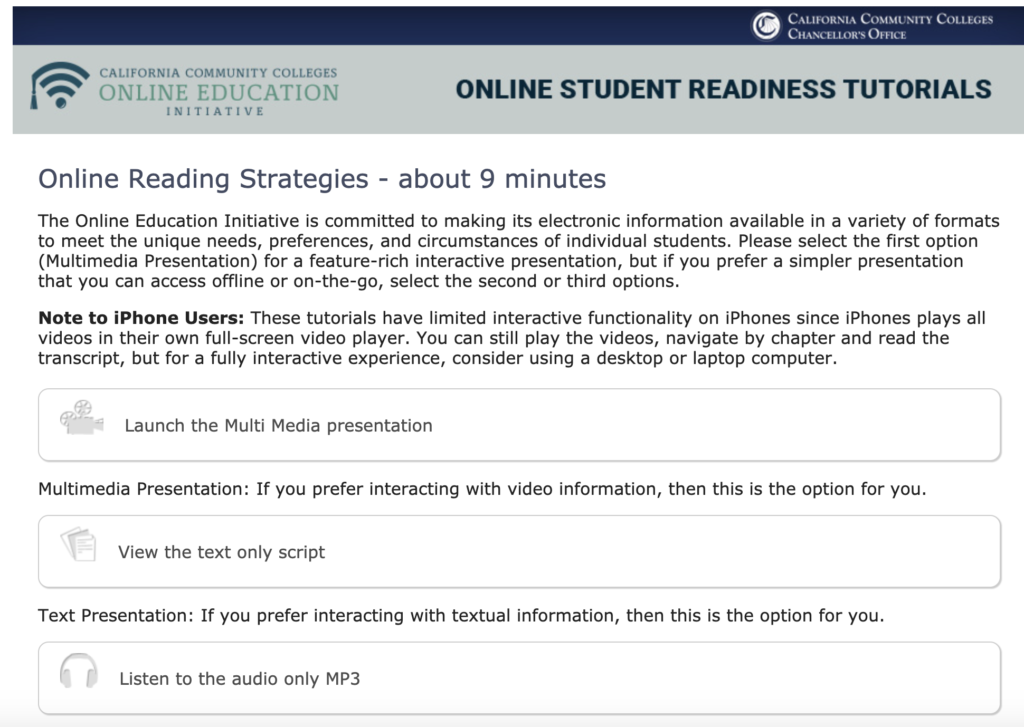
The link at the bottom of that screen leads to this page:
Of the Calbright students enrolled in October through December of last year, 449 enrolled in essentials courses, while 20 enrolled in a program pathway. In other words, the vast majority of students taking Calbright courses last term were taking courses that were using OEI content resources.
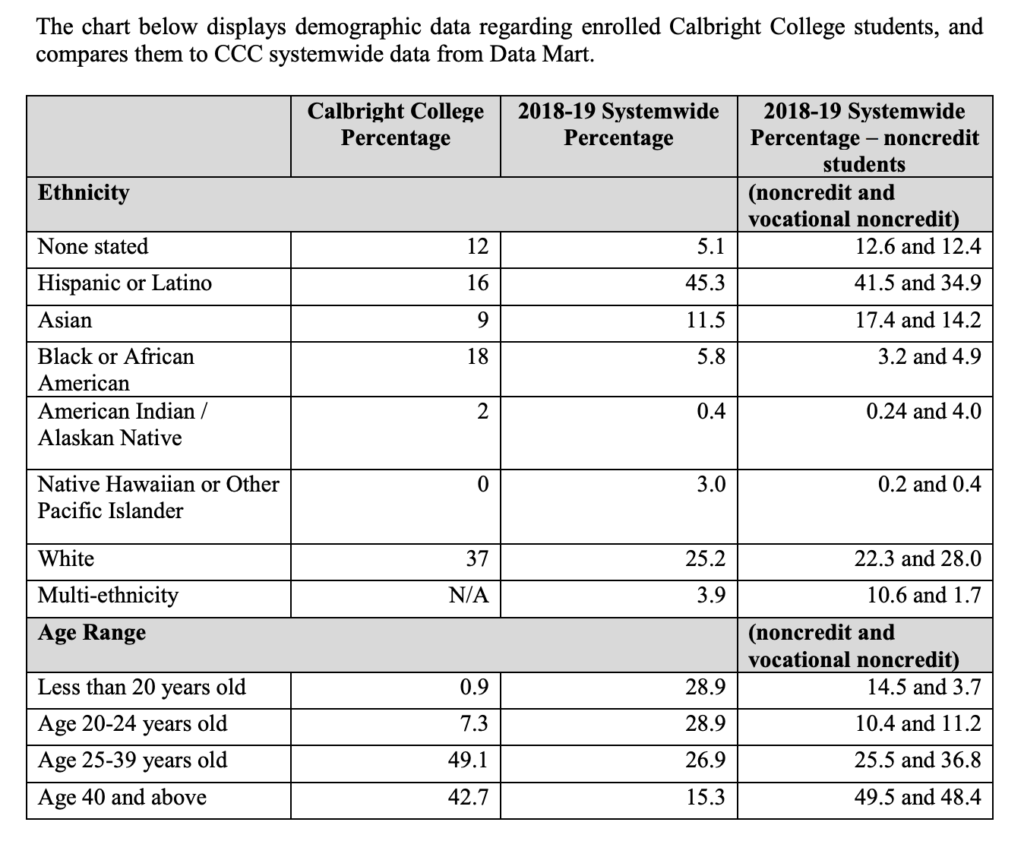
Also, while Calbright’s mission was specifically to reach underserved students that aren’t being reached via the 114 existing community colleges, the results so far are not promising on that score. For example, despite specifically targeting Latinx students, they represent 16% of Calbright’s enrollments—in contrast to 45% Latinx enrollment system-wide. Calbright’s students are, in fact, disproportionately white:
In addition to these reasons for questioning Calbright’s progress toward and ability to accomplish the mission set for it by the State Legislature, there’s also the fact that Heather Hiles, former Calbright CEO, resigned abruptly without public explanation less than a year after being hired.
So given these facts, is it reasonable for California to ask whether Calbright makes sense and is working as intended at this time? I think it is. While I don’t prejudge the outcome of that introspection, the legislators have a responsibility to at least ask the hard questions.
But, worries Price, whether or not OEI may work in practice, does it work in theory? He seems to take a kind of libertarian position that any program that is regulated will inherently be inferior to one that is not. He is aghast at the LAO’s concern that Calbright will eventually have to comply with the system’s collective bargaining agreements and spend 50% of its budgets on instructional salaries.
In other words, Calbright being embedded in CCCS subjects it to strictures that will eventually hamstring the school in its efforts to innovate for adult learners. The LAO report ironically makes the argument that even as an independent school, Calbright isn’t autonomous enough.
Does it? How much does it cost to run a Calbright-style CBE program with quality? How much of that money goes into instructional costs? How does that compare to the requirements that it is currently required to comply with and that OEI online programs do comply with? Again, the data exist, but Price either doesn’t believe he needs to justify his position or doesn’t have the data in question.
I don’t have it either. What I do have is a quote from the President of Southern New Hampshire University (SNHU), which the Christensen Institute valorizes without understanding—more on that in a bit—about the amount of human time and attention that is required to deliver quality CBE education:
I think there is a general lack of awareness of how rich now the underlying data analytics are. We monitor our students 24/7. We know when someone hasn’t logged on. We know when someone has struggled with a project. We know when performance has dropped off. We actually have closer to a 360-degree view of our students than most traditional institutions do. Then, when those students are engaged in the work, they have ready access to qualified faculty if they’re really stuck. We’re never going to let somebody get stuck on a math concept, for example, and just say, well, just figure it out. We’re going to get you help.
SNHU is putting significant time and money into instructor support. Is it 50%? I don’t know, and Price apparently doesn’t either. Is there a case to be made for granting Calbright some flexibility based on evidence of results in successful programs? Possibly, but Price doesn’t make it. Instead, he simply declares,
Without an autonomous Calbright, CA will struggle to properly serve its adult learner population. Innovators like WGU and SNHU will take good care of these learners, but CA will have ceded, rather than seized, the future of learning.
With little in the way of argument and nothing to speak of in the way of evidence, he concludes that (a) only Calbright can “properly” serve California’s adult learner population, (b) Calbright can only do so if it is “autonomous,” (c) Calbright represents “the future of learning,” and (d) if the California Legislature doesn’t cede oversight Calbright while continuing to fund it, then out-of-state competitors may disrupt or otherwise somehow surpass the California Community College System. It’s not at all clear how Price got us here, or even what he means by “properly” serving California’s adult learner population, or making Calbright “autonomous,” “ceding” or “seizing” the “future of learning,” or what role he believes that “innovators” such as WGU and SNHU will play in California’s future should the State Legislature fail to follow his prescription. He does link to (without really explaining the relevance of) another Christensen Institute post by another author about how the PASSHE system partnered with SNHU. I wish I could say that I found that article more persuasive.
Alas.
Is SNHU disrupting PASSHE?
Michael Horn’s post from February of this year bears the breathless title, “Why disruptive innovation is stealing Pennsylvania’s students.” The trigger for the article was an articulation agreement signed between Pennsylvania’s State System for Higher Education (PASSHE) and SNHU which enables PASSHE students to transfer up to 90 credits to SNHU and complete their bachelor’s degree at SNHU at a 10% tuition discount.
Horn emphasizes his belief that state regulations and slow-moving bureaucracy have hobbled PASSHE’s ability to innovate in online education, leading it to the necessity of outsourcing. He does so mainly by analogy to SNHU. There are several problems with this approach.
First, as I pointed out earlier, the idea of increasing autonomy to spur innovation was not newly introduced by disruption theory. Bell Labs embodied this strategy from its formation in 1925. Clayton Christensen wasn’t even born until 1952. Second, as I also pointed out earlier, the success of this strategy does not validate all of disruption theory, never mind its applicability to education. As Horn acknowledges in his post, PASSHE is not failing because its leaders did everything right in pursuing its most lucrative customers. (Not that we would want public education systems to do that anyway, which is yet another problem with disruption theory’s applicability.) To the contrary, PASSHE arranged for the articulation agreement because many of its (tuition-paying) students are not finishing their degrees, according to PASSHE Chancellor Dan Greenstein. Presenting those students with another reasonably priced online option was intended to increase student graduation rates, even at the possible cost of the system’s most lucrative customers. We have to follow Horn down a chain of several inferential steps—each of which is given with either thin factual support or none at all—to arrive at the implication that “disruptive innovation is stealing Pennsylvania’s students.”
Horn relies on a loose comparison to SNHU to do most of the work from him. To give him the benefit of the doubt, let’s stipulate several points:
SNHU’s growth has been undeniably impressive at a time when PASSHE has been experiencing a slow-motion crisis.
SNHU President Paul LeBlanc, like me, is a fan of Clay Christensen’s work. He has thought about it a lot and credits it with influencing his thinking.
Even so, it’s not that simple. LeBlanc hasn’t applied the separation principle dogmatically. SNHU operates under one shared governance structure. Autonomy is not the same as freedom from rules or oversight. Second, he has not hesitated to revoke autonomy when it wasn’t working. SNHU’s competency-based education unit, the College for America, used to be autonomous but has since been pulled back into the larger online learning unit.
Overall, Horn’s article is a confusing muddle. He readily acknowledges that the causes of PASSHE’s troubles look nothing like the causes of disruptive innovation described in The Innovator’s Dilemma. He also admits that better funding of the chronically underfunded system would help. He then swerves off into an explanation of disruption theory, connected only by the thread that SNHU employed the same basic strategy that Bell Labs used successfully nearly 30 years before Clayton Christensen was born. He ends with a call for state systems to create small incubators where new ideas can be piloted. I agree with that idea, but I don’t think it bears any relationship to the completely unjustified clickbait title of his post. I don’t think one has to believe in disruption theory to come to the conclusion that university systems have become sclerotic and need to find ways to get out of their own way. This could have been a perfectly good article if it weren’t trying so desperately hard to validate disruption theory. Horn’s rather modest call to action is not in any way proportionate to the dire pronouncement of the headline; nor does it justify Price’s call for Calbright to be exempted from oversight or collective bargaining rules before it has even proven that it can serve 1,000 students.
This is all hauntingly familiar. I mentioned that I own three of Christensen’s books, two of which I occasionally dip into to this day. The other one is Disrupting Class, which is the book that Christensen co-wrote with Horn about the application of disruption theory to education. In stark contrast to The Innovator’s Dilemma and The Innovator’s Solution, it was a disappointing mess. Parts of it attempt to stretch disruption theory beyond recognition in order to fit educational examples. Other parts contain thoughtful, reasonable observations that bear no credible connection to disruption theory. It doesn’t hang together as a cohesive work. I found the book unpersuasive when it was published 12 years ago and do not believe it has aged well. And in subsequent publications by disruption theory proponents in education, the flaws that were apparent in that original work have been papered over rather than addressed. Christensen has passed away, but the people carrying his torch in this domain have not done his legacy a service, however diligently and earnestly they may have tried.
Twelve years of trying is enough. It is time to think harder.
Grieving our errances
Alexander Pope wrote that to err is human, but he might have added that to err repeatedly due to habits of mind is particularly human. The disruption theory proponents love their idea. As a man who has written 7,000-word blog posts, I cannot credibly claim immunity from that particular siren song.
It is not a propensity to be ridiculed. Our capacity to fall in love with a thing as aetherial as a concept has been a key to our survival as a species, and to creating lives for ourselves that are about more than just surviving.
Sadly, we have not evolved to feel equal love for the process by which we produce, examine, and sometimes destroy ideas. We became toolmakers because tools enable us to accomplish more work with less effort. Ideas are tools that enable us to accomplish more work with less effortful thought. To err is human; to think is divine. These days, I am less inclined toward mocking people for being passionately wrong than when I was young enough to believe that only other people ever commit that sin. But I will attack their arguments without hesitation or mercy when I think they are harmful.
It has become clear to me that all talk of disruptive innovation in the context of education is harmful. Not just when applied thoughtlessly by people who don’t understand the theory, but even when applied diligently by people who do. It is harmful to advocate for a failed idea as if the fate of education depends on believing it is true.
Disruption theory in education is dead. Be sad if you need to, but move on. Seize the wheel and learn to be a navigator again.
As for Calbright, I remain agnostic. I believe it is a good idea in principle for California to create a safe space to experiment with alternative means of reaching the millions of Californians who need education but aren’t getting it. I worry that this characterization is not fully aligned with the stated goals of the Calbright program. I do not know whether the experimental college is being run well, or whether now is the best time to prioritize it over other educational exigencies of the moment. I do believe it is not only fair but important to ask these questions and insist on arriving at fact-based, well-reasoned answers.
An unbelievable number of words have been written about the technology affordances of courseware—progress indicators, nudges, analytics, adaptive algorithms, and so on. But what seems to have gone completely unnoticed in all this analysis is that the quiet revolution in the design of educational content that makes all of these affordances possible. It is invisible to professional course designers because it is like the air they breathe. They take it for granted, and nobody outside of their domain asks them what they’re doing or why. It’s invisible to everybody else because nobody talks about it. We are distracted by the technology bells and whistle. But make no mistake: There would be no fancy courseware technology without this change in content design. It is the key to everything. Once you understand it, suddenly the technology possibilities and limitations become much clearer.
For those familiar with course design lingo, the design pattern I am talking about can be summed up as backward design coupled with programmatic formative assessment. This post is the first in a series in which I will explain this design pattern, it’s possibilities and limitations, and the ways in which it makes possible a whole range of educational technology affordances.
Backward Design
“Backward Design” is a term that comes from a larger framework called “Understanding by Design,” (UbD) developed by Grant Wiggins and Jay McTighe and articulated in a book by the same name. While it was developed as K12 curriculum design approach, it has been widely embraced by curriculum and course content designers at all levels. Because the backward design practice as applied in courseware authoring necessarily requires what some might perceive as a “dumbing down” of the approach (for reasons I will get into later in this post), it’s important to understand the philosophical roots of UbD. On one hand, this is an approach that is grounded in the political reality of a K12 world that is driven by curriculum standards. Wiggins and McTighe are unapologetic about having defined curricular goals for students. On the other, UbD is intended to work against the tendency to memorization of facts and rote applications of lower-order skills, fostering critical thinking and knowledge transfer across domains. Three of the seven tenets of UbD (as articulated in this crisply written white paper by Wiggins) are as follows:
The UbD framework helps focus curriculum and teaching on the develop- ment and deepening of student understanding and transfer of learning (i.e., the ability to effectively use content knowledge and skill).
Understanding is revealed when students autonomously make sense of and transfer their learning through authentic performance. Six facets of under- standing—the capacity to explain, interpret, apply, shift perspective, empa- thize, and self-assess—can serve as indicators of understanding.
Teachers are coaches of understanding, not mere purveyors of content knowl- edge, skill, or activity. They focus on ensuring that learning happens, not just teaching (and assuming that what was taught was learned); they always aim and check for successful meaning making and transfer by the learner.
UbD is explicitly not a paint-by-numbers approach to education. It is, however, a design-intensive approach to teaching that emphasizes the value of preparation and goal-oriented thinking as a key to unlocking teachable moments. This 10-minute video of Wiggins explaining the philosophy is well worth your time and provides a philosophical guide star to keep in sight as we navigate backwards design in general and its application to courseware design in particular:
Grant Wiggins – Understanding by Design
The upshot of his message here is that teachers and student continually need to be asking the question, both individually and together—what are the larger learning goals here?
Backwards Design, at its most basic, is the idea that educators should be asking that question from the moment they start planning their course. Rather than starting with a collection of content and activities and putting it into a sequence, educators should start by articulating the end goals for the students (where an end goal is broad enough to encompass high-level and non-cognitive goals such as “a love of reading”). The three-step process of backward design is as follows:
Identify desired results
Determine acceptable evidence
Plan learning experiences and instruction
All content and activity choices flow from identifying the desired results and determining acceptable evidence of achievement of those results. This approach is “backwards” from the typical approach of starting with content that needs to be covered.
Backward Design in courseware development
Modern courseware, and many of the most highly touted technology affordances that come with it, flow from the Backward Design technique. But there are two additional constraints that are imposed by the medium. First, the activities in the courseware can only be activities that can be facilitated in an online medium—and, since courseware is modeled after the textbook, these are usually (but not always) solo activities by students that look like digital extensions of the kinds of exercises that you would expect from textbooks. Second, since key technological affordances of courseware come from its ability to auto-assess student progress, “acceptable evidence” generally must be machine-gradable evidence.
Since this is Backward Design, these changes have implications up the chain to the first step in the process. Rather than “identifying desired results,” courseware designers have to think in terms of “learning objectives” that are realistic to achieve and measure given the limitations of the medium. The University of Central Florida (UCF) has posted a learning objective builder tool which, while not limited to the application of courseware design, begins to convey how courseware designers need to think about learning objectives in order to design content that will work in the courseware medium. The learning objective structure in the UCF example has four components:
Condition, e.g., “Given a blank map of the United States…”
Audience, e.g., “…the student…”
Behavior, e.g., “…will identify all 50 states and capitals…”
Degree, e.g., “…with 90% accuracy.”
In comparison to Wiggins’ framing of UbD, this may feel starkly reductive to you. It’s important to keep in mind that the example was undoubtedly written for clarity rather than to illustrate how creative an educator can be while still staying within the bounds of the format. That said, there is no question that the format is limiting.
And this, I think, is where a lot of unilluminating argument over the value of courseware originates. On the one hand, if the idea is that courseware will largely replace human instruction, then we have to recognize the gap between the learning objectives which the courseware can assess and the desired educational results which a human teacher can address and assess. On the other hand, it’s very hard to talk about that gap meaningfully and specifically when the entire course hasn’t been backward designed in the first place. If a course has clearly defined desired outcomes and clearly defined acceptable evidence of those outcomes, then it is a straightforward exercise to identify the subset of goals and evidence that courseware can address. But in absence of that larger course blueprint, educators who want to argue that courseware is too reductive start to get hand-wavy pretty quickly. We shouldn’t be surprised that interactive curricular materials are not complete substitutes for a classroom experience, but we should be able to clearly articulate what the gap is and how classroom interactions address that gap in ways that courseware can’t on on a course-by-course basis.
The atomic unit of courseware content design
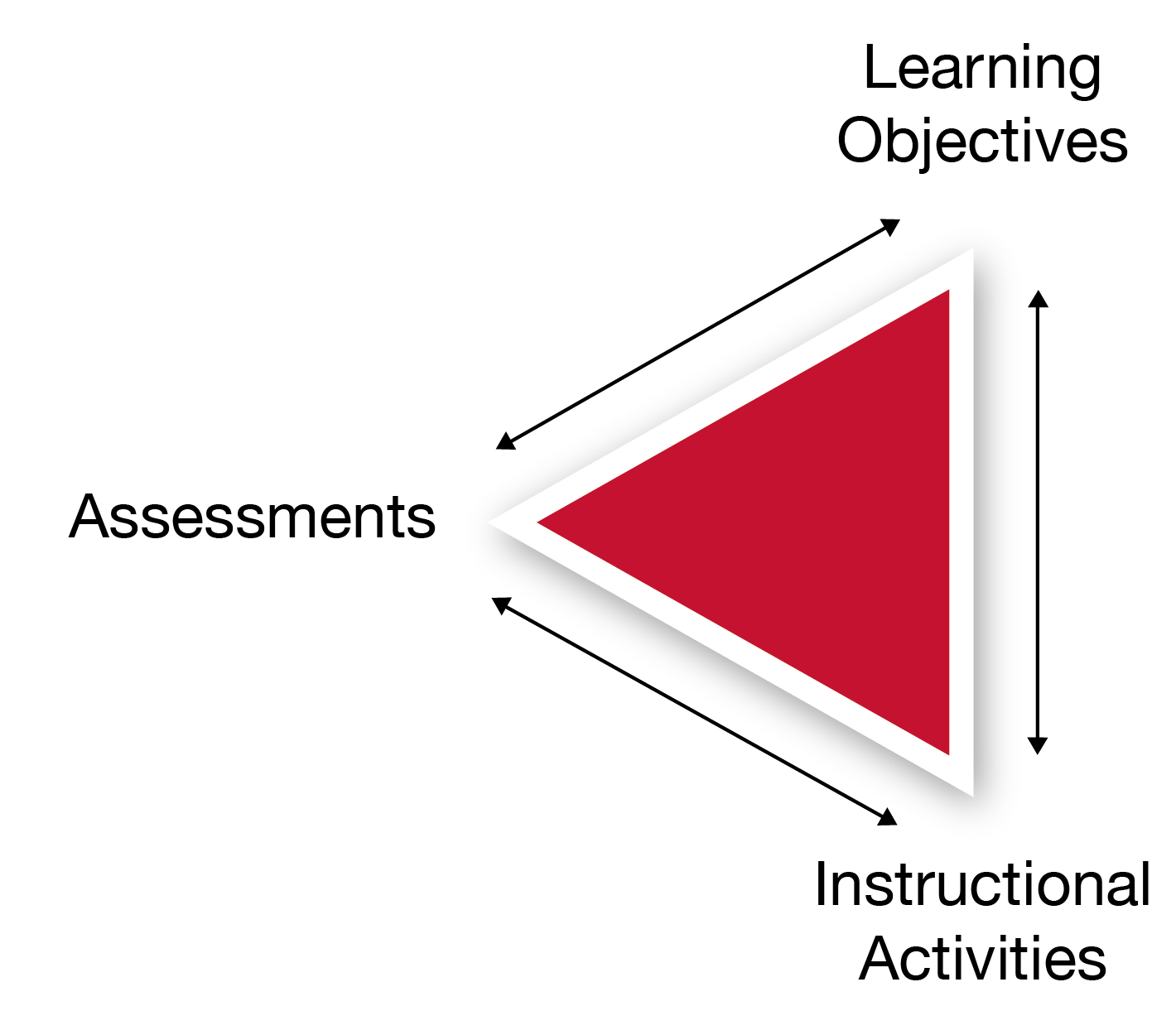
Once we’ve translated the principles of Backward Design to fit the constraints of courseware, we end up with a tightly constructed content design:
The content triangle of learning objectives, assessments, and instructional activities
Again, this structure is not limited to courseware; it’s a good distillation of the results of backward design in general, using language that also translates well into courseware design. But when building modern courseware, this design is formal and structural. Every instructional activity (which, in the case of courseware, means interactive or non-interactive content items) and every assessment activity is tagged to correspond with a specific learning objective. As far as the software is concerned, this collection of items and metadata is a formal and atomic unit of instruction. McGraw-Hill Education even went so far as to name this collection a “compound learning object (CLO)“.
As we will see in detail in the next post in this series, many of the technology affordances of modern courseware depend utterly on this formal structure. And once you understand the design pattern, you can see it everywhere in most curricular materials products and in an increasing number of courses designed on campuses with the help of professional instructional designers. I would go so far as to say that the formalization of this content structure, and not any fancy technology capabilities like adaptive learning algorithms or learning analytics dashboards, is the defining innovation in curricular materials over the last decade. It is the key to everything.
Programmatic formative assessment
There is one other defining content feature that is worth talking about before we explore implementation examples in the next post. A key educational affordance of courseware products that is often touted is instantaneous feedback. Since there is strong evidence that timely feedback is critical to the learning process, this is a key benefit (assuming that the feedback is meaningful). But instantaneous feedback on summative assessments—on assessments at the end that measure how much the student has learned before moving on to the next lesson—is not as helpful to students as it might be because…well…they’re moving on to the next lesson. They may or may not take the time to reflect on their incorrect answers. In contrast, feedback on low-stakes assessments, particularly when it is supported by feedback and support from the educator, can be very useful. In fact, I have long argued that this ability to have students practice their skills and test themselves—yes, before they take a summative assessment, but more importantly, before they walk into a class discussion—is a key value proposition for modern courseware. Class preparation.
This is often billed as a technology affordance, but once again it is utterly dependent on the content design. Their analog…er…analogue is back-of-the-chapter homework problems. Practice problems that are linked to a skill or a bit of knowledge that will ultimately be assessed for a grade is not a new idea. The technology simply improves on the kinds of practice and feedback that were possible with flat textbooks. It can be given more often, in more interactive formats, with more timely feedback.
Circling back to the Grant Wiggins video at the top of this post, students and educators alike need to constantly be asking the question “Why am I doing this now?” Whatever we are learning—or teaching—we should always also be studying whether our activities are aligned with our goals. Good educators are continually assessing their students in a variety of ways, starting with looking at their faces to see if they look like they are following, bored, confused, etc. They adjust according to what they see. Likewise, students need to be assessing their learning strategies and progress in order to get better at achieving their learning goals. One defining characteristic of modern courseware content design is creating as close to a continuous assessment feedback loop as possible.
Content as infrastructure
As I’ve stressed throughout this post, I don’t think it’s possible to overstate the role of this content design pattern—Backward Design plus programmatic formative assessment—in most of the recent innovations in digital curricular materials. In the next posts in this series, I will show concrete examples of how this design pattern makes various technological affordances possible as well as how it opens up new possibilities for tuning both courseware content and teaching strategies for continuous improvement. In the last installation, I will write about the need for and benefits of having content interchange and analytics interoperability standards that are tuned to this ubiquitous yet invisible content design pattern.
In Part 1 of this series we looked at and compared seven online course design rubrics as they are today. In Part 2 we looked at why these rubrics have become more important to individuals, programs, institutions, and higher education systems. In this segment, Part 3, I’ll review what’s missing from the rubrics, what’s next, and how various stakeholders are going, or should go, beyond what the current course design rubrics assess.
Ease of use (product)
Most of the rubrics have been shared with a Creative Commons license, making it easy to use or adapt them as a part of your institution’s online course redesign or professional development efforts. However, many of the rubrics also pose some challenges, two of which I’ll cover here: barreling and organization.
Criterion Barreling: Possibly to reduce the number of criteria and/or to shorten their length, some of the rubrics use criteria that evaluate more than one aspect of a course. This issue, known as barreling, can make it difficult to use the rubric accurately to review a course, since a course may meet one part of a criterion, but not another. The Blackboard Exemplary Course Program Rubric addresses this challenge by assigning higher scores “for courses that are strong across all items in [a given] subcategory.” In their next round of revisions, rubric providers should investigate ways to decouple barreled criteria or move to holistic rubrics that ask reviewers to count the number of checkboxes checked in a certain category.
Categorical Organization: As discussed when comparing the rubrics in Part 1 (WHAT?), each rubric provider organizes their course design criteria differently and has a different number of categories. This makes it difficult to go back and find what you need to fix. For example, most of the rubrics put criteria about clear instructions and links to relevant campus policies at the beginning, but Blackboard puts them at the end in its Learner Support category. Ultimately, the categories should be seen as a messy Venn diagram rather than a linear list.
To increase meaning and motivation among online teachers and instructional designers, rubric providers should provide online versions of the rubrics to allow people to sort the criteria in different ways. For example, instructors and course designers could follow the backward design process as they build or redesign an online course. They would start with the objectives or outcomes, then confirm they ask students to demonstrate achievement of those objectives (assessment), then make sure they provide opportunities to practice (activities, interactivity, and assignments), then create and find course materials to support reaching the outcomes (content).
Ease of use (process)
Time for course review: Based on conversations with one of the CCC system’s trained faculty peer reviewers, the course review process involves a) going through an entire online course, b) scoring the rubric, and c) providing useful and actionable written feedback. This takes her an average of ten hours per course, which is analogous to what I have experienced myself–if you are going through an entire course, it’s going to take time. Like the CCC, institutions should train and compensate peer reviewers for the considerable time it takes to support their colleagues.
Tools for course review: Earlier I mentioned that online course design rubrics a) take time to use, and b) do not make it easy to link from document-based rubrics and feedback to elements within an online course. LMS vendors should support online course review by repurposing existing LMS rubric tools and allowing reviewers to share feedback with online instructors. This would involve creating a rubric that sits above a course to review the course as a whole, as opposed to rubrics that sit within a course to review assignments. Reviewers should also be able to tag specific course materials, activities, and assessments in reference to the rubric scores and/or written feedback. If we can annotate PDF documents, images, and video clips (e.g., Classroom Salon, Timelinely), we should be able to do the same with an online course.
Time for course revision: The course revision process takes time—several initiatives tied to the rubrics ask faculty to go through the review and redesign process over an entire academic term or summer break, before implementing the changes. Unless they are given release time, faculty complete this work in addition to their typical full load. For itinerant lecturers, this workload is spread across multiple institutions. Stipends can incentivize or motivate people to do the work, but release time actually may be more valuable to reaching the desired redesign goals quickly.
Tools for course revision: Most of the organizations that have created these rubrics also offer related professional development and/or course redesign support—Quality Matters, SUNY, the CCC system’s @ONE unit, the CSU system’s Quality Assurance project, and UW LaCrosse all offer some level of training and support for people redesigning online courses. Systems like the CCC have moved to local Peer Online Course Review processes to address the bottleneck effect of one central organization having to support everyone.
Exemplars
Only one of the rubrics—the Cal State system’s QLT rubric—has a criterion related to showcasing samples of exemplary student work so students know what their work should look like. However, all of the online course design rubric providers should showcase what meeting and exceeding each rubric criterion looks like. By providing exemplars—courses, modules, materials, assessments, and activities—to novice and veteran online faculty alike, these initiatives would make it easier for those faculty to design or redesign their courses. For example, SUNY’s OSCQR initiative devotes a section of its website to Explanations, Evidence & Examples–there are links to examples for some (but not all) of the 50 criteria and a call for visitors to share their own examples through the OSCQR Examples Contribution Form. Other rubric providers may fold examples into their professional development workshops and/or resources, but public libraries of examples would allow a larger number of faculty to benefit.
Engagement
In the Limitations and Strengths section in Part 1, I mentioned that the majority of the online course design rubric criteria focus on reviewing a course before any student activity begins. Even criteria related to interaction and collaboration measure whether or not participation requirements are explained clearly or collaboration structures have been set up. However, when my program at SF State completed an accreditation application to create a fully online Master’s degree, one application reviewer made this comment and request: “Substantive faculty initiated interaction is required by the Federal government for all distance modalities. Please specifically describe how interaction is monitored and by whom.” Some institutions have created tools to estimate the time that will be devoted to student engagement:
Santa Barbara City College – Non-credit Distance Learning Student Attendance Summary
If both the research literature and the accreditation bodies state that interaction, community, and the like are critical to online student persistence and success, then the online course design rubric providers should provide more criteria for and guidance about reviewing faculty-student and student-student interaction after the course has begun.
Further still, LMS providers need to make it possible for instructors to see an average feedback response time. The research shows that timely feedback is critical, but instructors do not have a dashboard that lets them see how long they take to rate or reply to students’ discussion posts, or post grades for assignments.
Empowerment
For the most part, the rubrics and related course redesign efforts focus on the instructor’s side of the equation. However, some research shows that online learners benefit from online readiness orientations (e.g., Cintrón & Lang, 2012; Lorenzi, MacKeogh & Fox, 2004; Lynch, 2001), and need higher levels of self-directed learning skills to succeed (e.g., Azevedo, Cromley, & Seibert, 2004). Therefore, rubric providers should add more criteria related to things like online learner preparation, scaffolding to increase self-direction, and online learner support.
Equity
While eliminating online achievement gaps is a goal for several state-wide initiatives, none of the rubrics compared in this article address equity specifically and/or comprehensively. In a future post I will outline how Peralta Community College District (Oakland, CA) developed the Peralta Equity Rubric in response to this void. As part of the CCC system, the Peralta team has already begun working with the CVC-OEI’s core team ((Disclosure: OEI is a client of MindWires, and I have been working directly with Peralta CCD.)) and its newest cohort that is focused on equity. If we keep seeing the highly positive (and thankful) reactions the Peralta team receives as it shares the rubric via conference presentations and virtual events, expect to see more institutions add equity to their rubrics in the near future.
Efficacy
As stated in the Evidence of impact section in Part 2, more rubric providers need to go beyond what got us to this point—i.e., “research supports these rubric criteria”—and validate these instruments further. It also would help the entire field for existing research to be made more visible. Reports like the Quality Matters updates to “What We’re Learning” (Shattuck, 2015) are a start. Now we need to see more research at higher levels of the Kirkpatrick scale, as well as more granular studies of how course improvements impact different sets of students (e.g., first-generation, Latinx, African-American, academically underprepared). Here is a list of impact research efforts to watch in the near future:
The CCC’s newly branded California Virtual Campus-Online Education Initiative plans to conduct more research in its second funding period (2018-2023), which just began last fall.
Fourteen CSU campuses are participating in the SQuAIR project—Student Quality Assurance Impact Research—to determine “the impact of QA professional development and course certification on teaching performance and student success in 2018-19 courses.” The SQuAIR project will analyze course completion, pass rates, and grade distribution data, along with student and faculty survey results.
Enforcement
Colleges and universities, community college districts, and state-wide higher education systems should review these rubrics (if they do not already use one) and kick off adoption initiatives that include training for faculty and staff alike. (Kudos if you are already doing this!) These efforts take time, money, and institution-level buy-in, but if online course enrollments continue to increase at the current rate, then institutions must invest in increasing student success across the board, not just with early adopters and interested online teachers.
I’m not sure why all of the NOW WHAT? elements above begin with E, but I am sure that this list is not exhaustive. Further, while I primarily have focused on the rubrics themselves to maintain a reasonable scope for a blog post series, these rubrics are rarely used in a vacuum–the rubric providers and the institutions that adopt them have built robust professional development efforts that use the rubrics in different ways to increase student success. Keep an eye on the MindWires blog for more installments related to online course quality and supporting online student success.
In Part 1 of this series, I compared seven online course design rubrics that are used by multiple institutions to improve the quality, accessibility, and consistency of individual courses. The institutions do this with an eye toward offering online degree programs, credentials, and certificates. Rubric comparisons are all well and good, but why is this an important topic now?
Demand > Persistence > Success
First, it’s about the numbers. By now, most people watching distance education have heard the statistics—while overall college enrollment is static or declining, enrollment in online courses and programs is growing dramatically. In Fall 2015, 5.95 million students—almost a third (29.8%) of higher education students in the United States—enrolled in at least one distance education course (NCES, 2018).
Similarly, enrollment in online courses at a CCC district I work with doubled in five years, from roughly 9% to 18%. However, that increase in enrollment is offset by rates of student retention (roughly 75% complete a course) and student success (roughly 67% pass a course). Until the district can improve those rates (e.g., through improving course quality and supporting online learners), it is reluctant to add more online course offerings.
In that Feb 12 article referenced in part 1, Phil Hill noted that improving online student success rates throughout the CCC system can be only partially attributed to the Online Education Initiative. If we look at that data further, success rates increased by 13% over a ten-year span. With only two in three students passing online courses, though, there is room for more improvement. (The fact that face-to-face success rates did not change over those ten years is a topic for another blog post.)
Student Success = $
It’s also (or soon going to be) about the money. As more students choose online courses and higher education funding models begin to stress successful completion as much as or more than enrollment, institutions cannot just leave it up to chance that online learners will persist and succeed on their own. If one in five course enrollments is online, and one in three students will take online courses, and the numbers keep growing, the rubrics and related efforts will play an even larger role.
Moreover, while the rubrics focus at the course level, successful completion of online courses contributes to completion of degrees. The CSU system’s Graduation Initiative 2025, the CCC system’s Vision for Success, and the SUNY Completion agenda all point toward system-wide efforts to increase degree completion and eliminate equity and achievement gaps. It should be no surprise, then, that all three of these systems—three of the largest higher education systems in the country—have launched online course quality projects featuring rubrics.
Course design rubrics and related professional development are becoming as important to the institutions themselves as to the students they serve, and the large-scale initiatives that support them all still have work to do. The Public Policy Institute of California summed up the situation fairly well:
Our research suggests that a more data-driven, integrated, and systematic approach is needed to improve online learning. It is critical to move away from the isolated, faculty-driven model toward a more systematic approach that supports faculty with course development and course delivery. A systematic approach better ensures quality by creating teams of experts with a range of skills that a single instructor is unlikely to have completely. (Johnson, Cuellar Mejia, & Cook, 2015, p. 3)
Multiple achievement gaps exist
As colleges and universities address rapidly increasing distance education enrollments, they must also address two achievement gaps that often appear in the research:
Overall, online learners have lower retention and success rates than learners in face-to-face courses (Xu & Jaggars, 2014).
Achievement gaps are larger for some subpopulations of online learners—e.g., students who are male, who are academically underprepared, or who belong to specific ethnicity groups (Jaggars, 2014)
Evidence of scale
This comparison has become important for another reason: scale. Quality Matters and Blackboard serve international networks of systems and individual institutions with their rubrics, related professional development, and awards. Meanwhile, the California Community College (CCC) system, the California State University (CSU) system, the State University of New York (SUNY) system, and the Illinois Online Network (ION) all have led far-reaching efforts with their own, internally created rubrics and professional development training. Within the CCC system alone, the Online Education Initiative’s Consortium serves 56 campuses ((Disclosure: OEI is a client of MindWires.)), all of which have committed to reviewing and redesigning—with the rubric—20% of their online course offerings over two years.
Evidence of impact (and the need for much more)
A number of the rubric providers have made an effort to evaluate their respective rubrics’ impact. Currently, Quality Matters publishes “What We’re Learning” reports to synthesize the research about the impact of its rubric (e.g., Shattuck, 2015). Quality Matters also shares the largest number of studies focused on its impact—through the Quality Matters Research Library that can be searched by standard or keyword and a set of Curated Resources. Of these 25 curated studies, four studies appear to look at the highest level of Kirkpatrick’s Four Levels of Evaluation—i.e., those four studies look at the end results, or to what extent redesigning a course based on the rubric affects students completing and/or passing a course. An equal number of studies investigate Kirkpatrick’s third level, or changes in faculty behavior as a result of training and exposure to the rubric. The largest subset of these curated studies focuses on learner or teacher perceptions, motivation, and satisfaction, but I have not reviewed the entire library!
In its 2018 grant proposal, the Foothill De Anza CCD team stated that “the OEI courses that are aligned to the [OEI Course Design] rubric, checked for accessibility and fully resourced have an average student success rate of 67.4%, which is 4.9 percentage points higher than the statewide average online success rate of 62.5%” (Nguyen, as cited in Foothill De Anza CCD, 2018, p. 4). Anecdotally, interviews with executive CCC stakeholders have identified that some online faculty also improved the quality of their face-to-face courses based on what they learned from the rubric.
That said, the evaluation of OEI’s impact on student success is just a start. While that evaluation showed that rubric-reviewed and redesigned courses had better success rates compared to other online courses, the study did not identify a) which learners performed well or b) what aspects of the course design and/or facilitation helped specific subgroups of students who do not persist or succeed as much in online courses.
Overall, however, we still know very little about the impact of these rubrics. With access to learner analytics capabilities in online learning environments, institutions, programs, and individual instructors should be able to track online course activity and results in real-time. In a recent email exchange with a colleague who works with big data, I proposed tags for learner analytics data within a learning management system. Here are three sets of tags that correlate to three of the rubric comparison categories with the most criteria—Instructional Design & Course Materials (Content), Collaboration and Interaction (Interactivity), and Assessment:
find/create/share/review/reflect on content
content + access: student downloads files, accesses online media via links, visits an LMS content page
content + share: student shares a new, unique, external resource related to course topics–e.g., via discussion post or common page (Google doc)–that he or she has found or created
content + review: student plays media–e.g., while you cannot guarantee the student is actually watching a video, you can tell that it has played for X minutes and/or it has been played Y times
content + engage: student has used digital tools to highlight, annotate, leave questions about text or media
engage in an individual activity or interactivity
activity + engage: student starts an individual learning activity
activity + complete: student completes an individual learning activity, such as a simulation
activity + share: student shares a new, unique, external learning activity related to course topics
interactivity + initiate: a) student initiates contact with other students–e.g., student sends a message to a group or posts a new discussion thread in a group space (or a general forum for the entire class)–and/or b) student creates an activity or environment for working with other students–e.g., creates a Facebook group, creates a group homepage in Canvas
interactivity + support: student helps a peer who has identified a personal obstacle or challenge
interactivity + contribute: student completes a task as part of a whole-class activity, group activity, or group project–e.g., reply to a peer in a discussion, submit a file in a group area for others to review
interactivity + summarize: student creates a summary of a group discussion, virtual meeting, or project
assessment + self: student completes a prescribed self-assessment activity (e.g., practice quiz)
assessment + complete: student completes a low-stakes assessment–e.g., quiz–or high stakes assessment–e.g., essay
assessment + peer: student provides feedback to another student–e.g., Turnitin peermark assignment
assessment + course: student submits feedback about the course–e.g., completes a mid-semester evaluation survey or student evaluation of teaching effectiveness survey, posts feedback for instructor in a general forum
assessment + reflect: student submits a reflection in an assessment context–e.g., posts a reflection with an ePortfolio artifact
Of course, using LMS analytics data is not the only way to evaluate the effectiveness of rubric-guided course redesign (and universal design) efforts, but it’s an avenue that holds promise—especially if we can determine what leads to student success for individual students and different student subpopulations. In my own online class, I emailed a student who earned an A the semester after failing the course to congratulate him for his efforts. He told me one of the biggest factors in his success the second time around was how I redesigned the instructions for everything—it had made everything so much clearer to him. It turns out that in between the two semesters I had redone ALL of my content review prompts, and discussion and assignment instructions after learning about the Transparent Assignment Template by Mary-Ann Winkelmes from University of Nevada Las Vegas. It made me wonder—how many times do those types of changes make an impact without the instructor knowing? It’s time we started finding out.
In Part 3 of this three-part series, NOW WHAT?, I point out some new or upcoming research, as well as call for much, much more evidence about the impact of these rubrics and their individual criteria a) at the highest levels of Kirkpatrick’s model, b) over time, and c) on specific populations of students.
Currently, the primary method to scale online course quality is through the use of rubrics that inform online course (re)design. Understanding the rubric field is critical for educational institutions that a) want to offer quality online programs, credentials, and/or certificates, and b) want to increase online student success rates. To support these institutions—especially those that do not yet use a rubric at scale—as well as the rubric providers themselves, I conducted a review of the most widely used online course design rubrics, which I have turned into a three-part series:
Part 1: WHAT? A comparison of the seven most widely used online course design rubrics, along with their collective strengths and limitations
Part 2: SO WHAT? A discussion of why using these rubrics has become so important, and some early evidence of impact
Part 3: NOW WHAT? Recommendations for what the rubric providers and adopters should do next to increase online student success further
Part 1 of 3: WHAT?
Overview
My investigation of online course design rubrics began with exposure to two rubrics at the same time:
I also knew about Quality Matters and wanted to explore the full range of rubrics used to support quality at scale. Curiosity did not kill any cats, but it led to search results listing several online course design rubrics*, each of which is used by multiple institutions (see Table 1).
TABLE 1. Online course design rubrics used by multiple institutions
* NOTE: New Mexico State University also created a rubric that at one time was referenced by other schools but has since switched to Quality Matters.
Speed of change
While some of these online course design rubrics date back twenty years, their promotion and use at different levels—institution, district and system—really has ramped up in the last five years. To emphasize this point, consider the following. Baldwin, Ching and Hsu (2018) compared six of the seven rubrics listed in Table 1 above. Five of those six rubrics have been updated since those authors completed their study in July 2017. [NOTE: Ironically, the rubric comparison study did not appear in any of my search results. I only found it as a link from the OSCQR Resources.]
Depending on what milestone you choose as a starting point, people have been completing online courses for thirty years or so. For those of you wondering why we have not gotten online course quality figured out by now, keep in mind that face-to-face courses in higher education began over 1000 years ago and to date do not undergo as much evaluation.
Each rubric is broken into broad categories—ranging from three to ten, depending on the rubric. Across all seven rubrics there are fourteen categories in all, one of which I have created. For this comparison, I reorganized each rubric to put comparable criteria in the same categories for consistency, and repeated criteria that measure more than one aspect of an online course. Table 2 shows how many criteria each rubric includes in each comparison category. (Bold numbers signify a rubric has 7 or more criteria in that category; italicized numbers signify a rubric has 2 or fewer criteria in that category.)
TABLE 2. Number of criteria each rubric includes per comparison category
Quantitatively, this allows us to see what aspects of online teaching each rubric emphasizes, which categories are well covered by every rubric, and which categories are not emphasized enough overall. For example, all seven rubrics have several criteria related to assessment, but only two rubrics—QLT by the CSU system and OCE by UW LaCrosse—address an online instructor’s facilitation strategies. Similarly, all seven rubrics have several criteria related to accessibility, but on the whole they pay little attention to individualized learning activities.
To what extent does research support rubric criteria?
Beyond how many criteria each rubric offers in a specific category, though, how well does learning design research and learning science support usage of these rubrics? Since MindWires leads the Empirical Educator Project—an effort to promote broader adoption of evidence-based teaching practices—I went through a number of research articles and research literature reviews. My goal was to identify correlations between a) the aggregate set of rubric criteria and b) online course design factors (or online teaching techniques) that have increased student engagement, motivation, persistence, success, etc. Below is a representative sample of what I found.
The CCC Chancellor’s Office (2013) identified faculty-student interaction and increased communication with the instructor as key factors in student success.
Communication/availability rated as the top characteristic of an outstanding online teacher, followed by compassion, organization and feedback (Orso & Doolittle, 2012).
In Table 3 below, I’ve started the process of aligning research articles with rubric criteria in common rubric categories. While the research supports the concepts, though, not every rubric actually addresses them to the extent that the research dictates. For example, four of the seven rubrics have a criterion related to timely instructor feedback, but two of the four stop short at simply sharing expectations for timely feedback. Those rubrics do not measure whether or not faculty actually give timely feedback.
TABLE 3. Research literature supporting rubric criteria
Common rubric categories
Research literature supporting rubric criteria in those categories
Instructional Design & Course Materials
Ragan, Orso & Doolittle, 8 studies cited by Lister
Interaction & Collaboration
CCCCO, Crews et al., 9 studies cited by Lister
Assessment
Feedback: CCCCO, Lister, Crews et al., Orso & Doolittle, Hart, & more
Learner support
CCCCO, Crawley, & more
Some rubric providers also allude to or directly reference other literature that supports the inclusion of rubric criteria. For example:
While the OSCQR website shares research supporting OSCQR standards (4 articles), the site does not draw correlations between the articles and specific rubric categories or criteria.
Quality Matters states that “the QM standards have been examined for consistency with the conclusions of the educational research literature regarding factors that improve student learning and retention rates, as well as activities that increase learning and engagement” (https://www.qualitymatters.org/qa-resources/rubric-standards/higher-ed-rubric).
On the flip side, the research identifies practices that the rubrics do not address much or at all. For example, several studies show increased success when institutions require students to participate in a course-level orientation or module-based introduction to online learning (Cintrón & Lang, 2012; Lorenzi, MacKeogh & Fox, 2004; Lynch, 2001). However, there are very few criteria across the rubrics that address helping students assess and address their online learning readiness.
Limitations and strengths
As far as limitations go, all of the rubrics focus heavily on reviewing courses before they begin—i.e., before the students show up. While all seven rubrics also have criteria related to interaction, those criteria largely address activity set up, clarity of activity instructions, and other factors that can be reviewed without the students being in the course. Only two of the seven rubrics—CSU QLT and UWL OCE—really look at instructor facilitation.
Given these limitations, the rubrics do provide great value. Ultimately, these rubrics represent the current thinking about improving the quality of online courses. Some of the rubrics have evolved over twenty years and will continue to do so. The rubrics’ strengths manifest at different levels—for individual instructors, a rubric acts as a course design guide; for institutions and systems, a rubric creates a common vocabulary, an aspirational worldview, a mechanism for consistency and accountability, and the basis for a social infrastructure that runs parallel to the technological infrastructure.
In Part 2 of this series, SO WHAT?, I will look at why these rubrics are important for improving online course quality at scale, and how well rubric providers have evaluated the effectiveness of their instruments.
03/20/2019 UPDATE – Table 1: Changed Rubric Provider Type for Quality Matters to Non-profit organization.
Last week I had the good fortune to co-keynote the Northeast Regional OER Summit at UMass Amherst. My counterpart keynoter was Don Kilburn, the current CEO of UMassOnline and former CEO of Pearson North America. We each gave brief talks, followed by a conversation facilitated by UMass Amherst’s Marilyn Billings. It was a lively discussion that inspired a lot of passionate debate on Twitter. That, in turn, inspired requests for more information about the conversation from people who weren’t able to come. So this is my recap.
Don’s talk
Don was there in his UMassOnline capacity but he spoke from his perspective as a long-time senior executive at a major textbook publisher. From the beginning, it was clear that having Don on stage would be both potentially interesting and inevitably fraught. Many folks in the OER community have a visceral negative reaction to the way of thinking and the kind of language that Don employs instinctively due to his particular professional history. And Don, for his part, didn’t seem to have had a whole lot of exposure to or understanding of the audience he would be addressing. The most cringe-worthy moment was when he trotted out the old “free as in puppy” chestnut as if it were a novel statement and not something that the OER community, and the open source community before it, had heard ad nauseam for at least a decade. That cultural clash between the audience and the opening speaker…resulted in the kinds of tweets that you would expect, and appeared to have an outsized influence on the way a vocal segment of the audience reacted to the whole conversation.
That’s unfortunate, in part because Don knows a lot that could be useful to people who want to learn how to be more effective at driving OER adoption and understanding how a broad cross-section of faculty approach curricular materials adoption in general. He knows about the many experiments, both successful and unsuccessful, that the textbook industry has tried in order to figure out which value propositions persuade faculty to adopt curricular materials. He knows what’s happening in the market right now, how the publishers think, where they are gaining traction, and where they are struggling. Whether or not you agree with him, he can provide useful intel that is normally inaccessible to academics.
I won’t summarize his talk here, but since the first part of my talk built off of Don’s, you’ll hopefully get a rough sense of the ground he covered through my summary of my own talk.
My talk, part one
I’m not going to recap the discussion in strict chronological order. Instead, I’ll address the piece of my talk that built off of Don’s now and circle back to the other part—which was really the main part of my talk—later. In retrospect, the conversation after the talk provides some good context for understanding the main point I was trying to make.
A lot of Don’s talk was about how curricular materials prices are coming down and how the industry is trying to establish the value of its product in the face of this change. This seemed like a good place for me to pick up, since the most common argument for OER is about affordability There is absolutely no question that the value of base informational content—the part of a textbook that could easily be replaced by a Wikipedia article, for example—has commoditized. This is one reason why textbook prices are coming down. (I could tell another story about used books and rentals and Amazon and Chegg, but the two narratives are really just two sides of the same coin.)
In the curricular materials markets, there are two pricing bands that are beginning to emerge. The first one is in the $10 to $40 range, and it is often presented as either a cheap version of the print textbook—a black and white softcover, for example—or something close to a direct digital replacement of the book. The other band, in the $60 to $100 range, tends to have products with lots of formative assessments, student and instructor dashboards, nudges and reminders, and maybe adaptive capabilities. Here, publishers are trying to establish a different value proposition from the print textbook. The “courseware” products that typically inhabit this price band can provide both students and instructors with a lot more information about how the students are doing, whether they are coming prepared to class, and where they need help. I have written severalposts about these two competing value propositions, labeling them as “good enough” versus “better enough”.
As long as those two value propositions dominate the way in which curricular material choices are framed for (and by) the faculty, they will also frame the way that OER are valued. And I mean that partly in economic terms, since not all OER are cost-free to the students and none are cost-free to the creators and maintainers. If the Wikipedia-like portions of the textbook have little to no economic value, then what else are students paying for and how much should they have to pay for it? How much is professional curation—in the form of scope and sequence—worth? How much is it worth to have somebody align learning objectives, assessment questions, and the informational content? To keep the content up-to-date? To provide frequent, auto-graded or easy-to-grade formative assessments? To provide dashboards that show progress on those assessments? To provide adaptive learning tools as differentiated instruction aids? There is no one correct answer for each of these questions, but now at least the pricing is starting to become transparent enough and product options unbundled enough that it is possible to answer them. The affordability problem, while not yet solved, is moving in the right direction. Because unbundling is part of this movement, educators can start making more fine-grained, student-centered choices about any potential trade-offs between accessibility and effectiveness.
In my view, the OER community needs to become more sophisticated in its discussions of these trade-offs and more respectful of the individual decisions faculty make as they try to find the right trade-offs for their particular contexts. “Free as in puppy” may be glib, but that doesn’t mean it’s completely false. On the one hand, I don’t know anybody who got a free puppy that didn’t…you know…already want a puppy and know that puppies require care and feeding. On the other hand, some people do underestimate the amount of care and feeding a puppy requires. If you want to make sure that those puppies don’t get given to a shelter or abandoned at the side of some road, you need to make sure that somebody is prepared to be responsible for them. You need a puppy sustainability strategy. Some puppies are more work than others, and some families are more prepared to care for puppies than others. Sometimes you’d be better off adopting a dog that’s already been house trained. Or to pay for a trainer. Or to get a cat instead. Or a goldfish. Any resource that has a cost of upkeep needs a sustainability plan. Resources that do more will often—though certainly not always—require more initial investment and more upkeep. A puppy that is going to be a family pet requires a different level of investment—both up front and ongoing—than a rescue dog or an agility dog.
The utility of an open license, part 1
Of course, “good enough” and “better enough” is not the only way to frame the value of either affordability or OER. This is where the conversation among OER advocates can (and did) get chaotic quickly. For example, one topic that came up during Q&A was the utility of an open license to enable faculty to customize the content to their students’ needs. I said that faculty can and do customize with proprietary content all the time, and that anyone who believes the only way to do this is with OER is fooling themselves.
This comment caused some consternation. I stand by it.
When faculty want to adjust proprietary content, they skip chapters, supplement with other content (including some they may have made themselves), reorder the content, combine different texts, and so on. Instructors are endlessly creative in the ways that they slice and dice proprietary content. In fact, this exact tendency is one reason why textbook publishers got into pricing trouble in the first place. They have known forever that English comp professors are likely to use maybe one out of every three readings in an anthology, and that the particular readings which get used will vary from professor to professor. So they produce anthologies with three or four times as many readings as any class could use in a term. They do the same thing with problem sets. Or textbook chapters. Maybe one Biology 101 professor likes to spend more time on cellular biology while another is into ecology. No problem; the publishers just put in lots of chapters on both. Faculty will use what they want.
What you end up with by employing this publishing strategy is a puppy that has been house trained, agility trained, and rescue trained. That is one very expensive puppy. And the students—who, after all have to buy that puppy—get irritated because it is obvious to them that they will never have to use their dog for an avalanche rescue.
Customization happens regardless of license. Yes, a license makes certain kinds of customization easier. It’s an affordance. If you train your puppy yourself, you can decide what you want to teach it to do. Our dog, who we adopted as an adult, was trained by her prior family to ring a bell with her nose when she wants to go out. That was apparently useful to them. But I’ve had lots of dogs during the course of my life, and we never had to train them to do something specific when they wanted to let us know that they had to go out. Each had his or her own way of accomplishing this function. We didn’t suffer from that particular loss of control.
The definition of open education is an open question
One weird aspect of the “free as in puppy” analogy is that it treats the dog like a possession whose primary salient characteristics are cost of purchase and cost of ownership. That’s certainly one valid way to think about curricular materials (though not about puppies). But if what you’re really interested in is a pedagogical approach—let’s call it “open education”—then this is not the only way, or even the best way, to think about OER. Some OER advocates are interested in open education as a way of teaching, with OER being a set of raw materials designed to support that way of teaching. The problem is that we don’t have anything close to a consensus on what “open education” actually is.
Some of the summit attendees talked about the value of having students create and edit the content. Say you want your kid to learn some responsibility and empathy, as well as something about animal behavior and psychology. Having a dog will give them some of that. Having your kid train the dog will give them a lot more of it. Having two of your kids train the dog together will also teach them something about cooperation. In this case, the “cost” of training and caring for the dog is actually a benefit.
There is overwhelming evidence that having students learn by doing (including by researching and authoring) can be very effective. But there are two caveats regarding how this general principle of learning translates into the specific activity of student co-creation of curricular materials. First, having students write and edit their own curricular content is not inevitably effective as an active learning strategy. Sometimes, sure. But like everything else in education, it’s highly context-dependent. Second, depending on how broadly the students are sharing this work, it’s not clear that you need an open license on it, or that you need all content and source materials to be openly licensed. If the instructor doesn’t put any license at all on the student-created content but makes it freely available on the web, is it OER? In spirit, probably, but that would not be consistent with common usage of the term.
As a teaching strategy, I’m enthusiastic about having students co-create curricular materials. As a teaching philosophy, I’m agnostic and utilitarian about it. As teaching dogma—no pun intended—I’m deeply skeptical, as I am about all blanket generalizations about the “best” way to teach regardless of context.
My favorite variation on student production of curricular materials as a teaching strategy is Mike Caulfield’s notion of choral explanations. It adds the dimension that having a handful of different explanations can be more helpful than having just one. Think about your own behavior when you’re looking up a health condition on Google or a how-to demonstration on YouTube. Do you tend to look at just one search result? Or do you look at a few different ones? I often look at a few, and sometimes more than a few. The reason we can have the benefit of that diversity is because, on the web, there are many different people producing content resources and sharing them for free. They may not have Creative Commons licenses, but they are OER in a real sense.
Again, I’m enthusiastic about this approach as a teaching strategy and utilitarian about it as a teaching philosophy. If it works for your students, in your subject, with your pedagogical activities, that’s great.
Not all open education advocates define it this way. And to be clear, I’m not trying to provide a comprehensive list of useful definitions for open education here. I’m summarizing and reflecting on last week’s conversation. But I do want to touch on a subset of those other definitions that are often less well defined, more essentialist, or both. Because they did come up in that conversation, and because that’s where there are real problems.
Real problems
One question I got in the Q&A was what advice I had about things that the open education community isn’t doing as well as it could. That’s easy: Stop bickering so much.
Teaching, when done right, is deeply personal. That’s both good and bad. On the good side, first, many educators are motivated to be good teachers even when their environment actively disincentivizes them, because they care about their students. It’s one reason why educational systems produce so many success stories in spite of the fact that the systems themselves are deeply, disturbingly messed up. Also, there is evidence that the very fact that a teacher cares about a student has a strong chance of positively impacting that student’s physical, emotional, and financial wellbeing for the rest of their lives. (Many of us have our own personal stories about this, but there is also hard, longitudinal evidence.)
The bad side of teaching being so personal is that it can be very hard to maintain ego boundaries when you care so deeply about so many students in a messed up environment like the modern classroom (or, really, like human existence in general). I speak from personal experience as well as from knowing, working with, and living with many educators over the course of my life. It’s hard to separate the job from your personal identity. For some people, “open education” is an affinity group of sorts.
In and of itself, that’s fine. Teaching is hard, teachers deserve and need emotional support, and one way to get that support is to find your “tribe.” But I have observed a lot of infighting about shibboleths that mark membership in the open education tribe. Too often, it gets unreasonably heated and personal. At its worst, this behavior metastasizes into a particularly noxious form of identity politics. At that point, it is no longer about helping students.
As I said in answer to the question at the summit, there are only two essential goals that I care about in education: (1) increasing access and (2) increasing the value that students get from the education that they can access. I am agnostic and utilitarian about everything else. To the degree that discussion, debate, or usage of open education teaching strategies or open educational resources furthers one or both of those goals, then I’m for it. To the degree that it distracts from activities that could further those goals, then I’m against it. In recent years when I have attended conferences that are billed as “OER” or “open education” events, I have not been impressed with the ratio of constructive conversations to painful distractions.
This is absolutely fixable—if the participants decide that it is something they want to fix. I hope they do. Some of the brightest, most talented and dedicated educators I know are among these people. I would like to see them accomplish all the good in the world that they can.
My talk, and the utility of an open license, part 2
All of the conversation I described above is important. I’m glad we had it. But it wasn’t the conversation I had hoped to provoke. In the main part of my talk, I recapped the four levels of empirical education:
Intuitively empirical: This comes down to whether you pay attention to your students and do something differently with them based on what you observe. Do you always do the same thing, or do you have a bag of tricks that you can draw from when you see students struggle? I believe that the substantial majority of educators are empirical in this sense. They may not think of it as empiricism, but they are observing student behaviors and are adjusting their strategies based on what they see, guided by some sort of rationale for choosing which strategy to employ in different circumstances.
Mindfully empirical: Mindfully empirical educators think about how they can get the maximum amount of useful diagnostic information from day-to-day course work. They design their courses with a goal of creating many feedback loops that enable them to be adjust their teaching to the needs of the students.
Meta-cognitively empirical: Meta-cognitively empirical educators are empirical not only about how they use their existing bag of tricks but also about which tricks they should have and how effective those tricks really are. They consciously and regularly test their own assumptions about effective teaching, and they are open to trying new appropaches. My read of Lauren Herckis’ research is that the barrier of moving from mindfully empirical to meta-cognitively empirical (and to the next level, socially empirical) is where a lot of the difficult work needs to be done. Lots of educators are intuitively empirical, and the transition from there to mindfully empirical is not a huge leap. Getting them to test and challenge their deeply held beliefs about what constitutes effective teaching is a lot harder.
Socially empirical: Socially empirical educators view effective teaching not as an individual art but as a shared pool of knowledge and experience that everyone can learn from and contribute to. They seek out common vocabulary, methods, and standards of proof so that they can learn with their colleagues and raise the collective bar. This is the beginning of disciplinarity.
One possible defining purpose of “open education” is fostering socially empirical education. We can learn together and teach each other, teacher to teacher, teacher to student, student to student, and student to teacher. We can collectively learn how to teach and learn more effectively. We can conduct experiments, check each other’s work, and develop shared notions of what constitutes “evidence” of effective education. With this formulation of open education, as with the others, an open license is not a necessity; it’s an affordance. But substantial kinds of openness are essential to socially empirical education. You can’t build a shared body of knowledge without sharing.
The strategy of having students collaboratively construct knowledge artifacts fits in with this ethos nicely. Students learn how to negotiate the development of shared understanding. Here again, I am endorsing a strategy, not a dogma. But by framing student creation of curricular content as “learning how to negotiate the development of shared understanding,” we take the motivation for the educational activity out of the realm of say, social constructivism, which individual instructors may or may not buy into, and reframe it as a life skill that all humans should have. Doing this will help more instructors better understand why, when, and possibly even how they might want to utilize the strategy of having students co-create curricular materials.
Framing open education in terms of socially empirical education is intended to be a provocation rather than an argument. Since I am a critical friend of the open education community rather than a member of it, I don’t really get a vote. But I hope that the notion of socially empirical education can enrich the conversation among proponents of open education.