e-Literate

Present is Prologue

Category: Strategy & Change Management

  • The Billion Dollar EdTech Platform Hole

    Actually, make those plural: billions, holes…

    In my last post I began to frame a multi-part discussion about the state of play of #edtech and how response to the global pandemic will result in a significant acceleration of what has been a relatively long and drawn out adoption of technology-enabled teaching and learning. And, while it seems an obvious statement – in light of the extraordinary increase in, say, use of technology-enabled grocery delivery – my point is that many of the specific objections and barriers that persisted are moot in the face of the alternative (insolvency of the institution). As those issues are reconciled, it is clear that a key driver is the (re?)realization that organizing around the needs of learners is job one.

    Let’s start with a quick historical take on the various players in the education ecosystem and their assertions about how technology, platforms and data would transform the education landscape. I will speak in broad brush generalities and to protect the innocent and guilty I will not use names of companies, institutions or individuals.

    Some quick, level-setting definitions for purposes of this post (obviously leaving some categories out at this point of the series):

    Publishers – large and small purveyors of products including textbooks and online courseware systems that are based on a specific author’s (or team of authors’) content, pedagogy and reputation.

    Institutions – including higher education state systems, for-profits and consortia

    LMS providers – commercial and not-for-profit providers of learning management systems (LMS) / virtual learning environments (VLEs) and course management systems (CMS)

    Point Solution providers – defined as offerings typically designed to solve on specific business problem. Due to this specialization and focus, point solutions are champions in their specific area of functionality.

    Going back more than twenty years, we saw the first portals and LMS companies enter the market. Most of the positioning related to efficiencies like “get out of line and get on line” – for example, providing online access to registrar and bursar functions, anytime access to course materials like syllabi and handouts, and even rudimentary online office hours. For the institutions, the LMS promised to give students an anytime, anywhere access point to their courses and ideally for the institution to have another vehicle for collecting data. But it was hard work!  The teaching faculty were mostly left to their own devices to set these courses up; it took well more than a decade for 50% of US college courses to have an instance in their local LMS that presented much more than a file download of their syllabus.

    Publishers, on the other hand, used technology to create marketing splash and develop bundles intended to preserve the demand and value of the underlying print product. What started as CD-ROMS in the back of books became online access to supplemental course content and eventually to auto-graded online homework systems (a huge time-savings benefit to teaching faculty, especially in quantitative disciplines). As I mentioned in my last post, these systems typically comprise a fraction of the overall course experience. It is also evident that not all disciplines could be supported effectively by the auto-graded homework systems.

    Point solutions providers invariably entered the market chasing whatever cycle of buzzword-worthy solution development was in vogue: e-portfolios, lecture capture, e-books (42 at the peak, including “fit for learning” tablets), and adaptive learning platforms to name a few. As my definition indicates, these typically solved for a specific value proposition and many championed big ideas for the market broadly. Many failed along the way, a smaller number operate independently today as small companies, while a surprising number were acquired and bundled into the LMS and Publisher portfolios.

    Meanwhile, Institutions have been developing their own technologies as well. Partnering with other institutions to build LMS as well as creating point solutions like clickers, e-book readers and adaptive systems.

    And along the way, each of these organizations staked their claims to the nature of the market:

    • “the cable television network of education”
    • “the EBay of education”
    • “the consortium that will flip the textbook market on its head”
    • “the Amazon of education”

    You get the idea.

    It’s in that incomplete, but sufficient context, that I want to make my case. It takes millions of dollars, in some cases hundreds of millions of dollars, to build, maintain and evolve education technology platforms. Across the landscape there are dozens and dozens of organizations that have made investments at that order of magnitude. In some instances, organizations built and acquired more than one. That adds up to billions of dollars.

    And yet, the learner journey and experience remains very disjointed in today’s reality. In the spirit of academic freedom, an overwhelming majority of individual teaching faculty curate the materials and tools for their courses. And since it is the very rare case for a single provider to deliver an end-to-end experience – it is rather common for students to be required to navigate multiple, disparate systems, jump through multiple authentication sequences, and experience jarring differences in user experience and content fidelity. Beyond the challenges of the interactive experience, this form of curation can also complicate topics like affordability and equity of access for diverse student audiences.

    In the background, industry technology interoperability standards have evolved tremendously but are implemented in asymmetrical, unpredictable and sometimes proprietary ways. The use of instructional designers by institutions is growing, but there are still only 10,000 or so individual practitioners or roughly 1 per 100 teaching faculty members. These and other efforts can help, but are really band-aids covering bigger issues.

    Billions of dollars spent to develop products that are still hard to use because of massive market inefficiencies, competitive dynamics and other challenges in the broader education ecosystem.

    And here we are, the great acceleration. Yes, adoption of technology-enabled teaching and learning is and will accelerate further. But the question is how higher education institutions and the companies that serve them will react to preserve (or not) academic freedom. Certainly, there is a bi-furcation within the market and even within institutions for more top-down course design and development – but a significant percentage of the overall enrolments are based in institutions with far more complex academic freedom cultures and governance models.

    I think this bi-furcation will widen. More and more courses will be built to “scale” with super clean instructional design, careful consideration of student engagement models, insightful use of data to drive outcomes, and “hands on” training for instructors who will deliver using best practices, their own skills and experiences, but little academic freedom.

    On the other hand, institutions for which academic freedom is a key tenet in their institutional mission will strive to build the capacities necessary to preserve their brands and the uniqueness of their teaching culture, while delivering high quality, differentiated learner experiences in technology-enabled environments. For these institutions, two things will become paramount: 1) changes to tenure and promotion incentives and 2) providing the time and resources (including outsourced services) to help faculty develop great courses.

    And those are not the only big changes looming: those institutions will become far more demanding of the companies seeking to provide them with content, technologies and services to ensure those offerings are not locked into proprietary platforms and business models. As they don’t say in politics, it’s about the learner experience, stupid!

    Next Up: The Netflix of Education, part ad nauseum

  • Shape of the Curves: What Next in the Higher Ed Courseware Market?

    This is a post by Curtiss Barnes, Senior Advisor at e-Literate and the Empirical Educator Project.

    Now that I’ve joined up with Michael, it’s time to share some of my thoughts on the industry, the various players in the ecosystem and opinions about the current state of play and how things might evolve. My posts will be relatively short, rarely steeped in deep scientific research, and intended to spark dialogue and debate rather than being “right”. I’ll also provide some updates on #backyardchickens and other tidbits related to the work we are doing at e-Literate and the Empirical Educator Project.

    For some reason I’ve been thinking (and dreaming) frequently about longitudinal curves and their shapes for the last 150 days or so. I can’t quite figure out why…

    Seriously, in addition to flattening curves, many are writing and discussing accelerating curves across different sectors. And that’s what I’ve been turning over a bit; how the impact of COVID-19 is accelerating the technology adoption curve in teaching and learning and in turn fundamentally changing the digital courseware landscape.

    Today I will focus on the issues of technology adoption (a market’s willingness to embrace or adopt new technologies) and, product-market fit (the degree to which a given product and it’s features/capabilities meet strong market demand) and implications on the sector. This will be a multi-part blog, in part because it is a richly textured topic, but also because I intend for my blogs here to run about half the length of Michael’s usual tomes 🙂

    A number of articles struck me in recent weeks, I’ll use just these two examples:

    1. McGraw Hill ALEKS® Wins Two CODiE Awards for Successful and Effective Education Technology
    2. How ‘Learning Engineering’ Hopes to Speed Up Education (Jeffrey R. Young, EdSurge)

    At first glance, these might be only loosely related. One is an announcement about an award for a digital courseware and assessment system, and the other is a brief history of the now-again-buzzy term “learning engineering”. My point? Both highlight the effective use of online/hybrid teaching and learning technologies that were initially developed in the 1990s and have not otherwise been fundamentally rearchitected in the ensuing twenty plus years.

    Twenty plus years ago.

    And concurrently I am hearing from colleagues across the industry about numerous cases where teaching faculty are frantically uploading their powerpoints into an LMS to facilitate whatever version of online/hybrid/flex learning will be their reality next term. And as they do so, they realize how under prepared they are to *really* teach online and how to select and leverage various technology offerings to replicate the quality and consistency of outcomes as in their in-class courses.

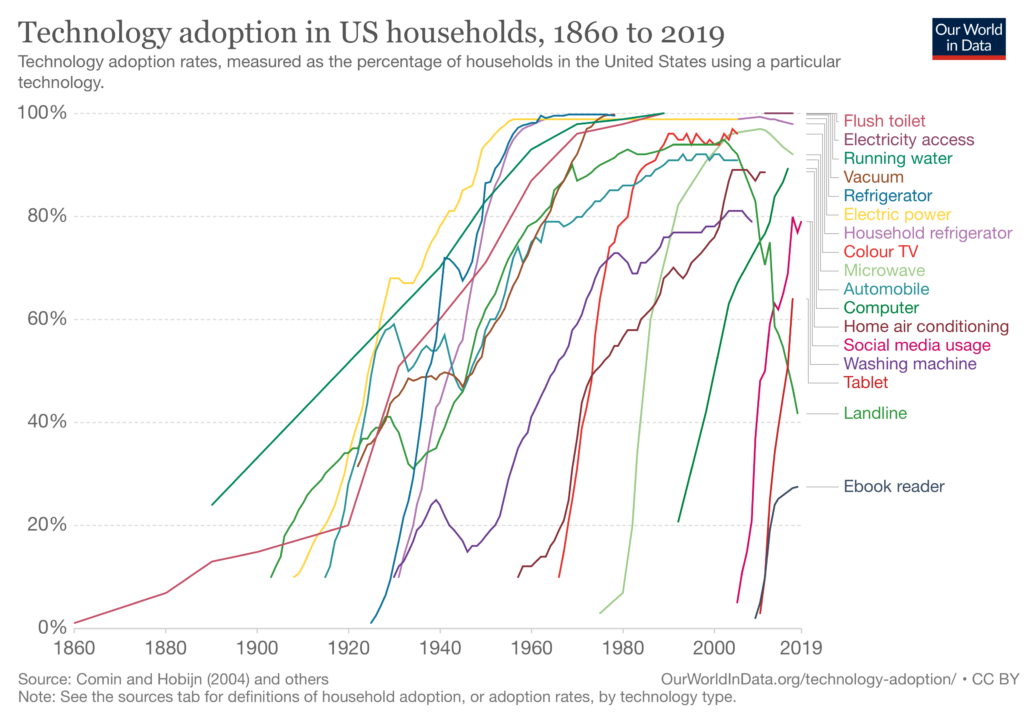
    Typically adoption curves project a market’s desire for a product. The graph below is a standard view of various technologies adopted over time by US households. Clearly some achieve nearly 100% market adoption (like flush toilets), while others achieve high adoption only to lose share in the long run (like landline phones). Geoffrey Moore’s Crossing the Chasm suggests that a company tailor its products specifically to a key market segment known as the “early majority” to move from “early adopters”, achieve success and grow more market share. Those that don’t cross this chasm either fail outright, or limp along in a low- or no-growth regime, sometimes for, well, decades (like Ebook readers!). This is something I have seen countless times in edtech, and that was certainly true of ALEKS before it was acquired by McGraw-Hill Education (MHE).

    https://ourworldindata.org/technology-adoption

    So what changed? For ALEKS, being more integrated with MHE content, marketed and sold by the considerable resources of a major textbook publisher helped generate new demand. But like most big publisher products, faculty tend to use ALEKS as a supplement to a course. Typically these products comprise 30% or less of the course activities and grade-able components. It’s difficult to say whether the product has “crossed the chasm” at this stage.

    On the other hand, Acuitus—the tutoring technology platform cited in the EdSurge article—has been refining an approach over the last several decades to model how human tutors help with valuable interventions at key points of the learners’ progress. Their goal now is to pivot to more mainstream education needs, including an income-share arrangement for upskilling workers. A task that will require many millions of dollars to achieve. They are most definitely still trying to cross the chasm.

    Some would argue that product-market fit—the degree to which a given product satisfies strong market demand—improved in both of these cases, but why is it taking so long for the industry at large to adopt these kinds of technologies? Despite the growing influence of “online learning” in the industry, why are so many faculty still wrestling with getting the basics of their curricula ready for the demands of the incredibly altered 2021 academic year education landscape? Why does it seem like EdTech players writ large continue to struggle to find the right product-market fit to gain significant market share advantage?

    First and foremost, technology alone is not going to provide the answers. The latest adaptive learning platform is useless without good content. And an online course will fall short if it does not offer truly great user / learner / teacher experiences from implementation through completion. Using technology to track learner profiles is great, but if a significant percentage of the learners are using their own technology to search homework sites for answers to textbook questions, then a learner profile will not describe outcomes accurately. More generally, faculty who do not have formal training or the support of institutional culture, policy, infrastructure and best practices to implement their courses will likely struggle.

    I would never claim to have all the answers, but I do believe that these extreme exogenous factors that flow from the pandemic are fundamentally recasting many of the vectors that drive an adoption curve. Chief among them, the stark threats to institutional viability and business continuity will force the shape of what has been an otherwise long and drawn out technology adoption curve to accelerate. Other vectors like advancing technology, business model innovation by institutions and commercial providers, the regulatory landscape, and changing consumer tastes will continue to add accelerants as well.

    It is increasingly clear this crisis mode we are in will permanently change attitudes. But it certainly should/will not be simply “how do I stuff my powerpoints into the LMS?” rather a more deliberate consideration of how technology-enabled teaching and learning must be implemented to ensure our academic institutions stay relevant to the needs of learners while also retaining the most important features of academic freedom, academic integrity and enduring brand value.

    Next up: The Billion Dollar EdTech Platform Hole

    The egg layers: Poppy, Paisley, Cherry, Princess Leia and Nutmeg
  • #ResilienceNetwork Discussion Prompt Video

    As I mentioned in a previous post, I want to encourage conversation among groups about how we can build a #ResilienceNetwork together. The first such conversation will be next week at the Apereo Foundation virtual conference. I’ve created a discussion prompt video to kick off the conversation:

    #ResilienceNetwork Discussion Prompt

    [https://youtu.be/n8rY1PnH6o0]

    Here’s the lesson plan:

    • The foundation will be posting the video above on a discussion thread accessible to conference attendees. We will encourage folks to brainstorm asynchronously before we start.
    • I will facilitate a conversation with community leaders—in this case, Ben Maddox from NYU, Matthew Rascoff from Duke, and Aria Chernik from Duke OSPRI—about the input. We will also have synchronous breakout groups to discuss the prompt. These two pieces can be sequenced in either order, depending on the preference of the community.
    • We’ll wrap with a discussion with the leaders processing the input from the community and talking about the next steps to refine and prioritize the ideas and develop an action plan.

    The video and lesson plan are CC-BY licensed, as usual. You can use them without my prior permission. If you want to do this yourself with your group, feel free. If you produce interesting results, let me know. If you think that I can help, then ask me and I’ll help if I can.

  • Surviving the Third Wave of COVID and Beyond

    We have now fully transitioned into the second wave of the COVID crisis for higher education. Educators and students, having survived the sudden and painful transition to remote education, are now turning to the fall and frantically searching for a less painful and more meaningful educational experience than the one they just endured. I’m beginning to see hopeful signs in the sector-wide collaboration in this phase. Within a week, there will be an announcement of the first initiative that will demonstrate what a proportionate response could look like. Stay tuned for the details.

    But the third wave is coming fast. It will be a financial crisis that tears at the social fabric of academia and threatens to unmake colleges and universities as we know them, not only because of the economic hardship itself but also because many academic institutions do not have the unity of vision and effective governance to navigate this next wave without a great deal of distracting and destructive infighting. As the early budget cuts are starting to roll in, so are the early skirmishes being fought in faculty senates and in the academic press.

    As I read one harbinger of the next wave of the crisis—”Bashing Administrators While the University Burns” by Gabriel Paquette in The Chronicle—I was struck by just how intimately related the coming challenges are to many of the themes covered here in e-Literate. If we want to weather the coming waves with as little permanent damage as possible, we would do well to revisit these lessons afresh and consider them as intimately connected to academia’s core challenges rather than as one niche of debatable importance.

    Ahistoricity

    It’s easy to read Paquette’s piece as the expected administrator’s response to a labor dispute with faculty brought on by budgetary pressures. But if we read the piece more closely, there is a lot here to unpack.

    Take this passage, for example:

    Myths provide comfort but offer little practical guidance. It is easy enough to conjure a vision of a lost academic paradise where philosopher-kings served as presidents, and departments were semiautonomous cantons. This paradise, the myth continues, was decimated by the irruption of centralized authority, the eclipse of academic [sic] by corporate values, and the corruption brought by private philanthropy and athletics. The only chance for redemption, according to this view, is a restoration of the prelapsarian idyll.

    If such an idyll ever existed, its heyday coincided with an age when universities were bastions of race-, gender-, and class-based privilege, with a minute fraction of the population enrolled in higher education. This scholastic arcadia could not withstand the pressures brought by the expansion of access to (and democratization of) higher education, the conversion of universities into vehicles of social mobility, the administration of enormous government contracts and grants, and universities’ newfound status as economic bulwarks of entire communities. The resulting transformation gradually made traditional modes of academic organization obsolete. What replaced this beloved anachronism was not necessarily superior to it. But it was a form of management better suited to the complex, large-scale multiversity.

    Bashing Administrators While the University Burns

    Back in 2017, when describing research on cultural differences in learning, I wrote,

    We are currently facing two civilizational educational challenges. By “civilizational,” I mean that they go beyond country- or region-specific challenges. They are unprecedented in the history of humanity. The challenges I’m talking about are universal access to quality education and universal lifelong learning, both of which are almost certainly ones that you’re well aware of. But we don’t talk enough about how unprecedented they are, what we need to learn to do differently to meet them, and how we could go about learning what we need to learn.

    Research in Translation: Cultural Limits of Self-Regulated Learning

    Notably, that post was about a study examining the differential impact of teaching techniques in MOOCs on students from different cultures. Yes indeed, the world has changed. As much as there has been good reason to decry the early hype and continuing shortcomings of the MOOC model, nobody was asking this kind of research question back in the good old days of the Great Depression. (The previous one.) We cannot commit ourselves to the ideal of equal access to quality education for a global population of 7.8 billion people and simultaneously remain committed to the ideal of small in-person seminars as the paragon of quality education. The two are simply incompatible. I am not suggesting that we lower our standards. Rather, I am suggesting—and I believe Paquette is suggesting—that we take a good hard look at how much our standards may be influenced by hidden assumptions of privilege. Why should a “quality education” for the 21st-Century masses look identical to the “quality education” of the 19th-Century elites? Where do these ideas of quality come from? Whose goals do they serve? And what trade-offs do they entail?

    Paquette continues,

    Among the drivers of the much-lamented “administrative bloat” are government regulation and student services. The former has added layers of compliance most university denizens applaud, including the creation of offices to uphold civil-rights laws and Title IX, unmistakable signs of social and political progress. Similarly, the advent of a vast support apparatus is not an affront to the university’s academic mission. The monochromatic student body of yesteryear has been replaced, felicitously and partially as a result of faculty advocacy, with a heterogeneous one more reflective of society’s diversity at large. Students from less privileged backgrounds often depend on support services to flourish, with staffs large enough to meet high demand.

    This faculty critique of the contemporary university is predicated, then, on a surprising ahistoricity. Such critiques obscure from view the rationale for current structures of governance.

    Bashing Administrators While the University Burns

    This part of Paquette’s argument is more complicated. On one hand, there are many reasons why administrative costs have grown dramatically, not all of which are as straightforwardly benign as Title IX compliance. On the other, the very complexity of these decisions is further justification for the careful and cool-headed accounting conversation that Paquette calls for.

    Consider robo-graded homework platforms. Why do they exist? Five or ten years ago, publishers would tell you it’s because faculty appreciate the labor-saving convenience. (They have better answers now, but those answers have nothing to do with why robo-graded homework platforms were created to begin with.) Faculty will often tell you it’s because they just can’t grade multiple homework assignments a week in a 400-person class, even with the help of TAs. Why do we have 400-person classes? Because as universities strive to teach more students without having access to proportionately more money, it turns out that large lecture classes are very cost-effective. In a different sector, they would be called “profitable.” They generate more revenue than they cost. Where does that extra revenue go? It’s hard to tell in many cases because a lot of colleges and universities are allergic to this kind of accounting. But one place that money often goes is to subsidize courses and programs that would be called “unprofitable” in a different world. Foreign language departments. Upper-division and graduate programs. Is this the right educational trade-off to make? I don’t know. I’m not sure there is one universally correct answer to that question.

    But I do know answers to two different questions that are highly relevant to the previous one. First, was this set of trade-offs made consciously by most institutions? No, it was not. The vast majority of the people involved in making the incredibly complex chain of decisions that are relevant here—down to how many graduate students academia should be producing in different disciplines—are almost completely ignorant of these economics. They certainly are not trained to have sophisticated conversations about them (even if their institutions were capable of performing the necessary accounting, which many are not).

    Second, could a different set of technology-assisted trade-offs have been made? For sure. Technology is good at reducing the cost of repetitive work that requires relatively little judgment. For example, when I was a product manager at Oracle in the mid-2000s, I was shocked to discover that most faculty were still copying students’ final course grades from their electronic LMS grade book and pasting them manually into their electronic registrar grade book. Every minute spent doing so was a minute less that a given instructor had to perform other, higher-value work. If you work at a college or university, think about how much of your day is spent performing such mind-numbing tasks, like manually entering data into a spreadsheet when that data exists somewhere else in electronic form. Academia could have relentlessly sought out such inefficiencies first. But they didn’t. They still haven’t.

    Here’s another example: Businesses understand that losing paying customers is bad. If they go away, not only do you lose the revenue, you also have to spend money to attract a new customer to replace that revenue. Many universities treat student retention as a mission issue. They’d rather not fail their students that way, all things considered. Not all universities even see it as that much of a problem. So-called “weeder” programs are still all too common. But in reality, in addition to being an issue of ethical responsibility, retention is also one place where universities leak money. This is an area where the institution can be more financially sustainable by serving its students better. Technology can definitely help with this problem in multiple ways. And yet, many segments of academia have been slow to prioritize retention, as well as the related challenges of degree completion and time-to-graduation.

    Hang together or hang separately

    Ultimately, Paquette is not as focused on taking sides in an adminstration/faculty budget war as he is on pointing out that war is not the answer:

    Denunciation, recrimination, and grandstanding are pit stops on the road to oblivion. This is not to say that faculty criticisms of university leadership are unfounded or invalid. But they are a dead end unless accompanied by the constructive aim of collective betterment. The allure of mounting the barricades is almost irresistible, but what’s the point if we all end up guillotined? What use is rehearsing old grievances if students balk at further indebtedness, and our revenue models collapse?

    I anticipate one of two scenarios in the coming years. In the first, the familiar feuds persist, and the university edifice crumbles, with old enmities slight consolation for those who remain amid the ruins. In the second, instinctive self-preservation and mutual interest incite faculty-administrative cooperation, institutional moribundity is reversed, and a new university is erected on the foundations of the old. Viva la revolución, indeed.

    Bashing Administrators While the University Burns

    In one of my earlier posts on COVID, I quoted Ben Franklin as saying, “We must, indeed, all hang together or, most assuredly, we shall all hang separately.” That is as true intra-institutionally as it is inter-institutionally. In recent months, e-Literate has proudly featured two guest posts by Susan Baldridge, co-author of The College Stress Test. Both posts were about having hard internal conversations about institutional change. They may have seemed tangential to e-Literate‘s core focus. They were not.

    What does it mean to be “e-literate”? When I came up with that name many years ago, it was meant to be self-deprecating. But it also contains a serious message I believe in passionately, now more than ever. Academics—educators—take literacy very seriously. It is a word with deep meaning and many nuances. A life-changing word. E-literacy is a kind of literacy. Today, as we all learn how a funeral or a wake over Zoom can be meaningful and resonant, as we learn how social media can be used simultaneously to bring us together and tear us apart, as we struggle to support friends and loved ones and colleagues and local businesses and total strangers from a distance, we are learning to be more e-literate. Just as literacy is about more than employing the technology of the printed word, e-literacy is about more than EdTech. It’s about culture. It’s about understanding how we change ourselves—consciously or not—when we choose to depend on certain tools in certain ways. And it’s about making mindful choices.

    We are entering the third wave of the crisis. If you want to understand what that means, then just turn on the TV news for five minutes. This is the moment when either we all come together or we all fall apart.

    We need to think harder, and we need to share what we are learning with each other so that we can learn faster together. That’s what the written word was invented for. That’s what literacy is about.

  • The Resilience Network Manifesto

    I have been writing here on e-Literate about the need for higher education to create a resilience network in response to COVID-19 and future continuity crises (like hurricanes, wars, and so on). In the course of evangelizing this idea with various parties, I have discovered two barriers. First, as with every other aspect of the COVID-19 crisis, people are at different stages of understanding with the first-, second-, and third-order effects. We are not yet all on the same page regarding how different this crisis is and how different our response needs to be. Second, even with people who are far along in that journey, many struggle to envision what an appropriately different response could look like. COVID-19 is revealing the reflexes and habits of mind that have made us vulnerable. But recognizing that our most reliable strategies are failing us is not the same as being able to envision new strategies. We are confronting a cascade of systemic failures, one of which is a failure of imagination.

    Time is running out. We are not moving quickly enough and I have apparently not been communicating clearly or urgently enough. This is a call to action.

    What’s at stake

    Let’s start with what we know.

    We know that, while online education can be as effective for students as face-to-face, it often isn’t. We know that delivering quality online education is hard, requiring specifically trained faculty, specifically designed courses, specifically optimized technology services, specifically designed guidance programs, and a whole host of other difficult operational skills. We know that, when colleges don’t get all of these hard operational details right, more students fail out or drop out. Sometimes dramatically more. We know that underserved and neurodivergent students are disproportionately hurt during these failures. We know that students who drop out are at higher risk of not returning.

    We know that the most effective online programs have taken years or even decades to hone. We know that the vast majority of colleges and universities do not have years or decades of experience and do not have sufficiently knowledgable staff in sufficient numbers to be able to build such programs quickly. We know that many of the people upon whose shoulders a transition will fall are not active participants in the associations that help people like them find the knowledge and resources that they need.

    We also know that even the tried-and-true formulas of the most experienced online programs may not fit the environment we will face several months from now. I am not aware of any university that designed entire degree programs to be adaptable on the fly to multiple possibilities of online and blended. I am not aware of any university that has trained all its faculty and prepared its physical plants for the kind of flexibility we may very well need for an unknown period of time. The vaccine is at least a year away, and that estimate is extremely optimistic.

    The other day I was on a call with an administrator I respect from one of the very best and most effective online programs that I know of. One that operates at significant scale. He said he is very worried that his own administration is overconfident in their ability to move the rest of the university online quickly and effectively. He said they think they are a lot better prepared than they actually are. I can’t name that university here, but if I did, you would be appropriately afraid. I certainly am.

    We are on the cusp of losing a generation of students. But that is not the worst of it. Because if we lose a generation of students, then many colleges and universities, including ones that we have thought of as safe and stable, will fail. The University of Michigan is forecasting a $1 billion budget shortfall. Every college that emphasizes the benefits of residential education is at particular risk. All of their previous investments in that idea are now costs that they have no obvious way of sustaining. Everything that was a mark of distinction is now a disadvantage.

    The Cal State system has announced that all campuses will be closed in the fall and all courses will be online. Their more prestigious sibling, University of California system, is having a harder time making that call. Here’s an excerpt from the article linked above:

    The state’s other four-year public university system, the 10-campus University of California, was not prepared on Tuesday to immediately follow CSU’s example, a spokeswoman said.

    “We are exploring a mixed approach with some material delivered in classroom and labs settings while other classes will continue to be online,” Claire Doan said in an email to EdSource. “Our campuses will reopen for on-site instruction when it is safe to do so — in coordination with federal, state and local health departments and authorities.”

    Classes across the UC system have been online since March. The UC Board of Regents is meeting next week and is expected to discuss plans for the fall. So far, UC San Diego has announced a massive coronavirus testing plan for students, faculty and staff. UC San Diego this week is starting testing for the 5,000 students currently on campus, with plans to expand that to all 65,000 students, faculty and staff in the fall. That campus is aided by having its own medical center.

    First in nation, California State University to close campuses for in-person instruction this fall

    Think about that billion-dollar shortfall that Michigan is facing. Now think about how the UC system is struggling with the idea of giving up the fees that pay for student dormitories, cafeterias, gyms, and so on. And struggling to imagine how they convert the kind of residential education that they have held up as an ideal into an online format that students will recognize as being of equal quality—and equal financial worth—in three months. Think about how many colleges and universities are in this situation.

    We are facing more than one pandemic.

    All of those crazy predictions of 25% or 50% of colleges going out of business are suddenly a lot more plausible. We will lose institutions. Some will be ones that you don’t expect. Many that do survive may have to make draconian cuts that, particularly if they are made out of a sense of panic, could fundamentally alter the missions of these institutions while putting them at greater risk of failure. This could happen very quickly.

    As with COVID-19 itself, every day counts. We will permanently lose students and universities. Careers will die. Institutions will die. The question is how many. The answer to that question depends on the adequacy of our response.

    Our current response is inadequate

    I have written before about how the POD Network has published a Google Sheet with 400+ links to university continuity web sites, and that it overlaps to an unknown degree with a separate Google Sheet organized by Bryan Alexander that also has several hundred entries. This is laudable work. And it is impressive, particularly given how much else the organizers have to deal with in the rest of their work and personal lives. Four hundred institutions is a non-trivial percentage of all colleges and universities in the United States. Almost a double-digit percentage. (Not all of the institutions on the spreadsheet are US colleges and universities, but that doesn’t take anything away from the accomplishment.) I have spoken with many educators who are involved in one sort of effort or another to create a database or a web site or a Google Sheet that lists resources. I thank you all. I admire you all.

    Please understand that I mean no disrespect when I say that all of these efforts amount to a drop in the bucket relative to the current need. Those people who found time in their busy days to add a link to their web site in the Google Sheet? Each of those people is in the middle of a separate institutional hurricane. It is chaos. OK, they have some content. Is it the right content? Is it everything they need? If not, will they have the time they need to click through each of the 400+ links in that Google Sheet in an effort to find what they need? Are they able to get the information effectively to all the institutional stakeholders who need it, when they need it?

    You already know the answers to these questions.

    Some of you have pointed out to me that there are years—decades, even—of high-quality resources that people have been creating to help faculty learn how to teach online. That’s true. Let’s imagine that everybody knows about this content. (They don’t.) Imagine that they know where to find it. (They don’t.) And that they know what to look for. (They don’t.) Ask yourself this question: As somebody who knows about all of this great existing content intimately, are you able to fill all of your campus’ informational needs simply by plugging in resources that already exist? Or are you finding yourself creating new documents, videos, and training interventions despite the fact that all these great resources exist, and that you know about them, and you know where many of them are, and you know what you need? As your institution goes through successive waves of the crisis—from online to blended, or blended to online, through the budget crisis, through the thrashing about for new kinds of programs that can keep you afloat, through teaching everybody just what the heck a stackable credential is, through the unknown series of twists and turns—as you go through all of the waves that are coming, what are the odds that you will continue to need to create new resources?

    So we’re all in #pivotonline now, and online is finally getting its due. Yay rah. Nobody expected us to pivot this way. Nobody prepared for this. Nobody can fully prepare for what comes next. Because we don’t know what comes next.

    We are not ready for this.

    Nobody will save us

    Will the state of Michigan fill the university’s billion-dollar budget hole? Could they do it even if they wanted to? I don’t know. Will universities that had what they thought were good cushions in their endowments be able to live off their rainy day funds now that the stock market has tanked and revenues are circling the drain? I have no idea. Will the Federal government ride to the rescue? I’m not even sure that the Federal government will continue to deliver my mail six months from now.

    No central agent will coordinate the production of COVID tests. Nobody is procuring and distributing PPE, balancing supply and demand across 50 states. Nobody has maintained the stockpile of ventilators and made sure that they are in good working order. There will be no grand rescue plan. Nobody is coming to save us. We must save ourselves.

    The corollary is that whatever we can do that is different and more effective than what we are doing now, it will not be beautifully architected and meticulously orchestrated. It will be messy. Inefficient. Chaotic. Redundant. Exhausting. In other words, similar to the current situation, but incrementally and iteratively better. It will not be an adequate response to the crisis either. We are beyond the point where adequacy can be achieved in the foreseeable future. We must now aspire to produce the least inadequate response possible and to make it less inadequate as quickly as possible. This is where we are. The sooner we come to terms with that, the more careers and institutions we will be able to save.

    What a resilience network could be, conceptually

    When I have spoken about a resilience network with various people, I have repeatedly gotten the sense—sometimes said explicitly, but often not—that people think it is something that I intend to own or control. Let me be clear: the Resilience Network is not trademarked. It is not proprietary to me. This is not about me. It’s about mustering a more effective group response to immense suffering.

    In terms of ownership and central coordination, I think of the resilience network as something like a hashtag and something like a potluck dinner. It’s like a hashtag in the sense that it is a way to crowdsource organization with intentionality. Creating lists of useful resources is good. Creating discoverable resources is better. Creating discoverable resources that are tagged with something that has semantic weight is better still. There is a difference between the way the #adorables hashtag works and the way the #MeToo hashtag works. Also, #pivotonline is different than #resiliencenetwork. There’s nothing wrong with either of them, but one focuses intentionality on the problem of the moment—getting courses online—while the other focuses on building a supply chain that can help us respond to the larger crisis as it evolves over time in a way that leaves us more capable rather than less. But the main point is that anybody can label their resource, their list, their workshop, or whatever as #resiliencenetwork.

    The resilience network something like a potluck dinner in the sense that the tagging with intentionality enables us to conduct some lightweight collaboration. If we know who is coming to the potluck dinner and what they are planning on bringing, we can begin to identify redundancies and holes. If we have four salads and no proteins, then maybe somebody should bring a protein. Note the level of specificity. Realistically, everybody is producing and sharing what they are capable of producing and sharing. No amount of intentionality will make me capable of cooking salmon without producing an inedible mess. But I can probably manage some burgers if I know that people need protein and already have plenty of greens. We can incrementally but meaningfully improve our coordinated production and sharing of resources.

    This description may give you a sense of what a resilience network could feel like, but it’s probably still too vague to give you a clear vision for what it actually does. We need to get more specific and operational.

    What a resilience network could do

    I have a few ideas about what we could realistically be doing to improve the effectiveness of our crowdsourced response at this moment of great chaos.

    Use technologies to help with curation

    Between the two aforementioned Google Sheets alone, there are hundreds of web sites that purportedly fulfill the same purpose. It would not be hard to have a web crawler index all of these sites and apply machine learning to begin classifying the documents it finds. It could make a list of all resources that look like instructions for creating effective lecture videos, all the ones that look like they are about facilitating online discussion, and so on. I suspect the level of effort for the first iteration of this is somewhere on the order of one engineer working for somewhere between a few days and a few weeks. Several iterations would likely be required to make the software as useful as it could be. For example, we might cross-reference URLs with IPEDS data so that somebody browsing the database could filter documents for ones being used by institutions that are like their own. We could also increase its value by having it crawl more data sources, like databases that are being maintained by various associations for different purposes. But even the first iteration could greatly increase the value of the resources that are being shared by increasing their discoverability and making their curation easier.

    Importantly, this application of technology would enable us to detect changes in the resources being produced over time. As we roll through successive phases of the crises, needs will change. The people on the ground who are managing their respective institutions’ sites will be the first ones to see the new needs as they arise. If we can watch their responses as they are evolving, then we can galvanize faster and more effective collective action.

    By itself, a crawler with some intelligence behind it would be a major improvement over what we have now. It doesn’t supplant the current efforts by human experts. Rather, it augments them. Even better would be to have a collaboration space where some of the people who are creating, curating, or looking for content can collaborate across organizational boundaries. The crawler’s classification algorithm will need to be tuned and retuned over time. To do this, we will need people to correct its mistakes and to enrich the results with information that only the human experts can apply—like, for example, if the resource is grounded in evidence-based practices—in order to make the resource lists maximally useful. So having a large-scale but porous collaboration space, like Slack or Yammer, could complement the machine classification by supporting better human curation across the organizational silos that normally confine this sort of work. At some point, we all need to talk about what we’re bringing to the potluck, what we have too many of, and what we need more of.

    Use technologies to help with dissemination

    The strategy above would help us develop better resource lists, but that’s only part of the problem. Another part is that most educators struggling to get through this crisis don’t have time to sort through even well-curated lists. Support staff at colleges and universities are doing heroic work organizing content into structures that help faculty walk through course design and delivery processes with step-by-step and just-in-time guides. But they are overwhelmed. Even if all faculty came for help (which they don’t), there simply aren’t enough staff to answer all the questions that aren’t on the generic guides.

    We have technology that can help with this too. Once we have the curated and evolving list created with the help of our crawler, we can feed it to a chatbot. Educators could ask natural language questions for exactly what they need and get targeted answers. As with the crawler, a first iteration of a chatbot could be built quickly and then refined iteratively over time. Rather than answering the same questions 100 times over, the human experts could identify the increasingly frequent questions, train the chatbot to recognize and answer them, and then focus their time on answering the tough or unusual questions. A cloud-based chatbot could be embedded anywhere and everywhere that people might have questions in the moment. It could be put in an LMS. Or in a courseware product. Or on a university web site. Or an association web site. It could be in all of those places at once. Since different points of use would likely have different audiences, we can use the information about where the chatbot is embedded to scope the answers and produce more reliably useful ones. If the chatbot is embedded in a chemistry text, then users are more likely to be asking questions about teaching or learning chemistry. If it’s on the site of an association for instructional designers, then we can expect different questions.

    With these technologies, we can assemble a supply chain. We can find resources wherever they are, track changes in production of those resources, organize and curate them so that the right resources are more likely to be routed to their point of need, and create a delivery system that is ubiquitous.

    When people talk about the Fourth Industrial Revolution—a phrase that I confess I am ambivalent about—this is what that term can mean in the best sense. Machines helping humans to be more fully human. Creating tools that let us apply our expertise and good intentions more effectively, wasting less time on work that could be automated so that we can invest more time in high-value work that requires human judgment. This is not the hard part. There is absolutely no reason I can think of why we can’t or shouldn’t do this.

    Facilitating collaboration

    But by itself, technology won’t save us. We need to do the work. And we need to do it together. Collaboration is hard in even the best of times, but the fact that it is hard does not make it any less necessary. We need to find lightweight yet effective ways to coordinate our potluck efforts.

    I am offering to run a traveling collaboration roadshow. The first organization to schedule such an event is the Apereo Foundation, although I am in conversations with a number of other organizations and expect to have more such announcements soon. In Apereo’s case, my roadshow will be part of their 2020 virtual conference next month. I’ll describe how we intend to structure the interaction, as I expect it to serve as the first iteration of a template for similar events.

    I will record a brief video talking about the concept of a resilience network as a hashtag and a potluck. The video will end with two discussion prompts. First, what does your community have to offer to such a network now that it wishes to share more effectively? Second, what could your community create, consistent with its strengths and own immediate needs, that it could contribute to a larger effort? This video will be embedded in a discussion thread before the event. Community members will be invited to comment.

    At the two-hour session itself, I will open the conversation with a brief expansion on the idea of a resilience network, including some of the ideas in this post. I will then have a conversation with a community leader, responding to the comments that we gathered in response to the discussion prompt. (In this case, my discussion partner will be Aria Chernik from the Open Source Pedagogy Research + Innovation network (OSPRI), a Red Hat-supported project housed at Duke University, about how institutions can process the lessons learned from the pivot to emergency remote instruction this spring.) The intention here to set the stage for the second round of brainstorming, this time in the synchronous session.

    From here, we will go to breakout groups. Participants will add to the original discussion thread as they develop ideas in their breakout groups. We will end the session with a final discussion led by Aria and me to process the ideas.

    I hope to conduct a number of these sessions with different organizations, and to encourage each organization to follow up on the brainstorming by identifying the best ideas that their group can follow through on. By the fall, I hope to have had enough of these conversations that representatives from these groups can gather for a potluck planning session. What is everybody cooking up? Are there ways in which we can adjust our plans to increase the complementarity and reduce redundancy in the work that each group is doing?

    I don’t know for certain what we should do after that. It will depend on what everyone wants to do and is able to do. The way we will figure out how to better collaborate going forward is by collaborating better now.

    It’s on us

    I am working to bring about all of the ideas listed above, as well as helping out with some other initiatives that I believe are important to the idea of a resilience network (whether or not they choose to label themselves as such). In many cases, I am doing this work for free. In some cases, I may actually end up contributing money as well as time. I’m doing this not because I believe that the resilience network is my project but because I believe that helping in this time of crisis is my responsibility. If you want to do something that you believe is relevant to #resiliencenetwork and think I can help, then ask me. I will help if I can. Whether or not you need my help, you definitely don’t need my permission. We need a resilience network. Please build one. Do your part. Take the name. Take the ideas. Take whatever you need. Just do it.

    I love the people who work in education. I don’t mean that in the casual sense. I love you. The work you do—particularly now—inspires me. It pains me greatly to tell you that what you are doing is not enough. We are not rising to the challenge, collectively, in the way that we need to be. Everybody is working incredibly hard. Everybody is working in good faith. Those are not enough. We also must work effectively. And we must work differently. Change and efficiency are not higher education’s strong suits.

    But we are good at learning. It’s time to learn quickly and act quickly.

    I know that we can do this. But I don’t know if we will.

    Are you with me?

  • COVID-19: What comes next

    One of the weird things about humans is that we most want to be told what will happen next at the exact moment when the future is uncertain because the outcome depends upon decisions we have yet to make. Most of the time, the future is predictable partly because there isn’t a lot we can do to change it. This is not one of those times.

    Like so many aspects of this civilizational crisis, our choices—as individuals, institutions, and societies—will shape the future. We can decide to let our institutions fall apart. We can try to hold them together with chewing gum and string. We can let others decide for us, which risks letting the most powerful and self-interested actors determine our future. Or we can choose to mindfully rebuild. Each of us gets some say in what happens next (though, tragically, some more than others).

    I don’t know how all of this will play out, and pretending otherwise would be harmful. We all need to dwell in the uncertainty that enables us to make choices, and we need to make our choices together as a sector. For this reason, I’m reluctant to advocate too forcefully for my views of what is likely happen, or even what should happen. There may be time for that later. But at this moment, as our educational first responders are struggling to deal with the first wave of the crisis while beginning to brace themselves for the second wave, I think it important for those of us who are not in that role to exercise some situational awareness. Now is not a great time to pontificate or prognosticate—at least not without extra doses of humility and empathy.

    That said, we are far enough into the first wave that it is time to start thinking about the future. For some of us, that will mean learning to walk, chew gum, and juggle chain saws at the same time. So with that in mind, I’m going to offer up some of the change vectors I’ve been thinking about lately as conversation starters

    Everyone will be cash-strapped

    Students and their parents have lost income. Adjunct faculty, upon whom so many colleges and universities rely, are also highly vulnerable to a social safety net with many holes in it. Universities face the possibility of refunding student tuition and fees, and may well experience a major shift in enrollments next year as students reconsider their options. States face massive budget deficits.

    While all of this is obvious, the implications are not. We don’t know yet how our federal governments will respond. Or the states. Or the institutions. Or the students. Or anyone, really.

    When I think about these sorts of multi-level problems, I try to find the highest organizational level at which I think I can have a significant influence. For climate change, I am more focused on state and local actions than at Federal or global ones because I feel more able to influence my state and local governments. For COVID-19 and higher education, it may be at the institutional level. University communities have never been terribly good at understanding the mechanics of their institutional sustainability models. How much money comes from public funding vs. grants vs. tuition vs. alumni donations? Which programs cross-subsidize which others? What have been the drivers of cost increases? How are these dynamics shifting? Now is the time to get smarter about this so that we can make smarter decisions going forward. While this sort of thinking feels uncomfortably close to reducing education to a consumer commodity, there will be no higher education if universities can’t get their budgets to balance. This is a particularly urgent conversation to be having.

    Online isn’t going away any time soon

    While I find some of the cheerleading for #pivotonline to be too soon and sometimes too opportunistic—particularly from folks who are not working on the front lines—we shouldn’t expect the need for online education to magically disappear by September, or for the world to eventually revert to the way it used to be. What holds for all other aspects of the post-coronavirus world also holds for education. Social distancing is a reality that we will be living with for a long time. Long enough that new patterns of life and work will set in. The implications are both deep and wide.

    First, this change will impact the sustainability models I referenced above. Students are already asking for their housing costs to be refunded for the semester. Those who have been paying attention to the trends in online pricing are aware of a wide range of price-relevant experiments in various stages of progress in the market, from xMOOCs to stackable credentials to affordable degrees at scale to premium-priced OPM-designed master’s degrees. There is no one right answer here. Colleges and universities will find different combinations that fit their missions, sustainability needs, and organizational capabilities.

    Second, we will need to pay extra attention to equity. This is an area that was already beginning to get some much-needed focus, but the current crisis will bring the problem into sharper relief. For example, universal access to affordable broadband is more obviously an equity issue when it is inextricably tied to access to education. More broadly, we know, based on a rich body of research, that underserved students underperform relative to their peers online. (This is likely even more true in hastily and poorly executed remote education courses like the ones that are being thrown up out of necessity this term.) We need to redouble efforts to understand their needs and fill gaps in our support for them.

    One potential bright spot in the larger crisis is the opportunity to introduce more faculty to both new ways of thinking about their teaching practices and closer relationships with expert support staff. We know that both of these things tend to happen when faculty are introduced to online teaching on a more orderly and voluntary basis. Unlike with face-to-face instruction, many instructors don’t feel like they should be expected to somehow know how to be master teachers online and therefore are less reluctant to see themselves as novices and students. On the other hand, if the transition goes disastrously poorly at a moment when faculty (like all of us) are feeling vulnerable in other parts of their lives, the trend could turn in a different direction. This is a moment when the deep structure of academic culture will get rewired, one way or another. We need to be mindful about how we support and enable the support staff so that they have the best chance of steering the change in a productive direction.

    The curricular materials ecosystem is especially fragile

    This one may be less obvious to some. The curricular materials ecosystem was already in danger. Almost none of the textbook publishers were financially healthy even before the virus hit. OER is doing fine, but it is not on a growth path that is remotely fast enough to fill the giant hole in course coverage that would be left should the publishers start to implode. And while it may be tempting for some to say “good riddance” to the traditional providers, try telling frazzled faculty who are in the midst of a sudden, unplanned, and unwelcome online transition that they will also have to cobble together a replacement for their textbook in the process.

    At the same time, if we really are facing a new reality of a large-scale and long-term switch to online education, then we need to find the means and measures for closing online achievement gaps for transitioning students in general and underserved populations in particular. To do this, we will need to embrace digital affordances. The sector is in no way prepared for this. We don’t have the privacy policies, procurement practices, or widespread literacy among faculty regarding how to make effective use of digital affordances. Furthermore, if the publishers collapse, where will these digital products come from? The majority of sophisticated courseware authoring platforms have either died on the vine or been acquired by the publishers. There is very little in the way of sustainable open-source alternatives. Nor is there an alternative ecosystem in place to produce content for these platforms.

    As part of this larger shift, we need to engage in some big, out-of-the-box, but reality-grounded thinking about how we might reconfigure the entire curricular materials ecosystem to create more stable and beneficial sustainability models. I don’t have a lot to say about this yet but hope to have more to say about it soon.

    Working together more effectively

    Finally, folks who have been reading e-Literate regularly over the last few years know that my current professional obsession is about how ineffectively higher education collaborates as a sector, despite the deep reservoirs of goodwill and generosity among the people who work in it. I have written quite a bit about the Empirical Educator Project in general and the idea of a resilience network in particular. We need to work on improving our collaboration now more than ever.

    As Ben Franklin memorably put it, “We must, indeed, all hang together or, most assuredly, we shall all hang separately.”

    Truer words….

  • The Resilience Network Supply Chain

    This post is part of a series on building a lasting resilience network to support the continuity of quality higher education during times of crisis. In the web version of this post, a table of contents for the series is included at the top of the post.

    In my most recent post in this series, I wrote about the kinds of resources that are necessary to create, curate, and distribute during a continuity crisis such as the one we are experiencing now with COVID-19 and made the analogy to the supply chain for healthcare. As the crisis unfolds, we are learning about not just the materials that are needed but how they need to be found or created, vetted for quality, and distributed to where they are needed. Sometimes those resources already exist. A store of N95 masks may be sitting in the crypt of a cathedral. Somebody might invent a way to convert a snorkel mask into a ventilator part, which will need to be tested for efficacy and safety. Or they may develop and test a new ventilator hardware design and release those specifications as open-source, but the plans still need to get into the hands of organizations that are capable of making the device. Maybe thousands of former military personnel volunteer to help, but those volunteers must be matched to hospitals that need them. If we produce needed resources while ignoring the logistical challenges of distributing them effectively, we may end up with serious problems like bidding wars for life-saving supplies. We have a similar problem with educational resilience resources.

    Not all resources are the same. We need to think through our supply chain challenges differently for different kinds of resources.

    A content resource supply chain

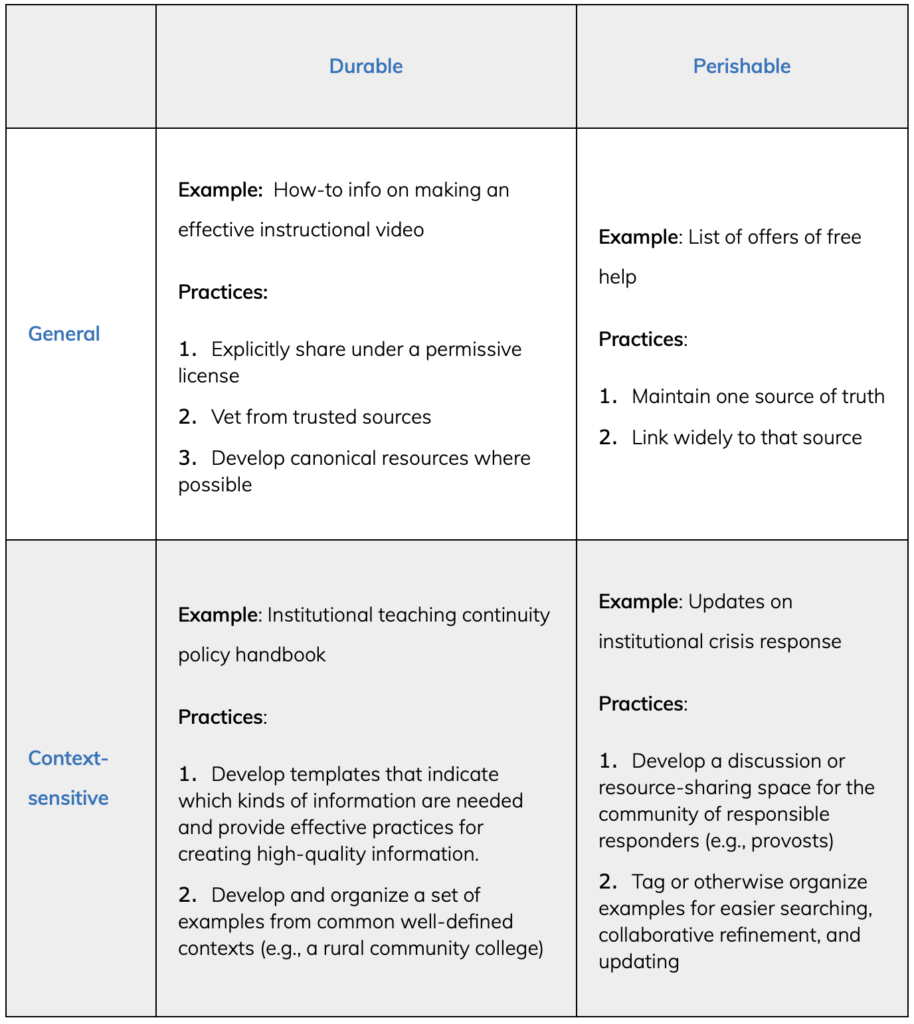
    In my most recent post in the series, I broke down the different content resources into four different categories:

    There are basically two types of resources here: (1) content that should be easily shareable and adaptable for point-of-use applications and (2) canonical copies of information that should be maintained in one place by a trusted curator.

    To understand how we can improve the supply chain, let’s return to the overlapping Google Sheets mentioned in my first post in the series: the POD list of university continuity web sites (which has 420 entries as of this writing) and Bryan Alexander’s list of universities that are going online during the crisis, including links to each institution’s documentation (which has 279 entries so far). Assuming no overlap, that would give us 679 URLs of web sites that contain a mix of the various types of information and that probably link out to other sites that also contain relevant information resources. Both POD and Bryan’s Future Forum have been effective networks for gathering links to useful information. But sorting through all that information is labor-intensive even within a given network. If we add the goal of sharing information and sorting through the overlap between these networks—and others that may be doing similar aggregation work—the task quickly becomes daunting.

    But it is also one that lends itself to technological aid. For example, somebody could create a crawler that indexes all of these sites and applies machine learning to provide a preliminary categorization of resources. “These pages look like policy documents, while these other pages look like instructions on how to teach using webconferencing software.” That information could be cross-referenced with basic IPEDS data like whether the document comes from a community college or a research university.

    This preliminary categorization could then be surfaced to human curators, who could verify the labeling by the algorithm, correct any errors, and add relevant metadata that would be important for people interested in using the content that might not be detectable by an algorithm. These curators could be hand-picked for their expertise, or editing could be Wikipedia-style, relying on the wisdom of the crowds. Either way, there needs to be a collaborative online space for reviewing the results of the search and enriching the resulting records. The result would be a single searchable database with a wide range of high-quality machine-sorted and human-curated resources.

    We then would need to get those resources to points-of-use, which will be different for different people. It might be a web site of an association like EDUCAUSE. Or an individual university’s web site. Or it might be distributed by vendors. Vendors are a particularly important distribution vector because they are generally very good at reaching particular types of educational stakeholders with targeted messages. One way to do this would be through a faceted search interface like Amazon’s, where you can refine your search results by checking boxes on the sidebar related to different parameters. People could search for what they need and link or embed the resources where they need them. Another approach would be to create a chatbot interface that can be embedded at the point-of-use and scoped according to the same parameters available in the faceted search. For example, you might want to tell the chatbot that it should only display resources related to teaching online when embedded in a web site where that’s what people are most likely to be looking for. These two approaches aren’t mutually exclusive.

    A people resource supply chain

    One of the interesting aspects of creating a content resource supply chain in this way is that it also enables us to identify experts by attribution. Who authored this particular resource? Who curated it? Who edited it? We can use these connections to enable people who want to help build profiles that make them more findable. And again, we can use machine learning algorithms to make helpful suggestions. “It looks like you have contributed three content resources related to active learning techniques in online courses. Would you like to include that as an area of expertise in your public profile?” In other words, we can back into a kind of LinkedIn for resilience-related help expertise simply by taking advantage of attribution. People become findable—and build their reputations for expertise—based on their contributions.

    Mass volunteering is an interesting hybrid case. Suppose, for example, you want to make a list of instructional designers who want to volunteer to help faculty convert their courses in a hurry. The list itself is a content resource. But each name will be linked to a profile. If we really want to go crazy here, we can make it possible for people to issue profile endorsements (or badges) based on the help that the volunteer provided.

    All of the technology pieces for this network exist in the world today and could be assembled with a small fraction of the effort that is being put by many well-meaning organizations and individuals that are currently tossing their offerings into the ether and hoping that somebody finds their messages in a (digital) bottle. Furthermore, since these are all resources that people want to publicly contribute, privacy issues should be easy to navigate. (“Would you like to add this to your profile?”) We can create a resilience supply chain if we choose to organize ourselves.