In my recent post on Cengage’s author moving over to OER, I included some references to a small company called Activ Learning which was mentioned in a joint press release. I received a complaint from the company’s CEO on Friday afternoon, asserting that the post contained inaccurate speculation about Cengage’s relationship with Aktiv—the companies have none—and an assumption that the interaction model in their current OpenStax integration in their current Chemistry product would also apply to the new Organic Chemistry product.
After reviewing Aktiv’s complaints, I concluded they were reasonable. Consequently, I have removed all references to Aktiv from the original post. I apologize for any inadvertent confusion I may have caused.
I’ve been building the Argos story slowly in this series for two reasons. First, we’re in something like a trough of disillusionment with courseware products. “Trough of disillusionment” is a term from the Gartner Hype Cycle about how innovations are viewed in the marketplace over time:
I say “something like” the trough of disillusionment because the hype cycle is really about expectations rather than product/market fit. A new product comes out and we get excited because we’re told it will “change everything.” It doesn’t. We get disappointed. We decide we’ve been scammed. Over time, we figure out that, even though the new thing isn’t going to change everything, it’s useful for some things. Once we finally figure out what it’s good for, we talk about it less and use it more. Throughout the whole process, the thing itself often hasn’t changed. Oh, sometimes the start-ups decide pivot, or they die because they can’t outlast the trough. But Stanford-style MOOCs, for example, haven’t changed all that much since 2012. We just know what they’re good for now.
I don’t think that’s what’s going on with courseware. It feels like a trough of disillusionment. In 2014, Campus Technology wrote about “The Great Adaptive Learning Experiment.” (One sign that the market is mixed up is that we can’t seem to settle on terminology. Are we talking about adaptive learning, personalized learning, or courseware? What’s the difference?) Since then, we’ve seen a handful of these “personalized learning” companies—e.g., Knewton, Acrobatiq, and Smart Sparrow—sold off for a low price and largely fade into the companies that bought them. CogBooks was the latest to be sold off to Cambridge University Press. While this may be a decent deal for CogBooks—the financials have not been disclosed—I doubt it will be read as a sign that this product category is changing the world. The big textbook publishers have done OK with courseware but not well enough to halt their continuing shrinkage as businesses.
There’s a general sense of disappointment and malaise with the product category. I’m arguing that this is not a genuine trough of disillusionment but a failure of product/market fit. This is actually much more common in EdTech product categories. Think of retention early-warning analytics, ePortfolios, and learning object repositories, among many others. They all got hyped, disappointed the market, and then got stuck. The problem wasn’t that the market misunderstood the product but rather that the product makers misunderstood the market.
My colleagues and I believe that the same thing has happened with courseware. The market has gotten stuck on an idea of the value that doesn’t actually appeal to the people who have to adopt and use it. There was some progress when publishers realized that students like low-stakes practice. Before EdTech, many students voluntarily created flashcards for themselves. When publishers realized that students were increasingly refusing to buy the expensive curricular products that their professors were prescribing, they became more “learner-centric,” by which they meant that they thought of students as the buyers. So they built in features that students would like. Low-stakes practice. That helped some. But then they got stuck again.
Low-stakes practice could give instructors more information about how their students are doing. It could change the way those instructors teach. But so far, it mostly hasn’t. Which means that instructors don’t see value in prescribing courseware over alternative formats, like simple ebooks. The “market” for textbooks is both students who buy the product and instructors who prescribe it. Both use the product in some important sense. But on the instructor side, the paradigm has largely been stuck in the bound book format. It’s immutable. It’s a thing they adopt and then teach around.
In contrast to the publishers, stand-alone course platform providers went in the complete opposite direction. They gave instructors a blank page. In their later stages before their acquisition, these vendors invariably—invariably—began developing or acquiring catalogs of titles so that instructors wouldn’t have to start from scratch. That tells us something about product/market fit. But the platform vendors also differed from the publishers in that they were selling their platforms first to institutions as enterprise software licenses. Those institutions then typically engaged in top-down efforts to get faculty to adopt the platform and develop content. In this conception, the product has three kinds of customers—the institution paying the license fee, the instructor adopting (or creating) the curricular product on the platform, and the students who are using (and possibly paying for) that curricular product.
It doesn’t work.
The joy and magic of product/market fit
Way back in the first sentence of this post, I said there were two reasons why I’ve been building this story slowly. The second reason is that I take joy in writing this way. It’s a teacher thing. I want to make you care about things that you don’t think you care about. I want to make you spend time thinking about topics that you never thought you’d spend time on.
You think you wouldn’t spend time reading a long piece on how fMRI machines work, the mathematics behind certain kinds of machine learning, and how these pieces come together in a methodological paper in cognitive psychology? You think there’s no way you would read a seven-thousand-word article on how Pearson is using HR policies to foster efficacy in its organization (which, by the way, was published on New Year’s Day)?
Heh. Let’s put that to the test. I bet I can make you care. And I’ll spend days or even weeks researching and crafting a blog post to prove it.
Again, it’s a teacher thing. I have an urge. I will go to irrational lengths to fulfill that urge. But not infinite lengths. If I had to write these blog posts using Dreamweaver in raw HTML, I never would have gotten started blogging. I needed WordPress to lower certain barriers for me so that the urge could take over. Remember “web 2.0”? This is web 2.0. When I started blogging, I never imagined I would still be doing it 16 years later, or that literally almost everyone who has access to the internet is creating and sharing personal content over some platform, whether it’s Facebook, TikTok, Twitter, LinkedIn, YouTube…the list goes on and on.
Great product design works that way. I have spent a lifetime failing to get myself to exercise regularly. No product and no subscription I tried could crack that nut. Until I bought an Apple Watch and subscribed to Apple Fitness+. Now I do 30-minute yoga sessions at least three times a week. In good weeks, I’ll add a couple of core workouts and high-intensity interval training (HIIT) sessions.
And then there’s the kayaking. I wrote a post on product/market fit that included a description of origami kayaks that my wife and I use. We had a canoe a while back but it was too heavy and too hard to get on and off the car. Now we go kayaking. And, interestingly, I received a handful of notes from people who read my post and decided to buy themselves the same kayaks.
Oru Kayak
I always wanted to exercise regularly. Logistical and psychological barriers prevented me from doing so. It would have been easy to conclude from a distance that people like me don’t want to exercise. I did hate exercising, but I wanted to exercise. I wanted to not hate it. My Apple Watch and Oru Kayak enabled me to find ways of exercising that I didn’t hate. As a result, my lifelong behavioral patterns changed pretty dramatically.
One of the best examples for the story of courseware is Wikipedia. When it came out, most people thought it was nuts. The big thing in encyclopedias at the time was Microsoft Encarta, which was supposed to be a multimedia, interactive Encyclopedia Britannica killer. The idea that a bunch of randos on the internet would write a credible encyclopedia was literally a joke. Stephen Colbert encouraged his viewers to write absurd details into Wikipedia articles. Random people could never write a comprehensive encyclopedia with no formal coordination and no financial incentive. And even if they did, nobody would trust it.
Today, when you search on Google the top-right corner of your results page will often have information summarized from and linked to Wikipedia. I don’t know about you, but I click on that link fairly often. And I generally don’t think about whether I can trust the article it takes me to. As I write this sentence, random people on the internet are fact-checking and updating articles on Wikipedia. I’m not one of them. I’m mostly just a consumer. Most of you probably are too. And that’s fine. It works.
I started a Wikipedia page once because it was related to a particular EdTech topic that I was passionate about. I only wrote a couple of lines; it wasn’t much more than a stub for the topic. A bunch of other people each contributed a bit to the entry. I haven’t looked at it in years but others continued to contribute and update it This is the page today, complete with 148 footnotes. As I write this, the most recent update to the article was yesterday.
We forget about Wikipedia because now we’re thinking about Facebook, which is designed to facilitate the opposite kind of behavior. Humans are malleable and adaptable. But you have to understand their drivers if you want to fulfill their needs, particularly if doing so entails a change in their behavior.
My colleagues and I believe that the courseware product category is in a rut because the market has fundamentally misunderstood both how educators use curricular materials and how they would use them if only certain barriers were lowered for them.
Upcycling curriculum
In the first posts of this series, I wrote about how educators think about and use curricular materials in their course design. In this last section of this blog post, I’m going to start telling a story of how that can work using some mock-ups that we’re user testing. The goal here is to give some examples of how upcycling can work.
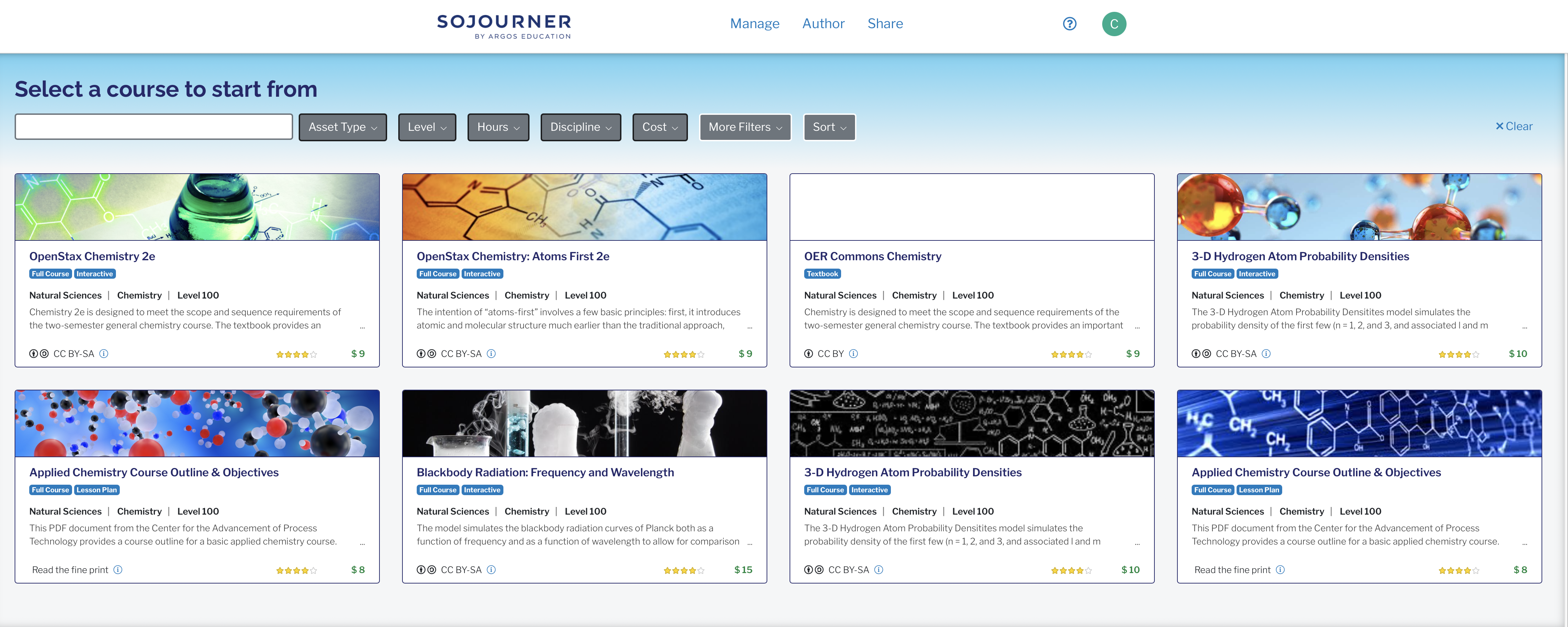
Let’s say you’re selecting a textbook for your Chemistry for Non-Majors course. Your goal isn’t really to pick textbook. It’s to design your course. You go into the store that has all the products that run on Argos Education’s Sojourner platform. You have some good choices. You could pick Carnegie Mellon OLI’s General Chemistry course, which has a mastery learning approach and has been carefully engineered for efficacy. You could teach with ASU Inspark Network’s Critical Chemistry, a heavily experiential learning-based product for non-majors that is thematically organized around how chemistry is used to save lives. But in your case, your college puts a strong emphasis on affordability. That’s a major priority. So you search the catalog particularly for inexpensive options:
You’re still focused on getting through the curricular materials selection process so you can get to the course design process. You review the options and pick your title.
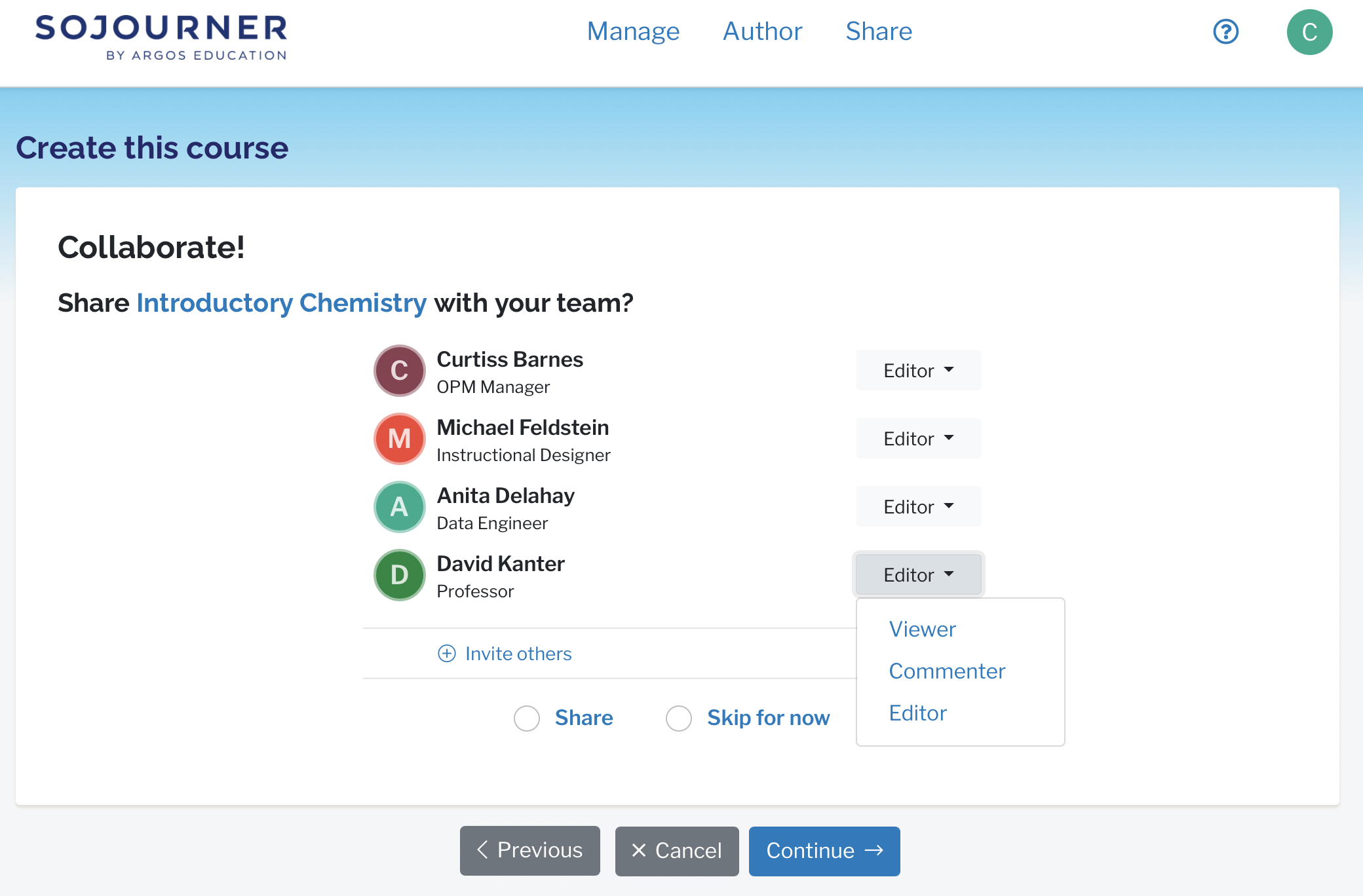
Now you have a choice. Are you working on your own? Are you leading a departmental adoption process? Maybe working with a learning designer or an OPM to create an online course? Maybe you want collaborators involved:
You have options based on your use case. And not everybody gets to edit. For example, maybe as a department, you want to have all instructors be able to see what you’re working on, some who are able to comment, and just a couple who are able to actually make changes. On the other hand, if you’re just making the selection yourself, you can skip over all this. Or you can invite your institution’s faculty support person or a colleague in to give you some suggestions.
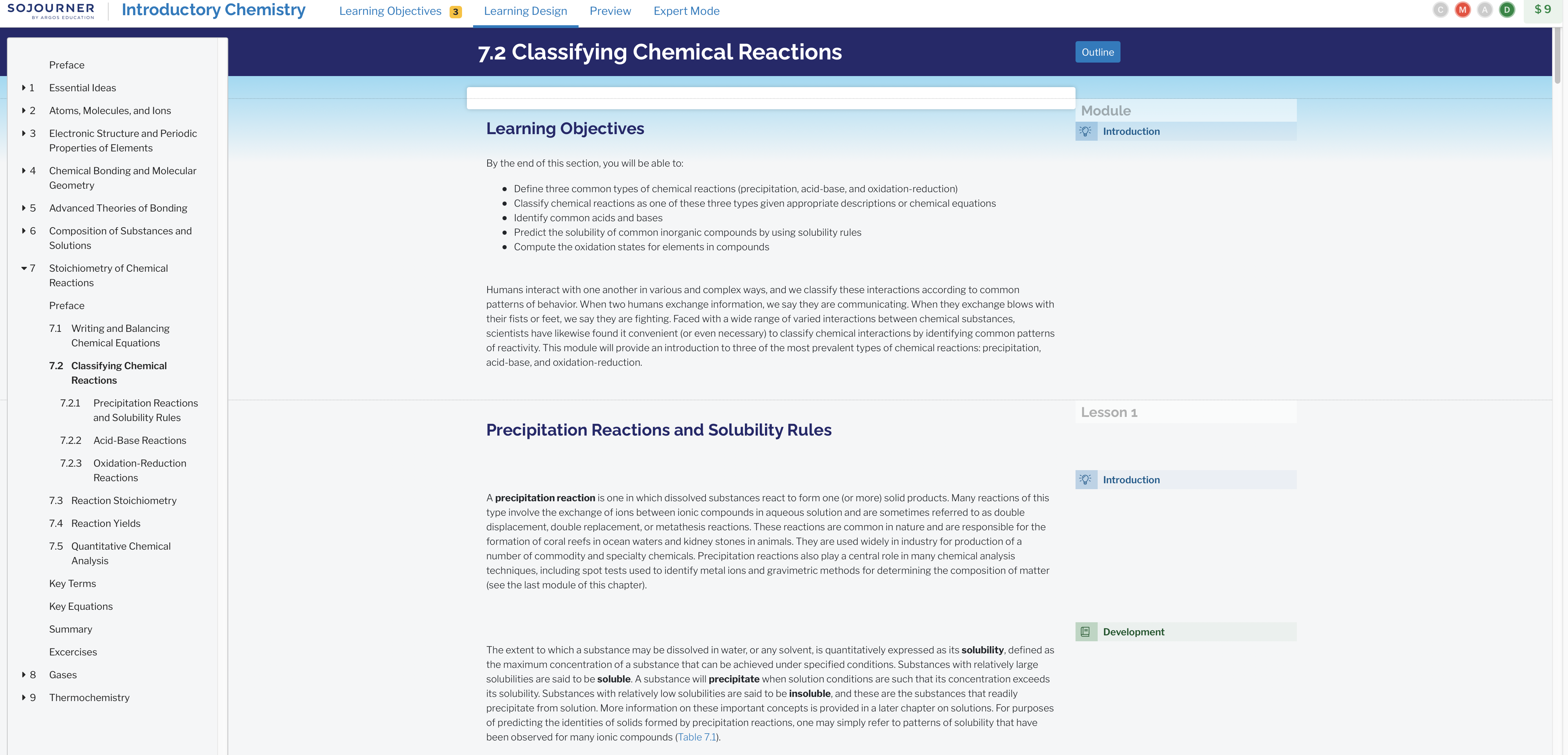
But you’re still in adoption mode. You’re getting to know the text so that you can design your course. You’ve picked an unmodified OpenStax title, so it’s going to start off looking a lot like the free PDF version:
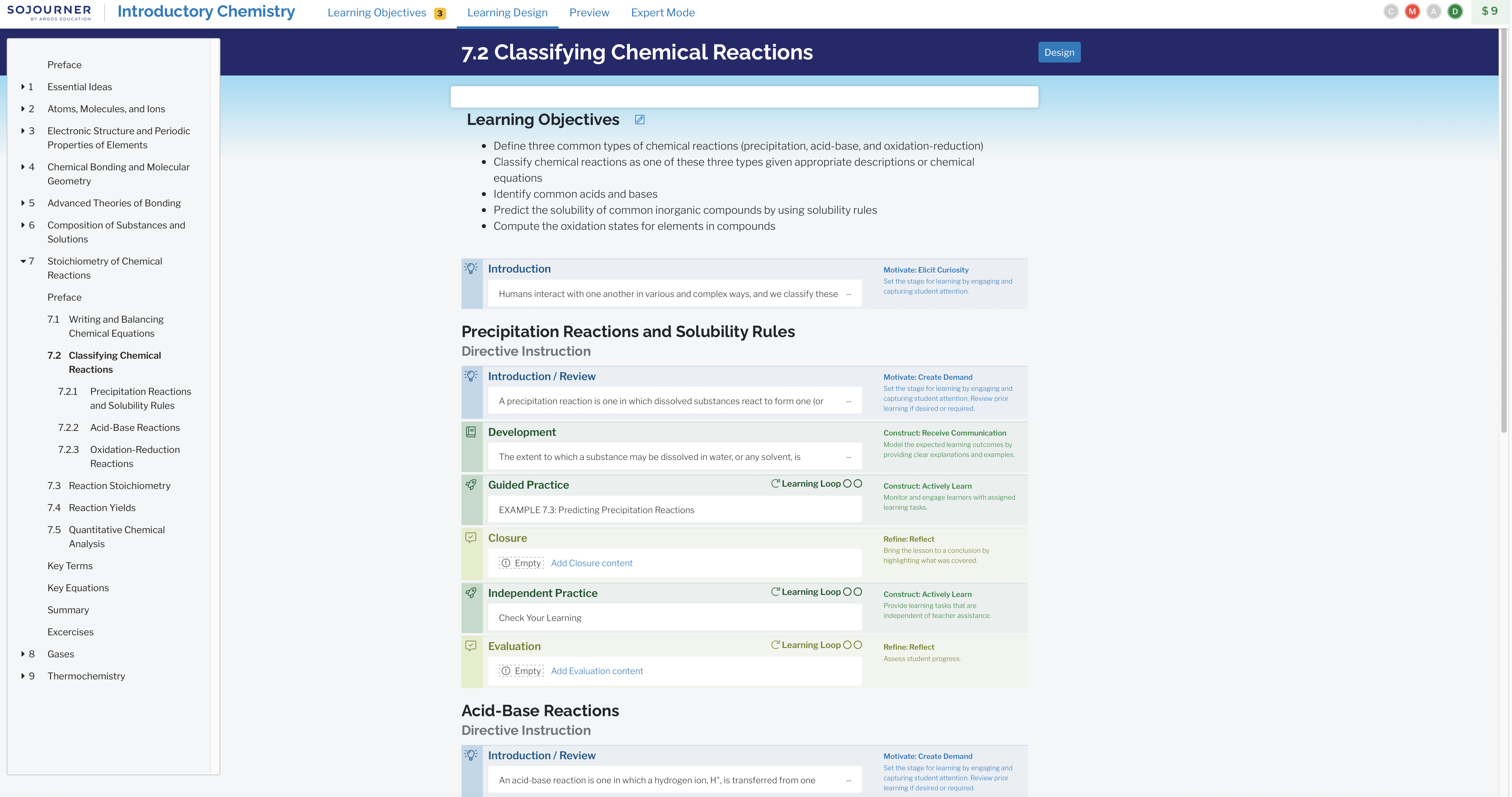
Notice the little notes on the right-hand side. We’ve applied a little machine learning and a little learning design research to make the pedagogical structure of the text more visible to you. If you mouse over the little item, you can see more detail:
Ah. This is interesting. You get this. It’s a bit like how you think about putting together your lectures. Maybe you want to switch to outline mode so you can see the overall structure of how this thing is put together:
You’ve collapsed the text so that you can focus more on those little post-it notes and see the structure. It’s pretty much like a lecture. (It’s labeled “directive instruction” for a reason.) You introduce the concept to help students understand why the topic is important to the course, you provide them with some information, maybe you work a problem out for them—if you were doing this in class, you might work that problem out on a whiteboard—you…
Oh. Hmm. Usually you wrap up the lecture with a summary. This text doesn’t do that. You could fix that, but honestly, you’re not too worried about it.
The OpenStax text also doesn’t give an end-of-chapter test at the end. The truth is that you’d want to pull together some questions from a test bank anyway. So you’ll worry about that later too.
You dive back into Design mode to review the text. You want to give it a close reading now as you think through the design of your classes. And you find another unpleasant discovery. The section on acid-base reactions is just not right for your class. The language is a bit garbled and probably unnecessarily complex for your students.
This is the point when you would normally write the following in your syllabus:
When you get to Section 7.2.2 on acid-base reactions, do not read it. Instead, please go to this folder in Canvas and read the document called “Acid-Base Reactions.” Follow the link at the bottom of the page and take the quiz there. Then read the rest of Section 7.”
Which is not ideal for anyone. For you, you’re writing documents and organizing folders and diving into LMS quizzing tools and then trying to knit together what the students are doing in the LMS with what they’re doing in the courseware. For the students, they’re jumping through hoops.
But instructors do it all the time. Locking down the courseware might create enough friction that they will do it less often than they might otherwise. But many of them will do it. It’s a bad experience for everyone. And there’s no way for anyone to tell if the net result is better or worse for the student because the activity is happening in different systems that don’t really talk to each other. But as a dedicated instructor, you will do it if you think it will help the students.
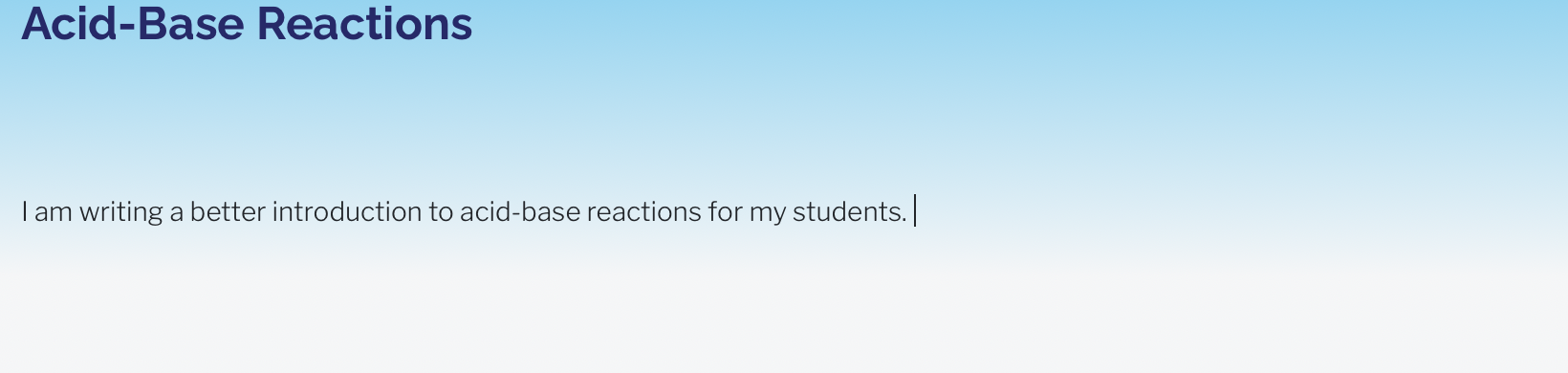
Or, if you’re in a platform that allows you to edit the curricular materials, you could just do this:
This is better for everyone. Students don’t have to jump through hoops. Instructors spend much less time setting up the content. And now that all the information is in one system, it’s possible to track whether these changes actually help students. That last piece is another topic for another blog post, but it’s incredibly important. If we want to create a virtuous cycle, we want to share changes, test which ones improve learning in which contexts, and generally create positive evolutionary pressure.
Finding teachable moments in the course design process
This idea of pulling editing “inside the tent” is central to understanding product/market fit and the levers available to change behaviors. As an instructor, you are mostly not trying write or rewrite textbooks. That’s not you think about what you’re doing, in part because the textbook is the raw material for their course design. It’s not a thing you care about in and of itself.
We want to catch you in those moments when you’re thinking about their course design and pull you into a kind of dialog as you use the raw materials to build that course.
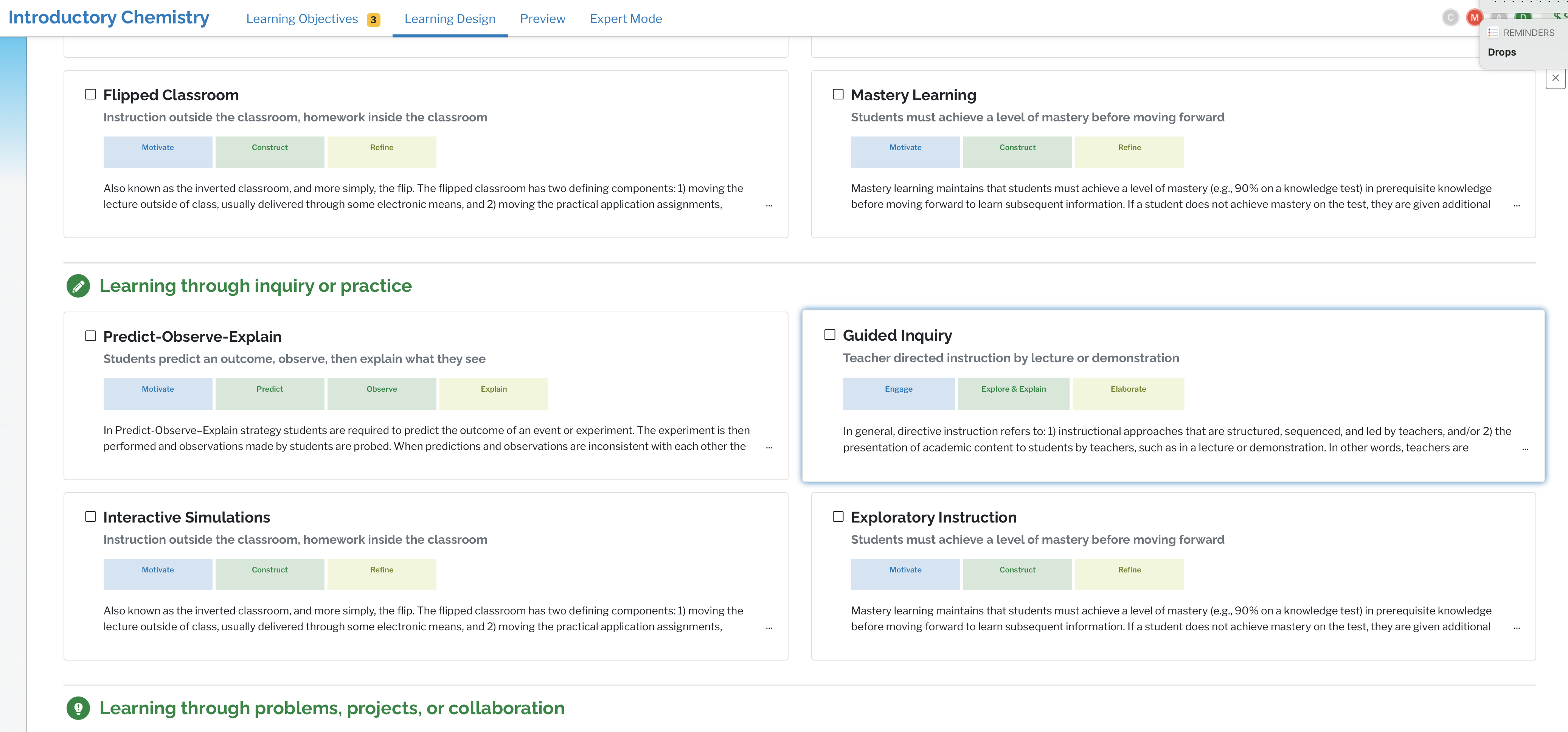
And we’re always making choices about what we want to ask you to think about and what we want to get out of your way. If you want to add a virtual lab, maybe we give you the option of some scaffolding to help you think through all the steps you want students to go through:
When you pick their actual virtual lab, maybe we don’t bother you by calling attention to the learning objectives but we do show you a selection of labs that are tagged with the learning objectives associated with the content section you are working on:
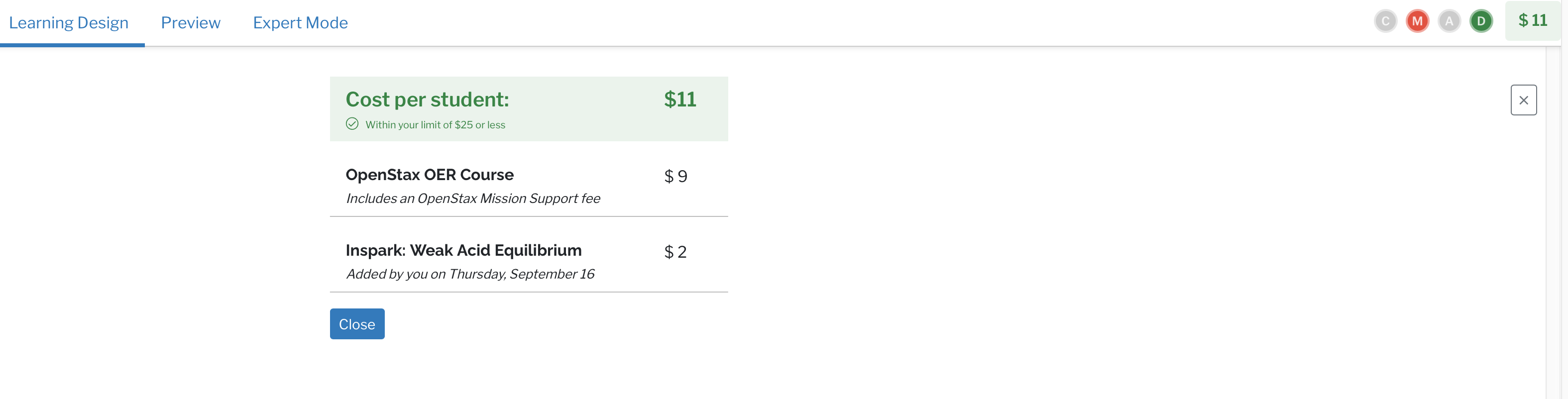
When you choose the lab, we let you see the cost change and, if you have set a cost cap, we warn you when you go over. We even give you a breakdown of what you’re asking the students to pay for:
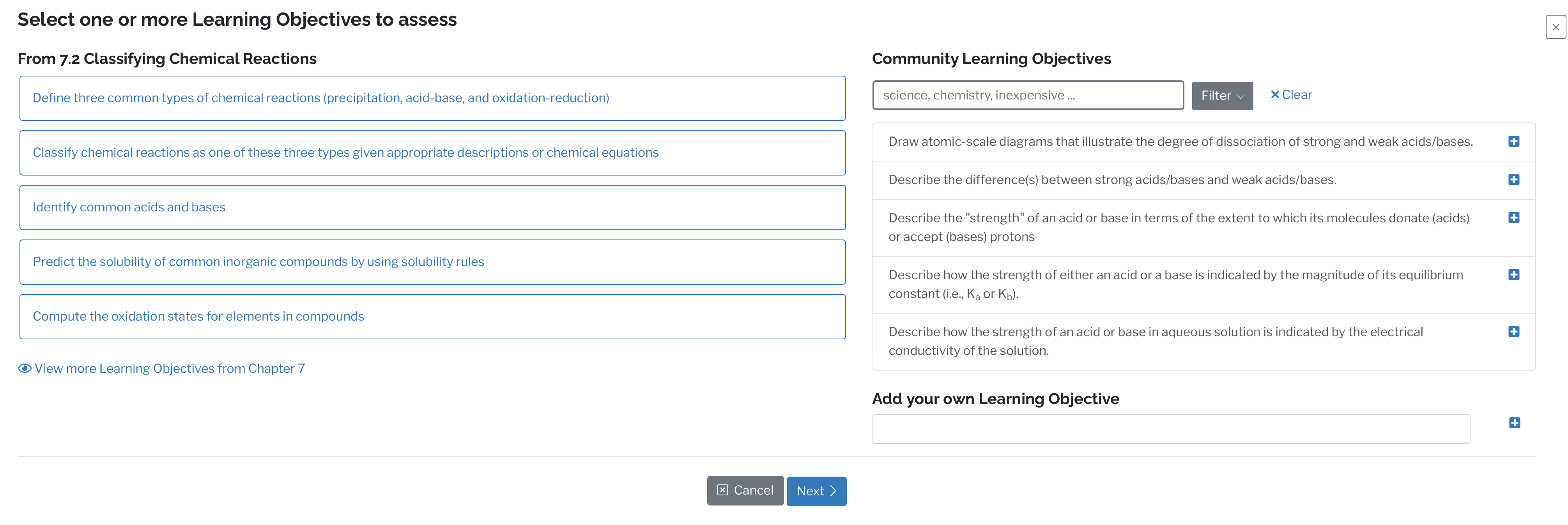
We don’t always want to hide learning objectives from you. Rather, we pick the moment when learning objectives are most useful to think about, like when you’re picking out assessment questions:
Notice that the platform introducing a bit of implicit community here. Other instructors are also designing courses around the same curricular product that you are. Maybe they have some good ideas that they’re willing to share.
And the real value of the sharing is not just the content but the rationale behind the course design. Why did the author write a particular answer in a particular way?
I could go on, but hopefully the theme is clear.
Professionally designed courseware has a lot of useful information either explicitly or implicitly built into it. We hide that design information from the instructors and then lock the product down. In doing so, we turn it into a static artifact that they have to work around. However the publisher might conceive of the product’s value is irrelevant if instructors are using it as raw materials for their course designs.
But if you start from that assumption, let them do what they’re going to do anyway in an environment where you can scaffold, collaborate, and provide feedback on the results of their designs, you can engage them in a much deeper way while saving them time and giving them more control over the things they care about. Also, we no longer have to separate conversations about course design from conversations about effective teaching practices. The fact that we do so now is a strong indicator that something is broken in our ecosystem. Course design and in-the-moment teaching are a continuous cycle. The two are constantly in dialog with each other. That’s the way teachers actually teach in the real world. Lesson plans change. You adjust. You improvise. Much of this is not arbitrary but rather driven by your encounters with your students.
If we want courseware to grow in adoption and educational impact (and perhaps as a useful and self-sustaining industry), we have to get away from the book. That doesn’t just mean getting away from linear, non-interactive designs. More importantly, it means getting away from the textbook as a static artifact that educators teach around.
By the way, today’s Blursday Social (9/16 at 4 PM ET) will be a chat about Argos. So you can come to that if you’re curious. Sign up here.
In my first post in this series, I wrote about what good teaching is. While the argument was wrapped in a lot of autobiography, it makes a number of assertions that are foundational to the mission of Argos:
The best evidence we have suggests that teachers change lives, by I we mean that students who have had good teachers will make more money, be physically and mentally healthier, and have more fulfilling relationships over the entire course of their lives.
Good teaching combines the emotional and the intellectual. In particular, teaching the diverse group of students that can be found in almost any classroom effectively requires diagnostic skill and creativity.
The intellectual aspect of good teaching is largely invisible to our society, including even many proponents and practitioners of education. The average person may sense it from time to time but, as a rule, we don’t talk about how it works and don’t think about it as an aquired skill set (nevermind a discipline that evolves over time).
As a result, there are social barriers to educators sharing craft with each other on top of the barriers created by the employment conditions in higher education.
One result is a poor understanding of the textbook’s role and product/market fit. In turn, this has contributed to several decades of slow, painful, and often unproductive efforts to creating a vision for a digitally transformed version of the product. We can’t see what we can’t see. As Henry Ford put it, “If I had asked customers what they wanted, they would have told me a faster horse.”
The primary purpose a textbook serves is to enable an instructor to upcycle the author’s course design. They adopt and adapt that design to fit their local needs and context rather than spending enormous amounts of time writing all the course elements from scratch. In the Industrial Age, where editing, typesetting, printing, distributing, and selling paper books were all labor-intensive and specialized tasks, it made sense to have one author, one editor, and one distributor to produce an artifact that each instructor would then independently upcycle. In the digital world, we can continuously upcycle course design by crowdsourcing improvement, both directly through collaboration and indirectly through shared data.
That’s an essential part of what Argos Education does. We enable a virtuous cycle where educators can continuously upcycle their course designs with their peers. This enables them to teach more effectively with less work. It also creates a positive evolutionary pressure on their course design and delivery. While educators are still free to exercise their judgment in their respective classrooms, they will do so knowing how their peers are upcycling the same basic course design as well as how well various aspects of the course design are working based on analytics. In other words, they will have peer and expert feedback and suggestions that they don’t have now.
How paper textbooks work
What is an educator doing when she selects a textbook? What is she looking for? What are her criteria? On a micro level, then answers vary dramatically from one educator to the next. One is looking for good back-of-chapter questions. Another is looking for readings that will be engaging and accessible to her students. Or a particular angle on the curriculum. Or a particular teaching method.
On a macro level, all of these fall into the larger bucket of looking for pieces of course design to upcycle. The specifics of what professors look for can be heavily inflected by a variety of factors. For highly procedural subjects like math, many educators will focus on the progression of scaffolded and unscaffolded problems. In economics, it could be philosophical/political. Conservative economists may like Greg Mankiw’s explanation of inflation while progressive economists may prefer Paul Krugman’s. A biology professor may choose a text that emphasizes an ecological lens to the topic over a microbiological one for several reasons. Maybe her university is known for its environmental studies programs but not for its pre-med programs. Or maybe she herself feels better equipped to teach the subject well from one angle rather than the other.
These differences can be neutral with respect to some imagined ideal of an “effective” class. How much does it really matter if a first-year biology student learns a little more ecology and a little less microbiology? Or the other way around? In those early courses, we mainly want to help the students develop their interest in the subject, some general knowledge, and some discipline-related thinking skills.
But in context, the differences can be dramatic. Teaching biology 101 from a microbiology perspective to a student who is trying to decide whether she wants to pursue a major in environmental studies may cause her to drop the course or even her major. Likewise, having a professor teach the course from an angle that they’re not comfortable with is likely to lead to a disengaged, paint-by-numbers teaching approach. If the educator is bored or uncomfortable, then the students will likely be bored or uncomfortable too.
Educators look for textbooks that give them more materials that they can upcycle into their course designs. The more the materials fit the course design in the teacher’s head, the more that teacher can focus on adding value in her context rather than filling in holes in the base course materials. And make no mistake: Educators almost always customize, even if they don’t think about what they’re doing in those terms.
When I taught a variety of subjects to middle school students, the one I was least opinionated about was pre-algebra. The book I had been given was pretty good and I didn’t feel terribly confident in my ability to come up with better teaching approaches to that subject. So I taught the book, chapter by chapter. I didn’t write a lot of supplemental materials or skip around. But I improvised all the time. For example, at that age, some students acquire abstract thinking later than others. This makes teaching concepts like negative numbers difficult. The book I was using talked about number lines but those were still too abstract. So I took the kids out onto the streets of Hoboken and we turned one of them into a number line that the students could walk. Later, when we were graphing lines, we turned it into a two-dimensional graph. (I was lucky that Hoboken streets had a grid layout.)
I created lessons that weren’t in the book so that the course design would fit the real needs of my actual students. I didn’t do it for pleasure or out of a sense that I was a better mathematician than the textbook author or even that I was a better curriculum designer in the global sense. But I knew better what my students needed from me because I knew my particular students’ needs and my own capabilities better. So I upcycled the course design. I took a found object that didn’t quite fit the purpose and turned it into something that did.
Even though I was more opinionated about how to teach science, I found a textbook that I really liked and followed that fairly closely too. But when a student asked a question that was provoked by but not answered by the experiment in the book, what was I supposed to do? Ignore it? Tell the student to go read about it?
No. I wanted to visibly reward genuine scientific curiosity in front of the class. So we made up experiments together to answer her question.
I didn’t think of it as either following or not following the textbook. I didn’t care about the textbook one way or the other. The textbook was just a tool for producing a better course design with less work. I cared about helping my students learn what they needed to learn in the ways that they needed to learn it, some of which the textbook’s author could anticipate and some of which he could not. (It was a male author.)
Sometimes—often, if we’re being honest—educators are not lucky enough to find a book that fits their contextual needs perfectly. For example, some of my students had never been out of a city. Taking them to the zoo helped stimulate some of them, but a zoo is not the same as a natural habitat. And even if I had VR and could take them out to the African savannah or an alien planet virtually, it still would have been an abstract concept to them. The best way to hook a lot of them was to create a transect in the park directly across the street from the school. I showed them how the space where they hung out and kicked a ball around was absolutely teeming with life that they never noticed. Suddenly, ecology was real to them. It was salient. At that point, the information in textbook would become much more meaningful to them.
The book I had adopted had some ideas about creating transects but I had to improvise a lot and fill in gaps where the text failed to address urban ecologies. I ended up creating a fair bit of original curriculum. Again, that had not been my intention. I didn’t even think about it as altering the course design. I was just trying to fill in holes for my students. It was often an improvisational act.
College is no different. First-generation students at Georgia State University are just as likely to have never seen the countryside as my Hoboken middle schoolers. In every course at every school, we have to adjust to the people who are in front of us using the skills that we have. There is no chance that we can “instructor-proof” courses with “personalized learning” any time in the foreseeable future, even if that were a desirable outcome.
We have fetishized the artifact of the textbook without really understanding how it is used by an expert practitioner (partly because we don’t think of educators as expert practitioners). We have constructed a fantasy of A Young Lady’s Illustrated Primer as the apotheosis of the textbook when textbooks have never functioned that way.
Biologists don’t select “Pearson Biology.” The top-selling biology textbook sold by Pearson is named after the biologist who authored it—Neil Allison Campbell. Educators who adopt Campbell Biology do so, in part, because they like Campbell’s course design, freeze-dried into textbook format. They upcycle the materials for their own classes. They attribute that course design to a presumed colleague, even if he’s one they haven’t met: noted biologist and biology educator Neil Allison Campbell. Pearson actively maintains that fiction even though Campbell has been dead for sixteen years and three editions have been published since his death. So baked into the very heart of today’s textbook branding system is a sense of collegial sharing that is increasingly a facade created by the publishers.
Two-cycle upcycling
Sometimes academic departments select textbooks as a group. And they do so as part of designing the curriculum for their entry-level courses. In this case, the department is upcycling the course design collaboratively—or, at least, the tenured and tenure-track professors are—and then that design on to the individual educators. Who inevitably upcycle it themselves from time to time. Even if they color inside the lines, there are always things that come up with the students that the course design didn’t anticipate. And many educators take liberties with the course designs they are given.
In an ideal world, educators within a department would meet regularly to share their upcycling and improve on the core course design template. But they generally don’t because they don’t have the time and because these upcycling changes aren’t easy to share. Sometimes they happen in class, either planned or unplanned. Sometimes they happen in the LMS, or in individual tools connected to the LMS. The departmental course adoption process demonstrates the need and desire for collaborative, multi-cycle course design upcycling. But it’s too hard and too time-consuming. As a result, all that extra work that educators put in to improve their course designs, and that could contribute to a collegial upcycling conversation, are lost.
EdTech has made upcycling harder
You would think that having everything in digital would make upcycling easier. At the moment, the opposite is true. Suppose, for example, that you decide to adopt the latest edition of Campbell Biology. You have a couple of choices. Your students could use the eText or a textbook. The eText is no more editable than the textbook. You could also augment by adopting the bundle of the eText and Mastering. So you’ll have to tell students, “First, read this section in your eText. Then follow this link to the homework platform. After that, come back to the LMS.” Is that easier than it was to accomplish the same tasks in a physical classroom? Is it easier for the instructor to set up and customize? Or easier for the students to follow along? I think not. It is easier to grade the homework. And it’s super easy for students to Google the answers to those homework problems.
Now suppose you don’t think a section of the textbook is appropriate for your students. Maybe it’s too hard for the mix of students you have, for example,
Read sections 7 to 7.2.2 in your eText. Do not read section 7.2.3. Instead, follow this link to the LMS folder called “Chapter 7” and read the document called ‘Alternate 7.2.3.’ Then, follow the link at the bottom of the document and take the quiz in the LMS. After that, go back to your eText and read 7.2.4 through to the end of the chapter.
Easy, right? While we’re at it, let’s throw in a virtual lab and a discussion in the special, non-LMS forum tool that you like. Upcycling in this environment is incredibly hard. Sharing your upcycling for somebody else to use—or even just migrating it from one LMS to another—is way too hard and time-consuming to expect full-time educators to do.
Attempts to address this problem have largely failed. OER creates a licensing structure that is supposed to facilitate upcycling. But upcycling requires infrastructure as well as a license. Just because you can theoretically edit that OER-licensed PDF doesn’t make it any easier to upcycle in reality.
On the technical side, Learning Object Repositories (LORs) designed by technologists for large organizations fail because the product category takes the wrong approach. The whole idea of a “re-usable learning object” is built on the analogy to re-usable software objects. But software and content aren’t re-usable in the same way. Educational content is all about context. You can’t chop up a bunch of courses on the same topics, paste pieces together, and have them make sense to learners. Creating modular, ready-to-reuse content (as opposed to upcyclable content) is incredibly hard. Often impossible. So LOR creators often spend tremendous amounts of time creating elaborate content taxonomies, only to discover that most people are using their fancy systems as media libraries and quiz question banks.
I’m not suggesting that either open licenses or LORs are useless. They just don’t solve the whole problem of continuous upcycling.
Continuous upcycling is possible
What if we could dramatically lower the barrier for continuous, collaborative, data-informed upcycling of course designs? Catch that teacher at the moment of improvisational need and make a good suggestion? Share brilliant teaching ideas that often never leave the classroom of the person who created them? Nudge teachers who are in a bit of a rut to show them some exciting things their colleagues are doing? All while keeping them focused on their core teaching challenges?
What if every educator who adopts a “textbook” could join one or more communities of adopters? What if they could edit, delete, and insert new content into the product they were upcycling? What if they could choose to share those edits with their department, their learning designer, the original author of the curricular product, or the whole community of educators who are adopting it? What if the product could recommend changes that colleagues are making, particularly if those changes seemed connected to better learning outcomes? What if educators could selectively adopt those changes? And what if they could choose to have conversations with their colleagues about the design, how they’re changing it, why, and how they could tell if it works?
This is how Argos Education aspires to change the fundamental value proposition of the “textbook,” or “courseware,” or whatever awful name you want to invent for that freeze-dried course design that educators upcycle to meet their local needs.
In my next post in this series, I’ll talk concretely about how this ecosystem—and economy—works.
In the meantime, this week’s Blursday Social will be a chat about Argos. So you can come to that if you’re curious. Sign up here.
Those of you who have been paying close attention to my LinkedIn profile have known that something has been up with me. I have quietly been working with friends and colleagues toward building a start-up. As we have been building the company, we have been collecting a group of Angel investors who are, almost universally, people we respect and turn to for advice. We’ve been very lucky that way.
Yesterday WGU Labs announced that they are our first institutional investor. I am deeply satisfied that our we are starting off with support from a fund that is affiliated with an access-oriented university. It sets the tone for who we want to be and what we want to accomplish.
This post is the first in a series about what Argos Education is. The truth is that I’ve been writing about aspects it for a while without mentioning the startup angle. My post series about the open-source collaboration on a courseware platform between Carnegie Mellon University’s OLI group and Arizona State University’s ETX group was about the software and the collaboration that forms the heart of Argos. If you’re impatient with the meandering Feldstein style and want to get a concise summary of what we’re up to, one of our Angel investors, the wise-beyond-his-years Matt Tower, has written up his own thesis about us. Matt is far more succinct than I am.
Here on e-Literate, I feel compelled to tell the story e-Literate-style. This first entry will be a very personal one. I’ve been lucky to have long-time readers who have traveled my EdTech journey with me for as long as sixteen years. I’m going to take some time to explain how this latest change fits into that journey. You won’t learn much about what Argos actually does in this installment, but if you’re an e-Literate reader, you’re used to my George R. R. Martin style. I promise you, The Winds of Winter is coming and it won’t suck like the TV show.
Argos is very personal to me. It has to be. I walked away from a very comfortable consulting practice during my peak earning years to take on a level of risk and hard work that frankly don’t make sense at this stage in my life. The reason I’m doing it is that I believe I have a once-in-a-lifetime opportunity to make an impact. If it succeeds, it will be the culmination of everything I’ve tried to accomplish in my professional life. Beyond my wildest dreams.
So today I’m going to write about the personal mission and values that led me to this step as well as how it will affect my continuing work here on e-Literate and on the Empirical Educator Project. Later posts in this series will delve more deeply into Argos’s mission goals and how we aspire to accomplish them.
I believe in teachers
If there’s one statement that has guided my life choices, including the co-founding of Argos and even a major reason why I fell in love with my wife, it’s that I believe in teachers. This is not a bromide. It means something very specific and nuanced to me.
I grew up in a family of educators. Both my parents and both of my sisters are in the family business. My father, who is my role model in many ways, was an elementary school principal for much of my life. To this day, the highest compliment he can pay to person is to call them “a good teacher” or “a real teacher.” When he says that, he is making a holistic statement about the person’s character, values, intelligence, and skills. Real teachers change people’s lives, not just through their inspiration and dedication but also through their acuity and ability to solve complex problems. Dad reveres reading teachers for their diagnostic skills. I come from a family of real teachers and aspire to live up to their excellence and accomplishments.
When I went to college, I thought I wanted to teach philosophy. My very first week at Rutgers, I met a senior who was a philosophy major and, importantly, had a very impressive beard to prove his bona fides. He told me he was interested in something called “cognitive science.” I had never heard of it before but instantly decided that was what I wanted to study. Since Rutgers didn’t have a cognitive science major, I made my own unofficial one. In philosophy, I gravitated to courses in topics like epistemology, philosophy of mind, and philosophy of science. Outside of my (official) major, I took a lot of courses in linguistics, cognitive psychology, cognitive anthropology, and any other subject I could find that seemed related. I even managed to talk my way into a couple of graduate courses that were genuinely interdisciplinary studies of cognitive science frontiers at the time, like learnability theory.
At first, I thought I was doing it to acquire knowledge of the subjects I would teach. But the more time I spent sitting in graduate classes, the more I realized that I wasn’t passionate about studying how humans learn. No, I wanted to apply that knowledge. My studies were my way of figuring out how to be a real teacher.
I have always been deeply troubled by the lack of recognition of the skill and knowledge required to teach well. I still remember vividly how a well-meaning advisor at Rutgers reacted when I told her I wanted to be a teacher.
“Well, we need good teachers, but you’re too smart to be a teacher,” she said.
I was too stunned to respond, but I thought, “Who do you want teaching your kids, lady? Who do you want to be in the room with them when they get stuck or when it turns out they have an undiagnosed learning problem? Or are going through a personal or developmental crisis? Do you think that any idiot can do diagnose and help your kid and 25 others simultaneously in one class?” To this day, it make my blood boil to think about it. And yet, she was just saying what so many people think. She was trying to help me fulfill my potential. In her world, smart people couldn’t possibly make full use of their intelligence by becoming teachers.
That lack of understanding of teachers as skilled professionals is endemic to our society. It infects the way we talk about, think about, and implement EdTech. While I take every opportunity I can to mock the former CEO of Knewton’s statement that his product was a “robot tutor in the sky that can semi read your mind,” the truth is that he mostly just said the quiet part about EdTech ambition out loud. Sometimes our society seems more ready to entrust the education of its youth to unproven and poorly understood technological gadgets than it is to trust human educators. When people talk about products or strategies that are “learner-centric,” they often implicitly or even explicitly denigrate the role of the educator. So-called “personalized learning” products are often designed to do end runs around the teachers.
This attitude is by no means confined to the start-up world. I’ve heard smart, well-intentioned people working at highly influential organizations talk about “instructor-proofing” courses with technologically enhanced content.
Some of the most robust longitudinal findings we have confirms the personal experience that’s so pervasive it’s become a cliché: real teachers change lives. To accept those finding while believing also believing that educators cannot be trusted to decide how to teach their students…I don’t know how you square those two beliefs. I don’t know what teaching is in a world in which both of those statements are true. I don’t know what teachers would actually do.
I believe many college instructors are—and/or aspire to be—”real teachers”
There’s a popular notion that most college instructors don’t really want to teach or care about their teaching. I will write more about the evidence base that contradicts this in a future post, but for now, just think about it for a minute. Most professors found their career path because some teacher or teachers sparked their passion. Ask a few. They can usually tell you who it was. They had an encounter with somebody who set their lives on a new course.
That course will have them spending the greater portion of their week…teaching. Very few of even the most talented, elite young professors are able to avoid teaching between six and ten courses every year for at least their first five years (if they’re lucky) until they get tenure. The overwhelming majority of college professors are destined to spend the overwhelming majority of their professional time teaching for their entire careers. And even the ones who are elite enough to be able to spend more of their time researching went through the crucible of teaching. Working really hard for mediocre to lousy pay relative to their level of education. Do you believe that the majority of people who are willing to endure seven years of graduate school to become college instructors genuinely dislike the main job they know they’re going to be spending a large percentage of their lives doing?
Or let’s approach this from another angle. If you’re reading this, there’s a good chance that you have a weird job which is hard to explain. Maybe you’re in EdTech. Maybe you’re a venture capitalist. Or an administrator. Or a learning scientist. You’re probably not a police officer or family doctor. You don’t have a job that most people know a lot about and can picture what you do without you having to explain it. My family mostly doesn’t understand what I do for a living despite us all trying really hard to remedy that situation. I have mostly given up trying to explain it and they have mostly given up asking about it. That’s true with many of my friends, too. Including close ones. When I find somebody who actually gets my explanation and is hungry to learn more, it’s the best feeling in the world. It’s crack cocaine for geeks.
When you’re a college instructor, you have an opportunity in every class to inspire students the way that you were inspired to dedicate your life studying bugs or irrational numbers of some long-dead poet. You get to let your freak flag fly. Students are self-selecting. They come to you. Sometimes it’s to fulfill a graduation requirement, but even then, you have a window of opportunity. You spend a lot of time carefully crafting your 15-week journey with them to invite them into your world.
Again: We know from solid longitudinal research that educators who genuinely want to share that passion for their subject with their students improve students wellbeing for the rest of their lives against a variety of measures, including financial, physical, mental, and social metrics. But if you’re a college professor, you don’t need to read the Gallup-Purdue research to know this. Somebody already changed your life. That’s how you ended up in that classroom. Now you have a chance to be that person who changes people’s lives.
Are there college instructors who hate teaching or just don’t care about it? Sure. Name me one profession in which nobody hates their job. There’s no reason to believe that college instructors are worse than average on this score.
On the other hand, there’s plenty of reason to believe that college instructors are actively discouraged from caring about their teaching by their institutions. At an elite university I know that offers one—one!—course in effective pedagogy for all graduate students, they have to deal with potential enrollees being told by their graduate advisors that “every minute you spend not working on their dissertation is a minute they spend harming your career.” We know about the pressure to publish and research for tenure and promotion even at institutions that pull in fairly little grant money and are primarily teaching institutions. We know that college instructors are not trained to teach, not supported well in their teaching duties, and not rewarded for their excellence in teaching.
This is finally beginning to change for reasons that have to do with the changing nature of college and university funding sources. Worcester Polytechnic Institute has pioneered the tenured position for non-research teaching faculty. I don’t believe they will be alone in this for long. Again, this is a topic for another post. The point for today is that if you want college to be more student-centric, then you have to make it more teacher-centric. I’m not talking about pandering to faculty and letting them do whatever they want in the classroom. I’m talking about cultivating the sense that their excellence and accomplishments as educators should be part of their professional identities that they promote rather than hide in order to advance in their profession and in the eyes of their peers.
And let’s please cut the crap about the word “teacher” being “too K12.” That just perpetuates the problem. If we want our college instructors to teach well, then they have to think of themselves as ones who teach. As teachers. We should embrace that term with pride.
I continue to work in higher education because I believe that it is full of real teachers, in the way my father means it, whose potential is underdeveloped and underutilized.
EdTech is about education, not technology
Given the above, I have always believed that that the principal value of EdTech is to enable, promote, and disseminate the craft and science in teaching. When I first starting designing educational software, it forced me to think consciously about teaching moves that I made instinctively in the classroom. They didn’t work the same online. I had to rethink some, abandon others, and invent some new ones. I learned to control my craft better. The name of this blog, “e-Literate,” was meant to be self-deprecating. I considered myself to be illiterate in using technology for teaching. That was a good thing. I was raised to believe that ignorance is an opportunity to learn, which is one of the best things in the world.
Later, when I helped college teachers learn to teach online, I saw it help them become more mindful of their craft the way it had helped me. This, by the way, is further evidence of my point of view about college instructors. Ask a handful what they learned when they were forced to teach online during COVID. The ones with thoughtful, interesting answers—and I guarantee you will find some—have some natural teaching ability.
EdTech could and should be a vector to enable, test, refine, and propagate effective teaching practices. And yet, we almost never think about it that way. Run through your head the list of EdTech product categories you know of. It might be a short list or a long one, depending on your role and experience. It doesn’t matter. However long your list is, think about the product categories in it. How many can you say put meaningful emphasis on the priorities I’ve articulated here? How many are good at it? And on the other hand, how many actively undermine teaching skill by trying to replace educator judgment rather than improve it? Or by focusing on solving other problems, making the exercise of the educator’s teaching craft problem harder in the process?
I care about EdTech because I care about improving education. And one of the best ways I know of to do that is to improve teaching.
Teaching in isolation is a bad idea
My first year teaching middle school, I used to go into the teachers room and ask for help with my latest challenge. In the early months, this would happen at least once a week. Later that year, one of the veterans there told me she thought I was brave for doing that. I thought that was a weird thing to say. I needed help solving a problem. There was help in the teachers room. I got help. Problem solved. How did bravery play into it?
Oh yeah. Because we’re somehow supposed to know what we’re doing. This is even more true in higher education than it is in K12. As a college instructor, even though nobody has ever given you a single lesson in how to teach, you’re just supposed to know. These are scholars who spend their lives exploring the edges of the known in their respective disciplines. But somehow there isn’t supposed to be anything new for them to learn in teaching. If they admit their ignorance, they fear it will reflect poorly on them.
I remember toward the end of my first year teaching, I went back to my favorite high school teacher. Mrs. Galligani. She asked me how it was going. I told her I was a terrible teacher. She asked me why I thought that. I gave her a twenty-minute litany of everything I had done wrong. I mean, everything. She just nodded sympathetically and listened until I wound myself down.
Finally, she said, “You’re going to be great.”
“How can that possibly be true?” I asked. “I just told you a million things I did that were obviously wrong.”
“Michael, she said, “All first-year teachers are bad. The good ones know it. I worry about the ones who tell me that everything is going great. Teaching is hard.”
That fear that you’re a terrible teacher is a core barrier to change. It’s not that college educators don’t care about their teaching. It’s that there’s so much fear and shame.
The irony is that, once you get past that, real teachers love to share. Remember, crack cocaine for geeks? It’s a wonderful feeling to find somebody who understands the challenges you choose to grapple with and an even better one to find somebody who wants to help. Or somebody who wants your help. I started the Empirical Educator Project partly on this belief: If I could just get people talking, great things would happen. And they did. Argos Education would not exist were it not for the spirit of academic collegiality and collaboration between some friends at Carnegie Mellon, some friends at ASU, and some friends at Unicon, none of whom knew each other at the beginning but all of whom are friends with each other now.
So…what’s the point already?
You’ve read all this way and I still haven’t told you what Argos Education is. I could give you some slogans. A sample of the 10,000,000 different elevator pitches we’ve tried.
It’s a floor wax AND a dessert topping!
The short version is that we’re bringing all the values I articulated above to rethinking curricular materials and, more holistically, course design. I’m gonna do me and tell this story my way. There will be more posts in the coming days.
For now, there are two points to keep in mind. First, everything you’ve learned about me in the past 16 years of e-Literate posts is relevant to Argos Education. This isn’t a pivot. It’s not a sellout. It’s a culmination. It’s a big bet on everything I believe in. If you keep that in mind, then my narrative about the company will make more sense.
Second, Argos will let me keep doing what I do. I will keep writing e-Literate. It will not change into a company blog. I will write about the big themes of my current work, as I always have. And I will write about other things, as I always have. I will be inviting some of my great colleagues to write occasional posts about e-Literate–appropriate topics here as well. You’ve already met my co-founder and dear friend Curtiss Barnes. My other teammates are also brilliant.
If you want to read Argos-specific posts and updates, I and my colleagues will eventually be blogging at the Argos web site. We don’t have much there yet, but if you enter your email in the signup form on the site we’ll keep you updated.
This week’s Blursday Social will also be a chat about Argos. So you can come to that if you’re curious. Sign up here.
The Empirical Educator Project (EEP) is also still very much a thing. Consider Argos to be a permanent sponsor of it now. We’ll have a big announcement coming up in less than two weeks. It will evolve, as it should, but the mission goals are the same and I’m as committed to it as ever.
I’m thrilled to announce that my long-time friend, colleague, and sometime mentor Curtiss Barnes is joining e-Literate and the Empirical Educator Project. We’re in a transitional phase right now, but the goal is for him to become a full partner in the business. For those of you who really know Curtiss, I don’t need to tell you why I’m so excited about this. But for those of you who don’t know him, or who only know him as that textbook publisher executive guy—seven years at Pearson and three at Cengage—an introduction is in order. I was planning on making this post brief. But has Curtiss and I chatted about his journey in education, I realized that his story contains interesting lessons about both the history of EdTech, the challenges of making it work for academia, the future of academic work, and also the future of e-Literate.
Also, Curtiss has influenced me and embodies the core values and mission of e-Literate in some non-obvious ways. I don’t feel that rattling off the typical marketing blah-blah-blah about so-and-so joining the company would really get at why his decision to work here is meaningful to me and why I hope it will turn out to be meaningful to you. So I’m going to use this opportunity to tell a broader (and longer) story.
A familiar origin story
Curtiss was, in his words, a “military brat.” His father was an enlisted service member in the U.S. Air Force who was trained as a linguist. While it’s not quite accurate to say that Curtiss was a first-generation college student, neither of his parents and most of the adult relatives he knew growing up had college educations. But as we know, lack of education and lack of intellectual curiosity or capability are not the same thing. His father learned to speak several languages—Vietnamese during the Vietnam War and then Russian during the Cold War—as part of his work in the Air Force. Curtiss spent most of his childhood in West Berlin, Germany at the International school, where he became interested in the differences between the German and American educational systems.
He went to Clark University for his undergraduate degree, in part because Clark gave him a good scholarship that made the price attractive relative to some state universities he was considering. That interested him too. How did this whole college finance thing work in America? He wrote his undergraduate thesis in Economics on philanthropy. (He also met his wife there.)
And for a while, Curtiss’s professional path was one that will be familiar to many academic administrators. He got a job working in Clark’s advancement department (i.e., fundraising) immediately after college. From there, he moved to the University of Pennsylvania. At first, he was involved in fundraising again. But that got him working closely with admissions, alumni relations, and institutional research. For family reasons, he managed to convince Penn to let him move out to the West Coast, where Wharton in particular had an interest in cultivating a stronger presence. While there, he eventually got involved with the creation of a sustained West Coast operation including Wharton’s West Coast Executive Education and Executive MBA programs.
So far, this may sound familiar to some of you (although the people who tend to follow this specific path often end up in different parts of the academic institution than the historic e-Literate readership). Most people who end up in academia are there because they are intensely curious about something. Often it’s an academic subject, but sometimes it’s some aspect of how the university works, like pedagogy or sustainability or policy. If your early stops on this train are a set of jobs working in a university as an undergraduate, there’s a good chance that you eventually end up going to graduate school. Which is what Curtiss did. He went to Wharton for his MBA.
And then his career took an interesting turn.
Product management
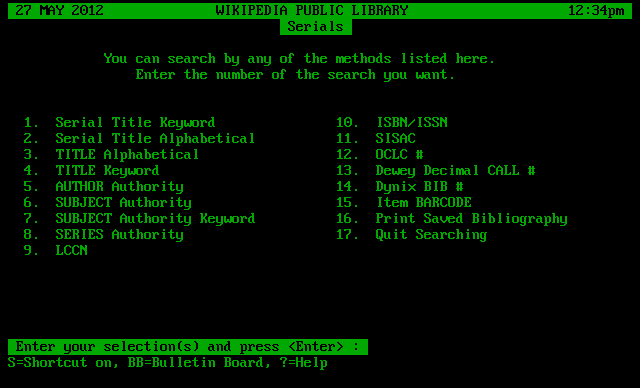
While he was working on his MBA, he took some time off to work at a startup called Campus Pipeline, which wasn’t a very successful company but turned out to be a fantastic place to work if you were curious about how technology would begin to impact higher education over the course of the next decade. This was back in 1999, when a lot was happening. Peoplesoft had created what became Campus Solutions from a system built by a team at UCLA. In the early days, it was a green screen application. For you young ‘uns in the audience, this green screen isn’t the feature in Zoom that lets you look like you’re web conferencing from the beach. It means that the user interface of your software typically looked something like this:
Green screen software
It was literally a screen that was all green, all text, and no mouse or pointer functionality. Peoplesoft and its competitors were very focused on getting the transactional registration and accounting details right so that people were registered for the right classes, got credit for them, got billed for them, and so on. And on making the interface less awful for the administrators who had to use the system. They weren’t terribly focused on the stakeholders beyond the back office folks like the registrar. People of a certain age will remember that students used to register for courses by standing in lines in the college gym and filling out paper forms. That was one problem to be solved, but the companies that made these Student Information Systems (SISs) were not really ready to take it on yet. They were busy working out the kinks in the core software.
Correction: While many of these early SISs had green screen implementations, Peoplesoft did not.
Another change of the time was the rise of the LMS. This was right at the time when LMSs were beginning to achieve widespread adoption. But they were pretty simple applications back then. They didn’t integrate well with these new SISs, and they hadn’t yet evolved good software for sharing information beyond the needs of individual classes.
And then there was this thing called the World-Wide Web. The internet search giant that was taking over the world—I’m talking about Yahoo!—was changing the way everybody was thinking about information. This word “portal” was making its way into the popular lexicon, even if not everybody knew exactly what it meant.
Campus Pipeline stood astride all of these trends. Or tried to. There were obviously some big new ways in which technology could help education, but it wasn’t yet obvious how they all would fit together usefully. The company never quite found its footing, in part because it was just too early to the party. It pivoted so often that perhaps “pirouette” would be a better term. Campus Pipeline survived the dotcom implosion in 2000 and was eventually managed to get acquired by the company that, several mergers later, would become part of Ellucian.
But the important aspect for our story is that Curtiss got bitten by the product management bug. He understood some of the challenges and changes facing higher education from his experiences on the inside. Now he had a chance to see what it was like to design products that helped with these problems. What if students didn’t have to line up in the gym to register for classes, as they had from time immemorial? What if they didn’t have to work their way through a maze of campus departments to get basic information and could instead just look it up on the web? How could students be served better and institutions work more effectively if these new, expensive software products that the universities were buying could actually integrate with each other in some way?
It’s intoxicating. I have teased Curtiss that there is a certain Forrest Gump aspect to his story of always stumbling into the right place at the right time, but the truth is that a lot of this was about him following his curiosity. This is partly a story of what it can look like when we stop defining ourselves by what we have done in the past and start imagining ourselves based on what we could do in the future—as individuals, organizations, and a sector writ large.
Products serving people
Curtiss followed Campus Pipeline into the bowels of the SIS world and soon found himself at Oracle. This was soon after Oracle had acquired Peoplesoft in a publicly acrimonious hostile takeover. And it wasn’t like Oracle otherwise had a sterling reputation before this. They were generally reviled as a company, even if their database product was highly regarded. Further, SISs were still relatively primitive but already very complicated. They are extremely hard products to build well because so little about the ways in which they were used was standard. Again, this is not exactly the description of an easy and fun job, but it was a great place to learn. (There is a pattern in Curtiss’ life choices that is developing at this point in our story.)
Higher education is not known for its loving embrace of aggressive corporate empires. Needless to say, the acquisition was not welcome news for many Peoplesoft Campus Solutions customers. To say the least. Luckily, Oracle was smart enough to keep most of the really wonderful group of people in the Peoplesoft higher education team (including some who had come from the UCLA team that developed the original software on top of generic Peoplesoft). Curtiss started at Oracle with the word “strategy” in his title. Strategist is often a difficult role to have because at many companies, everyone thinks they’re a strategist and almost nobody is really any good at it. At Oracle, being a strategist meant that Curtiss and his fellow colleagues were the connective tissue—and sometimes the mediators—between the sales team, the product team, and the customers. Their job was to understand how both salespeople and product people listen to customers (and each other) and synthesize what they heard into, for lack of a better term, a strategy. He also represented Oracle on the IMS Board of Directors (while I was contemporaneously serving my tour of duty representing Oracle on an IMS standards development committee).
At that time, Oracle had a couple of challenges that Curtiss worked on with his (truly excellent and often unsung) colleagues in Oracle’s higher education group at that time. First, they had to prove to the Campus Solutions customers that their voices would be heard and their needs met under the new ownership. This they did, at least to the degree that anyone can make people feel warm and fuzzy about an inherently crazy-making product category. (The number of people who have ever in human history said “I love my Student Information System so much!” is approximately zero. Almost as many as have said the same thing about their LMS grade book.) They really did win a lot of trust back, which is something you can only do by consistently listening to clients, making sure you are understanding their needs, and responding to them as quickly, empathetically, and effectively as possible over a long period of time. When Curtiss and I talked about what he considered to be the highlights of his time at Oracle, this work was the first thing he mentioned (along with his colleagues).
The best reason to make a living working on products is that you love solving other people’s problems. This means that you have to learn to love—or at least empathize with—the people whose problems you are solving.
The second challenge that Curtiss and his colleagues tackled was taking Campus Solutions to international markets. The good news (from a business perspective) was that large parts of the world were lagging the US in the adoption of this sort of product, so there was an early opportunity to get into those countries and serve those schools. The bad news was that universities function very differently in different countries. So there was a ton of product localization work to be done. Tech people tend to throw that word around as if it means “translate the labels into another language,” but really it means understanding how customers in a new area have different needs—typically influenced by different cultures, sustainability models, and regulatory requirements—and then redesigning your application to serve those needs (without breaking it for existing customers). This is really hard, especially for an application that gets deep into the quirkier and more arbitrary—and yet critical—aspects about how different universities and education systems work, like how credit is awarded and who pays how much for what aspects of the education at what times. So for a person with the word “strategy” (or “product”) in their title, growing into international markets should mean learning to empathize with different kinds of customers well enough to understand and help to address their needs and wants.
The third challenge that Curtiss and the team wanted to take on was to better serve their customers’ core mission of teaching and learning. This is why I was recruited to Oracle. I was their first hire who was supposed to be an expert on the “education” part of higher education. Like Curtiss, I had started off working in an educational institution and got bitten by the product bug. I had done some consulting work that had periodically gotten me into product design, but Oracle was my first gig where product design was my full-time job. I had an unusually large number of colleagues that I liked, admired, learned from, and still consider friends to this day. Curtiss is one of them, but he also was a mentor for me in a way that has had a profound impact on e-Literate.
Big companies like Oracle are weird in their own special way. If you’re an academic, you have probably had your moments when you’ve clenched your fists or pulled your own hair out in frustration that what should be a simple, rational process to accomplish something that obviously needs to be done is absurdly hard or even impossible. Corporations are no different in that regard. Their dysfunctions are often completely different—to the point of sometimes seeming incomprehensible to academics—but the end result feels striking similar from the inside. Understanding why organizations are dysfunctional in their own particular ways can be hugely helpful for both effectiveness and mental health. It helps you get more done while saving yourself some stress by avoiding battles that you can learn to recognize as unwinnable earlier on. Both of these are critical. We all want to spend as much of our time being effective at work and as little time as possible spinning our wheels. Curtiss had been a student of this dysfunction starting long before I had. He understood corporate dysfunction, academic dysfunction, and the codependencies between the two kinds of organizations. He taught me ways of thinking about these problems that animate some of my best writing and work in the sector to this day.
Ultimately, the team was not successful in getting Oracle to make a major investment in the teaching and learning side of education. It felt like we got close a few times, getting multiple meetings with top executives who seemed receptive. For me, the final nail in the coffin was Oracle’s acquisition of Sun Microsystems. It became clear that, while the company was happy to have the higher education business, they were hunting for bigger game. We were not going to be a priority. This was the bleeding edge for a company like Oracle at that time—along with moving to the cloud—but the company wasn’t ready to bleed for education. It was time to either come to terms with that fact or move on.
Products supporting teaching and learning
Curtiss left for a job at Cengage Learning, where he could get closer to the education problem. I quickly let him know that I wanted to follow him both because I wanted to continue to work with him and because Cengage seemed like an interesting opportunity to attack a meaty problem.
I’ll speak for myself here: I thought I was going to Cengage to start a methadone clinic for one of the major textbook publishers. The industry was addicted to high prices and frequent republishing of new additions to tamp down the used book market. As is often the case with addicts, it took a long time for the industry to admit that it had a problem. Curtiss was the right person to help them with this problem, and he was being hired at a high enough level that I had hopes he could help them do it (although he did have that pesky word “strategy” in his title). He also persuasively argued that the right team was in place to make the change. Cengage had hired Chris Vento, who was famous in EdTech circles for leading the creation of WebCT Vista, which was a cutting edge LMS in many ways in its day, and for driving some important standards work at IMS. Chris was the visionary behind their new digital courseware platform—though that term wasn’t in common parlance yet—called MindTap. Once I saw what he was working on, I was sold. Chris is one of the most brilliant EdTech product visionaries I’ve ever met. It would be a privilege to learn from him.
I wanted to work with Curtiss, Chris, and other valued colleagues to help Cengage re-invent curricular materials products as something new and genuinely educationally useful while pushing the company toward a healthier business model in the process. This was a growing passion of mine—to make EdTech healthier and more responsive. Continuing to learn about how to do it by working with and learning from Curtiss felt right.
It was a good hill to die on.
While the first generation of MindTap was fairly successful, we ultimately failed to achieve our larger ambition—at least in the time frame that the three of us stuck around the company—in part because the patient hadn’t reached the first step in the 12-step program. It would take a number of more years for the publishers to come around to our way of seeing things, and it’s arguable whether they’ve come far enough or moved fast enough.
During my personal trough of disillusionment with Cengage, Phil Hill approached me about starting a consulting business together. It seemed like an idiotic idea, which was one of the reasons that it appealed to me. If I was going to fail to make a difference, I wanted to at least do it my way.
But Curtiss stuck to his guns. He moved on to Pearson, where he finally shook the “strategy” label and found a place where he could help shepherd truly large-scale change.
Bringing the “Ed” and the “Tech” together
I was worried about Curtiss at first, for two reasons. First, my opinion of the industry as a whole was at an all-time low. And y’all know where my baseline is. Second, Pearson had a reputation at the time of being an old boys’ club and a highly political place, which is the antithesis of how I think of Curtiss.
But he steadily climbed the ladder there while still staying recognizably Curtiss. Before I knew it, he was essentially overseeing Pearson’s entire digital product portfolio. Textbook publishers’ organizational charts and accounting systems are even weirder and more Byzantine than many universities, so both describing what it means to “oversee” a portfolio at one of these companies and measuring the size of it in any definitive way are incredibly complex. Depending on how you count it, the products under Curtiss’ purview were worth anywhere between hundreds of millions and well north of a billion dollars in revenue. He certainly didn’t have absolute authority over that portfolio, but he had enormous influence.
Curtiss took some of the ideas that had failed to get traction at Cengage and helped drive them deep into Pearson. Digital curricular materials would be, as he puts it, “more than just a book under glass.” There would be educational affordances designed not just for the convenience of the professor but to support more effective teaching and learning. This meant bringing learning designers and UX designers into the center of the design process. It meant battling the notion that every discipline—which in the world of textbook publisher politics really meant every major editor—was an island unto itself and therefore should have been allowed to build its own half-baked platform. Pearson CEO John Fallon, about whom I have decidedly mixed feelings, deserves immense credit for pushing the company to hold itself accountable for its role in impacting educational outcomes. But it fell to Curtiss’ team, as well as to Kate Edwards and her colleagues in Pearson’s research and efficacy group, to actually operationalize that commitment and make real progress toward it.
One of the aspects of my professional perspective that I’m proud of is my ability to recognize important, hard-won progress without losing sight of how far we still have to go. That’s a trait that I share with Curtiss and may well have learned from him. The publishers are still a mess, and it’s very much an open question regarding where they go from here. That said, the sector has made substantial progress in figuring out what the potential of digital courseware can be. Some of the credit for that undeniably belongs to Pearson, and Curtiss played a significant part in that transformation.
Remember, this is the same guy who started out his professional life as a fund-raiser for his alma mater. In the current environment, many of us are likely to face some strange and unexpected career choices. We are who we choose to be. Or as the great Yogi Berra once said, “When you see a fork in the road, take it.”
Curtiss’s last role at Pearson shows him once again following his nose. He spent some time looking at the problem of life-long learning and career development in the 21st Century. The ongoing educational needs of today’s workers can no longer be met by the traditional corporate training and development department. (More accurately, the need can be met by T&D departments even less effectively than ever.) How can we build stronger, more agile partnerships between higher education, the corporate sector, and non-profit actors to address this challenge? As usual, Curtiss is onto the next frontier.
Run, Forrest! Run!
A really bad career decision?
So now Curtiss is starting to work with me at e-Literate and EEP. A person with his experience has options. I’m humbled—and honestly a little perplexed—that he’s chosen this particular option, but then, he’s never been one to take the easiest or most obvious path.
This post has been an introduction to my friend and colleague, but it’s more than that. And it’s also more than just a parable meant to encourage you about your own future career choices (though it is that too). Times are changing and we must change with them. e-Literate must change too. I’ve been signaling that in some of my recent posts. This is the first concrete sign of those changes. I want to help you make the world a better place, in this moment, in ways that matter. My skills are not equal to my ambition, and anyway, I’ve always enjoyed my job most when I’ve had the privilege of working with people that I admire. Curtiss is one of those people. You’ll be hearing his voice here on e-Literate soon enough. And you’ll hear about new initiatives that we’re cooking up. I can’t wait for you to see what’s coming.
In the meantime, my next post in this series will cover Curtiss’ history with pets, including his formidable chicken coop-building skills.
In a recent post, I wrote about my experience on the EDUCAUSE exhibition hall looking for vendors with proof that their products actually help students and how this is an example of the more general problem:
Right now, higher education has very poor signals to quickly distinguish between those vendors who can prove that their products are effective and those that can’t. Between those vendors who are contributing to the general state of knowledge about how to improve student success and those that aren’t. Until we can improve the signal-to-noise ratio, we are doomed to ride the roller coaster from hell that is the hype cycle until we pass out from exhaustion.
I’m going to do something about improving the signal-to-noise ratio, and I will be announcing what that something is within the next week.
Today I am pleased to announce the Standard of Proof ongoing webinar series, which attempts to do just that. The first is scheduled for November. But the plan is to have at least one a month starting in late January, after folks have returned from winter break.
How webinar topics are selected
For many years now, I have turned down requests to facilitate paid webinars because it’s very hard to do them without sliding down a slippery slope and either appearing to be a shill or actually crossing over the line and becoming one. And yet, I would like to give webinars that highlight genuinely good work, and I would like to get paid for my time so that I can afford to do this work.
The Empirical Educator Project (EEP) has given me a novel way to thread the needle. Vendors don’t pay me directly for a webinar. Instead, they sponsor EEP. I vet prospective EEP sponsors—they have to have something to contribute beyond just money—and I also price sponsorship to incentivize active participation and contribution. Standard of Proof webinars are now another incentive for vendors to contribute.
A Standard of Proof webinar is not an automatic benefit of EEP sponsorship. Each webinar is about not a company but a contribution to the work of empirical education. It can be, and often is, novel research conducted by the company that (a) contributes to our knowledge of how to help students succeed, and (b) adds to our knowledge in a way that is generalizable beyond their product or service. In other words, it is a contribution to the commons. But the contribution can also be a project that helps disseminate established research-backed practices or generally promote the culture of empirical education. A contribution should either be free if it has no maintenance costs or non-profit if it has does have a cost to maintain.
Contributions also have to have been developed with some meaningful collaboration with or peer review from academics. As with the definition of “contribution” above, I am more interested in the spirit of meaningful collaboration than in setting up narrow rules. But there has to be an academic who was involved enough in the project that she or he is willing to speak publicly about their participation and their views of the project.
While EEP sponsors are not guaranteed a minimum number of webinars in return for their sponsorship, neither are they limited to a maximum number. If they have made multiple contributions and I have time to cover them in the Standard of Proof schedule, I will. If that means running more than one webinar a month, I would be happy to have that problem.
The end goal here is to help vendors that meaningfully contribute to education differentiate based on those contributions. Providing credible evidence that their solutions support student success is part of that work, but the bar is higher than that. The webinar series title, “Standard of Proof,” refers not only to the products but to the vendors. The series highlights acts of good citizenship that promote empirical education. By raising the profile of these acts and the vendors who perform them, I hope to influence the criteria by which prospective vendors are selected and therefore their incentives for behavior.
Folks, this only works if you and your institutions decide that you will prioritize good behavior—including but not limited to credible proof that a product is effective—in your vendor selection. The most that I can do is help make that good behavior a little more visible.
The first webinar
As I wrote earlier in this post, the first webinar coming up later this month. I have two more lined up for early next year that I will be announcing at a later date and more in the pipeline.
Summer melt: A randomized controlled trial
We’ll be kicking off the series a randomized controlled trial by AdmitHub and its academic partners to advance our understanding of a critical phenomenon that influences the success of first-generation students.
Folks involved with admissions at access-oriented schools may be familiar with the term “summer melt.” It’s when students are admitted to a university, say they are coming, and then never show up. And it tends to be a first-generation student problem. There are all kinds of logistical and bureaucratic hurdles in getting from admissions to first day of classes that may be harder for first-generation students, either because the processes are not designed to accommodate their situations or because they don’t have anybody in their lives who can help them. Maybe they need an immunization certification and they don’t know how to get it. Maybe they need the signature of a parent who they don’t know how to contact. This is a problem that is often caused by a number of small contributing factors, and it is hard to diagnose because the people who know what kept them from coming to college…never came to college. So having a dialogue with them after the fact is difficult to arrange (not to mention unhelpful for the student, who has already missed an opportunity).
There are a number of products on the market, particularly machine learning-enhanced chatbots, that purport to address the summer melt problem. AdmitHub is one of them. But rather than just claim that they can help, they collaborated with their major customer, Georgia State University (GSU), and an academic researcher from the University of Pittsburgh who studies summer melt, to conduct a rigorous study of the impact of the AdmitHub-enabled interventions on summer melt at GSU. The results of the study? GSU was able to reduce summer melt by 20% using AdmitHub.
In addition to providing credible evidence for the product’s effectiveness, this study’s results and experimental design both contribute to our general knowledge of summer melt. We’ll be talking about that as part of the webinar, which will include the PI Lindsay Page from Pitt as well as Tim Renick from GSU, who happens to be a personal hero of mine.
You’ll notice that the e-Literate web site has gotten a redesign and that we’ve switched URLs to http://eliterate.us. (Please update your bookmarks and RSS feeds.) You will also notice that there is a new “Get Help (Services)” menu item at the top of the page. While I had originally put a commercial services page on the Empirical Educator Project site, that was just a placeholder until I could complete the e-Literate site makeover. It has migrated here, where it belongs. In this post and the next, I’m going to provide some more details about how e-Literate is evolving, what’s changing, and what isn’t.
The Past
During the first half of e-Literate’s life, it was simply a personal blog that was a work of passion. I started writing it as a way of thinking out loud about my work and of experimenting with what was then a new form. As my readership unexpectedly grew, it became a way for me to find new colleagues, engage in productive conversation, and advocate for change. For the most part, I never really thought about it as something that benefited me professionally, except on the rare occasions when I looked to change jobs and discovered, to my surprise, that people I was interviewing with already knew who I was.
When Phil and I started MindWires together, we were still pretty naive about the relationship between the blog and the company. We thought that MindWires would be our day job that we would use to feed our blogging habit. As it turned out, most of our work came because people knew us through the blog.
But it wasn’t that simple. Phil and I naturally gravitate toward somewhat different kinds of analysis and different kinds of work. As writers working in the same publication, those differences worked beautifully together. We complemented each other well. As business partners, it was harder to build a coherent business. Phil is a natural market analyst and process consultant. He does those things extremely well and enjoys the work for its own sake. He also likes maintaining the kind of neutrality that one needs in order to do that work well. I, on the other hand, am more of a puzzle solver than a referee and have always thought of myself as an activist, which is not a word that Phil uses to describe his own vocation. So there was always a certain amount of parallel play in both e-Literate and MindWires. That worked for a while, but the more ambitious we got, the harder it became to reconcile our respective passions under one roof.
Hence, the split. Our time together taught us something important about what we each need to be doing. And, as we have also learned through our seven years working together, our work and our writing is tied together more intimately than we had realized. Splitting up the business while continuing to blog together wouldn’t take us to where we each need to go right now.
For me, after 14 years of trying to have an impact through e-Literate while earning my living in various ways that are only loosely connected to the passion expressed on these pages, I need to bring the two closer together. So that is what I am doing.
The Future
e-Literate the publication is now one piece of a larger e-Literate organization, although it remains the beating heart of it.
Think of the organization as having two parts. The first part is dedicated to spreading understanding. e-Literate has been doing this from the very beginning. The Empirical Educator Project (EEP) can be thought of as a social, IRL extension of e-Literate. I think of this as “spreading the gospel,” but the business-speak for this part would be “media and events.” There will be the blog, the summits (which may evolve into a conference as interest grows), a podcast, and other logical extensions. I will have more details to share on this, including a way to pay for the expense of expanding this work that I think will actually do net good rather than harm, in tomorrow’s post. One does not get rich from education media and events, but if they pay the mortgages of the people working on them, that’s just fine.
The other half of the business is to help organizations implement the knowledge and effective practices that are brought forward in the first half. Everything published through e-Literate and EEP will be contributed to the commons via a Creative Commons or open source license. But sometimes organizations need help implementing these ideas, or they want context-specific coaching. So the rest of the business will provide a combination of workshops and consulting that help apply and extend just about anything covered in e-Literate or EEP. I do have significant ambitions to grow this part of the organization, largely because I think it’s an important way to grow impact.
Keeping Trust
Moving forward, I intend to increase the high standard of transparency that we have always tried to maintain on the site. I will continue the practice of prominently disclosing any financial relationship in cases where I am writing about an organization with which my company has a financial relationship. And I will also continue to write critical posts of current clients if I think it important to fulfilling the function that e-Literate plays in the higher education ecosystem.
By moving the unpaid writing and the paid work under the same brand, I am further increasing the transparency. Maintaining separate brands for the two different kinds of work creates only an illusion of independence in small organizations, where both kinds of tasks are performed by the same people. There is no practical firewall. The only way to provide assurance of ethical standards in such situations is through transparency. Putting everything under the same brand makes the responsibility as clear as possible. As an editorial convention, I will continue to italicize e-Literate when I am referring to the publication but will not do so when I am referring to the eponymous umbrella organization. But in the big picture, e-Literate and e-Literate are one and the same.
My intention is to build something that is ultimately bigger than me and that will outlast me. But for now, I understand that I am the personification of e-Literate. To reflect that reality, and in keeping with the proud tradition of small company owners making up their own absurd titles, I am calling myself e-Literate’s Chief Accountability Officer.