e-Literate

Present is Prologue

Category: LMS & Learning Platforms

Everything you want to know about Learning Management Systems and whatever comes after them.


  • Unizin RFP For LMS: An offering to appease the procurement gods?

    Well this was interesting:

    In a blog post from Monday, Unizin announced a public Request For Proposals (RFP) to solicit bids for an enterprise and multitenant LMS. The RFP states its purpose:

    We seek to identify a qualified vendor (“vendor”) to make available an enterprise and multitenant learning management system and related services (collectively, the “LMS”) to Member Institutions.

    Say what? (more…)

  • LMS Market Updates, Dec 2015

    There seems to be a series of news and analysis on the LMS higher education market worth summarizing.

    Major Adoption News

    I posted last weekend about University of Phoenix (UoP) and their LMS. UoP is well-known for being the biggest user of a homegrown LMS for well over a decade, but in the past several years they rolled out “Classroom”, an entirely new adaptive-learning based design. In a major strategic change, UoP is abandoning this effort and moving to a commercial provider.

    What we can now confirm at e-Literate is that the “learning platform” selected by the University of Phoenix is Blackboard Learn Ultra. This is the cloud-based redesign of Learn that Michael and I have described in several posts. Even with the University of Phoenix’s reduced enrollment, I consider this news to be the most important new client acquisition for Blackboard since at least 2011.

    Today Campus Technology reported that Stanford is moving to adopt Canvas as their campus-wide LMS. Previously Stanford was a founding member of Sakai, with its implementation called CourseWork.

    The university has been piloting Instructure Canvas since the 2014-2015 academic year. The vice provost for teaching & learning (VPTL) said in a statement that about 80 percent of faculty in the pilot reported being “very or somewhat satisfied” with the new platform; even more students (94 percent) found it “very or somewhat easy” to use.

    Alongside the pilot, two Stanford schools had already adopted the application independently. The Graduate School of Education moved to Canvas in 2013-2014, and the Graduate School of Business did so in 2014. Both adoptions were considered successes.

    During this school year, the migration was accelerated. Some 300 classes switched to Canvas. And the plan is to migrate the remaining 4,200 classes still using the legacy LMS software over the next academic year.

    (more…)

  • Exclusive: University of Phoenix moving from homegrown platform to Blackboard Learn Ultra

    The University of Phoenix has a history of using its scale to develop and rely on homegrown platforms, including the  adaptive learning platform branded as “Classroom”. I wrote about this investment in 2013.

    The full significance of the University of Phoenix bet on adaptive learning platforms goes beyond pure dollars and became clear when the school announced the closure of 115 of its 240 locations. The stated usage of the savings from campus closures is primarily to further invest in the platform as described by the Phoenix Business Journal.

    In early 2015 the University of Phoenix experienced “significant disruption with respect to our new online classroom platform”. By summer, the university’s parent company The Apollo Group announced to investors that it planned “to move away from certain proprietary and legacy IT systems”. CEO Greg Cappelli further described these changes in broad terms in the most recent earnings call. (more…)

  • New Visual From LISTedTECH Shows LMS Market By New Implementations

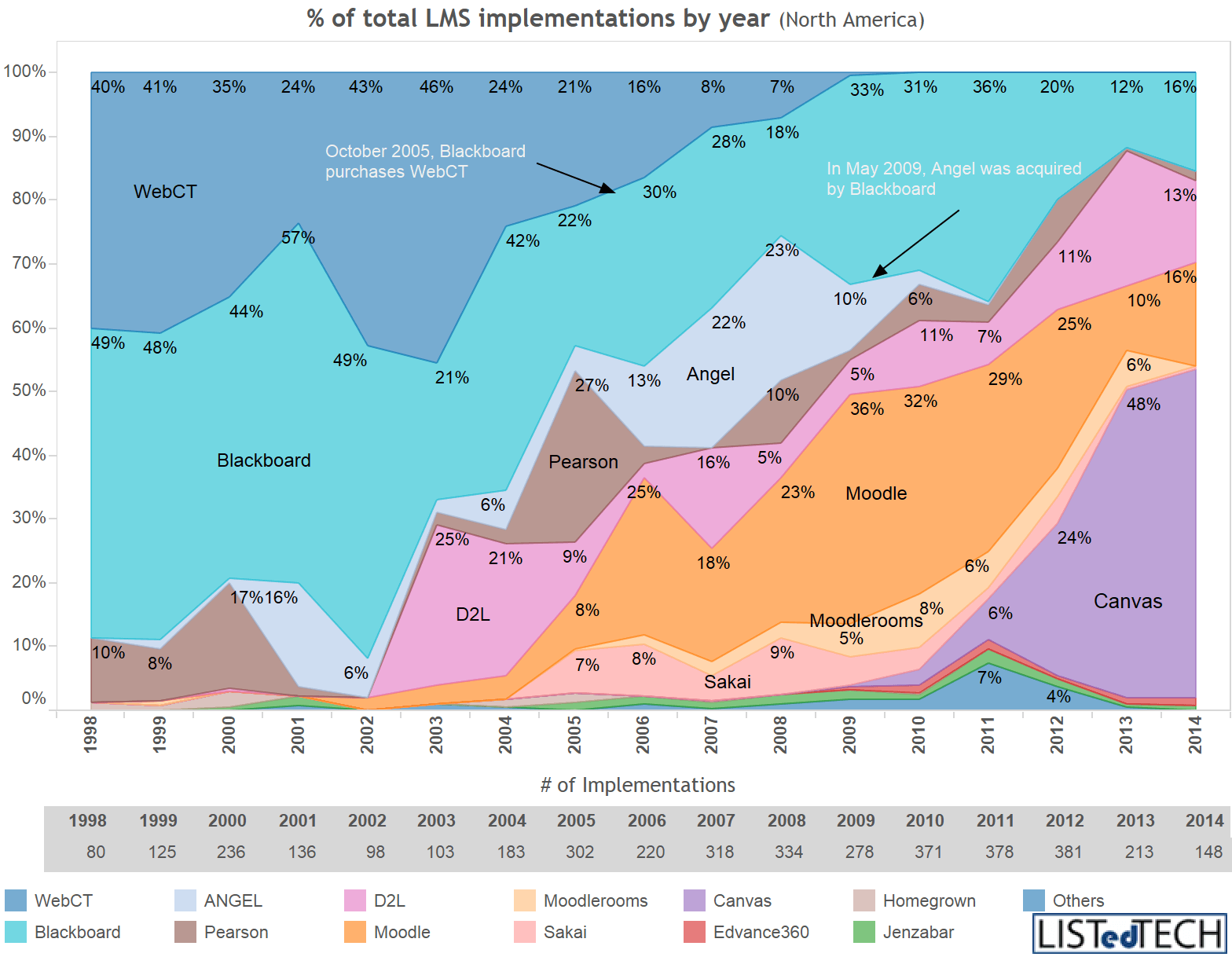
    Justin Menard and his team at ListEdTech have produced a great new visual on the LMS market in North America. Using his wiki-based data with 4,000+ institutions, he shows the percentage of LMS implementations per year (scaled to 100% for each year). While we are used to seeing LMS market share in terms of number or percentage of institutions using each LMS as primary system, this view highlights the dynamics of the market – which systems are getting adopted. See original post for full chart and additional description.

    LMS-Providers-Market-Share-by-Year1

    A few notes: (more…)

  • Interview with Josh Coates, CEO of Instructure, on today’s IPO

    Instructure, maker of the Canvas (higher ed and K-12 markets) LMS and Bridge (corporate learning market) LMS, held their Initial Public Offering today. Prior to the IPO, Wall Street analysts focused on the company’s growth, its large losses, and the challenges of the education market. The company was priced on the lower end of its range ($16.00), and closed up 12.5% at $18.00.

    This IPO and its lead up have been highly watched, particularly given the rapid growth in ed tech investments and questions on whether there are real businesses to emerge based on the investments. I had the opportunity to interview CEO Josh Coates today. What follows is an edited version of the interview, focusing mostly on how Instructure’s IPO will impact education markets and existing customers. I tried to capture as much of the Q&A verbatim as was feasible, but treat the answers below as a paraphrase.

    Q. What are your impressions on how the IPO has gone so far?

    A. The market in general has been a blood bath [ed. Dow down 585, or 3.3%, for the week], but we’re doing well so far. Given market conditions right now, we’re pleased as punch. We priced in range [ed. $16 – $18], and the market responding well. We’re really focused as a company 6-12 months down the road, but it is nice to get this IPO feedback. (more…)

  • What Schoology’s Venture Funding Means for the LMS Market

    LMS vendor Schoology just raised $32 million in Series D venture capital funding, bringing the total that they’ve raised to just over $57 million. If you’ve never heard of them, that’s because they have mostly been focused on K12, where they are doing very well. But they have turned their attention to US higher ed recently. They had a surprisingly big presence at EDUCAUSE, where CEO Jeremy Friedman told me that they are prepared to make an aggressive push. Their ability to get major funding was probably helped by Instructure going to market, and possibly by the leak that Blackboard is putting itself on the block as well. I don’t generally take money guys too seriously in their ability to predict ed tech, but they may be lucky on this one. I think there may be an opening the US higher ed LMS market for a new entrant.

    LMS selection for schools often works a little like the selection process that high school students typically go through when picking a college. Students looking at colleges usually have a favorite going in. Maybe their friends are going there. Or their big brother or sister. Or maybe they just heard that it’s cool. But they don’t apply to just one college, in case it doesn’t work out for one reason or another. So they have a second tier of schools that might be OK too. Generally, they don’t know much about your favorite school going in and they know even less about the “might be OK” schools. Depending on how cautious they are, they might throw in one or two “safety” schools that they really don’t want to go to but that they feel (or their parents feel) should be included for the sake of completeness.

    Likewise, colleges and universities frequently go into an LMS evaluation process with a favorite. Because the selection is generally done by a committee of stakeholders rather than just one person, there might be conflicting opinions on what the favorite is. But more often than not, there is a nascent majority or a consensus opinion about the likely winner, at least among the core selection committee. Back in the early to mid-aughts, the default favorite was usually Blackboard because it was considered to be the safe alternative that everybody was using. When Blackboard faltered, the favorite began to split between D2L and Moodle—and occasionally Sakai, particularly for larger public universities—with type of school and geography having a big influence on which one was likely to be the frontrunner. These days, the schools that Phil and I talk to report Instructure as the starting frontrunner at least four times out of five, across school types or geographies.

    But LMS selection processes still need their “might be OK” candidates. For one thing, most of them are mandated by policy or by law to do a real multi-vendor evaluation. And most evaluation committees genuinely do want to look at alternatives. Just because they have a sense going in of which alternative is most likely to be the best doesn’t mean that they are closed-minded. The trouble is that there aren’t many alternatives that selection committees feel hopeful about these days. Increasingly, Sakai and Moodle aren’t even making it to the serious evaluation stage in US higher ed evaluations; and even when they do, they are often treated like safety schools. Blackboard never fully recovered from reputational damage done under Michael Chasen and their failure to deliver on Ultra this year was a huge setback. At the moment, they are being treated like a safety school as often as not. If Ultra slips further—and maybe even if it doesn’t—they could start losing significant numbers of customers again. And we haven’t run into many schools that are particularly excited about D2L either. Probably the best I can say for them is that they are the least likely of the LMS companies that are not Instructure to be dismissed out-of-hand.

    I think there’s an opportunity for a new entrant to get a fair hearing from selection committees that want a real horse race but aren’t excited about any of the incumbents. Ironically, the rise and success of Instructure has probably reduced risk aversion among schools to go with a scrappy start-up. I don’t know if Schoology is going to be the one that gets a foothold in the market because of this opening, but their timing is definitely good.

  • Instructure Dodges A Data Bullet

    Last week’s EDUCAUSE conference was relatively news free, which is actually a good thing as overall ed tech hype levels have come down. Near the end of the conference, however, I heard from three different sources about a growing backlash against Instructure for their developing plans for Canvas Data and real-time events. “They’re Blackboarding us”, “the honeymoon is over”, “we’re upset and that is on the record”. By all appearances, this frustration mostly by R1 institutions was likely to become the biggest PR challenge for Instructure since their 2012 outage, especially considering their impending IPO.

    The first complaint centered on Instructure plans to charge for daily data exports as part of Canvas Data, which Instructure announced at InstructureCon in June as:

    a hosted data solution providing fully optimized data to K-12 and higher education institutions capturing online teaching and learning activity. As a fundamental tool for education improvement, the basic version of the service will be made available to Canvas clients at no additional cost, with premium versions available for purchase.

    What that last phrase meant was that monthly data access was free, but institutions had to pay for daily access. By the EDUCAUSE conference, institutions that are part of the self-organized  “Canvas R1 Peers” group were quite upset that Instructure was essentially selling their own data back to them, and arguments of additional infrastructure costs were falling flat. (more…)