You may have already heard a bit about NIXTY, since they have managed to make a significant media splash in the last few weeks. There have been a number of interesting analyses, both pro and con. I’d like to highlight a few aspects that haven’t gotten much coverage.
For starters, here’s a screencast that NIXTY CEO Glen Moriarty was kind enough to make for me:
I have a couple of take-aways from both the interview and the conference. First of all, I was astonished at how much D2L is growing. Based on what I saw at the Sakai conference, what the market surveys have been saying, and what I know from talking to people, it was already clear to me going in that there’s a big shift happening in the LMS market. I expected to see D2L benefiting from that. But I wasn’t prepared to see the number of new clients they’re on-boarding. I’m trying to get a list to illustrate the size of the growth. In his keynote, John had three slides’ worth of new logos. These aren’t expanded client relationships, which is the kind of thing that Blackboard tends to highlight these days. These are new clients.
Second, the economic downturn is affecting the market, but the effects are somewhat unpredictable. John’s story about PASSHE, a system with fourteen different universities, migrating to D2L in a couple of months, is remarkable. There’s only one thing that can drive a fractious group of state colleges to act that quickly in unison: a budget crisis.
And finally, I do see a vision for the future of the LMS emerging from D2L’s development work (although it’s hard to convey a clear sense of it in the interview format). It’s a vision that is significantly different in some ways from Sakai’s, Moodle’s, or Instructure’s. My sense is that it’s also different than Blackboard’s, but I’m not familiar enough with the details of Blackboard 9.1 and their roadmap to say so with a great deal of confidence. Desire2Learn is headed straight into the thicket of some thorny cultural change management problems at the university. Adopting and sharing learning objectives, sharing learning content, taking a systemic approach to ePorfolios, discovering metrics in student activity and performance data—each of these efforts individually is hard to sell in a university culture and results in failure more often than success. D2L appears to be betting that the problems are actually easier to solve together than separately because you can get synergies from integrating the technologies behind them. It’s not clear to me whether they’ve fully articulated their approach that way, even to themselves, but it is, in fact, what they appear to be trying to do.
I have more to say about what I learned about the conference, including about the company’s announcements about their mobile plans and how they stack up against the other market entrants, but I also have a Jim Farmer post, a post about another new LMS entrant called NIXTY, and probably the most important Sakai conference post to get up as well. And next week I’ll be at Campus Technology all week, which both limits the amount of blogging time I have and will undoubtedly provide fodder for new posts.
Up until now, it would have been fair to call Sakai 3 a mature experiment. Two years of work have been invested, mostly by Cambridge, to test out some ideas about the design, architecture, and development ecosystem of next-generation virtual learning environments. We have learned a lot from it, but the level of commitment to turn it from an experiment into a product system has been somewhat vague.
That changed a couple of weeks ago at the Sakai conference in Denver. We now have a much clearer idea of when Sakai 3 might be deployable as a production system to meet different purposes.
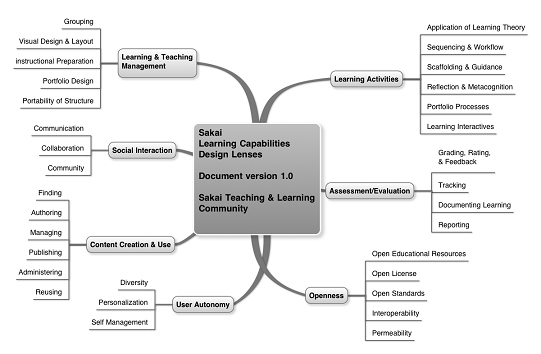
A while back, I asked David Goodrum to write a guest post about some of the work that the Sakai Teaching & Learning Group has been doing to articulate the educational goals and requirements for Sakai 3. The document that they have been working on is called the Sakai Learning Capabilities document, and it entered a 1.0 release just prior to the start of the Denver Sakai conference. This is very important work that will certainly impact the future of Sakai and could have a wider impact in instructional technology.
The group articulate seven “lenses”, which you might think of as functional goals or even as design values for Sakai 3. They are called lenses because each one presents a different view or perspective of any given piece of functionality within Sakai 3 (or any piece of educational technology, really). Every tool and capability within the system should be examined from the perspective of each of the seven lenses at some point in the design phase to help the designers make sure that they are upholding the design values of the system wherever and whenever possible. Each lens contains several finer-grained “facets” which are, again, intended to help software designers ask the right questions as they are designing educational capabilities. These lenses include capabilities for addressing traditional LMS and ePortfolio as well as important educational scenarios that are not handled well by today’s systems.
Here’s what version 1.0 of the lenses looks like as a mind map:
Sakai Learning Capabilities v1 Mind Map
Note that at least two of Dan Pink’s three drivers of motivation are articulated on the map. Autonomy is called out fairly directly as a lens. I would argue that “mastery” is represented in some of the facts of the “learning activities” lens. (Interestingly, the facet descriptors in the “assessment/evaluation” lens seem relatively devoid of connections to mastery at this point, although in fairness, there’s a lot more thought and analysis underneath this mind map that the descriptors may not be capturing.) I’m not sure that Dan Pink’s third motivator—purpose—can be wired into software, although I’ll be keeping my eye out for examples of it.
The key for the community will be to figure out how to translate these design values into concrete processes during the software design and development process. I have some ideas about how to go about this this. I hope/expect to write about them in a future post.
One of the best aspects of the annual Sakai conference is the Teaching With Sakai Innovation Awards (TWSIA). Every year, several teachers in the Sakai community are honored for their work and give presentations on what they’re doing in the classroom. This year, the TWSIA presentations were the keynote on the second day of the conference. The point of these awards isn’t to sing the praises of the Sakai software. Rather, it’s to (a) celebrate the work of some outstanding teachers, (b) remind all the people who contribute to the development and support of Sakai of why their work matters, and (c) give Sakai developers more direct exposure to how teachers are working online and what kinds of capabilities they need and and actually use.
This year, the first place winner was Dr. Scott Bowman, Assistant Professor of Criminal Justice at Texas State University. Here’s an interview of him talking about his juvenile justice course:
What’s striking to me is how well his course lines up with Dan Pink’s three elements of motivation, which I wrote about in my last post:
Autonomy: Dr. Bowman’s students are given a lot of room to take their own initiative regarding how they research their assigned cities. It sounds like many took full advantage of that opportunity, going above and beyond the minimum required of them.
Mastery: Because students studied different aspects of the same city over the entire course of the semester, they were able to grow their expertise. As Dr. Bowman told his students at the end of the semester, they probably new more about their cities than many of the folks that they talked to and many of the agencies that were responsible for the juveniles in their city.
Purpose: Perhaps the most powerful aspect of the course is that students were studying real juveniles in real places with real consequences. They knew that what they were talking about matters. It wasn’t all hypothetical textbook stuff. The students were able to “see themselves as practitioners.”
In terms of the technology, it wasn’t anything special. Dr. Bowman was using the relatively basic wiki tool in Sakai. And that’s a fairly important point. These students needed neither fancy LMS doodads nor radically different PLEs nor the burning down of the university as an institution. This worked on good old-fashioned student-centered teaching, with the help of a pretty basic social web tool, but used in a way that subverts the expectations of the typical classroom kabuki. (Hello, Secret Revolution.)
With all the talk about the technology, it’s easy to forget, especially when observing from the outside, that Sakai is first and foremost a community of people who are passionate about improving education. That’s one reason why I’ve been so delighted to see the TWSIA take increasing prominence at the conferences over the last few years.
Here’s the conference keynote presentations of the first- and second-place winners. It starts with awards for Sakai Fellows—people who are recognized for their great work in supporting the community in various ways. The keynote introduction begins at around 12:00.
OK, this was worth the wait. I have video of Anya Kamenetz’s keynote, which set the tone for the Sakai Conference 2010 in some important ways. I also have a short video interview with her, some related video content from Dan Pink, and of course, analysis of what all this means for educational technology in general and for the design of Sakai 3 in particular.
Be warned: It will take you over 90 minutes to consume all the content from this post. Not counting post-consumption rumination. ((Did I or did I not warn you about impending blogorrhea? I believe I did.))
We’re making progress on getting the Sakai conference keynote videos online, but while we wait for those to be ready for the kick-off to the conference post series, I’d like to take advantage of the unexpected lull to write a bit about a new LMS entrant that I had an opportunity to learn about recently. Instructure‘s Canvas product is one of a new generation of LMS’s being created by start-ups that seem to be suddenly popping up everywhere. It has some of the Web 2.0 features that you would expect, like easy personal profile integration with external social networking sites and easy video embedding. But unlike, say, NIXTY—another start-up that really emphasizes open education—Instructure’s big theme seems to be getting back to basics—in a good way.